Thursday, January 13, 2011

[UV, IR] A surprising lens without UV + IR focus shift IV: EL-Nikkor 5.6/80mm

Well, I had mentioned that my orchids started to blossom again, so why not take a chance and try out an old friend: EL-Nikkor 5.6/80mm (the older black/chrome version)

The sequence is: UV (through Baader-U), VIS (through UV/IR Cut filter), IR (through B+W 092)

[click on image to see a larger one]
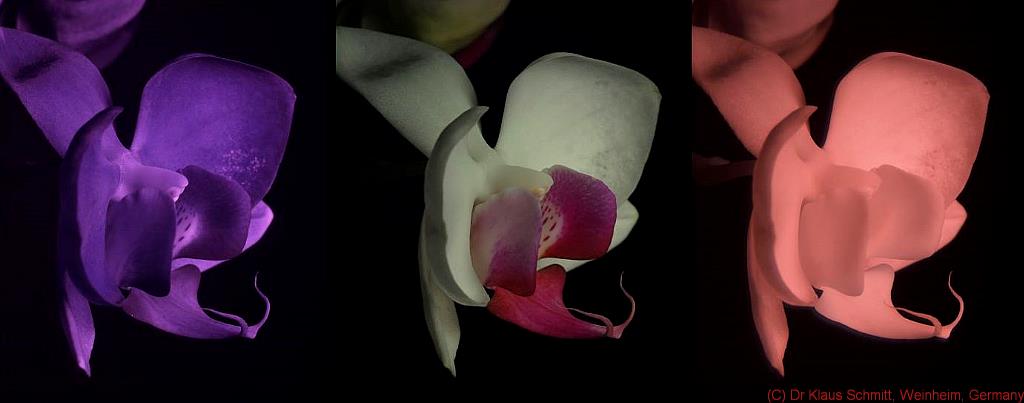


and here the same sequence but showing left and right differentials (VIS-UV, VIS-IR):
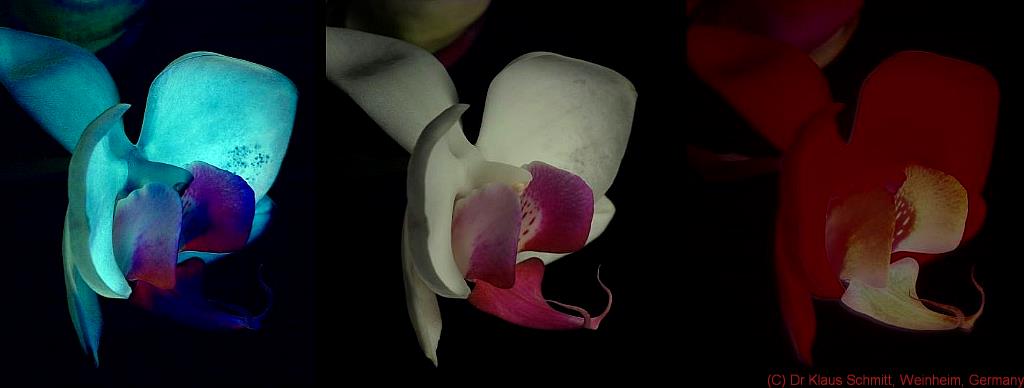


No focus correction was done during the shots using a single 400Ws adjustable Xenon flash and ND filters to balance out the exposure differences, so as to ensure an identical light direction.

And here a multispectral composite image by assigning UV->blue, VIS->green, IR->red and combining into one image without further ado.
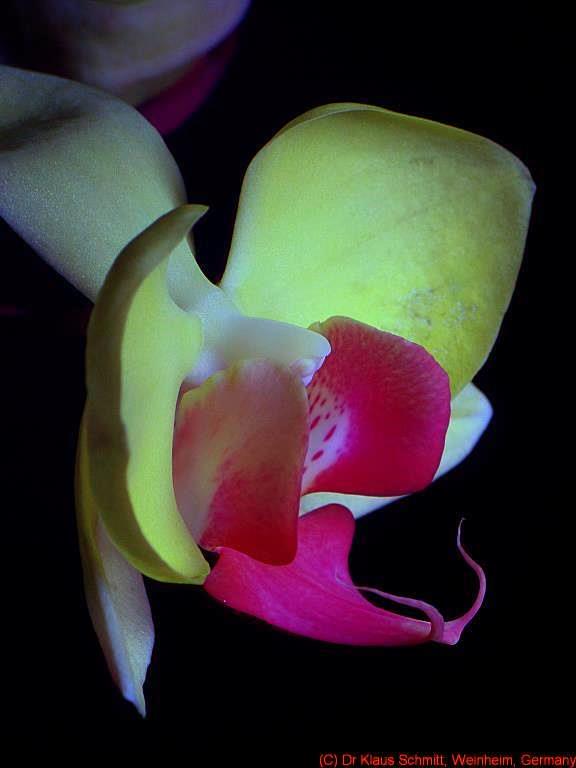


I find that result quite interesting ... as it hardly shows focus shift, but hardly anyone seems to use it ;)

P.S.: the 80mm EL-Nikkor (the older, chrome black full metal type) has an adapter ring on its base with outer M39x26tpi screw mount (Leica enlarger mount). Beneath it is a M25 thread for older #00 shutters. Company Schneider Optics offers adapter rings, if that one should be missing (oder code 92-013251).
P.P.S.: the filter thread of that older EL-Nikkor 80mm is 34.5mm, which is pretty uncommon, as me if you need an adapter ring.


Stay tuned, more will follow on that fascinating subject...

More info on this very interesting field may be found on my site http://www.pbase.com/kds315/uv_photos

Wednesday, January 12, 2011

[UV, IR] A surprising lens without UV + IR focus shift III

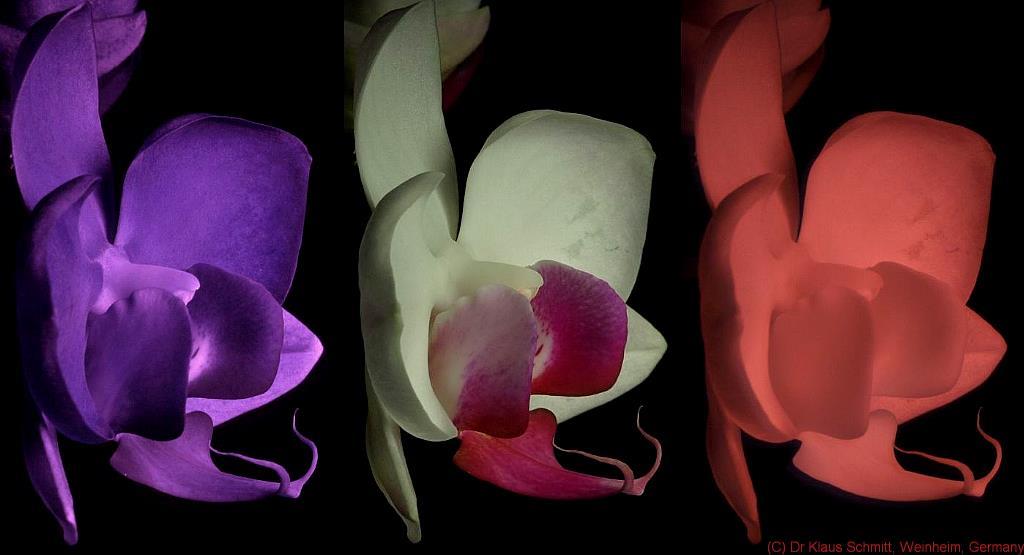
Well, my orchids started to blossom again, so why not take a chance and try one of those lenses out I published about a while ago here.

The sequence is: UV (through Baader-U), VIS (through UV/IR Cut filter), IR (through B+W 092)

[click on image to see a larger one]


and here the same sequence but showing left and right differentials (VIS-UV, VIS, VIS-IR):


No focus correction was done during the shots using a single 400Ws adjustable power Xenon flash and ND filters to balance out the exposure differences, so as to ensure an identical light direction.

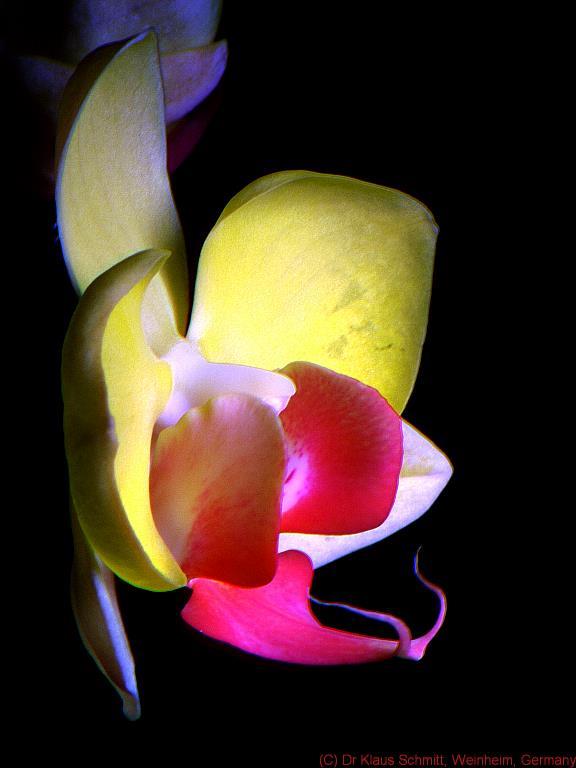
And here a multispectral composite image by assigning UV->blue, VIS->green, IR->red and combining into one image without further ado.


I find that result quite interesting due to the very small focus shift this lens shows for UV and IR as compared to the visible shot. To prove that, I made a shot under the same conditions of above of my calipher (this is a differential center cut out shown UV-VIS, VIS, IR-VIS):


Which shows, that for UV there was only a 0.2mm and for IR a 0.4mm focus shift (but in opposite direction).


Stay tuned, more will follow on that fascinating subject...

More info on this very interesting field may be found on my site http://www.pbase.com/kds315/uv_photos
Tuesday, January 11, 2011

Micro-Nikkor 105mm for UV photography?

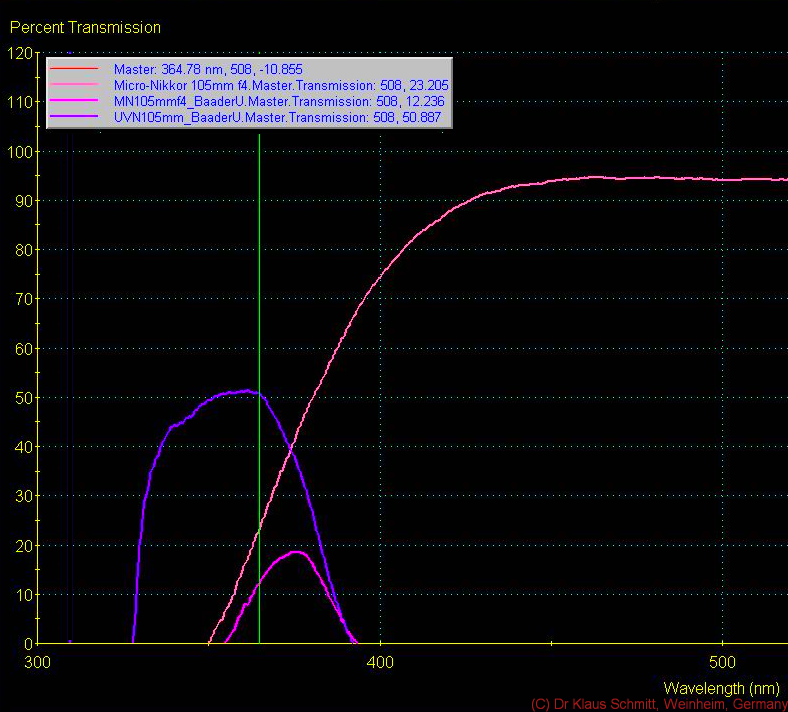
Well, today have a look with me what the normal well known Micro-Nikkor f4/105mm lens transmits if used for reflected UV photography. I measured the transmission in my spectrometer without (rosé) and with Baader-U filter (pink line). Also shown is the comparison to using the "standard lens" for UV photography, the UV-Nikkor 105mm with Baader-U filter (purple line).

[click on image to see a larger one]


The Micro-Nikkor 105mm with Baader-U filter showed a transmission which was limited to the 354 - 393nm band with a peak at 375nm (about 18% or about - 2.5EV compared to using the UV-Nikkor).

So it obviously does pass some limited, but useful amounts of longer UV, but that would still be enough to show the typical UV flower patterns, as these show in the 370-420nm band from my experience. A normal exposure using an UV-Nikkor 105mm is around 2-4sec at ISO200 f8-11, so expect exposure times of 8-16sec or open up the aperture a bit more and/or raise ISO to 400.

Further you have to deal with focus shift that Micro-Nikkor has if used for UV, but that may be dealt with using my calibration technique, shown here on my BLOG.

In case you wonder what a camera sensor might be able to record and in which channels of that transmitted UV through lens and filter, have a look at this link here which shows the result of a scientific study a colleague of mine has conducted and published using a Nikon D80 camera (same sensor than the Nikon D200) which had its internal filter removed.


Stay tuned, more will follow on that fascinating subject...

More info on this very interesting field may be found on my site http://www.pbase.com/kds315/uv_photos

Friday, January 7, 2011

Carl Zeiss Jena "Spy" lenses for VIS + IR

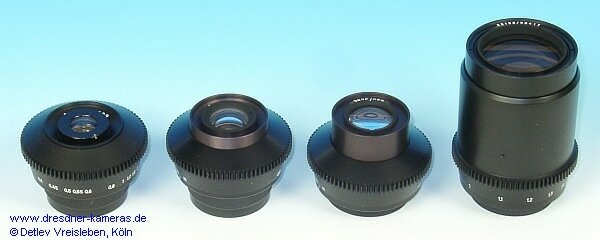
Well, many years ago in times of the cold war, Zeiss Jena had to developed special lenses for a very special ministry of the former east German GDR (dig you guess which one I mean - STASI, also called MfS), which are hardly known to the public, but are available. These are corrected for focusing in visible light, but also for shooting in (deeper) invisible NIR. There were also special noiseless cameras (GSK also called SR899) developed for these lenses.

To make things clear, I distance myself from that former purpose, but am interested in the performance of those special lenses!

The lenses were designed in such a way that the aperture location (more precisie the entrance pupil) was in front of the lenses, which allowed taking photos through small holes in walls, through button holes in bags etc. - I guess the purpose gets clearer now. A set of fixed apertures and also a variable iris usually comes which each lens. All these lenses cover the full 24x36mm format.

I was able to get a set of these very special lenses thanks to the contact to and the efforts of Detlev Vreisleben, a german engineer who, after his retirement has concentrated to shed some light onto these.

Here a list of these lenses (SO = "Spezial Objektiv"):

- SO-3.1 f2,8/35mm a FLEKTOGON wide angle
- SO-3.2 f2,8/50mm a BIOTAR normal angle
- SO-3.3 f3,5/75mm a TESSAR short tele
- SO-3.4 f3,5/135mm a SONNAR tele lens

They have a special M36 camera thread mount, but are easily adaptable.

First tests have shown very good to excellent sharpness in VIS as well as NIR. More about that later...

[click on image to see a larger one]


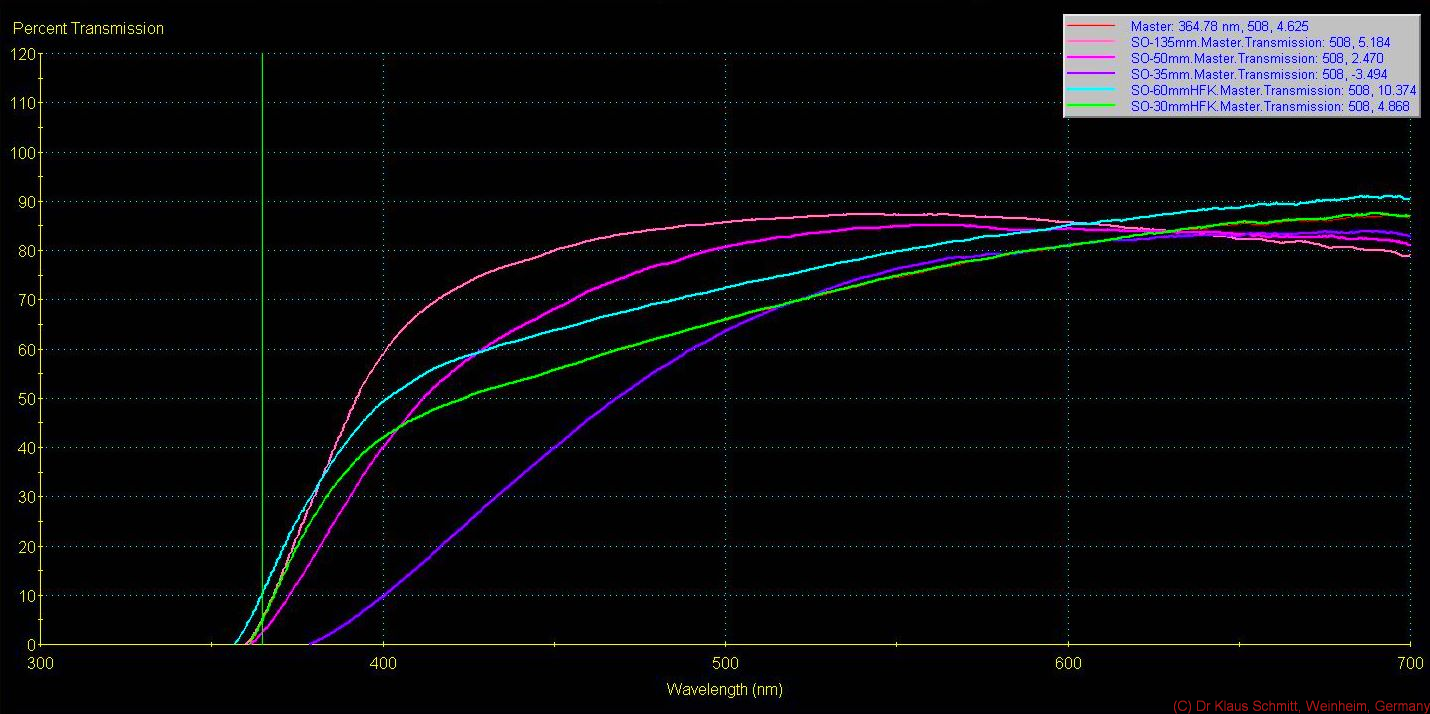
And no, they don't transmit UV at all, since designed for the other end of the spectrum incl. the special NIR coating.

Transmission graph:


(The 75mm Tessar is missing in that graph; two further lenses are included for the HFK "half format" camera)

Stay tuned, more will follow on that fascinating subject...

More info on this very interesting field may be found on my site http://www.pbase.com/kds315/uv_photos
Tuesday, January 4, 2011

Wide angle lenses for UV?

Here today a wide angle test I made with some wide angles I had around (all Nikon mount except the Lithagon)

1) Nikkor E 2.8/28mm
2) Nikkor-H 3.5/28mm
3) Tokina RMC 2.8/28mm
4) Tokina RMC 2.8/24mm
5) Enna Lithagon 3.5/28mm
6) Noflexar 3.5/35mm

The green vertical line indicates the 365nm wavelength and in that box one can find the transmission at 365nm as the rightmost value. Remember that 12.5% equals -3EV, 25% equals -2EV, 50% eq. -1EV

The 24mm lens is used to show how harder it is to get some useful UV transmission when the focal length and complexity of the lens design increases.

The blue line indicates the transmission of a typical Noflexar 35mm for comparison, about 63% at 365nm. A very good lens for UV which hardly shows any focus shift!

[click on image to see a larger one]


Remark: this test only shows the transmission of a lens, it does not say anything about sharpness, contrast, flare resistance, freedom of hotspots etc. which has to be evaluated additionally through photographic tests before a lens may turn out useful for UV photography!

[P.S.: that green line (Lithagon 28mm) shows the typical effect of "lens yellowing" which results in some loss in transmission of shorter wavelengths]


Stay tuned, more will follow on that fascinating subject...

More info on this very interesting field may be found on my site http://www.pbase.com/kds315/uv_photos

Sunday, January 2, 2011

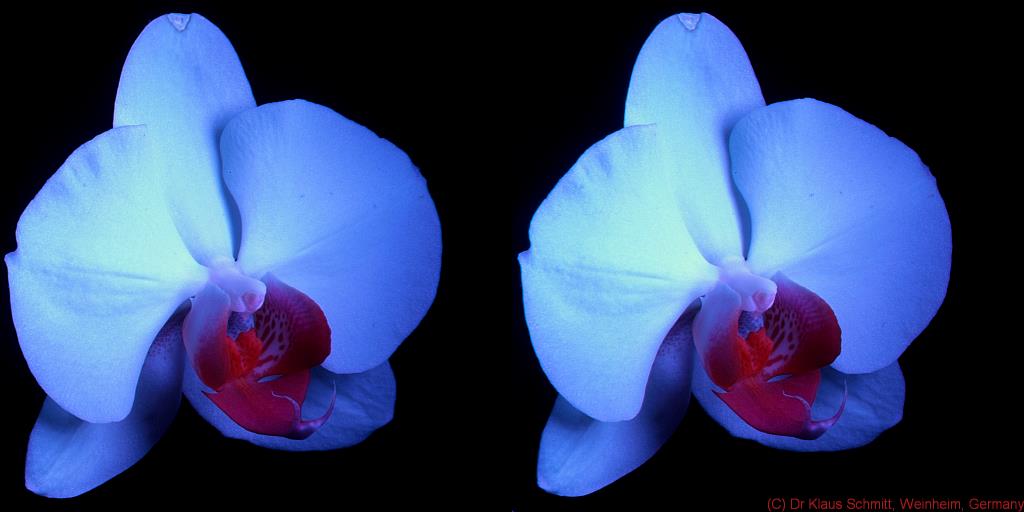
Phalaenopsis stereo in ultraviolet and butterfly vision

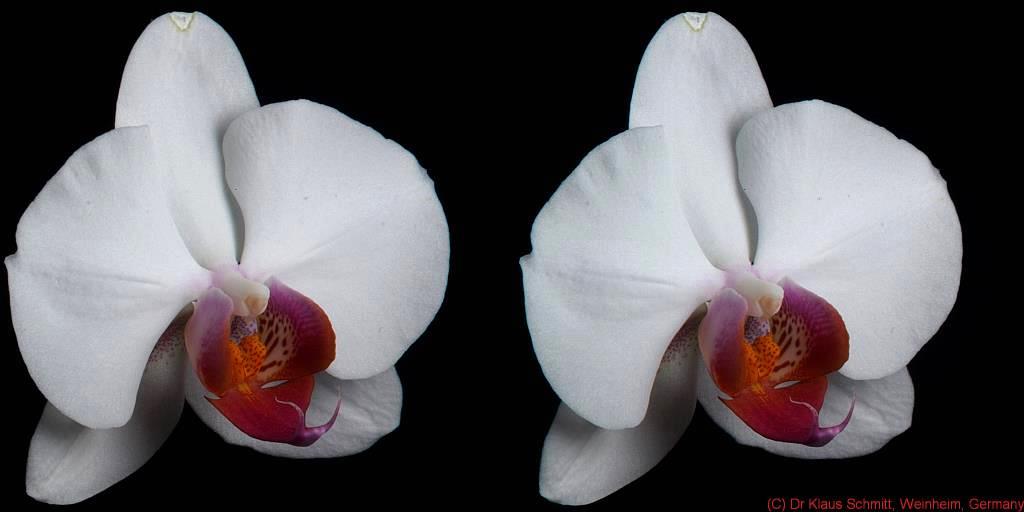
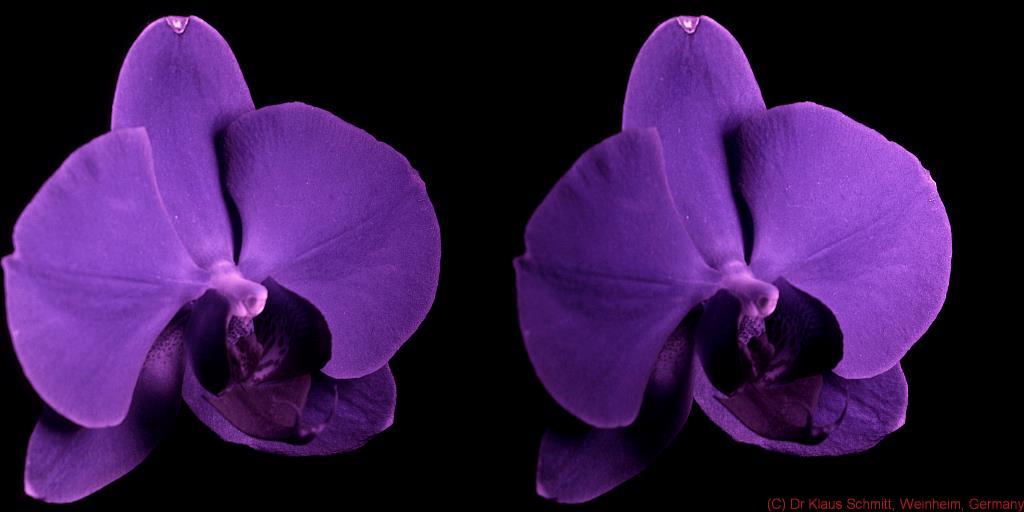
Today the first post of year 2011 will be about shooting stereo images (for crossed eye viewing) of a Phalaenopsis hybride orchid flower in visible, ultraviolet and simulated butterfly vision using a special stereo setup I'm currently investigating.

[click on image to see a larger one]

VIS (normal human vision image 400-700nm using UV/IR cut filter):


UV (ultraviolet image 300-400nm using Baader-U filter):


BV (simulated butterfly vision image 300-700nm using my XBV2 filter):


Stay tuned, more will follow on that fascinating subject...

More info on this very interesting field may be found on my site http://www.pbase.com/kds315/uv_photos
Thursday, December 30, 2010

Easy way to test for focus shift

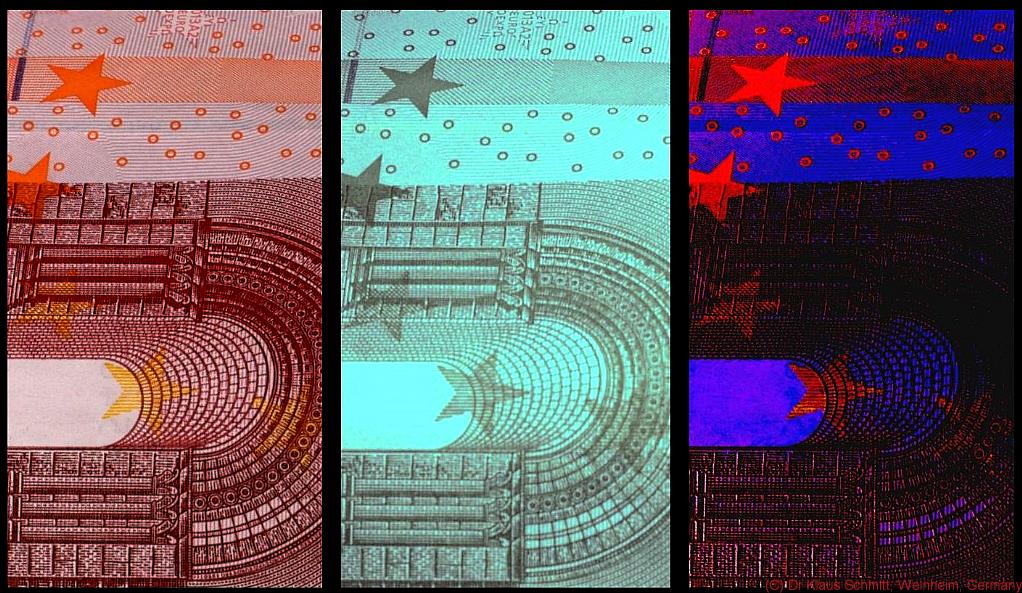
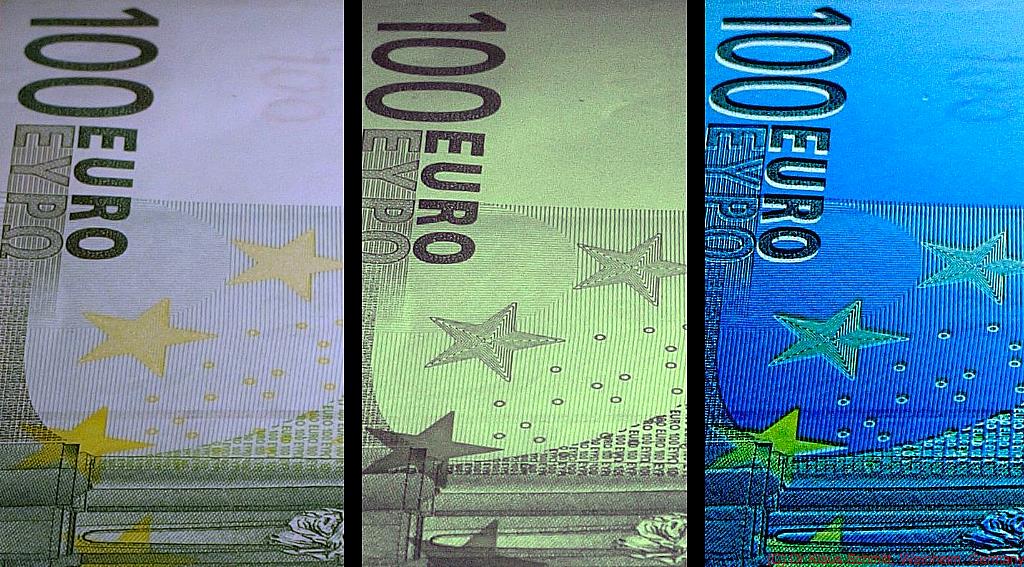
Well, sometimes it would be interesting to know if there is focus shift for a certain lens. I usually take parts of my calipher and shoot it in VIS and UV and look at the differential. If you don't have something the like handy, a bank note seems to also work well...

This here proves that the well known Noflexar 35mm has hardly any focus shift.

VIS, UV, VIS-UV shot of a 10 EURO bank note at an about 30 degree angle.

[click on image to see a larger one]


Here now an example of a 35mm lens which is quite capable in terms of UV transmission, but shows quite some focus shift:


Stay tuned, more will follow on that fascinating subject...

More info on this very interesting field may be found on my site http://www.pbase.com/kds315/uv_photos