Showing posts with label Monardia. Show all posts

Thursday, July 21, 2016

How to stand out in the crowd - Rudbeckia fulgida and Zinnia haageana show its ecologic advantage using intense UV reflection II

Today more about how some yellow flowers (Rudbeckia fulgida and Zinnia haageana) have achieved a competitive edge over other yellow flowers (Coreopsis verticillata in this case) by making use of a specific intense UV reflection around 365nm, matched to the insect eyes UV sensitivity. This will be shown side-by-side in human vision and also in reflected ultraviolet photography. I was using my "work horse" UV filter, the Baader-U filter for reflected UV, aside from a visible light shot. Lens was my UV-Nikkor 105mm quartz flourite lens. Light source was sunlight. All shots were done at f8.

[click on image to see a larger one]

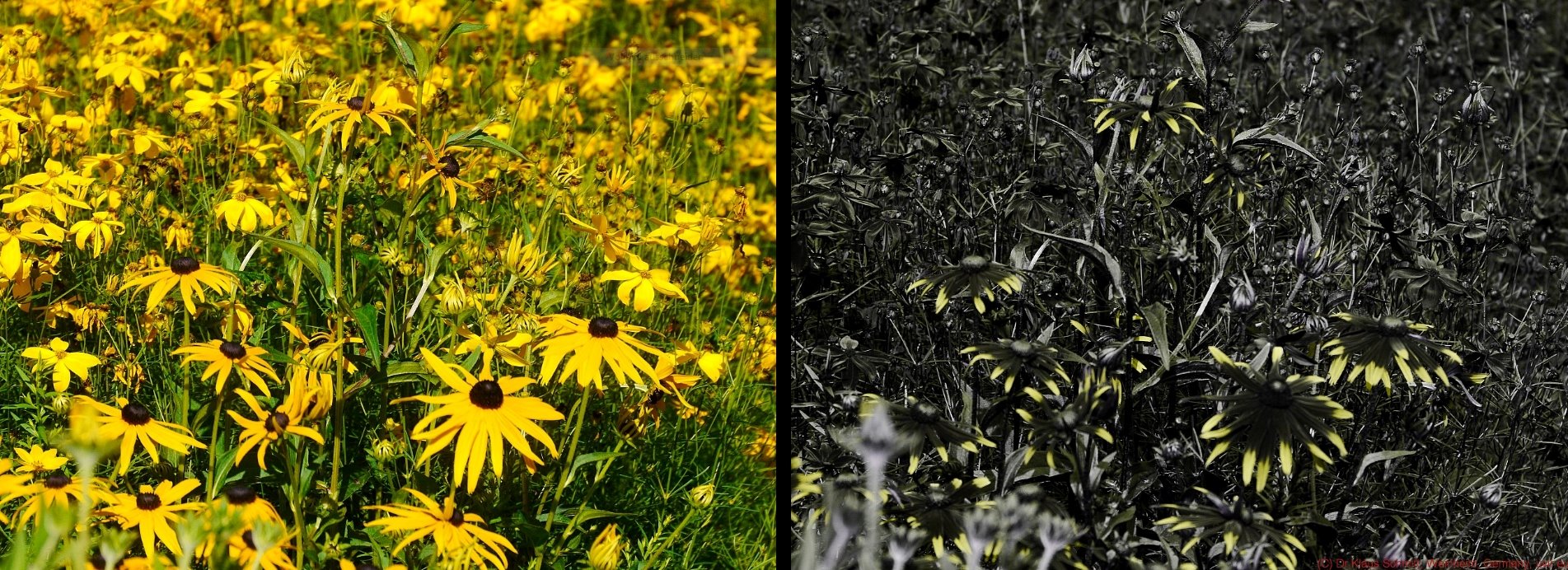
Diptych Rudbeckia fulgida vs Coreopsis verticillata overview, visible image (left) and reflected UV image (right):  
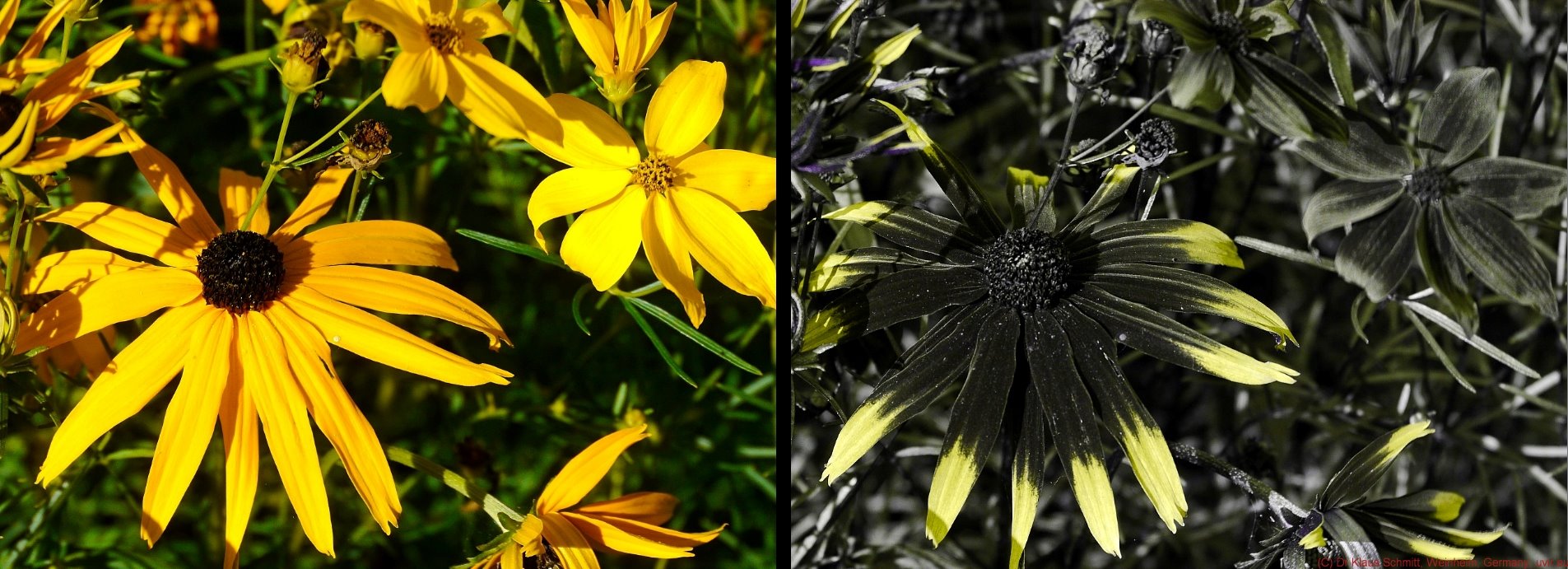
Diptych Rudbeckia fulgida vs Coreopsis verticillata detail, visible image (left) and reflected UV image (right):  
Diptych Zinnia haageana vs Coreopsis verticillata, visible image (left) and reflected UV image (right):  

Diptych Zinnia haageana vs Coreopsis verticillata, visible image (left) and reflected UV image (right):  

In visible light, all these flowers are rather bright yellow / orange to our human eye. But this Rudbeckia fulgida and Zinnia haageana flower shows a very prominent and bright bullseye pattern in reflected UV (only visible to bees and butterflies), as their petals are very UV bright (around 350-365nm) and their center is very UV dark, compared to the rather UV non-reflecting other flowers, which makes them nearly invisible in UV, hence creating an impressive competitive edge in terms of chances for getting pollinated - and all this gets nicely visible.

I have written HERE about it before.

Stay tuned, more will follow on that fascinating subject...

Friday, July 15, 2016

How to stand out in the crowd - R. Hirta shows its ecologic advantage using intense UV reflection

Today a little different topic: I would like to show, how a flower (R. hirta) achives a competitive edge over other flowers (Monardia, Echinacea) by making use of a specific intense UV reflection around 365nm, matched to the insect eyes sensitivity. This will be shown using a flower originating from the USA Prairie, a Black-eyed Susan - Rudbeckia hirta and it will be done in reflected ultraviolet photography using my "work horse" UV filter, the Baader-U filter aside from a visible light shot. Lens was my UV-Nikkor 105mm quartz flourite lens. Light source was sunlight. All shots were done at f8.

[click on image to see a larger one]

Visible light image (400-750nm):  

Reflected UV image using Baader-U filter (320-395nm):  

Diptych of visible image (left) and reflected UV image (right):  

In visible light, all flowers are rather bright to our human eye. But this R. hirta flower in UV (only visible to bees and butterflies) shows a very prominent and bright bullseye pattern, as its petals are very UV bright (around 365nm) and its center is very UV dark, compared to the rather dull UV reflecting Monardia and Echinacea flowers (around 380nm only), hence creating an impressive competitive edge in terms of chances for getting pollinated - and all this gets nicely visible.

Stay tuned, more will follow on that fascinating subject...