Showing posts with label XHUV. Show all posts

Wednesday, July 3, 2013

Human UV vision simulated using reflected ultraviolet UV photography II

Today more about Human UV vision still using shots of that decorative flower, a Zinnia haageana - Mexican Zinnia in reflected ultraviolet photography using my "work horse" UV filter, the Baader-U filter but additionally a new, very special XHUV filter to visualize and simulate HUMAN UV vision (hence labeled XHUV). I had mentioned before that it has been reported since years, that some humans have UV vision, mostly either after cataract surgery where the natural lens was replaced by one that allows UV to be transmitted or because of having aphakia. The ongoing discussion with individuals having this ability led me to do some more tests on myself and it seems that I also have some (limited) ability to see UV light, well not much, and quite blurry it was, but nevertheless it seems to be there (compared to my wife who cannot see anything at all under identical test conditions). Using my UV sensitive camera I tried to replicate the colors I am able to see as follows. But now I added an UV transmitting calcium fluoride diopter lens with 2 diotries (f=500mm) and the image is not blurry anymore but sharply focused.

*** DO NOT TRY TO REPLICATE THAT HERE, if you don't know exactly what you are doing, as it may harm your eyesight!! ***

Let me explain what I did a bit further: First one starts looking in the visible at the flower (and taking a normal photograph to document that for comparison reasons), then a UV transmitting filter stacked with that mentioned UV transmitting diopter lens is held in front of one eye, shielding all the natural light around. Let the eye adapt to darkness and then UV image starts to form. I use an UV LED to enhance the then visible UV image. Then I attach to my UV sensitive camera an UV transmitting filter and record in similar fashion what I have seen. Use these two images side-e-side as a diyptych to present the differences - this is what I have done here. It is a comparison side-a-side, is is NOT concurrently seen. What I have additionally done is experiment with various UV transmitting filters until I found one that closely records what I have seen in UV, that's the now called XHUV filter. Plus I added an UV transmitting calcium fluoride diopter lens and the UV image is then sharply focused.

Lens was a Hamamatsu 50mm quartz fluorite lens. Light source for photography was a UV enhanced Xenon flash, for the human tests sun and a UV LED. All photographic shots were done at about f8.

[click on image to see a larger one]

Visible light image, identical to how I see it (only for comparison):  

UV image using XHUV filter as my camera sees it, simulating how I saw it before (including the blurriness as I could not get sharp UV focus):  

UV image using XHUV filter as my camera sees it, simulating how I see it now (including that calcium fluoride diopter lens, now yielding sharp UV focus):  

Diptych to compare camera simulated human UV image before (left) and after (right) calcium fluoride diopter use:
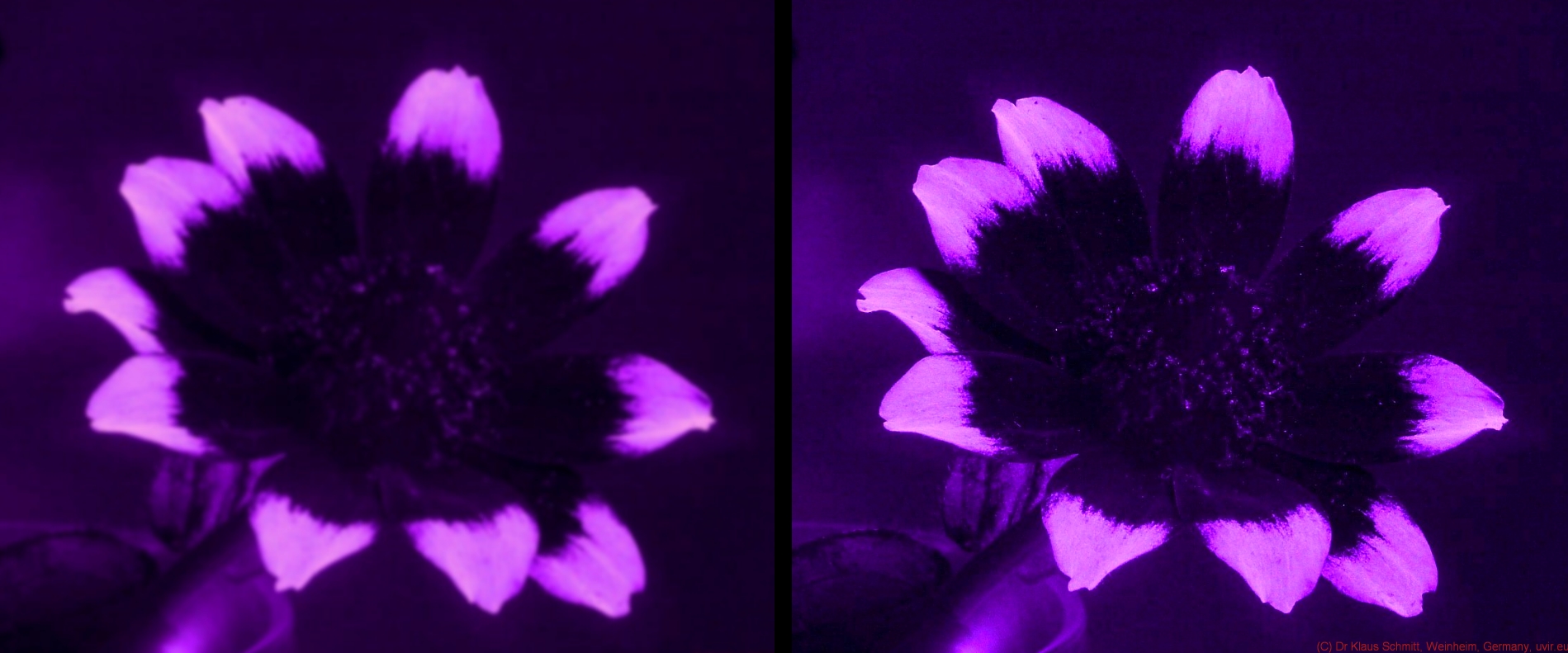


Mexican Zinnia flowers have a very specific UV pattern, its petal tips are very UV bright and teh center is quite dark. Hence why I used that to test out what I am able to see looking through an UV transmitting filter and then simulate that using my UV sensitive camera using the XHUV filter. I hope all this gets nicely visible.

*** Again: DO NOT TRY TO REPLICATE THAT HERE, if you don't know exactly what you are doing, as it may harm your eyesight!! ***

I have written previously about this HERE.

Stay tuned, more will follow on that fascinating subject...

More info on this very interesting field may be found on my site http://www.pbase.com/kds315/uv_photos

Monday, July 1, 2013

Human UV vision simulated using reflected ultraviolet UV photography

Today about something very different, still using shots of a decorative flower, a Zinnia haageana - Mexican Zinnia in reflected ultraviolet photography using my "work horse" UV filter, the Baader-U filter but additionally a new, very special XHUV filter, this time NOT for simulating bee and butterfly vision, but to visualize and simulate HUMAN UV vision (hence labeled XHUV). It has been reported since years, that some humans have UV vision, mostly either after cataract surgery where the natural lens was replaced by one that allows UV to be transmitted or because of having aphakia. Some individuals having UV vision are known to me and I am in discussion with them about this ability. This discussion led me to do some tests on myself and it seems that I also have some (limited) ability to see UV light, well not much, and quite blurry, but nevertheless it seems to be there (compared to my wife who cannot see anything at all under identical test conditions). Using my UV sensitive camera I tried to simulate the colors I am able to see as follows using XHUV filter.

*** DO NOT TRY TO REPLICATE THAT HERE, if you don't know exactly what you are doing, as it may harm your eyesight!! ***

Let me explain it a bit further: First one starts looking in the visible at the flower (and taking a normal photograph to document that for comparison reasons), then an UV transmitting filter is held in front of one eye, shielding all the natural light around. Let the eye adapt to darkness and then UV image starts to form. Use a UV LED to enhance that if needed. Then attach to the UV sensitive camera an UV transmitting filter and record in similar fashion when has been seen. Use these two images side-e-side as a diyptych to present the differences in visible and UV vision - this is what I have done here. It is a comparison side-a-side, is is NOT concurrently seen. What I have additionally done is experiment with various UV transmitting filters until I found one that closely simulates what I have seen in UV, that's the now called XHUV filter.

Lens was a Hamamatsu 50mm quartz fluorite lens. Light source for photography was a UV enhanced Xenon flash, for the human tests sun and a UV LED. All photographic shots were done at about f8.

[click on image to see a larger one]

Visible light image, identical to how I see it:  

UV image using Baader-U filter (approx. 320-395nm, effective peak approx. 375nm) as my UV camera sees it:  

UV image using XHUV filter as my camera sees it, quite similar to how I see it (including the blurriness as I cannot get sharp UV focus):  

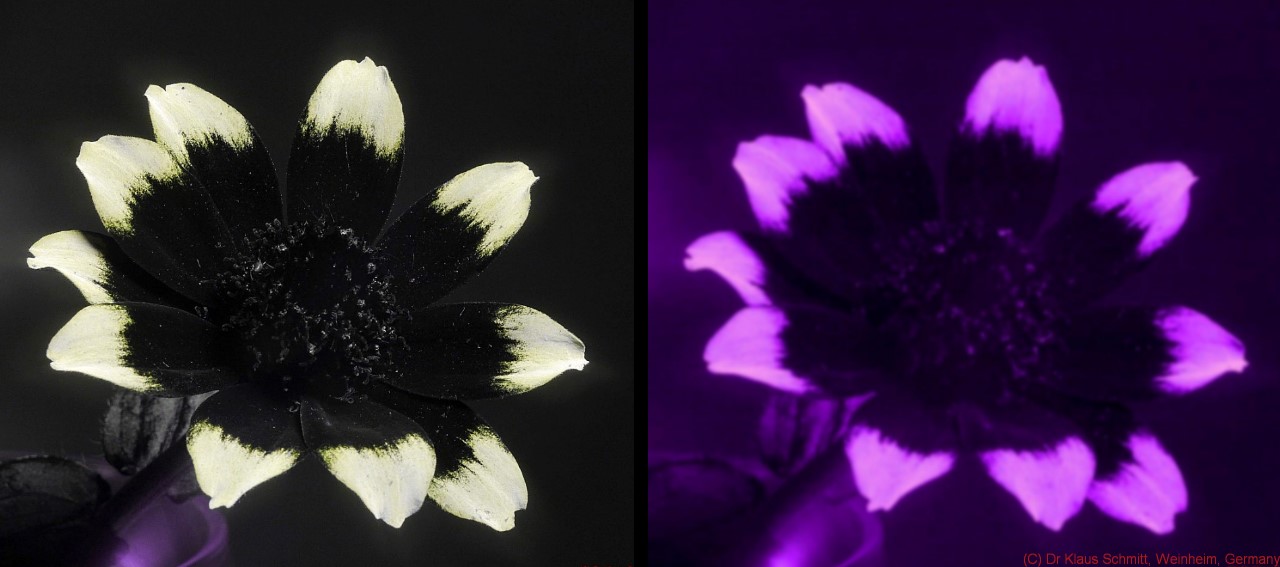
Diptych to compare visible image with camera UV image:
 

Diptych to compare visible image with camera simulated human UV image:
 

Diptych to compare camera UV image with camera simulated human UV image:


Mexican Zinnia flowers have a very specific UV pattern, its petals are very UV dark on the middle and bottom, but its petal tips are very UV bright. Hence why I used that to test out what I would be able to see looking through a UV transmitting filter and then to simulate that using my UV sensitive camera. I hope all this gets nicely visible.

*** Again: DO NOT TRY TO REPLICATE THAT HERE, if you don't know exactly what you are doing, as it may harm your eyesight!! ***

There is a follow up about Human UV vision HERE.

Stay tuned, more will follow on that fascinating subject...

More info on this very interesting field may be found on my site http://www.pbase.com/kds315/uv_photos