Wednesday, May 25, 2011
Full spectrum camera spectral response; simple test
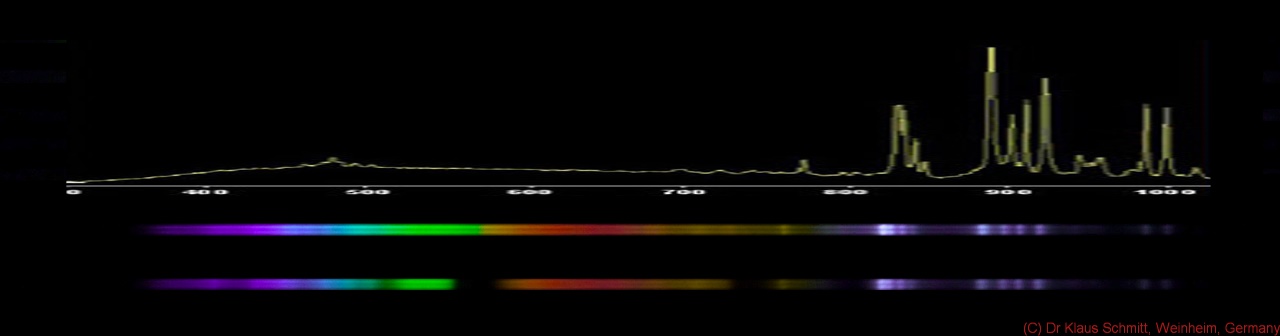
To figure out the approximate spectral response of my full spectrum converted camera, I played around a bit with some gratings and my stabilized, continuous Xenon light source. I also found a linear spectra of my Xenon lamp, so with its help an approximate calibration of the recorded spectra is possible.
The first line is the Xenon spectra, the second the unfiltered spectra as recorded by the UV sensitive camera, the third line filtered through a Didymium calibration filter.
[click on image to see a larger one]
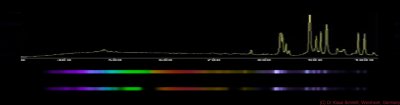
So from that and the color tests I published before, I would estimate that this full spectrum camera has a 320nm - 1000nm UV-VIS-NIR response. Actually I think it is more, as in such an image the exposure range limits the recording of fainter responses at the ends of the spectrum.
Found some better software which allows to read out such optical spectra. Here the results of using such:
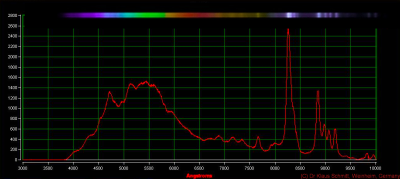
More info on this very interesting field may be found on my site http://www.pbase.com/kds315/uv_photos
The first line is the Xenon spectra, the second the unfiltered spectra as recorded by the UV sensitive camera, the third line filtered through a Didymium calibration filter.
[click on image to see a larger one]
So from that and the color tests I published before, I would estimate that this full spectrum camera has a 320nm - 1000nm UV-VIS-NIR response. Actually I think it is more, as in such an image the exposure range limits the recording of fainter responses at the ends of the spectrum.
Found some better software which allows to read out such optical spectra. Here the results of using such:
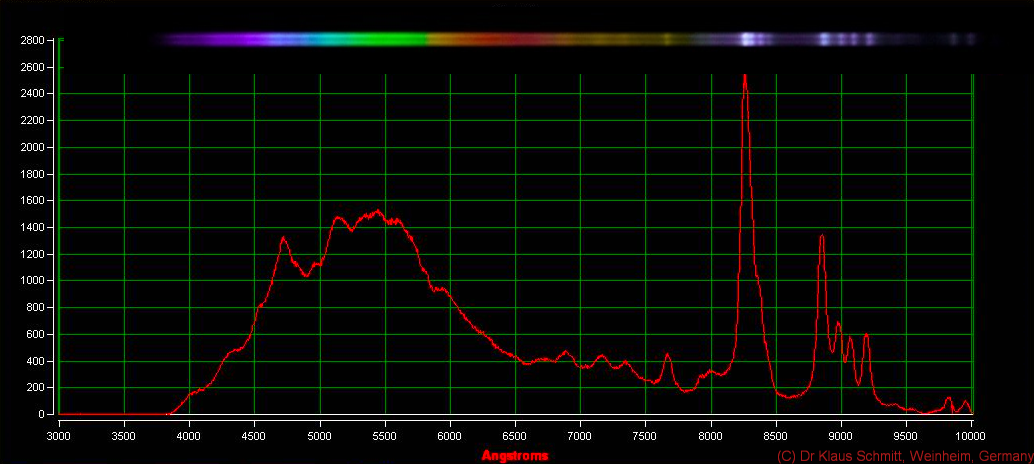
On top the spectra as taken by photo, underneath the read out and calibrated spectra using known data high pressure Xenon spectra. The x-axis is in Angstroms, so knowing that 10A equals 1nm, it is easy to understand.
Again, please remember that the grating used was not really made for UV, but for VIS + NIR, so no wonder the spectra ends around 380nm. The real sensitivity to UV of that converted camera is quite higher, but I haven't found its limits yet.
More info on this very interesting field may be found on my site http://www.pbase.com/kds315/uv_photos


A few quartz flourite UV lenses on the bench for lens transmission measurements
As I was taking some measurements with the Coastal Optics UV-VIS-NIR Apo 60mm, I thought why not also testing a few other fully color-corrected lenses while I'm at it... (forgot the Coastal Optics 105mm, unfortunately...)
[click on image to see a larger one]
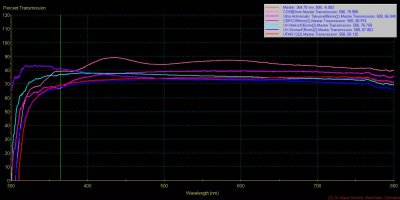
[validity: approx 310 - 750nm]
Interesting to note, how similar the older designs (Zeiss UV-Sonnar 105mm and LOMO UFAR-12 41mm) are, but the Pentax Ultra Achromatic Takumar 85mm has a notch in terms of transmission. Then comes the UV-Nikkor 105mm and the newer CERCO 94mm; the newest and best being the most advanced development, the Coastal Optics UV-VIS-NIR Apo 60mm.
Stay tuned, more will follow on that fascinating subject...
More info on this very interesting field may be found on my site http://www.pbase.com/kds315/uv_photos
[click on image to see a larger one]

[validity: approx 310 - 750nm]
Interesting to note, how similar the older designs (Zeiss UV-Sonnar 105mm and LOMO UFAR-12 41mm) are, but the Pentax Ultra Achromatic Takumar 85mm has a notch in terms of transmission. Then comes the UV-Nikkor 105mm and the newer CERCO 94mm; the newest and best being the most advanced development, the Coastal Optics UV-VIS-NIR Apo 60mm.
Stay tuned, more will follow on that fascinating subject...
More info on this very interesting field may be found on my site http://www.pbase.com/kds315/uv_photos
Tuesday, May 24, 2011
[UV] the meaning of "UV colors", or how to read the color response of a converted UVIR cam
(currently being reworked)
Monday, May 23, 2011
Bidens ferulifolia - visible, ultraviolet, bee vision
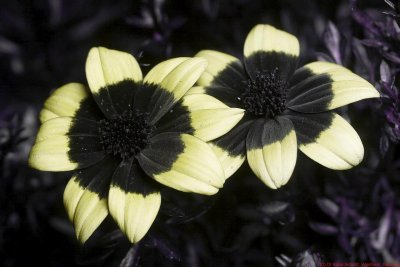
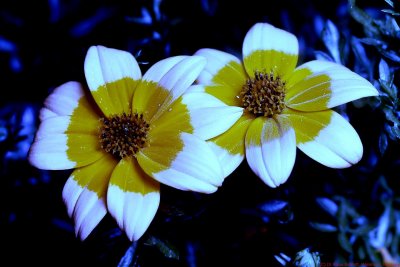
One of my "usual suspects" - Bidens ferulifolia shot using the newly converted camera.
[click on image to see a larger one]
VIS (using UV/IR Cut filter):
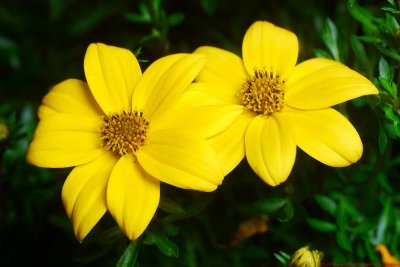
UV (using Baader-U filter):
BV (using my prop. XBV3 filter):
Stay tuned, more will follow on that fascinating subject...
More info on this very interesting field may be found on my site http://www.pbase.com/kds315/uv_photos
[click on image to see a larger one]
VIS (using UV/IR Cut filter):

UV (using Baader-U filter):

BV (using my prop. XBV3 filter):

Stay tuned, more will follow on that fascinating subject...
More info on this very interesting field may be found on my site http://www.pbase.com/kds315/uv_photos
Saturday, May 21, 2011
[UV, VIS, NIR] WhiteBalancing options
Well, I had presented my Reflection Disc solution, which had been tested against (R) Spectralon when a forum member came up with the remark, that there are commercially available gray cards available, claiming to also work equally well in UV. So of course I got one and run tests against the industry standard (R) Spectralon as well as against my Reflection Disc (approx 75% reflection). That WhiBal Card has a white, a black area also, as well as a large gray area - all have been measured.
Long story short, here are the results.
[click on image to see a larger one]
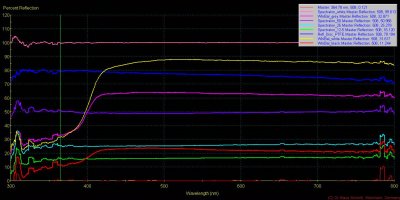
SPECTRALON (100=rose, 50=violet, 25=teal, 12.5%=green); ReflectionDisc=blue, Whibal Card (white = yellow, gray=pink, black=red)
[confidence area: approx. 360 - 775nm]
SUMMARY:
That WhiBal card is certainly useful for VIS + NIR, but not for UV.
The ReflectionDisc certainly is not perfect, but works quite well in practice and delivers jpgs directly out of the camera with acceptable whitebalance for UV, VIS and NIR, also for a quick exposure check.
Here the photographic proof of the above - reflected UV using Baader-U filter and Xenon flash.
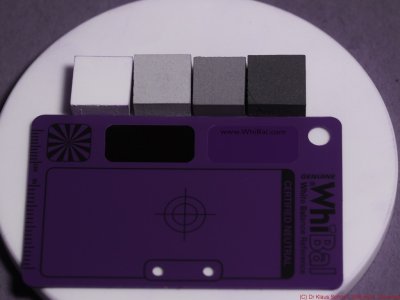
The card should be "white" or light gray, which it isn't. The cubes are Spectralon laying on my ReflectivityDisc.
It does work well in NIR though - here the card appears gray as it should be.

The cubes are Spectralon and my ReflectivityDisc stay the same color.
Stay tuned, more will follow on that fascinating subject...
More info on this very interesting field may be found on my site http://www.pbase.com/kds315/uv_photos
Long story short, here are the results.
[click on image to see a larger one]
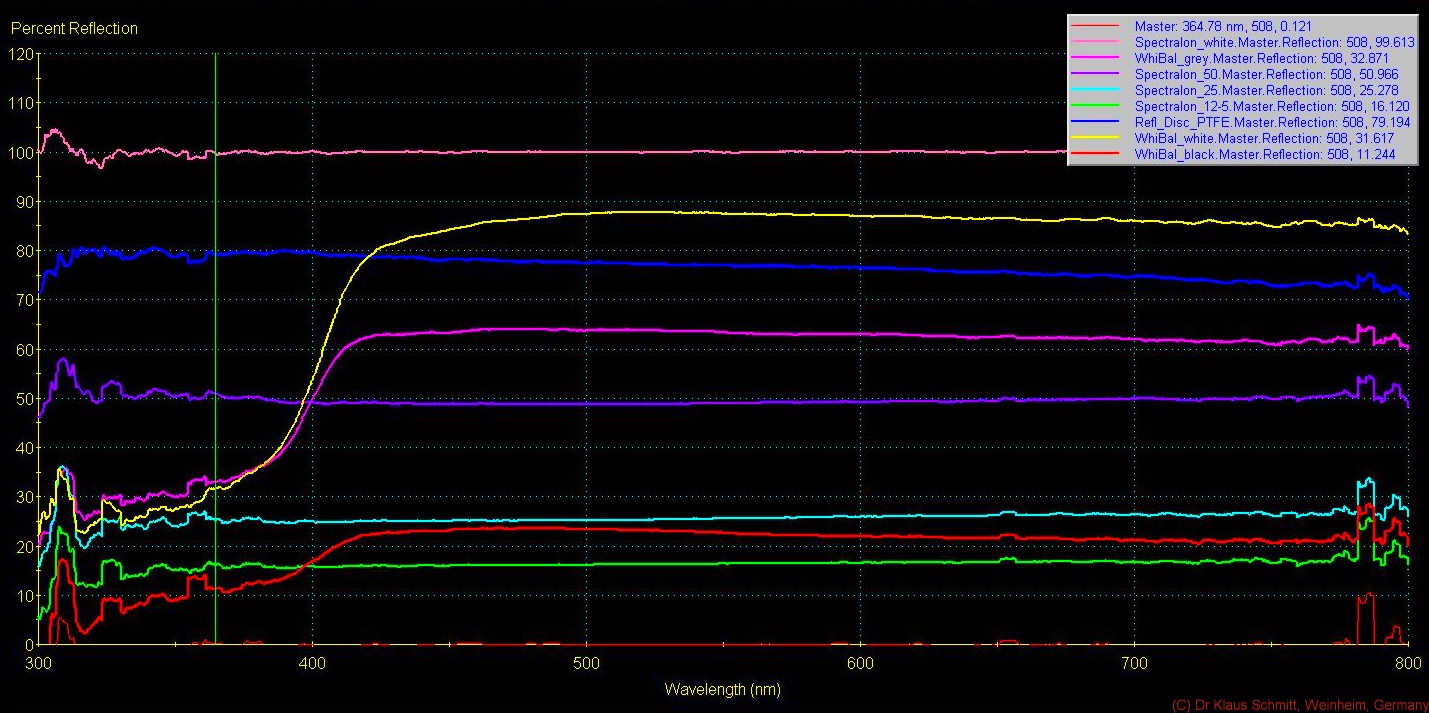
SPECTRALON (100=rose, 50=violet, 25=teal, 12.5%=green); ReflectionDisc=blue, Whibal Card (white = yellow, gray=pink, black=red)
[confidence area: approx. 360 - 775nm]
SUMMARY:
That WhiBal card is certainly useful for VIS + NIR, but not for UV.
The ReflectionDisc certainly is not perfect, but works quite well in practice and delivers jpgs directly out of the camera with acceptable whitebalance for UV, VIS and NIR, also for a quick exposure check.
Here the photographic proof of the above - reflected UV using Baader-U filter and Xenon flash.
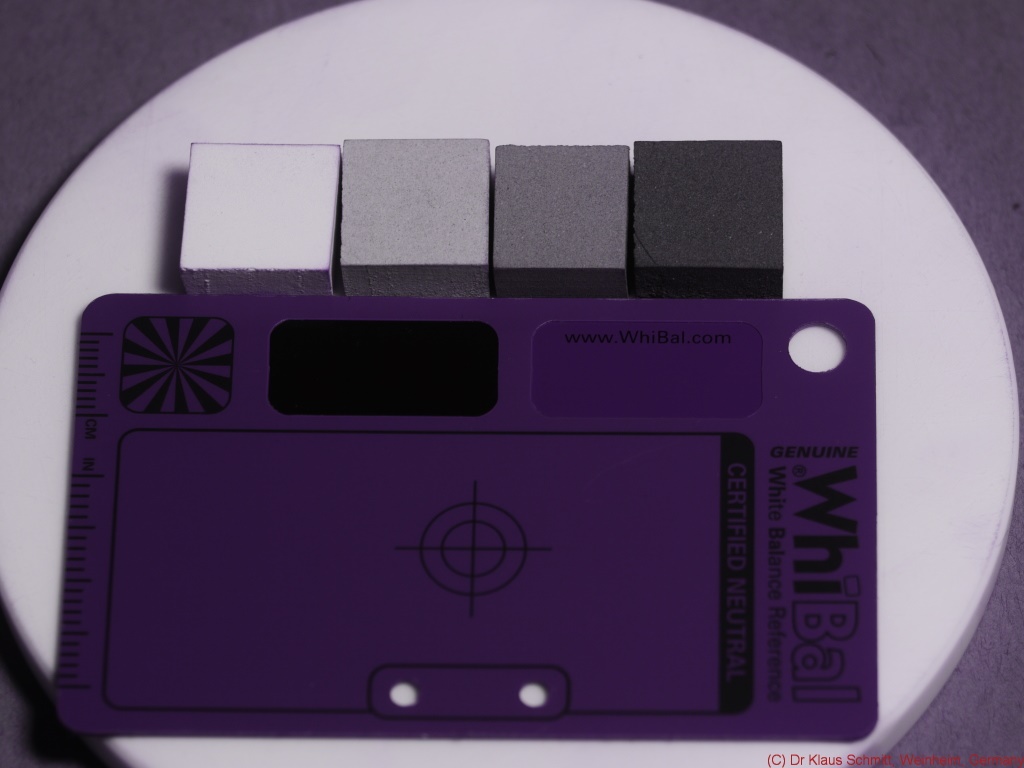
The card should be "white" or light gray, which it isn't. The cubes are Spectralon laying on my ReflectivityDisc.
It does work well in NIR though - here the card appears gray as it should be.

The cubes are Spectralon and my ReflectivityDisc stay the same color.
Stay tuned, more will follow on that fascinating subject...
More info on this very interesting field may be found on my site http://www.pbase.com/kds315/uv_photos
Subscribe to:
Posts (Atom)
