My BLOG about my journey into the invisible world of ultraviolet UV photography, simulated bee, butterfly and animal vision photography and the special lenses, filters and lighting needed to make it work - also in HD video + 3D stereo.
Showing posts with label Baader-U filter. Show all posts
Showing posts with label Baader-U filter. Show all posts
Today in my new location after the move more shots of a flower everybody has already seen, a common Sunflower - Helianthus annuus in reflected ultraviolet photography using my "work horse" UV filter, the Baader-U filter. Lens was my UV-Nikkor 105mm quartz flourite lens. Light source was daylight through the windows plus some supporting 365nm UV LED light. All shots were done at f8.
[click on image to see a larger one]
Human vision:
Reflected UV:
This flower has a specific and unique UV pattern, its petal tops are brightly UV reflective around 365nm and the rest and its center is UV dark forming an UV bullseye pattern, and all this gets nicely visible here.
Today more about an experiment I have done, using a light amplification device in front of a normal visible light camera for recording reflected UV footage. This device uses a MCP (multi channel plate) with UV sensitive photocathode (approx. 190nm - 650nm), amplifies light by approx. 20-50.000 and shows the resulting image on a green phosphor screen.
Using a suitable optical system, I relayed this image to my normal, visible light camera. UV filter used was a fully IR blocked (OD6) UV transmission filter (peak at 250nm). Target was a tea candle.
Using a f3.5/50mm quartz fluorite lens and an extension tube to get higher magnification.
1) Visible / IR light recorded w/o filter on full spectrum camera:
2) UV light recorded with a (fully blocked to 1100nm) 311nm filter on full spectrum camera:
It gets rather obvious that the 311nm line is - as expected - quite intense on the visible left and right outsides of the candle, where the UV emission of the OH (hydroxyl) radicals happens.
3) UV light recorded with a (fully blocked to 1100nm) Baader-U (320-395nm) filter on full spectrum camera:
The reaction of the CH (hydrocarbon) radicals however emit UV around 385-395nm mostly on the top, which can be shown using the Baader-U UV transmitting filter
(320-395nm).
I have written about this system doing still UV photography HERE.
I have done similar with a different amplified camera system before
which did not allow to have an external camera attached, with just a TV
output HERE
Stay tuned, more will follow on that fascinating subject...
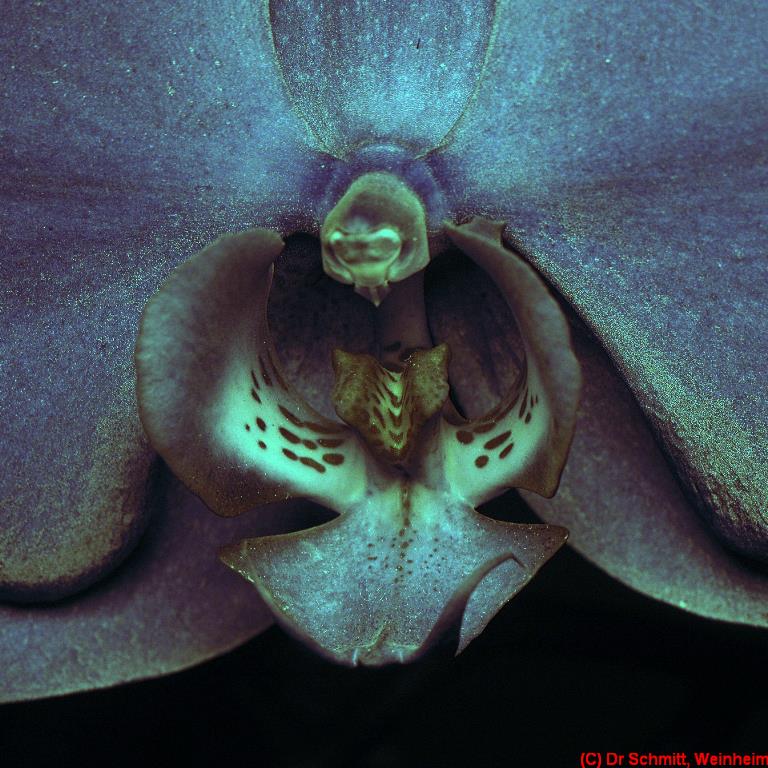
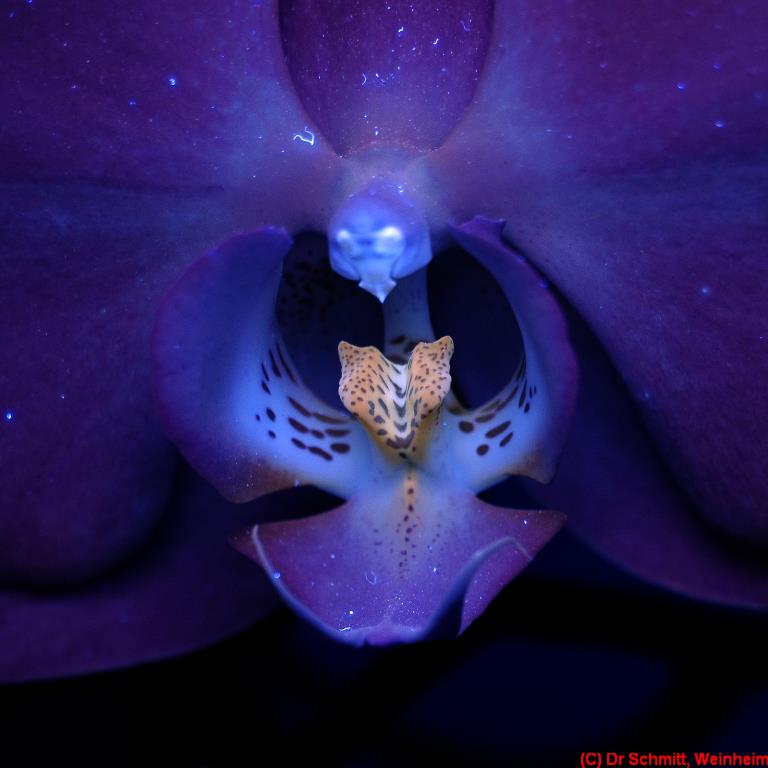
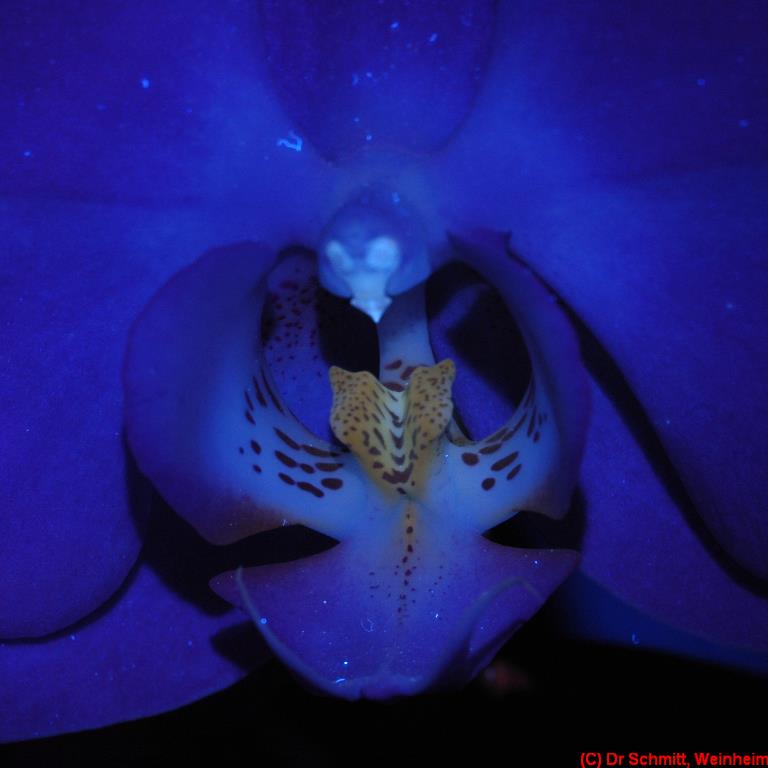
Just some test shots using a Phalaenopsis ("moth orchid") as a target.
Nikon D70 (unmod.), High Power UV flash, EL Nikkor 105mm, f8, 1/180sec, ISO400
[click on image to see a larger one]
VIS:
UV using Baader U filter:
FL using XCUT2 filter:
FL using Nichia 365nm UV LED (for comparison):
Stay tuned, more will follow on that fascinating subject...
More info on this very interesting field may be found on my site http://www.pbase.com/kds315/uv_photos
This is my blog about my film and photographic work in 3D, ultraviolet UV, infrared IR and fluorescence using special lenses and equipment. All text and images carry my copyright and I do not allow to link to or copy / download from my site or any parts thereof without my prior permission.
email me in case of questions or interest in my images (esp. for non-profit orgs) or if you need a complete camera + lens + filter + light set for UV photography:
postmaster AT macrolenses.de