Showing posts with label European Starling. Show all posts

Friday, February 5, 2016

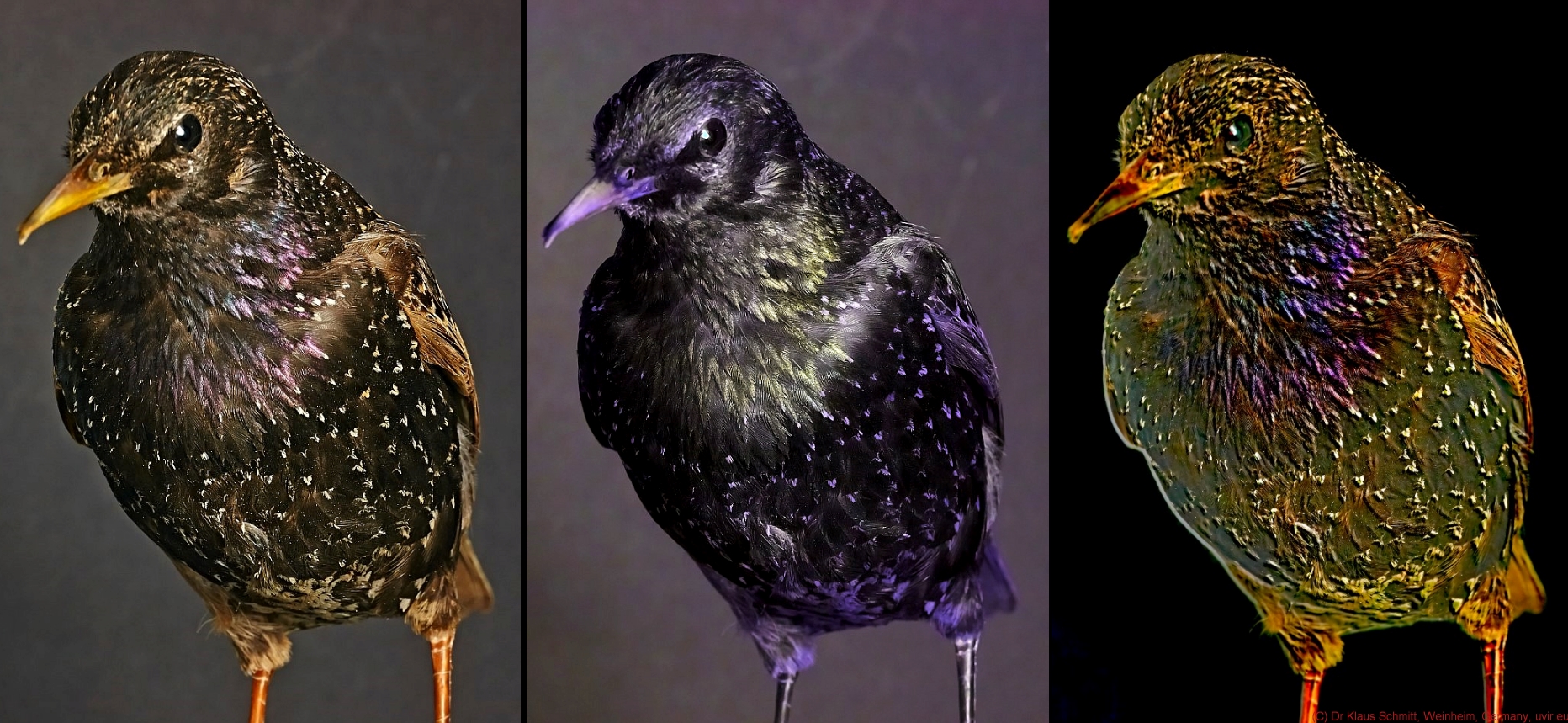
European Starling - Sturnus vulgaris in reflected ultraviolet and simulated bird vision photography

Today again about that a well known, attractive bird, the European Starling - Sturnus vulgaris in reflected ultraviolet photography using my "work horse" UV filter, the Baader-U filter. But this time it will also be about bird vision and a simulation how that might look like to us humans. Lens was my CERCO 94mm quartz flourite lens. Light source was a modified for high UV output Xenon flashlight. All shots were done at f8.

[click on image to see a larger one]

Triptych (left to right): Human vison, reflected UV and simulated bird vision (left to right):


This attractive bird has iridescent feathers with a metallic magenta shine around his throat, chest and back, which reflect at maximum under a 45 degree reflection angle, however it also reflects UV quite strongly, peaking at around 365nm (shown as yellow) and to a much lesser quantity around 385m (shown as purple). This UV image was then combined with the visible image to result into a simulated bird vision image (as birds can see UV, Blue, Green and Red) invisible to us humans (but made visible here using special photographic methods), and all this gets nicely visible here.

I have written about this bird HERE

And HERE is more about bird vision.
 
Stay tuned, more will follow on that fascinating subject...

Friday, November 20, 2015

BBC Four - Colour: The Spectrum of Science

BBC Channel Four has recently produced and aired their three episode series "Colour: The Spectrum of Science ". The last episode "Beyond the Rainbow" has been aired on November 18, 2015 and deals with invisible colors, resp. IR and UV, the latter also about using reflected UV for behavioural reasons (starling) and pollination (bees). I have consulted the production team about the latter and have photographed and shown them the European starlings UV pattern (I wrote about that HERE ).

Diptych (left to right): Human vison, reflected UV (Baader-U filter):


Quote BBC: " Colour: The Spectrum of Science - 3. Beyond the Rainbow
We live in a world ablaze with colour. Rainbows and rainforests, oceans and humanity, earth is the most colourful place we know of. But the colours we see are far more complex and fascinating than they appear. In this series, Dr Helen Czerski uncovers what colour is, how it works, and how it has written the story of our planet.

The colours that we see are only a fraction of what's out there. Beyond the rainbow there are colours invisible to our eyes. In this episode, Dr Helen Czerski tells the story of scientific discovery. To see the universe in a whole new light, Helen takes to the skies in a NASA jumbo jet equipped with a 17-tonne infrared telescope.

We can't see in ultra violet, but many animals can. Helen explores what the world looks like to the birds and the bees. With the discovery of x-rays we could look inside ourselves in ways that previously had only been possible after death. Today those same x-rays allow us to examine life at the atomic level, helping to develop new drugs and better materials. Ultimately, by harnessing all the colours there are, researchers are beginning to image the human body as never before, revealing new ways to treat disease."

Here now is the link to the video on BBC iPlayer

A wonderful production certainly worth watching!


Stay tuned, more will follow on that fascinating subject...
Saturday, August 1, 2015

European Starling - Sturnus vulgaris in reflected ultraviolet photography

Today shots of a well known, attractive bird, an European Starling - Sturnus vulgaris in reflected ultraviolet photography using my "work horse" UV filter, the Baader-U filter. Lens was my Zeiss UV-Planar f2 62mm quartz flourite lens. Light source was a modified for high UV output Xenon flashlight. All shots were done at f8.

[click on image to see a larger one]

Diptych (left to right): Human vison, reflected UV (Baader-U filter):


This attractive bird has iridescent feathers with a metallic magenta shine around his throat, chest and back, which reflect at maximum under a 45 degree reflection angle, however it also reflects UV quite strongly, peaking at around 365nm (shown as yellow) and to a much lesser quantity around 385m (shown as purple), invisible to us humans (but made visible here using special photographic methods), and all this gets nicely visible.

HERE is more about bird vision and how to simulate what birds might see.

Stay tuned, more will follow on that fascinating subject...