Showing posts with label UV colors. Show all posts

Friday, November 20, 2015

BBC Four - Colour: The Spectrum of Science

BBC Channel Four has recently produced and aired their three episode series "Colour: The Spectrum of Science ". The last episode "Beyond the Rainbow" has been aired on November 18, 2015 and deals with invisible colors, resp. IR and UV, the latter also about using reflected UV for behavioural reasons (starling) and pollination (bees). I have consulted the production team about the latter and have photographed and shown them the European starlings UV pattern (I wrote about that HERE ).

Diptych (left to right): Human vison, reflected UV (Baader-U filter):


Quote BBC: " Colour: The Spectrum of Science - 3. Beyond the Rainbow
We live in a world ablaze with colour. Rainbows and rainforests, oceans and humanity, earth is the most colourful place we know of. But the colours we see are far more complex and fascinating than they appear. In this series, Dr Helen Czerski uncovers what colour is, how it works, and how it has written the story of our planet.

The colours that we see are only a fraction of what's out there. Beyond the rainbow there are colours invisible to our eyes. In this episode, Dr Helen Czerski tells the story of scientific discovery. To see the universe in a whole new light, Helen takes to the skies in a NASA jumbo jet equipped with a 17-tonne infrared telescope.

We can't see in ultra violet, but many animals can. Helen explores what the world looks like to the birds and the bees. With the discovery of x-rays we could look inside ourselves in ways that previously had only been possible after death. Today those same x-rays allow us to examine life at the atomic level, helping to develop new drugs and better materials. Ultimately, by harnessing all the colours there are, researchers are beginning to image the human body as never before, revealing new ways to treat disease."

Here now is the link to the video on BBC iPlayer

A wonderful production certainly worth watching!


Stay tuned, more will follow on that fascinating subject...

Sunday, October 28, 2012

Colorful reflected UV ultraviolet photography II

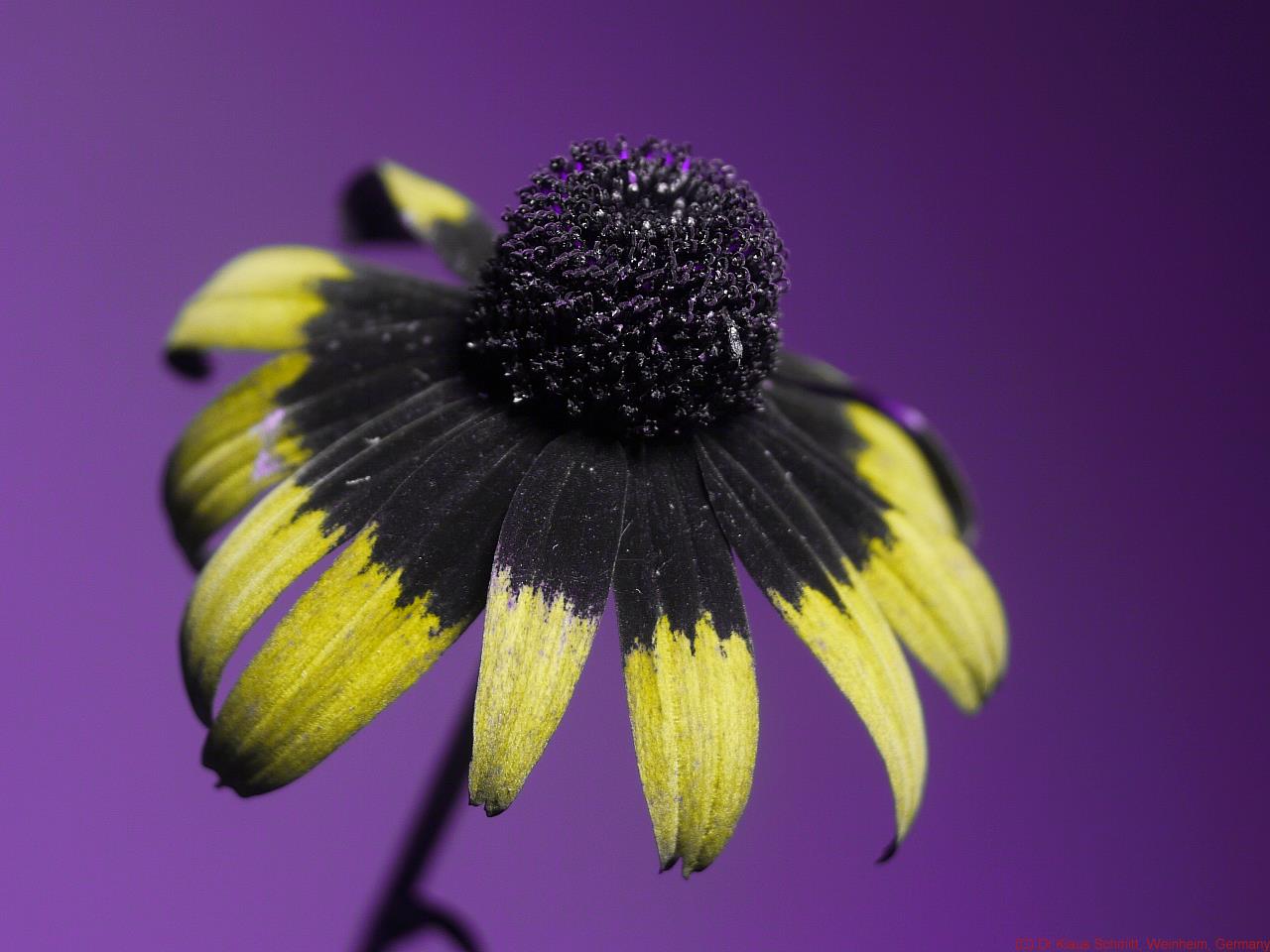
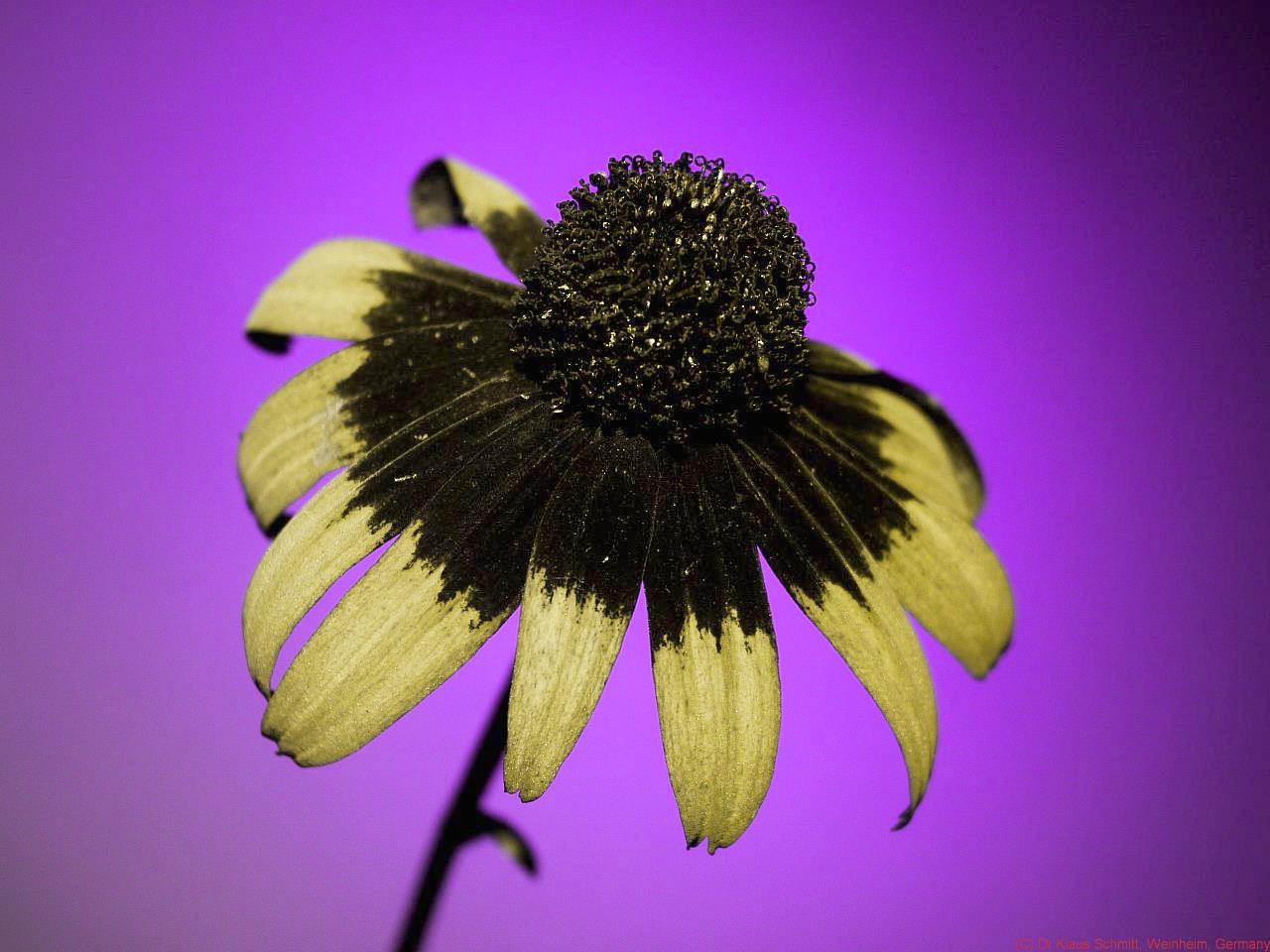
I have been wondering why reflected UV photography would have to look so drab in terms of colors often. So here some more recent experiments with a bit colorful background and various UV lights, when shooting it in reflected UV light using my "work horse" UV filter, the Baader-U filter and a quartz fluorite lens. Well, I was using one of my last Rudbeckia fulgida flowers for that, as the first snow is coming...

[click on image to see a larger one]

Conventional, looking monochrome:
 

Added front light:
 

Colorful, wider band:
 

Colorful Variant 1:
 

Colorful Variant 2:
 

Now this is "artsy" playing with light, but still documents very well the wonderful and prominent UV pattern this flower has...

Stay tuned, more will follow on that fascinating subject...

More info on this very interesting field may be found on my site http://www.pbase.com/kds315/uv_photos

Friday, October 12, 2012

Colorful reflected UV ultraviolet photography ?

I was always wondering if reflected UV photography would have to be so drab in terms of colors. We humans are so used to a wonderful world of colors, so I thought I should experiment a bit with that topic. Well, I was curious to see how that Rudbeckia fulgida flower I have here would look like, if I would create a bit colorful background for it, when shooting it in reflected UV light using my "work horse" UV filter, the Baader-U filter. Well, here an example for that...

[click on image to see a larger one]

Rudbeckia fulgida:
 

Now this is "artsy" and still documents the wonderful and very prominent UV pattern this flower has, very well still useful as a documentary.

Stay tuned, more will follow on that fascinating subject...

More info on this very interesting field may be found on my site http://www.pbase.com/kds315/uv_photos

Saturday, June 25, 2011

[UV] spectrometric vs photographic results using standardized false UV color palette

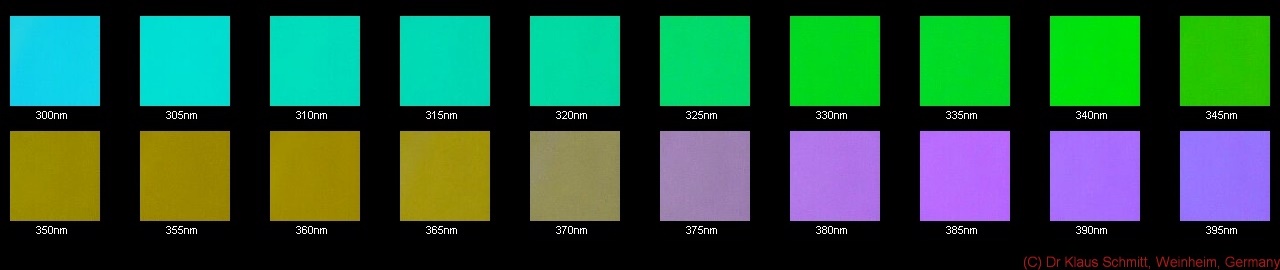
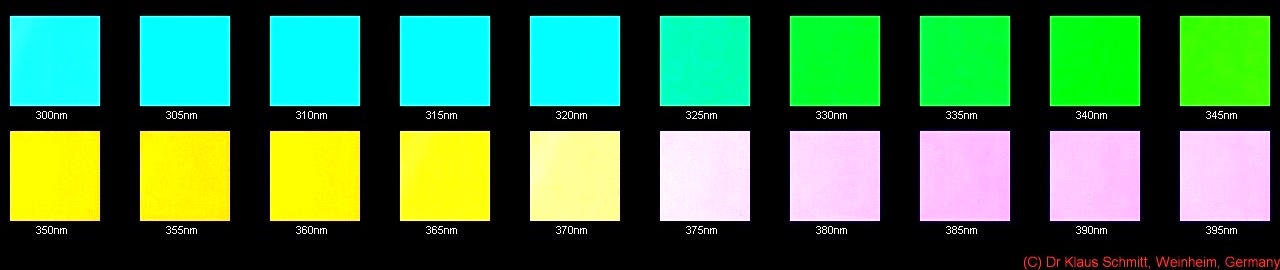
While I was shooting flowers at Herrmanshof, Weinheim park, I noticed some intense whiteish and some dimmer greenish UV reflectance patters (in my standardized false UV color palette) and I wanted to have some proof, if from the false color UV displayed it could be backward deducted about a specific sub-UV-A waveband reflection using spectrometric measurements . [click on images to see larger ones] Standardized reflected false UV "colors" according to the previously described "UV color palette" related to wavelength. The normal intensity palette: and this is the high intensity palette: Well, may I remind, that these false colors do not co-exist at the same time with the same intensity at the same wavelength stimulus (hence cannot be mixed), because of the very different sensor sensitivity to different UV wavelengths.
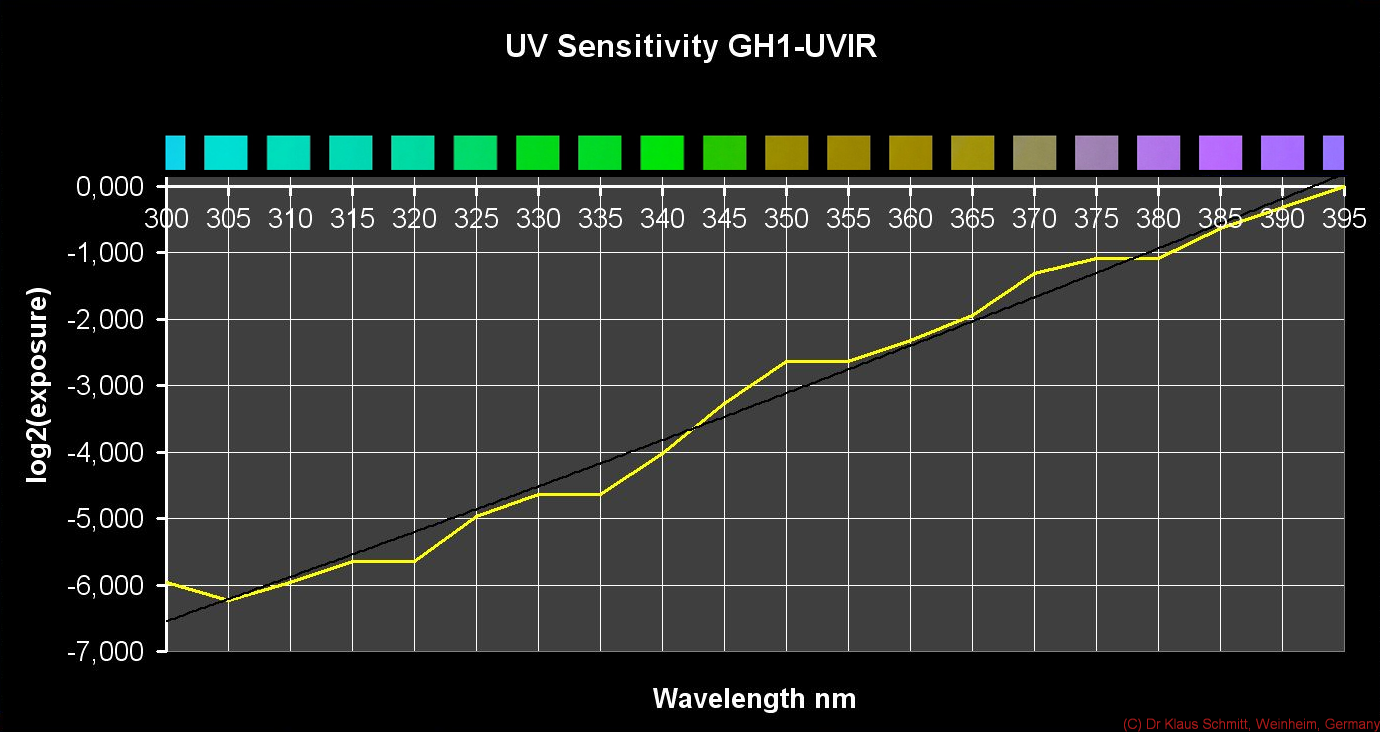
So from that above re-posted graph, which shows that GH1-UVIR sensor reaction to a monochromatic 5nm bandwith stimulus, for instance a 340nm "UV color" needs 4EV more exposure than one at 395nm and a 300nm needs even 6EV more.
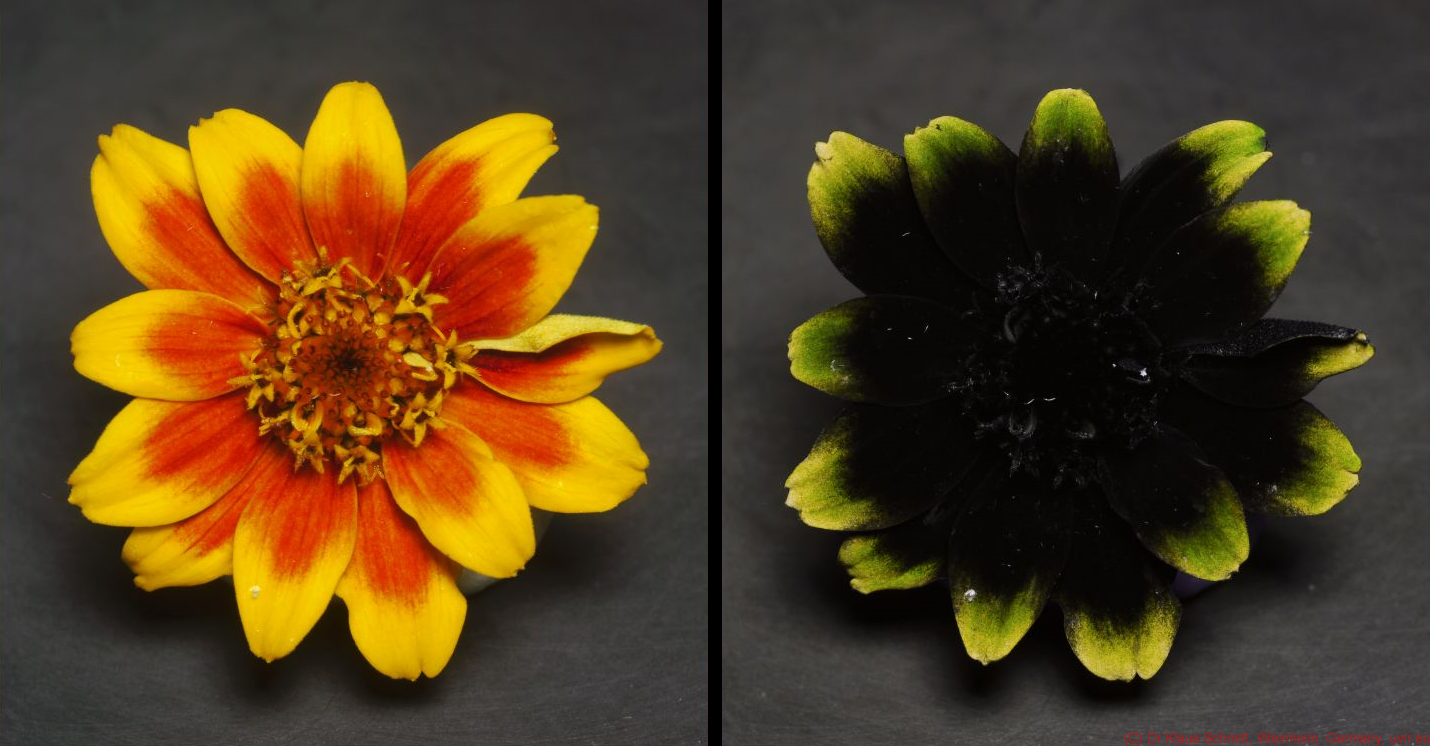
This is why I found it so special to find a green response (340nm) and yellowish response (370nm) in the same image (Zinnias as shown; also the reason why the green is so dim and the whitish yellow so overexposed) as there is 3EV in between - and this is why I doubt to ever find sea-green (around 300nm) in such a photo (6EV difference) that would contain this violet (at 395nm) - except I use a special technique which already forms in my mind...

So if one wanted to simulate how the UV color would look like in a resulting photo, we could use the spectrometer output and would have to multiply it with the Baader-U filter transmittance actually and then look up the exposure values per intensity. Unfortunately the sensor also responds nonlinear over wide exposure ranges (so the above is valid for mid level exposures only), so that yields only a crude approximation. But at least one would get a clue why that petal tip appeared green - yellowish in that image as posted above.
Spectrometric result of such a petal of the following Zinnia variant, tip greenish, rest nearly black (in UV) and yellow tip, orange-red the petal rest in VIS:
Photographic result: VIS:left, UV:right
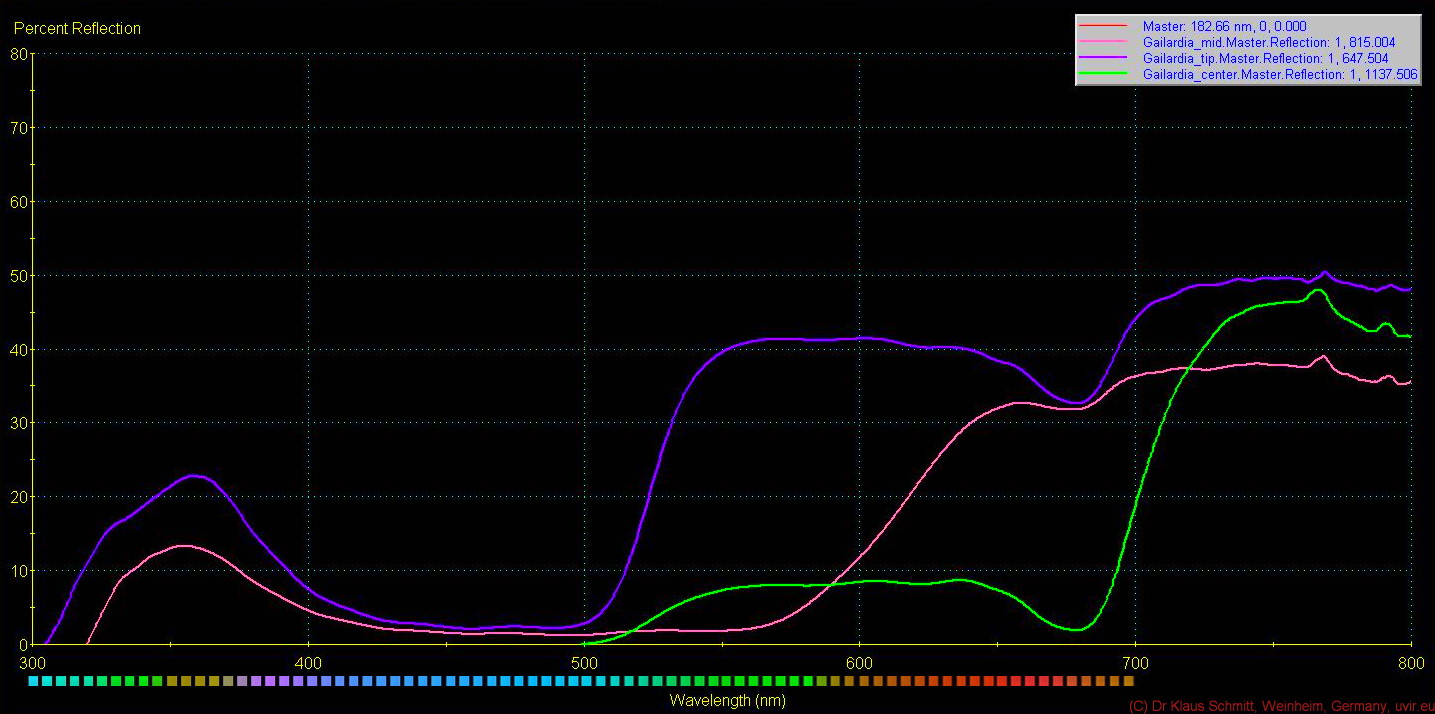
Following examples for comparison,: Bidens ferulifolia, petal tip looks bright yellowish and rest petal quite dark in UV and Sanvitalia procumbens which looks about the same UV color at its petal tip but dimmer and petal rest nearly pitch black in UV (using my standardized false UV color palette). Gaillardia aristata has an underlying UV reflective layer even over the whole tip under a in the visible yellow petal tip and orange-red rest of the tip; the flower center is all UV dark but in the visible orange red outside and greenish in the very center
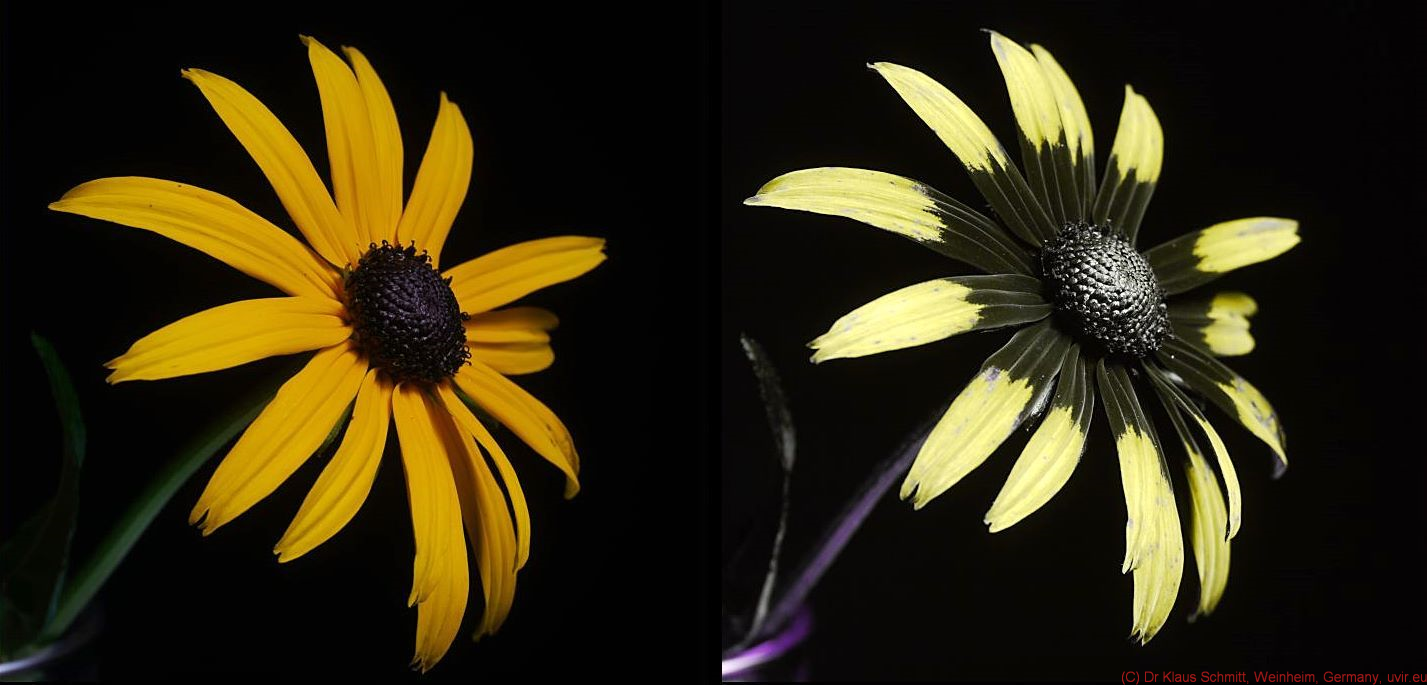
Spectrometric results Bidens ferulifolia: Prediction "UV color": bright whiteish-yellowish tip, dark rest of petal; dark center Sanvitalia procumbens: Prediction "UV color": whiteish-yellowish tip, dark rest of petal; dark center Photographic result: UV (right part of image is sunlight, left 365nm UV LED; Bidens left, Sanvitalia right): Gaillardia aristata: Prediction "UV color": bright whiteish-yellowish petal; dark center Photographic result: VIS / UV (wet, after rain): Added today: Rudbeckia fulgida flower: Prediction "UV color": yellow tip, dark rest of petal; whiteish-yellowish center reflection Photographic VIS/UV: So we see, that it holds true so far, that my standardized false UV colors can stand for specific UV-A sub-waveband reflections as shown here on my BLOG. Stay tuned, more will follow on that fascinating subject... More info on this very interesting field may be found on my site http://www.pbase.com/kds315/uv_photos

Saturday, June 4, 2011