Showing posts with label UV transmittance. Show all posts

Tuesday, July 15, 2014

Flare reduction and sunshade use in reflected UV ultraviolet photography

Today about flare redction when shooting reflected UV and the dedicated UV transmitting filters, like the Baader-U filter, my "work horse", for that. I'm using here my CERCO 94mm quartz fluorite lens, but in principle this method is applicable for any such lens. However, keep in mind, that quartz fluorite lenses for reflected UV are often single or even uncoated or show hotspotting, so it gets even more important to control flare efficiently, resulting in much higher image contrast and sometimes even removal of the hotspot. All images have been done at identical manual exposure settings, which were tested for correct exposure upfront.

Similar methods using such hoods have been used by others, I'm not claiming anything here, this just documents what I have done to further optimize my own setup.

[click on image to see a larger one]

Test images at nearly infinity (left to right) using (optimized for my camera's sensor size, other sensor sizes will require different sizes)
1) just the UV filter, no sunshade at all
2) a 40mm long sunshade with 50mm free diameter
3) a 50mm long sunshade with 21mm free diameter


The difference gets quite obvious, the longer and narrower the sunshade is, the better flare gets controlled.

Now some closeup shots, using the same method and sequence:

Also here shooting flowers at closeup, it gets pretty obvious, how much flare is present if using no or a simple sunshade, whereas a specilized deep and narrow sunshade results in much improved flare control, hence greatly improved image contrast.

Let me summarize:
Whenever shooting reflected UV (or other multispectral work), make sure to use the deepest and most narrow possible sunshade, that does not vignette, to achieve the best flare control and resulting in best possible image contrast. It is also suitable to control or even remove the effect of hotspots, some of those highly specialized lenses unfortunately show.

I have previously written about filter leakage HERE.

Stay tuned, more will follow on that fascinating subject...

More info on this very interesting field may be found on my site http://www.pbase.com/kds315/uv_photos

Friday, May 9, 2014

Filter leakage in reflected UV ultraviolet photography - How not to test a filter for leakage IV

Today about a method to test UV transmitting filters for leakage that should not be used. In priciple the idea seems to be straight forward and quite obvious: Shine a strong white light through an UV transmitting filter (a ionic colored LUV U2 will be used here) and if one (or a camera) "sees" something transmitted, that filter seems to leak. Well, let's have a look if that is really that easy....

[click on image to see a larger one]

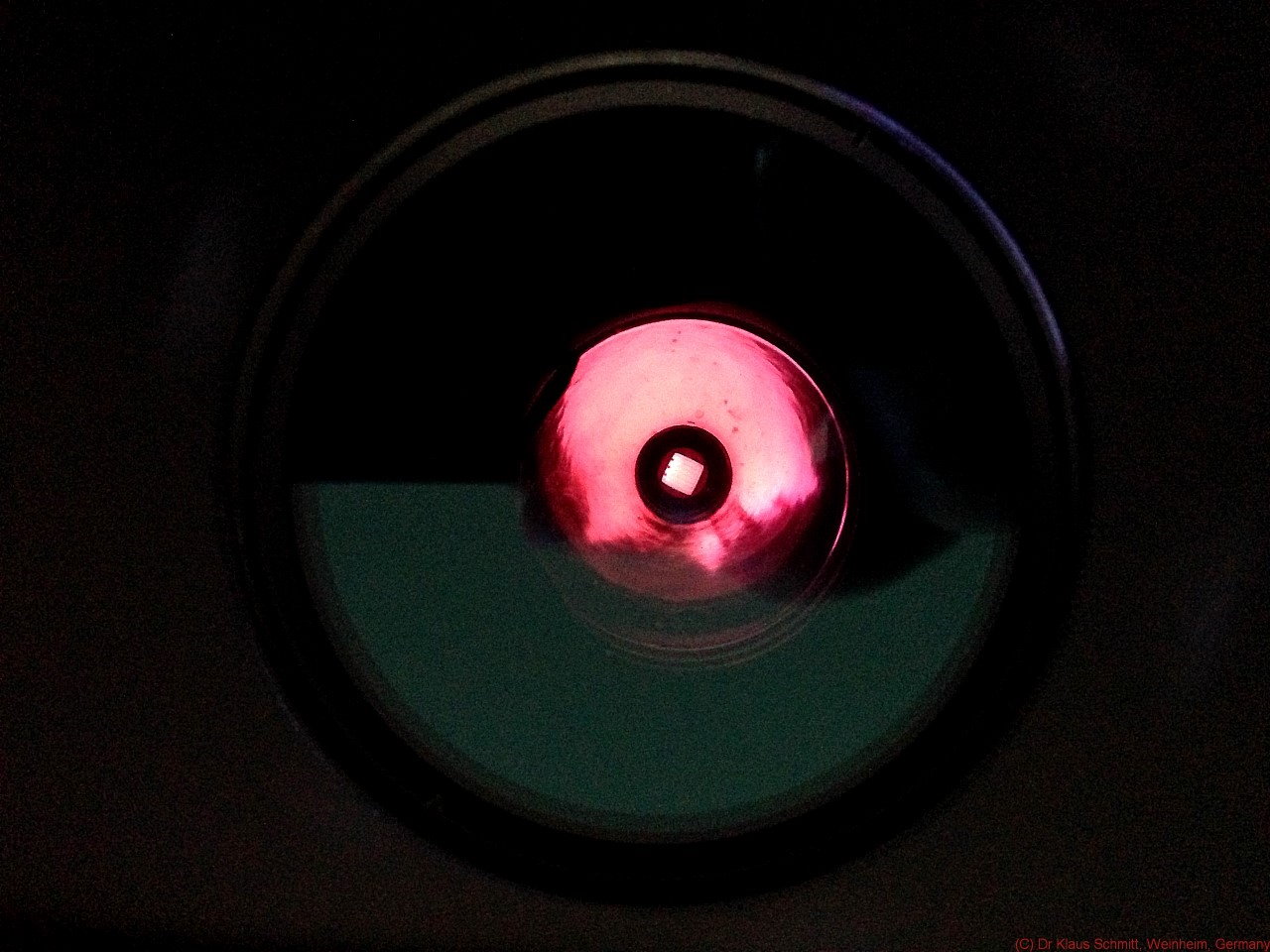
What my iPhone5 sees when shining a strong Cree white LED light through a LUV U2 filter:
 
So do I see leakage here? My iphone sees that as red, but I really see violet, so it either depends on the WB used or theremust be something else. It is basically all a matter of intensities, as the filter from what I know and have measured earlier has about OD4 suppression outside the UV range up to NIR, then using a very strong LED torch with an intensity of for instance 10.000 then gives 0.0001 (OD4) x 10000 = 1 and that can be easily recorded.

But let's see what my spectrometer system reveals about that same situation:
 
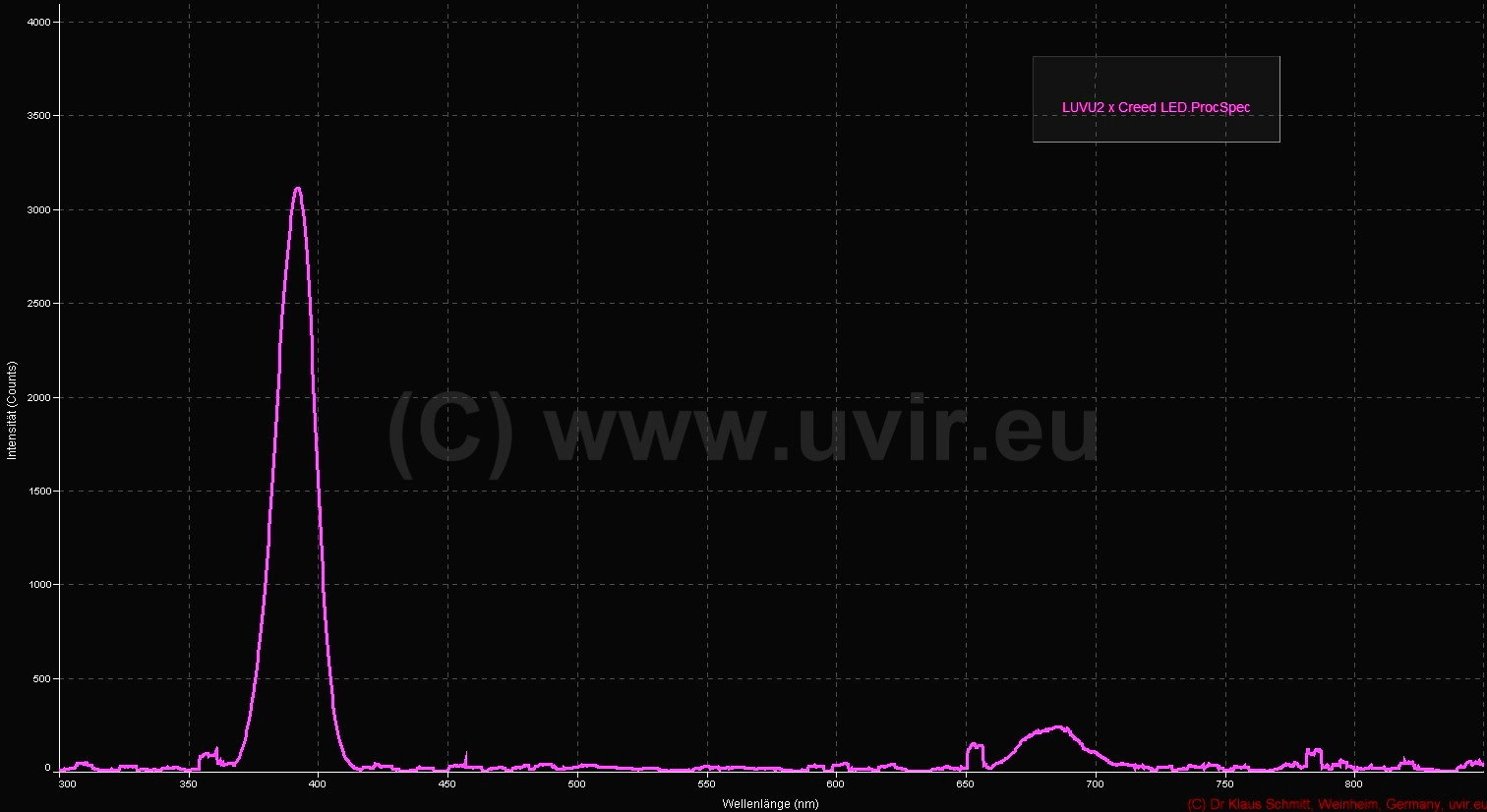
Obviously even that white CREE LED does emit some UV (peaks at 392nm) and there is some red between 650-710nm - that also explains why I see violet, as there is some UV + blue + red. (ignore the ripples, this is just noise caused by the very long integration time).

So what do we see now here in the next image: I have added to the experiment (using the same spectrometer settings) the Cree white LED light w/o that UV transmitting filter shining through 2x ND3 filters, equivalent to using 1x ND6 to reduce that enormous bright light to one my spectrometer can handle:
 
I needed two stacked neutral density ND3 filters (i.e. ND6) to reduce that intensity to a manageable level and to get about the same amount of count at around 670nm. So that means that this Cree LED is so intense, that it is even able to have that internal used phosphor (used to achieve the bright white light) emit some UV and some dark red!

Just to make that clear, ND6 means 1:1.000.000 reduction in intensity, so adjusting my previous example to real data now: if the UV transmitting filter suppresses OD4 (0.0001) and one uses a light with intensity 1.000.000 and shine it through that filter, one would still get 100 intensity counts (or simpler calculated OD6 – OD4 = OD2 equals a factor of 100). BUT in normal photography, one does not have that situation, so this really is irrelevant and renders such "test" useless.

Let me summarize:
I could not detect any IR leakage using the LUV U-2 filter as well as the spectrometric test did not show leakage up to 800nm in my earlier tests. So using a very strong LED torch of unknown properties to shine through such a filter, does not create a suitable and reliable testing method, nor do I recommend to use that. Neither do I recommend to look through such a filter pointing at the sun, as this creates an enormous risk for ones eyesight due to the high UV transmittance!!

I have previously written about filter leakage HERE.

Stay tuned, more will follow on that fascinating subject...

More info on this very interesting field may be found on my site http://www.pbase.com/kds315/uv_photos
Monday, April 9, 2012

[UV] Light Source - Flower - Filter - Lens - Sensor: a simulation of reflected UV photography

Well, just some ideas that came into my mind quite a while ago, when I was thinking about the chain:
Light Source -> Flower -> Filter -> Lens ->Sensor

To simplify things, let's assume

a) the light source being sunlight or Xenon light, as they are quite similar in the interesting UV region 300-400nm.
b) the lens being a quartz fluorite lens with flat transmittance in the interesting UV region 300-400nm

[click on image to see a larger one]

So here graphs (normalized to unity) showing in this example
1) flower (Mexican Zinnia, UV reflective flower tip): green line
2) filter (Baader U filter 2"): blue line
3) sensor (Nikon D200 mod. with quartz glass internal filter): red line


now lets add what that flower looks like after having passed the filter (pink line)


and finally what that sensor records of that (cyan line)


btw. if a normal, but UV transmitting glass lens (Noflexar 35mm - yellowish line) is used between filter and sensor, then the result looks like that:


The simple laymans terms summary: This is what the flowers reflects (green line) and what the camera records of it (cyan line) through a Baader U filter and Noflexar 35mm lens:


The bad news is, that it will only be a bit better if a quartz fluorite lens is being used, but not substantially.


So in the first case the 320-390nm Baader U filter appears like a 372BP15 bandpass filter and in the second, better example, like a 365BP16 bandpass filter. This has nothing to do with the type or quality of the Baader U filter, but is caused only by the process chain it is used within!


***THESE ARE VERY SIMPLIFIED SIMULATIONS BARE SCIENTIFIC ACCURRACY, SO NO DECISION, JUST INSIGHT SHOULD BE BASED ON THAT***


Stay tuned, more will follow on that fascinating subject...

More info on this very interesting field may be found on my site http://www.pbase.com/kds315/uv_photos
Monday, February 21, 2011

[UV] EL-Nikkor 80mm for UV - old vs. new type

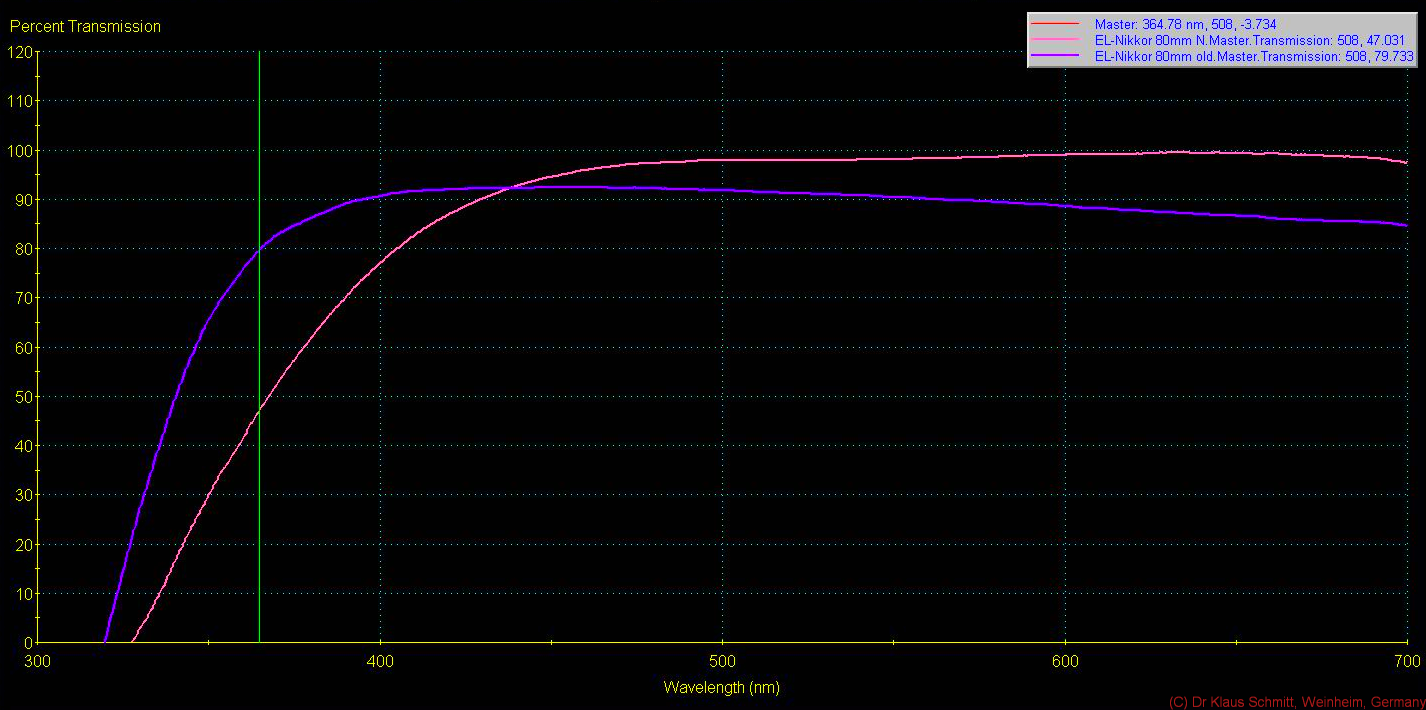
As I was testing (again) lenses for UV photography, I had done spectrometric tests on Nikon EL-Nikkor enlarger lenses. The question arose, if the newer 80mm EL-Nikkor has as good an UV transmission as the older, full metal type. So now since I found a new one, here the comparison transmission graph old metal one vs new plastic "tyre like" version. Both are f5.6/80mm.

[click on image to see a larger one]

UV transmission graph:


In terms of UV transmission, quite a substantial difference of about one stop in favor of the old type I would say. The newer one seems to have some fancy new multicoating, which brings the transmission losses in the visual range substantially down, but the UV transmission has been quite reduced by doing so.

P.S.: the 80mm EL-Nikkor (the older, chrome black full metal type) has an adapter ring on its base with outer M39x26tpi screw mount (Leica enlarger mount). Beneath it is a M25 thread for older #00 shutters. Company Schneider Optics offers adapter rings, if that one should be missing (oder code 92-013251).
P.P.S.: the filter thread of that older EL-Nikkor 80mm is 34.5mm, which is pretty uncommon, ask me if you need an adapter ring.

Stay tuned, more will follow on that fascinating subject...

More info on this very interesting field may be found on my site http://www.pbase.com/kds315/uv_photos