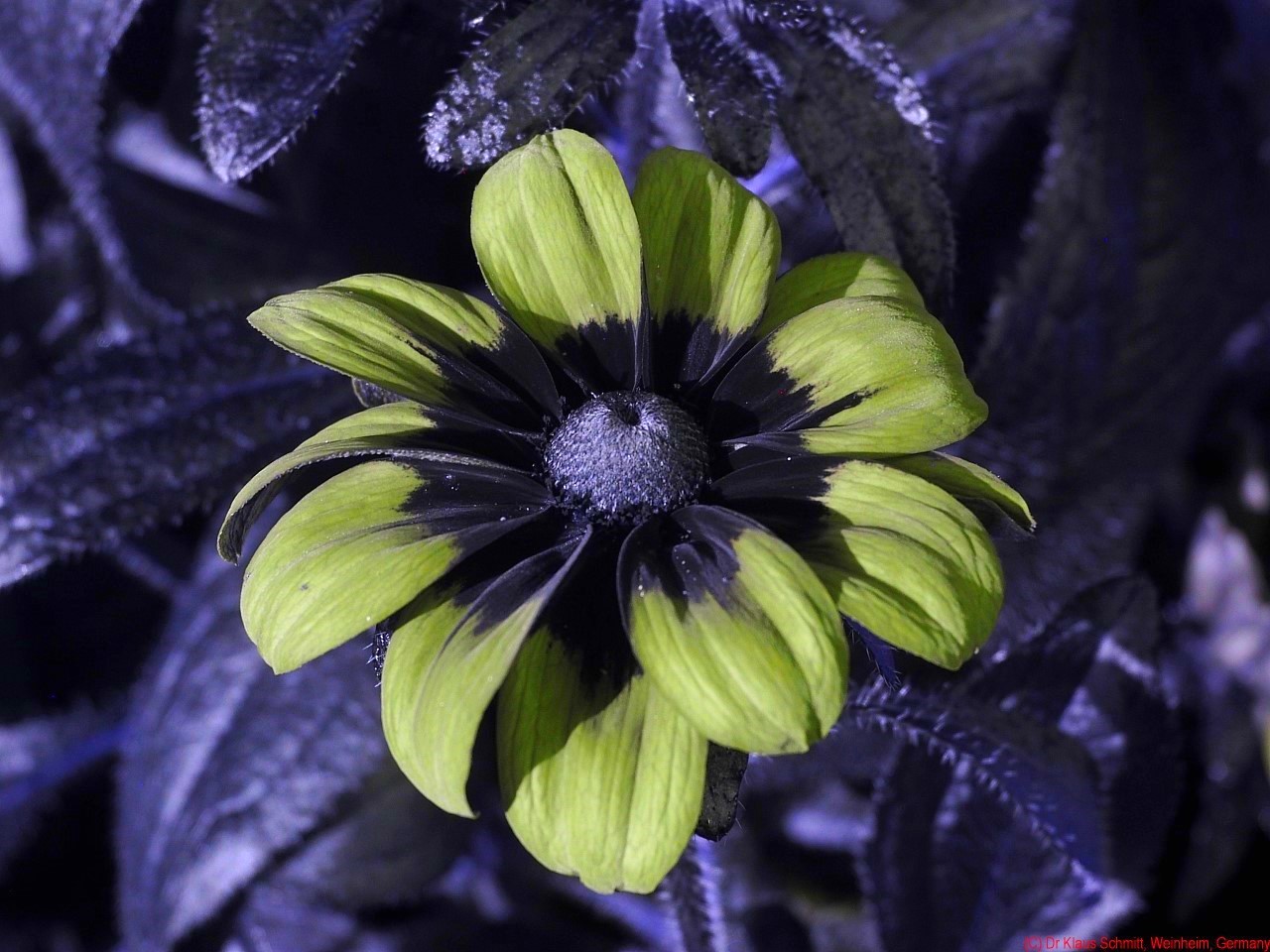
So today more about some UV-VIS-NIR measurements of some highly specialized lenses, which were specifically developed for reflected ultraviolet (UV) photography. This time it is about lenses with 85mm focal length.
Usually a photographic lens should reproduce visible images, which is the wavelength band of about 400-700nm. This is why lens makers apply a special multicoating (aside from achieving higher light transmission), which usually blocks light outside this visible waveband. For biological reflected UV photography however, the UV-A band (300 - 400nm) is the interesting one. So using such a modern UV lens and that (de facto "standard" UV transmitting) Baader U-filter will work very well together, if both lens + filter have a high enough transmission. Culprit is, that coating for such a wide range is tricky, so quite a few of those lenses are still uncoated.
Here now I have used my UV-VIS-NIR spectrometer system consisting of a stabilized Xenon light source connected with a quartz fiber to a quartz-fluorite condensor which generates a fine parallel output ray shining through the lens to be tested and a receiving Spectralon (R) coated integrating sphere which captures all the light of that diverging beam exiting the measured lens and transmits this via a quartz fiber to the digital spectrometer.
The following lenses have been measured (links lead to my macrolenses site with lens data):
- Quartz Takumar f3.5/85mm (M42 mount)
- Ultra Achromatic Takumar f4.5/85mm (M42 mount)
- Lavision f2.8 / 85mm UV (Nikon-F mount)
[click on image to see a larger one]
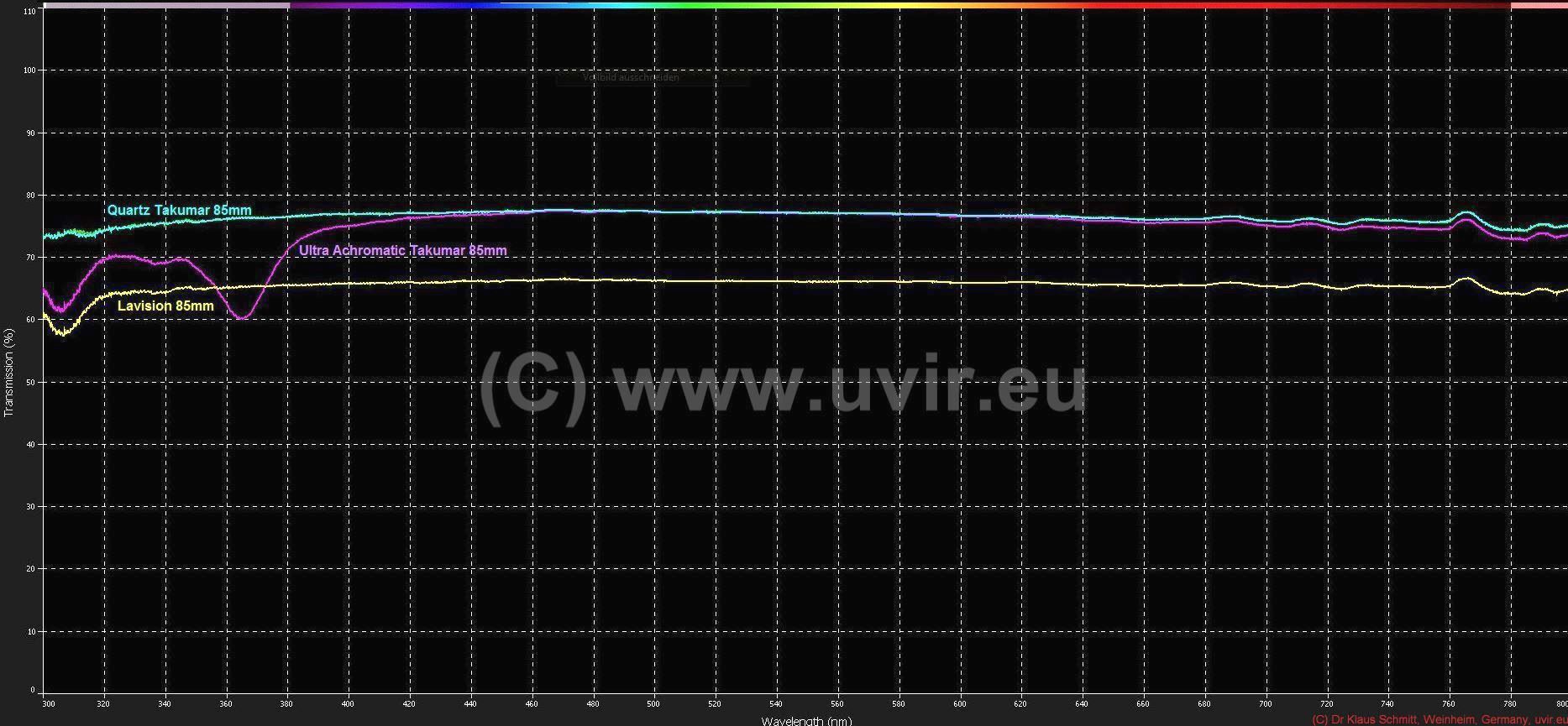
All these lenses show a relatively high UV transmisison, the Quartz Takumar 85mm especially. The Ultra Achromatic Takumar 85mm and Lavision 85mm are not only suitable for UV-A photography for biologic studies (which usually is the 300-400nm UV-A range), but for technical studies like combustion analysis etc. which demands a suitable transmission in the UV-B (also sometimes UV-C) range, which all these three lenses are capable of, reaching down to about 200nm.
The Ultra Achromatic Takumar 85mm shows some notable dip in transmission around 360-370nm, but I have no explanation for this yet - possibly caused by impurities of the used CaF2 cystals. All these three lenses seem to be uncoated. The Quartz Takumar 85mm is not color corrected, so shows quite some focus shift depending on wavelength; reason why it was shortly on the market only and replaced by the Ultra Achromatic Takumar 85mm, which is a color corrected quartz fluorite lens with very little focus shift.
The Lavision 85mm covers APS-C format. The Quartz Takumar 85mm and Ultra Achromatic Takumar 85mm are full format lenses. The latter two lenses are no longer made, but available on the used market; the Lavision 85mm lens is available from stock.
Just a remark, as a high UV transmission is a must for a suitable UV lens, but also good sharpness, high contrast, flare resistance, no hot-spots, etc. are requirements such a UV lens has to meet, and I have not jet mentioned an important point - focus shift. Most of these modern quartz-fluorite lenses have no or very little focus shift, but that depends on the wavelength range they are corrected for.
I have written about other such lenses HERE
More info on this very interesting field may be found on my site http://www.pbase.com/kds315/uv_photos