Showing posts with label apache beggarticks. Show all posts

Sunday, May 17, 2020

Apache beggarticks - Bidens ferulifolia in deeper reflected ultraviolet photography, simulated bee and butterfly vision XVI

Today in 2020 more shots of that long blooming spring flower Apache beggarticks - Bidens ferulifolia in reflected ultraviolet photography. All shots were done at f8 in reflected ultraviolet photography using my "work horse" UV filter, the Baader-U filter, as well as my deeper UV filters and the IDAS 330nm filter. Lens was a UV-Nikkor 105mm quartz fluorite lens. Light source was my UV enhanced Xenon flash.

[click on image to see a larger one]

Human vision:
 

Reflected UV:
 

Reflected deep UV with IDAS fiter (300-380nm, peak 330nm):
 

Reflected deeper UV (290-340nm, peak approx. 320nm):
 

Quadriptych (details) of human vision, UV, deep and deeper UV (left to right, top to bottom):
 

Bidens has a strong visible UV pattern, its petal tips are UV bright around 365nm, its center is quite UV dark, so this gets quite nicely visible, also in deep and deeper reflected UV photography.

I have written about Bidens previously HERE
 
Stay tuned, more will follow on that fascinating subject...

More info on this very interesting field may be found on my site http://www.pbase.com/kds315/uv_photos

Wednesday, July 17, 2019

Apache beggarticks - Bidens ferulifolia in reflected ultraviolet photography, simulated bee and butterfly vision XIV

Today shots of that long blooming spring flower hybride Apache beggarticks - Bidens ferulifolia in reflected ultraviolet photography and simulated bee and butterfly vision. All shots were done at f8 in reflected ultraviolet photography using my "work horse" UV filter, the Baader-U filter as well as a new alternative "colorful" XSP UV transmission filter, and my XBV filters for simulated bee and butterfly vision. Lens was a UV-Nikkor 105mm quartz fluorite lens. Light source was sunlight and a little help from my Nichia 365nm UV LED.

[click on image to see a larger one]

Human vision:
 

Reflected UV:
 

Alternative colorful reflected UV filtering:
 

Simulated butterfly vision:
 

Simulated bee vision:
 

Quadriptych of human vision, UV, alternative reflected UV and simulated butterfly vision (left to right, top to bottom):
 

Quadriptych of human vision, UV, simulated butterfly and bee vision (left to right, top to bottom):
 

Bidens has a strong visible UV pattern, its petal tips are UV bright around 365nm, its center is quite UV dark, so this gets quite nicely visible in simulated butterfly and bee vision, also using that standard UV (Baader U) and new alternative reflected UV filter which delivers rather colorful UV images.

I have written about Bidens previously HERE
 
Stay tuned, more will follow on that fascinating subject...

More info on this very interesting field may be found on my site http://www.pbase.com/kds315/uv_photos

Monday, June 10, 2019

Apache beggarticks - Bidens ferulifolia in reflected ultraviolet photography, simulated bee and butterfly vision XIII

Today shots of that long blooming spring flower "Rockstar" hybride Apache beggarticks - Bidens ferulifolia in reflected ultraviolet photography and simulated bee and butterfly vision. All shots were done at f8 in reflected ultraviolet photography using my "work horse" UV filter, the Baader-U filter, as well as my XBV filters for simulated bee and butterfly vision. Lens was a UV-Nikkor 105mm quartz fluorite lens. Light source was sunlight and a little help from my Nichia 365nm UV LED. But today also about a different color scheme for simulated bee vision.

[click on image to see a larger one]

Human vision:
 

Reflected UV:
 

Simulated butterfly vision:
 

Simulated bee vision:
 

Simulated bee vision in alternative color mapping:
 

Quadriptych of human vision, UV, simulated butterfly and bee vision (left to right, top to bottom):
 

Same as before but with alternative color mapping for bee vision (bottom left):
 

The idea behind this mapping is, that the petal tips reflect all colors a bee can see, including UV, so it should be "white" to our eyes representing "bee-white"; the center however does not reflect UV, so it is colorful in the non-UV colors.

Bidens has a strong visible UV pattern, its petal tips are UV bright around 365nm, its center is quite UV dark, so this gets quite nicely visible in simulated butterfly and bee vision, also using a different color mapping scheme.

I have written about Bidens previously HERE
 
Stay tuned, more will follow on that fascinating subject...

More info on this very interesting field may be found on my site http://www.pbase.com/kds315/uv_photos

Friday, May 31, 2019

Apache beggarticks - Bidens ferulifolia in reflected ultraviolet photography, simulated bee and butterfly vision XII

Today more shots of that long blooming spring flower "Rockstar" hybride Apache beggarticks - Bidens ferulifolia in reflected ultraviolet photography and simulated bee and butterfly vision. All shots were done at f8 in reflected ultraviolet photography using my "work horse" UV filter, the Baader-U filter, as well as my XBV filters for simulated bee and butterfly vision. Lens was a UV-Nikkor 105mm quartz fluorite lens. Light source was sunlight.

[click on image to see a larger one]

Human vision:
 

Reflected UV:
 

Simulated butterfly vision:
 

Simulated bee vision:
 

Quadriptych of human vision, UV, simulated butterfly and bee vision (left to right, top to bottom):
 

Bidens has a strong visible UV pattern, its petal tips are UV bright around 365nm, its center is quite UV dark, so this gets quite nicely visible, also in simulated butterfly and bee vision.

I have written about Bidens previously HERE
 
Stay tuned, more will follow on that fascinating subject...

More info on this very interesting field may be found on my site http://www.pbase.com/kds315/uv_photos

Monday, May 6, 2019

Apache beggarticks - Bidens ferulifolia in reflected ultraviolet photography, simulated bee and butterfly vision XI

Today more shots of that long blooming spring flower "Rockstar" hybride Apache beggarticks - Bidens ferulifolia in reflected ultraviolet photography and simulated bee and butterfly vision. All shots were done at f8 in reflected ultraviolet photography using my "work horse" UV filter, the Baader-U filter, as well as my XBV filters for simulated bee and butterfly vision. Lens was a UV-Nikkor 105mm quartz fluorite lens. Light source was sunlight and a little help from my Nichia 365nm UV LED.

[click on image to see a larger one]

Human vision:
 

Reflected UV:
 

Simulated butterfly vision:
 

Simulated bee vision:
 

Quadriptych of human vision, UV, simulated butterfly and bee vision (left to right, top to bottom):
 

Bidens has a strong visible UV pattern, its petal tips are UV bright around 365nm, its center is quite UV dark, so this gets quite nicely visible, also in simulated butterfly and bee vision.

I have written about Bidens previously HERE
 
Stay tuned, more will follow on that fascinating subject...

More info on this very interesting field may be found on my site http://www.pbase.com/kds315/uv_photos

Monday, April 8, 2019

Apache beggarticks - Bidens ferulifolia in reflected ultraviolet photography and simulated bee vision X

Today more shots of a long blooming spring flower "Rockstar" hybride Apache beggarticks - Bidens ferulifolia in simulated bee and butterfly vision. All shots were done at f8 using two different XBV filters for simulated bee vision. Lens was a UV-Nikkor 105mm quartz fluorite lens. Light source was sunlight.

This is to show that alternative possibilities exist for simulating bee vision, here using two of my proprietary XBV filters.

[click on image to see a larger one]

Human vision:
 

Reflected UV:
 

Simulated bee vision:
 

Simulated bee vision - alternative:
 

Bidens has a strong visible UV pattern, its petal tips are UV bright around 365nm, its center is quite UV dark, so this gets quite nicely visible, also in simulated bee vision.

Here I wanted to show that simulation of bee vision is possible, with a mapping that avoids to use the color red, as bees are not able to see that color and still make the otherwise invisible UV pattern visible. The first filter preserves the visible yellow color the petals have in natural light, whereas the second one maps in such a way as to make the petal tips, which are highly UV reflective, white.

I have written about Bidens previously HERE
 
Stay tuned, more will follow on that fascinating subject...

More info on this very interesting field may be found on my site http://www.pbase.com/kds315/uv_photos
Apache beggarticks - Bidens ferulifolia in reflected ultraviolet photography using an UV-LED IX

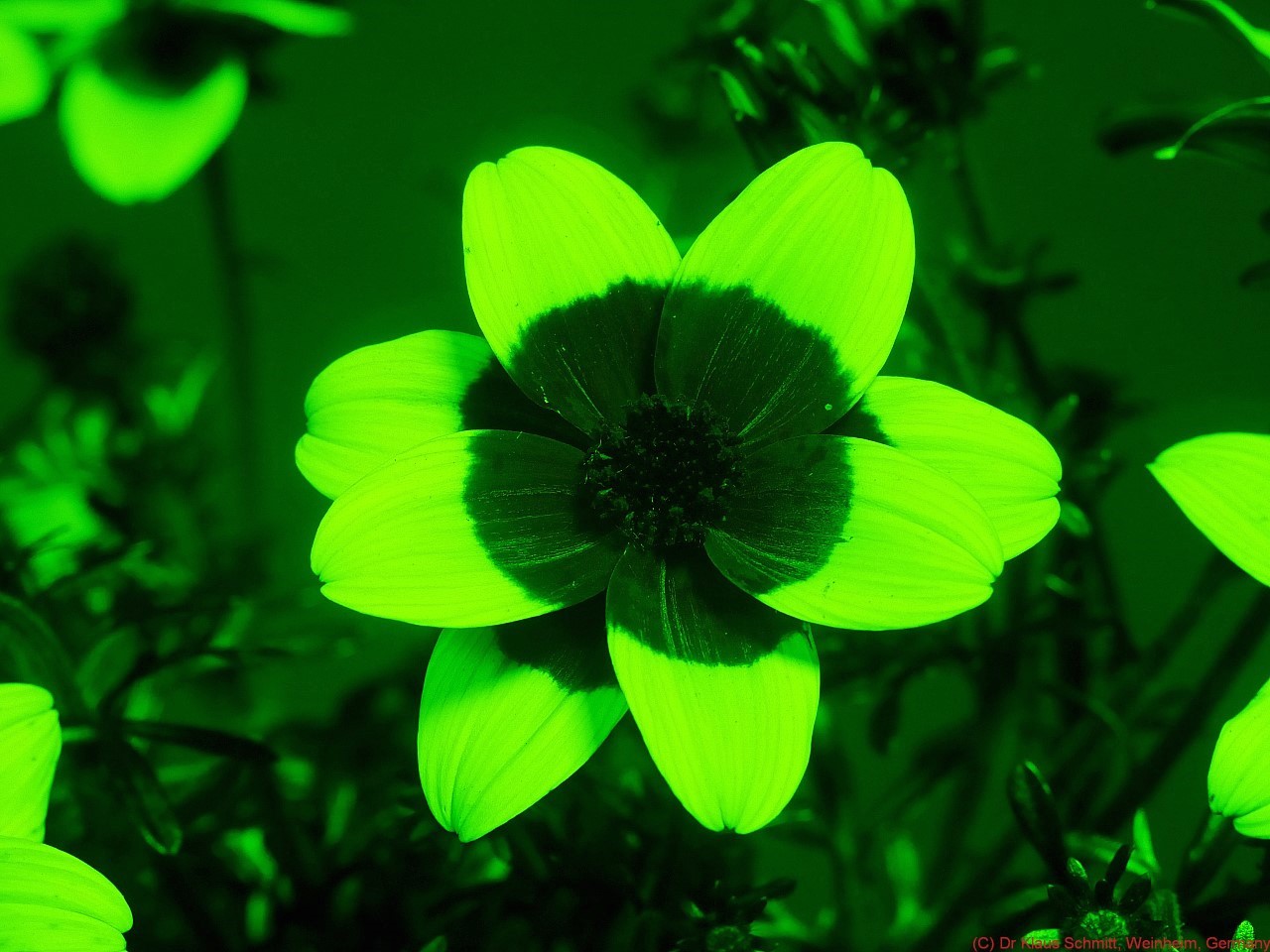
Today more shots of that long blooming spring flower "Rockstar" hybride Apache beggarticks - Bidens ferulifolia in reflected ultraviolet photography. All shots were done at f8 in reflected ultraviolet photography using my "work horse" UV filter, the Baader-U filter. Lens was a UV-Nikkor 105mm quartz fluorite lens. Light source was sunlight as well as a Convoy S2 UV LED with Nichia UV chip inside.

This is to show how useful such an UV-LED can be, in case not enough sunlight is available. This UV torch has been equipped with a front UV transmission filter to cut away all visible blue light.

[click on image to see a larger one]

Human vision:
 

Reflected UV with sunlight:
 

Reflected UV with filtered Convoy S2 UV LED :
 

Bidens has a strong visible UV pattern, its petal tips are UV bright around 365nm, its center is quite UV dark, so this is an ideal test object to test out this small Convoy S2 UV-LED torch, which strongly enhances the visibility of this UV pattern.

Personally I prefer sunlight, but if this is lacking, or a very sharp image is needed, the nearly monochromatic UV-Light is an ideal and easy to get UV light source.


I have written about Bidens previously HERE
 
Stay tuned, more will follow on that fascinating subject...

More info on this very interesting field may be found on my site http://www.pbase.com/kds315/uv_photos
Saturday, April 6, 2019

Apache beggarticks - Bidens ferulifolia in reflected ultraviolet photography, simulated bee and butterfly vision VIII

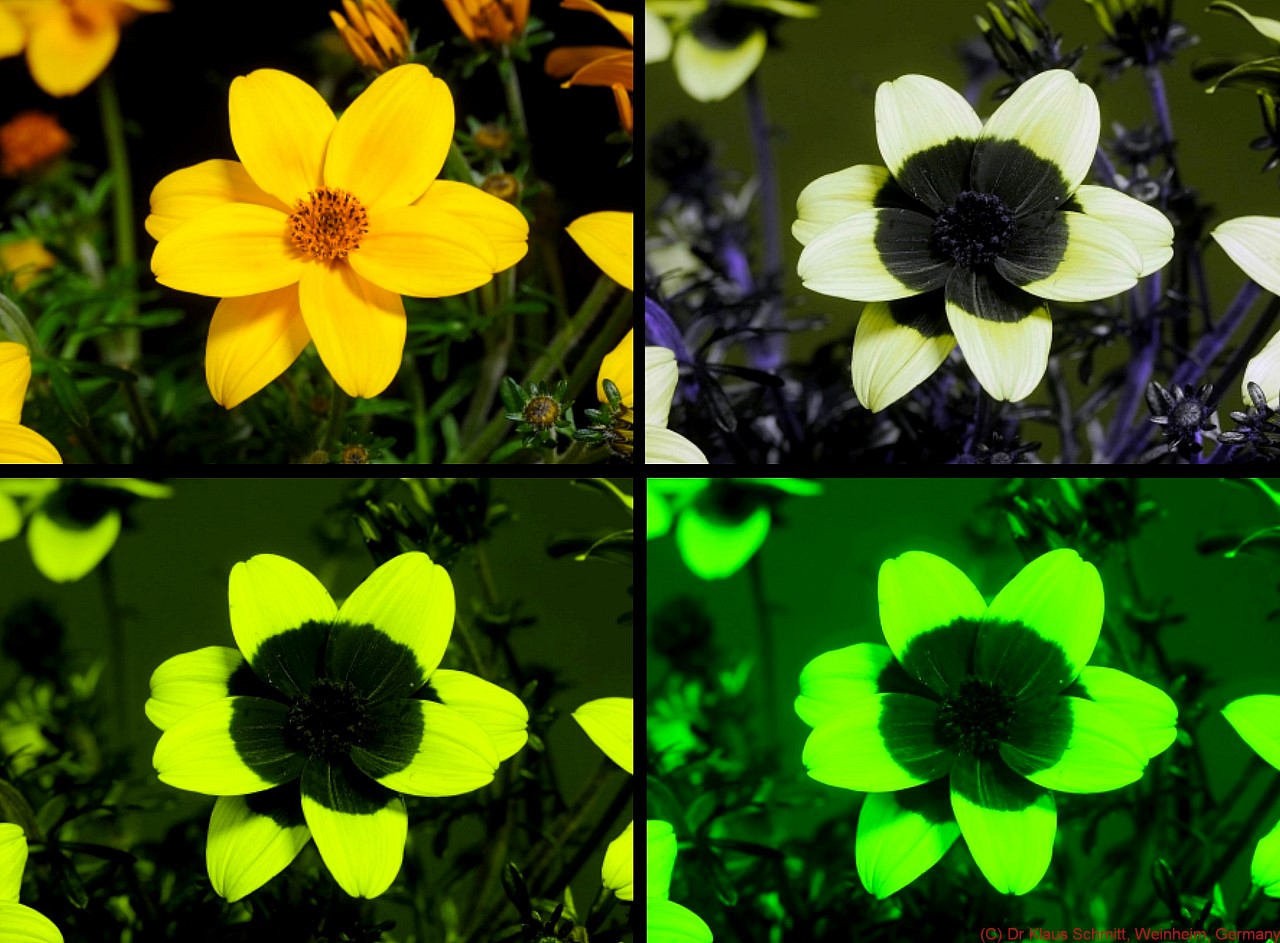
Today first 2019 shots of a long blooming spring flower "Rockstar" hybride Apache beggarticks - Bidens ferulifolia in reflected ultraviolet photography and simulated bee and butterfly vision. All shots were done at f8 in reflected ultraviolet photography using my "work horse" UV filter, the Baader-U filter, as well as my XBV filters for simulated bee and butterfly vision. Lens was a UV-Nikkor 105mm quartz fluorite lens. Light source was sunlight.

[click on image to see a larger one]

Human vision:
 

Reflected UV:
 

Simulated butterfly vision:
 

Simulated bee vision:
 

Quadriptych of human vision, UV, simulated butterfly and bee vision (left to right, top to bottom):
 

Bidens has a strong visible UV pattern, its petal tips are UV bright around 365nm, its center is quite UV dark, so this gets quite nicely visible, also in simulated butterfly and bee vision.

I have written about Bidens previously HERE
 
Stay tuned, more will follow on that fascinating subject...

More info on this very interesting field may be found on my site http://www.pbase.com/kds315/uv_photos

Tuesday, May 10, 2016

Apache beggarticks - Bidens ferulifolia in reflected ultraviolet photography, simulated bee and butterfly vision VII

Today shots of a long blooming spring flower Apache beggarticks - Bidens ferulifolia in reflected ultraviolet photography and simulated bee and butterfly vision. All shots were done at f8 in reflected ultraviolet photography using my "work horse" UV filter, the Baader-U filter, as well as my XBV filters for simulated bee and butterfly vision. Lens was a UV-Nikkor 105mm quartz fluorite lens. Light source was sunlight, background was the flower's own foliage.

[click on image to see a larger one]

Human vision:
 

Reflected UV:
 

Simulated bee vision:
 

Simulated butterfly vision:
 

Quadriptych of human vision, UV, simulated bee and butterfly vision (left to right, top to bottom):
 

Bidens has a strong visible UV pattern, its petal tips are UV bright around 365nm, its center is quite UV dark, so this gets quite nicely visible, also in simulated butterfly and bee vision.

I have written about Bidens previously HERE
 
Stay tuned, more will follow on that fascinating subject...

More info on this very interesting field may be found on my site http://www.pbase.com/kds315/uv_photos

Friday, October 2, 2015

ZDF TerraX Series "The Magic of Colors" Oct 18 2015 19:30h CET

TerraX has contracted me to supply them with Vis + UV stills and a reflected UV HD video for their forthcoming two-part series "The Magic of Colors" which will air Oct 18 (part I) and Oct 25 (part II), 2015 19:30 hours CET on TV channel ZDF - my work will be shown in part I on Oct 18.

Quote TerraX: "Whether ocher, red, yellow, green or blue: Behind every color shade are hidden stories and amazing facts. Why do they have such a great importance for us people and why has that always been that way? Only those who could recognize whether a fruit is ripe or toxic, could survive. All colors in nature serve a biological purpose and every living being has specialized his perception towards that. But man alone manufactures colors and gives them symbolic power."

That also applies also to animals and flowers, and evlolution found amazing ways of plant-animal interaction, benefitting them both. However not all animals and insects have the very same color perception we humans have, some of them can see what we cannot see, ultraviolet (UV) light for instance, or the very faint UV induced visible fluorescence some flowers emit to attract night active moths, like this four o'clock flower (Mirabilis jalapa) for instance shown in human vision and fluorescence with its glowing pollen:

Here now some examples what pollinating bees are able to see and what we humans see, Brown Eyed Susan (Rudbeckia fulgida) to start with (1st visible light and 2nd reflected UV)
There will also be a video showing a bee pollinating a Rubbeckia flower in reflected ultraviolet light:  

I'm pretty sure this whole series will be quite exciting to watch as there is so much more in it. Be sure to watch it of you can!

Stay tuned, more will follow on that fascinating subject...