Showing posts with label Kuribayashi 35mm. Show all posts

Thursday, December 20, 2018

NOVOFLEX T-NOFLEXAR 400mm for reflected ultraviolet (UV) photography


So today it is about a lens I had laying around for many years, intended to use for reflected ultraviolet photography, as it is a simple achromat from what I know, the NOVOFLEX T-NOFLEXAR f5.6/400mm.

To find out if there is a chance to get it to work, best aside from just trying out, to chech with a suitable spectrometer if there is some useful UV transmission - and this will be shown here. As a comparison, I will use two other lenses, both well known to work in UV, the Kuribayashi f3.5/35mm and the NOFLEXAR f3.5/35mm lens (also made by NOVOFLEX).

[click on image to see a larger one]


Now this transmission spectra clearly shows, that although the T-Noflexar 400mm cannot beat the Kuribayashi 35mm lens, it is very close to the Noflexar 35mm lens transmission, which is considered quite useful for reflected UV photography. It delivers about 67% transmission at 365nm, the Kuribayashi however has 78% there.

Remark: the 100% line reflects the transmission of a white SPECTRALON (R) reflection standard with 99% reflection in the 300-700nm region, so this result should be a true representation of the lens transmission.

I will shoot a few test images in visible light and UV, weather permitting. It is dull grey winter weather now, so that might be in coming spring...


I have written about lenses for UV before HERE


Stay tuned, more will follow on that fascinating subject...

More info on this very interesting field may be found on my site http://www.pbase.com/kds315/uv_photos

Friday, June 30, 2017

Petri Kuribayashi 35mm vs Kyoei E-Acall 50mm lens for reflected UV photography VII

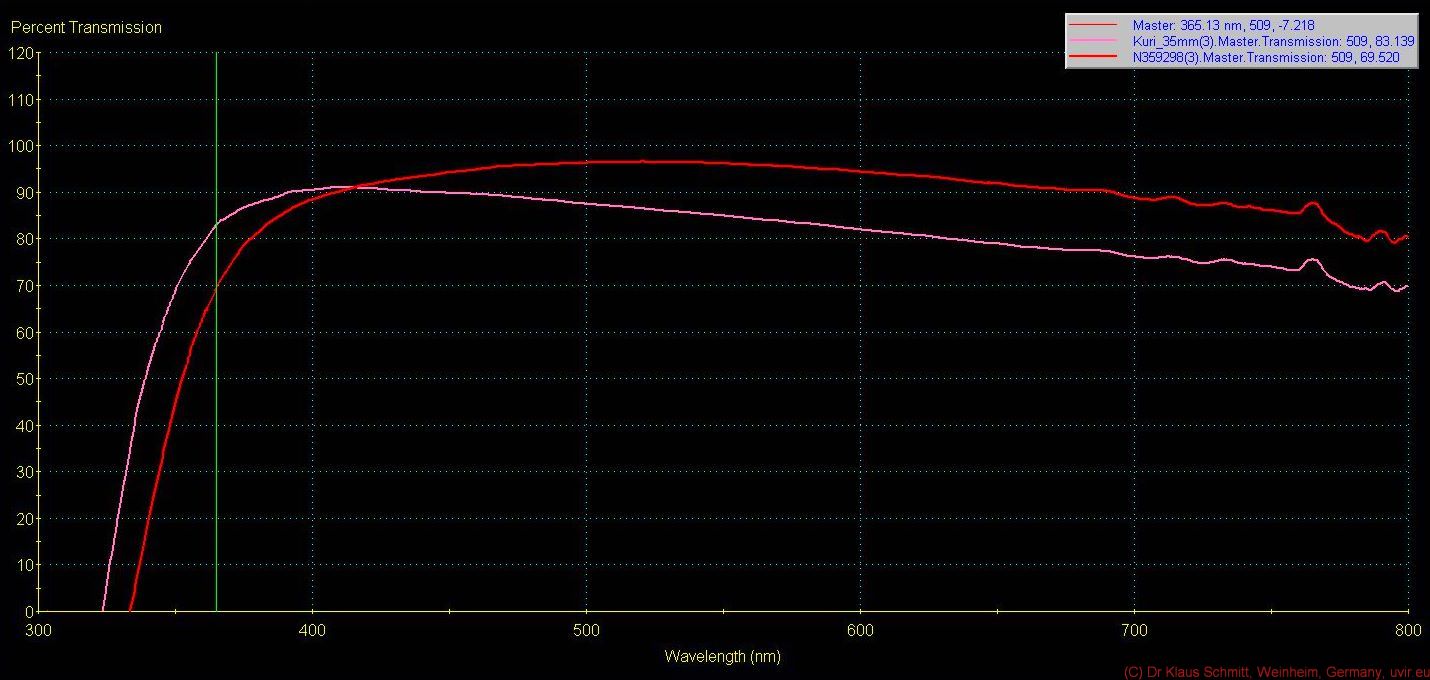
Today a spectrometric test using that previously mentioned Petri Kuribayashi f3.5/35mm lens, compared to a recently found Kyoei E-Acall f3.5/50mm enlarger lens, as a proof that both actually have a very useful lens transmission, especially in UV.

[click on image to see a larger one]


The Kuribayashi 35mm still reaches deep into UV, even a bit below 320nm and shows a rather high UV at 365nm transmission of over 80%. However the Kyoei E-Acall f3.5/50mm enlarger lens seems to be quite similar, reaches beyond 320nm too and has a tad above 70% UV transmission at 365nm, so another useful addition to the rather short list of UV capable lenses. It has a different blueish coating, compared to the golden coating the 35mm Kuri has, hence suppressing a bit the blue and UV area.

I will test how it performs as a UV taking lens soon, time permitting.

I have written about those lenses before HERE

Stay tuned, more will follow on that fascinating subject...

More info on this very interesting field may be found on my site http://www.pbase.com/kds315/uv_photos

Monday, May 8, 2017

Petri Kuribayashi 35mm vs Kyoei Acall 80mm lens for reflected UV photography VI

Today a spectrometric test using that previously mentioned Petri Kuribayashi f3.5/35mm lens, compared to a Kyoei Acall f3.5/80mm lens in M44 thread mount, as a proof that both actually have a very useful lens transmission, especially in UV.

[click on image to see a larger one]


The Kuribayashi 35mm still reaches deeper into UV, even a bit below 320nm and shows a rather high UV at 365nm transmission of over 80%. However the Kyoei Acall f3.5/80mm short tele lens seems to be quite similar, reaches beyond 340nm and has a 70% UV transmission at 365nm, just 10% lower!

I have written about that lens before HERE

Stay tuned, more will follow on that fascinating subject...

More info on this very interesting field may be found on my site http://www.pbase.com/kds315/uv_photos
Thursday, April 6, 2017

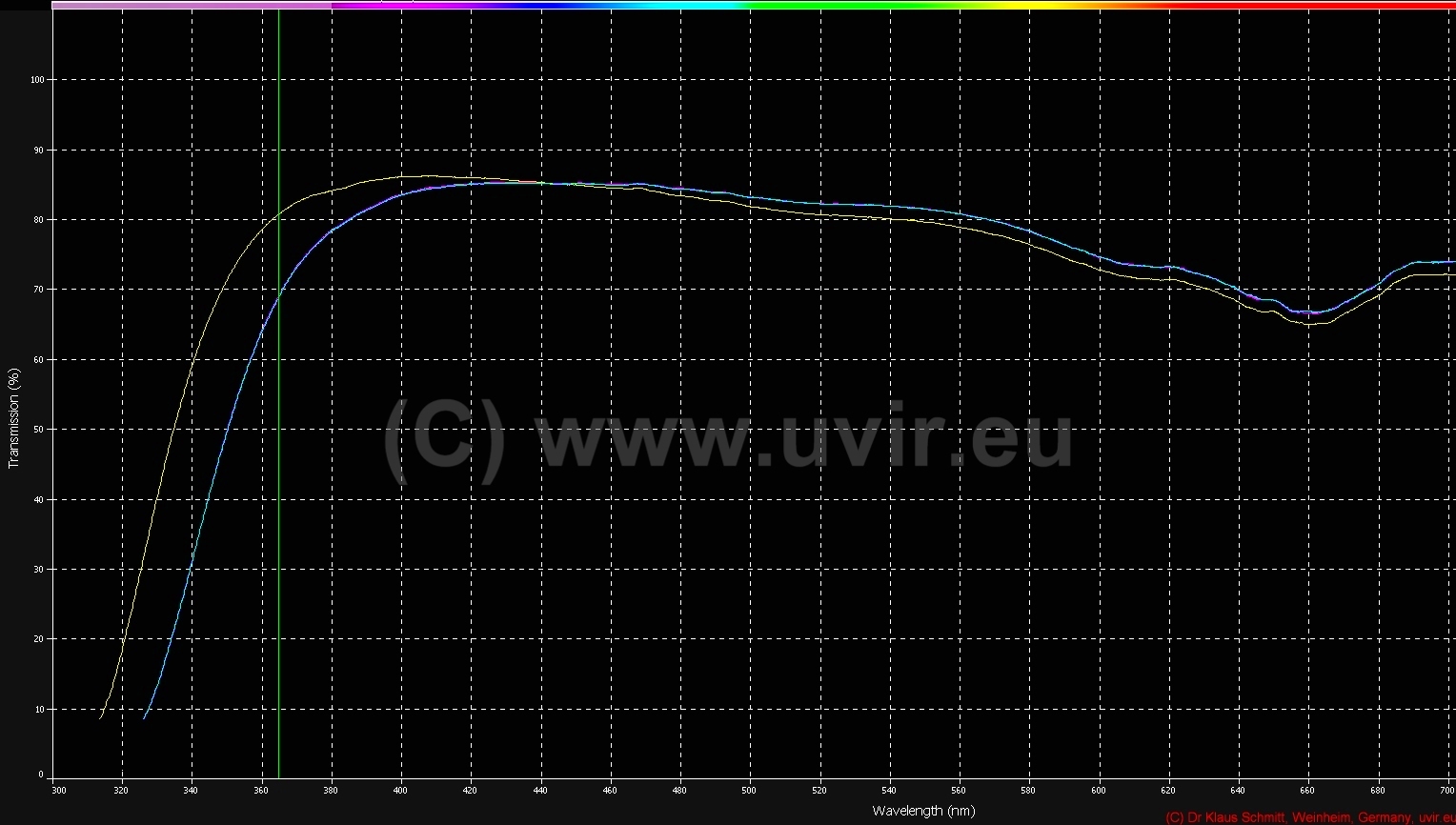
Petri Kuribayashi 35mm vs Kyoei Acall 180mm lens for reflected UV photography V

Today a spectrometric test using that previously mentioned Petri Kuribayashi f3.5/35mm lens, compared to a Kyoei Acall f3.5/180mm lens in M42 thread mount, as a proof that both actually have a very different lens transmission, especially in UV.

[click on image to see a larger one]


The Kuribayashi 35mm reaches much deeper into UV, even a bit below 320nm and shows a rather high UV at 365nm transmission of over 80%. However the Kyoei Acall f3.5/180mm tele lens seems to be a very different beast, as it has no useful at all UV transmission!

I have written about that lens before HERE

Stay tuned, more will follow on that fascinating subject...

More info on this very interesting field may be found on my site http://www.pbase.com/kds315/uv_photos
Petri Kuribayashi 35mm vs Kyoei W. Acall 35mm lens for reflected UV photography IV

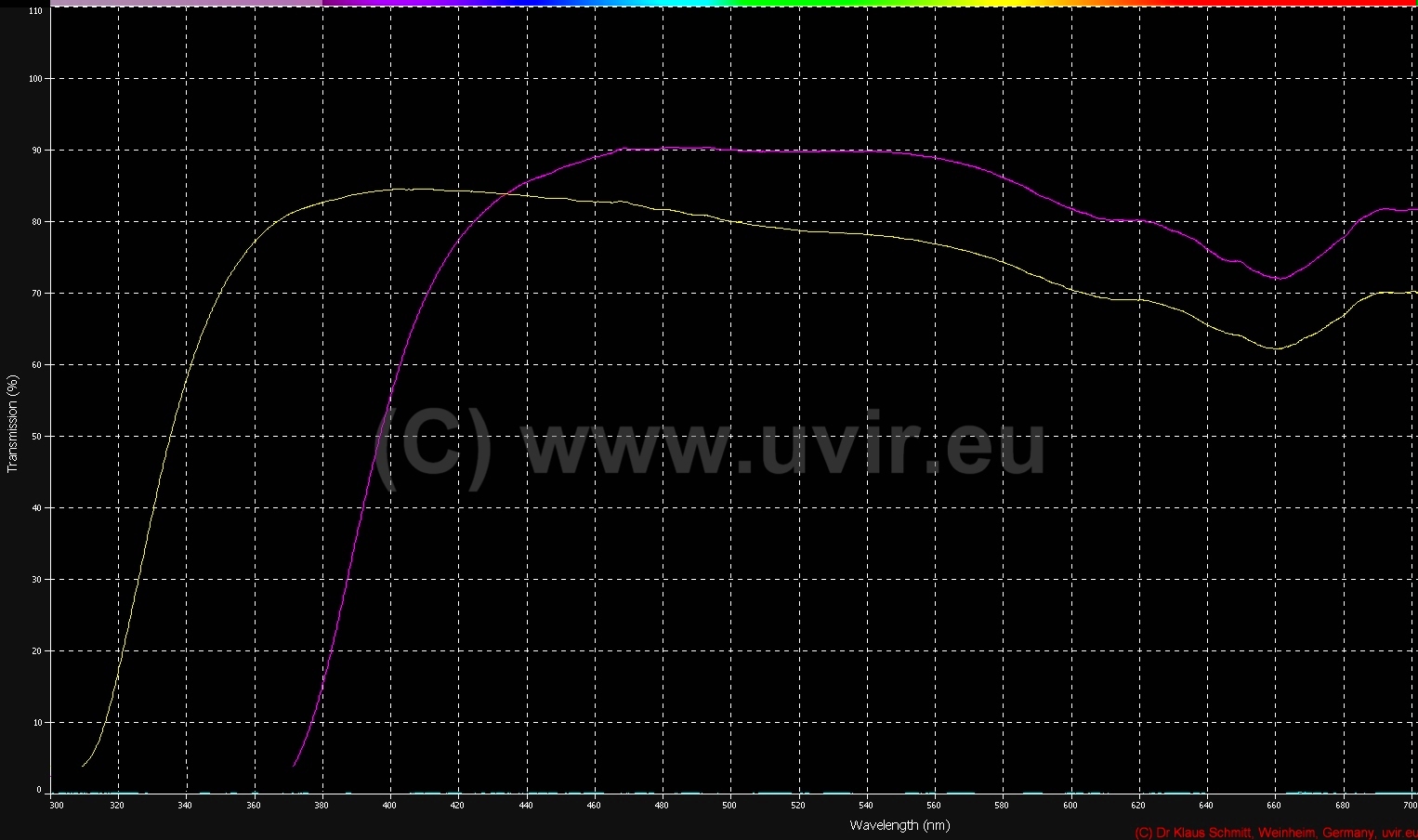
Today a spectrometric test using that previously mentioned Petri Kuribayashi f3.5/35mm lens, compared to the W. Acall f3.5/35mm lens in Leica Thread Mount (LTM), as a proof that both actually have a very different lens transmission, especially in UV.

[click on image to see a larger one]


The Kuribayashi 35mm reaches much deeper into UV, even a bit below 320nm and shows a rather high UV at 365nm transmission of over 80%. However the similar looking W. Acall 35mm seems to be a very different beast, as it has at 365nm only approx 5% UV transmission, so basically none useful at all!

I have written about that lens before HERE

Stay tuned, more will follow on that fascinating subject...

More info on this very interesting field may be found on my site http://www.pbase.com/kds315/uv_photos

Tuesday, March 12, 2013

Three 40mm lenses for reflected UV photography

Today about a comparison of three lenses of 40mm focal length for reflected UV, one a Cooke Triplet (C40), one a Dialyte design (D40), one a complex Sonnar design (S40) whose makers will be revealed here later - or simply contact me about it. The best of the three will also compared against the Kuribayashi 35mm. I'm using a yellow/red Phalaenopsis flower for that and my "work horse" UV filter, the Baader-U filter. Light source was an UV enhanced Xenon flash. All shots were done at f8 and are presented in a side-a-side format for easier comparison.

[click on image to see a larger one]

UV image using the Baader-U filter (approx. 320-395nm, effective peak approx. 375nm) - Cooke left, Dialyte middle, Sonnar right:
 

Here the three contestants present themselves side-a-side: It gets obvious, that the Sonnar is the softest of the three and has a bit less UV transmission (the latter had to be expected). The Cooke triplet lens and especially the Dialyte however show some respectable sharpness. So lets's have a closer look at the latter two.

UV image using the Baader-U filter - Cooke left, Dialyte right:
 

Here, the Dialyte has an edge over the Triplet, quite higher micro-contrast and higher detail reproduction, quite remarkable, considering it is an old prewar lens, and uncoated. So let's see how that Dialyte performs against the Kuribayashi 35mm.

UV image using the Baader-U filter - Dialyte lft, Kuribayashi 35mm right:
 

Here now it is hard to choose a winner, as both have very high sharpness and contrast, quite remarkable considering their age difference. I'm undicided honestly.

Transmission graph:
 

The Triplet is represented by a yellow line, the Dialyte by a reddish brown line, the Sonnar by a blue line and finally the Kuribayashi by a pink line. Transmisson of all lenses is quite high, at 365nm Sonnar: 60%, Dialyte: 64%, Triplet: 70% and finally the Kuribayashi 77%. Their reach into UV is quite remarkable, the Kuribayashi and Dialyte having the deepest, Triplet surprisingly the least, maybe caused by its bluish coating. So overall, some remarkable lenses for reflected UV.

Stay tuned, more will follow on that fascinating subject...

More info on this very interesting field may be found on my site http://www.pbase.com/kds315/uv_photos

Monday, February 25, 2013

Soligor 35mm vs Kuribayashi 35mm lens for reflected UV photography

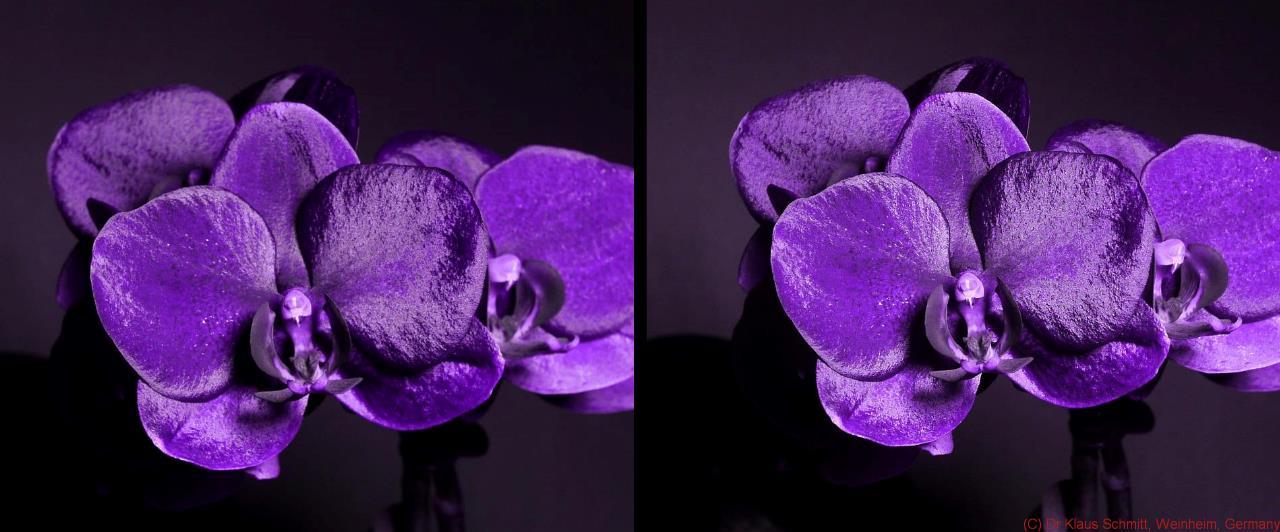
Today about the Soligor f3.5 / 35mm (older style) lens in comparison to the aforementioned Kuribayashi f3.5 / 35mm lens (also sold under the Petri brand name), a quite capable lens for reflected UV photography I have written about both lenses before here. I'm using a yellow/red Phalaenopsis flower for that and my "work horse" UV filter, the Baader-U filter plus the deeper reaching Jupiter-U filter. Light source was an UV enhanced Xenon flash. All shots done at f8 and presented on a side-a-side format for easier comparison, left the Soligor, right the Kuribayashi lens.

[click on image to see a larger one]

Visible light image:
 

UV image using Baader-U filter (approx. 320-395nm, effective peak approx. 375nm):
 

UV image using Jupiter-U filter (approx. 280-385nm, effective peak approx. 365nm):
 

SOLIGOR lens transmission:


As I have written before, the Kuribayashi 35mm lens is quite a useful one for UV, sharp and contrasty and only having a 1.03% focus shift. The Soligor 35mm shows 1.3% focus shift and also some other differences, like a needed 2/3 stop higher exposure, as its UV transmission is lower than the one of the Kuribayashi lens. In terms of sharpness they are about even, but the Kuribayashi has the higher contrast. So in total the Soligor 35mm is a useful lens, yet reaches not quite the Kuribayashi.


Stay tuned, more will follow on that fascinating subject...

More info on this very interesting field may be found on my site http://www.pbase.com/kds315/uv_photos
Saturday, July 28, 2012

Petri Kuribayashi 35mm vs CERCO quartz fluorite lens for reflected UV photography III

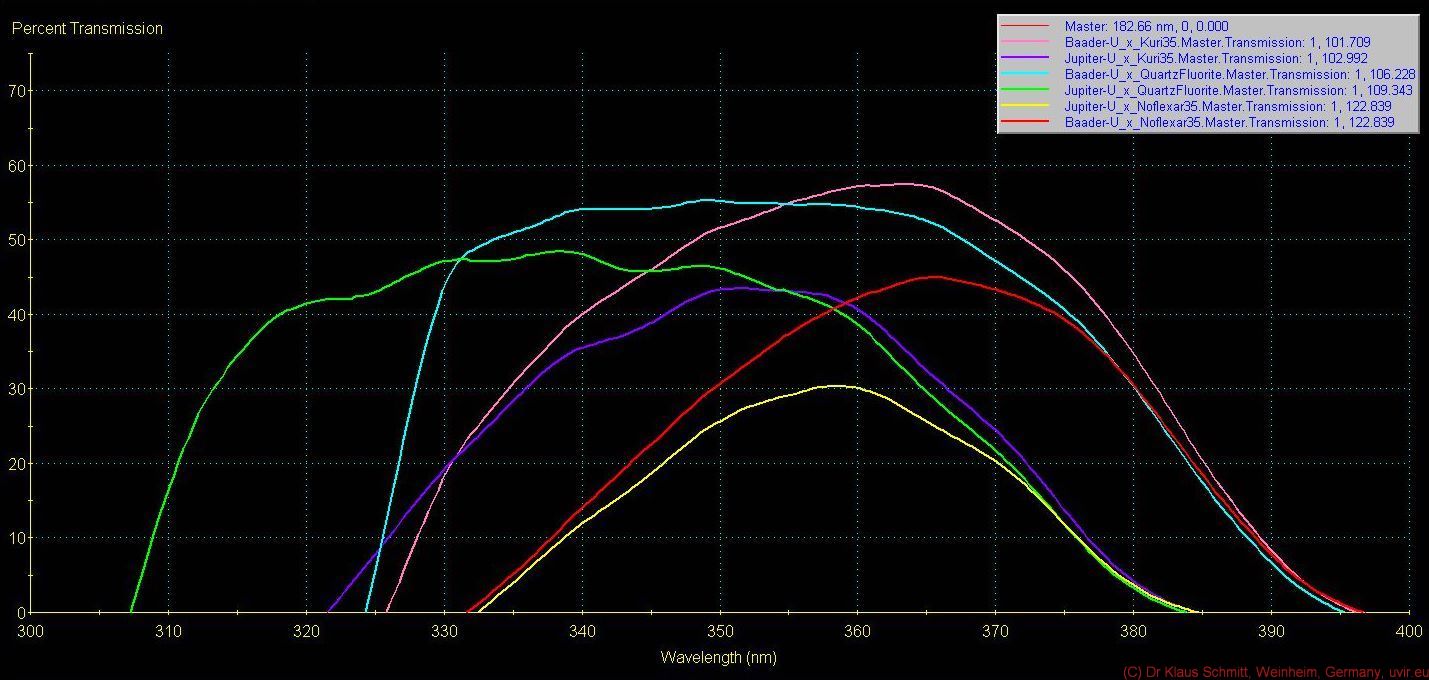
Here now a test using that previously mentioned Petri Kuribayashi f3.5/35mm lens when used with the standard UV transmission filter, the Baader-U as well as my shorter wave Jupiter-U filter, compared to the Noflexar f3.5/35mm lens, but now also in comparison to a quartz fluorite lens, here the CERCO f4.1/94mm.

[click on image to see a larger one]


The CERCO 94mm delivers a peak transmission of about 55% at 350nm when used with the Baader-U filter and about 48% at 338nm when using the Jupiter-U filter. That compared to the Kuri 35mm which has a peak transmission of about 58% at 362nm, wheras the Noflexar 35mm shows one of about 45% at 365nm when teh Baader-U filter is used. And when using the Jupiter-U filter, the Kuri 35mm has a peak transmission of about 43% at 350nm, wheras the Noflexar 35mm shows one of about 30% at 358nm.

So using the very same filters, the CERCO 94mm reaches much deeper into UV, which could have been expected, based on its flat UV transmission. However it is a much more expensive lens and quite hard to find, so the Kuri 35mm certainly is a welcome new find for the aspiring UV shooter, also considering that it virtually has no focus shift between UV and visible light.


Stay tuned, more will follow on that fascinating subject...

More info on this very interesting field may be found on my site http://www.pbase.com/kds315/uv_photos

Petri Kuribayashi f3.5/35mm lens for reflected UV photography II

Here now a test using that previously mentioned Petri Kuribayashi f3.5/35mm lens when used with the standard UV transmission filter, the Baader-U as well as my shorter wave Jupiter-U filter, compared to the Noflexar f3.5/35mm lens.

[click on image to see a larger one]


When using the Baader-U filter, the Kuri 35mm has a peak transmission of about 58% at 362nm, wheras the Noflexar 35mm shows one of about 45% at 365nm, that is a gain of about 0.4 stops for the Kuri 35mm.

When using the Jupiter-U filter, the Kuri 35mm has a peak transmission of about 43% at 350nm, wheras the Noflexar 35mm shows one of about 30% at 358nm, that is a gain of about 0.5 stops for the Kuri 35mm, based on its deeper reach into UV.

There is a part III about this lens HERE.

Stay tuned, more will follow on that fascinating subject...

More info on this very interesting field may be found on my site http://www.pbase.com/kds315/uv_photos

Petri Kuribayashi f3.5/35mm lens for reflected UV photography

Now this today was based on an information I got from a forum,  that the Petri Kuribayashi f3.5/35mm lens was very capable of working for reflected UV photography.

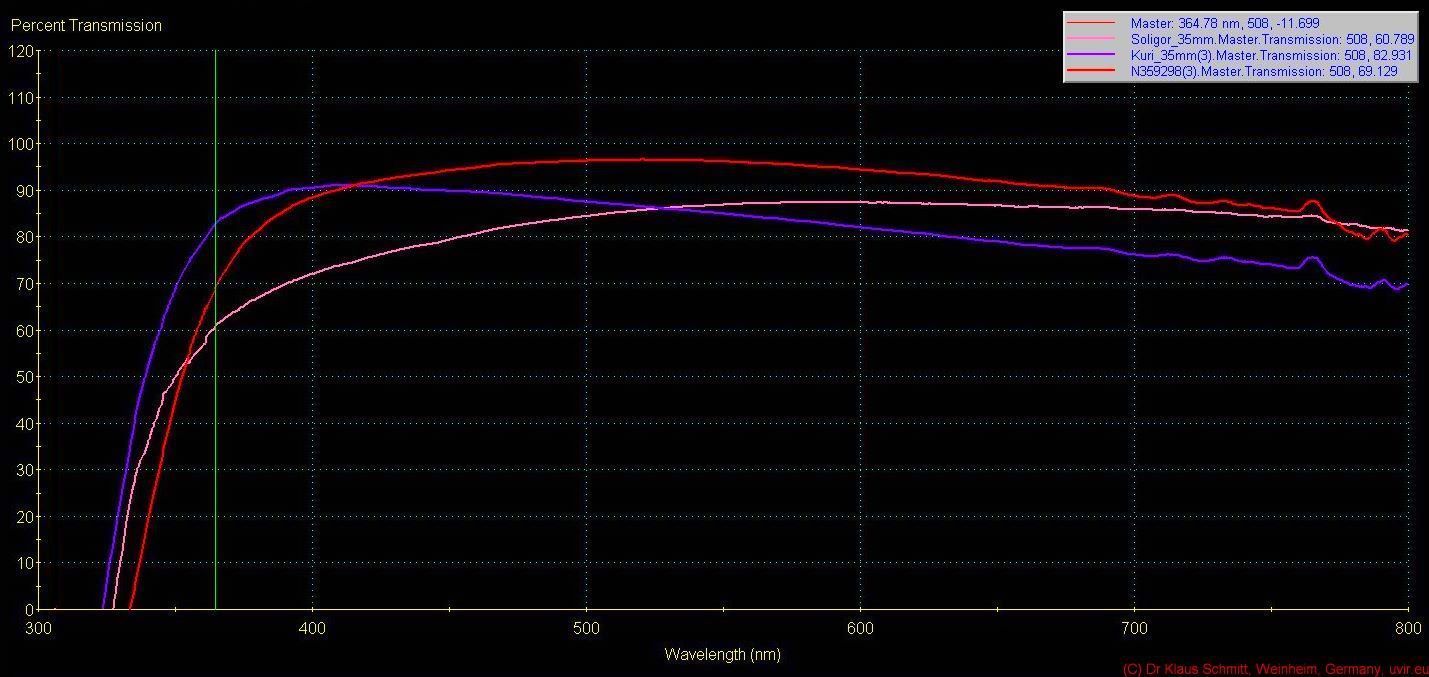
I tested that lens and it performed even better (pink line) than the well known Noflexar f3.5/35mm lens (red line), reaching down into UV to about 320nm. At 365nm it even has a 12% higher transmission (1/4 stop).

[click on image to see a larger one]


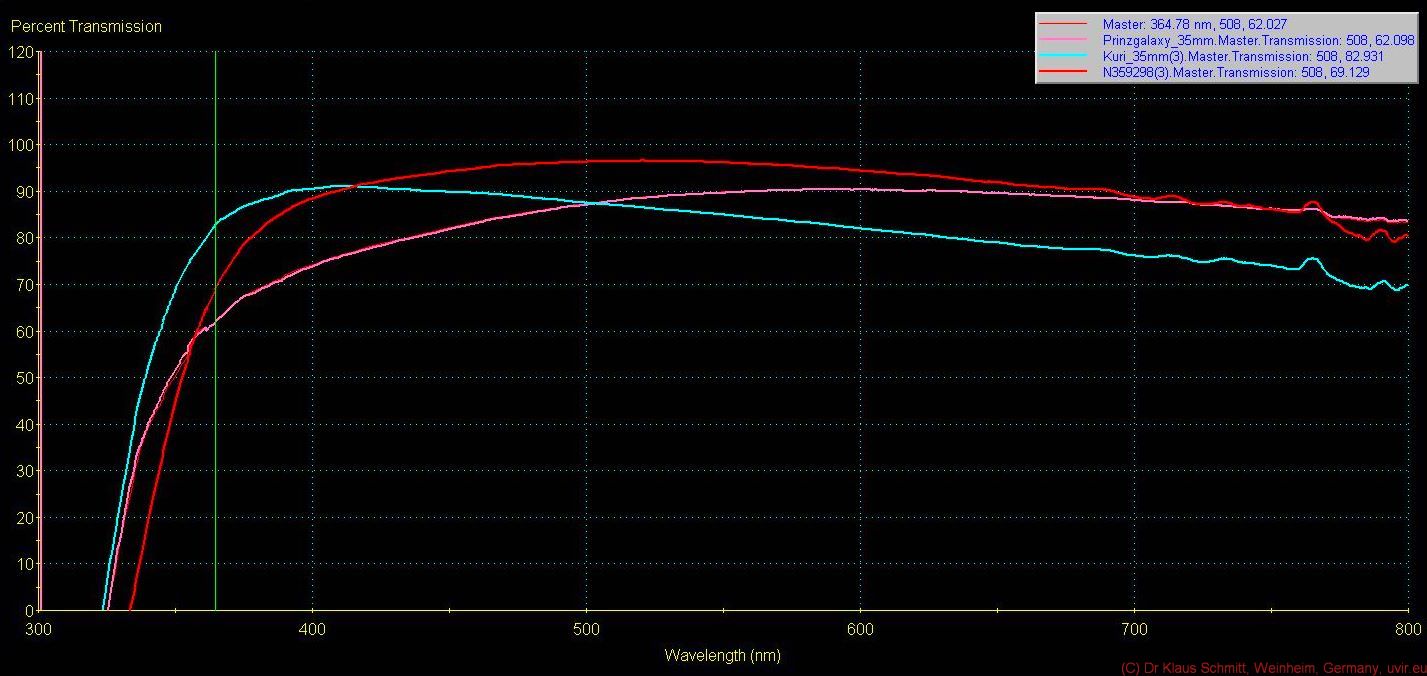
There are a few similar looking re-branded emanations of that Kuri lens, but with lesser performance, so be aware of that. These and a few other emanations of basically the same lens were not my finds, but Boon Tang and Alex Holovachov deserve the credit for those finds and bringing it to my attention. I'm not sure if later made models may have the same good transmittance, as the coating may have been changed to more modern ones that unfortunately suppress UV to pass (blue coating color is an indication for that). Here for instance the Prinzgalaxy f3.5/35mm in comparison, that shows a about 20% lower transmission at 365nm, but still useful (1/2 stop less):


And here one of SOLIGOR brand:


Here now a quick photographic test of that original Kuribayashi 35mm lens, which shows virtually no focus shift (1.03%), as well as very good sharpness and very good contrast in reflected UV using the Baader-U filter:


Here the visual shot for comparison:


The little downside that it only focuses to about one meter (3 ft) can be overcome by using a small helicoid or tube, if so needed. Here the Noflexar 35mm has an edge, as it has a built in close focus ability to about 1:2 (0.5x) magnification.

So this "zebra" barrel styled Kuribayashi lens from the 50ies / 60ies is a very welcomed new lens to the very few "normal" i.e. non quartz fluorite ones that does perform very well.

There is a part II about this lens HERE.

Photographic comparison between the Kuribayashi and the Soligor lens is HERE.


Stay tuned, more will follow on that fascinating subject...

More info on this very interesting field may be found on my site http://www.pbase.com/kds315/uv_photos