Showing posts with label white balance. Show all posts

Tuesday, May 12, 2020

About White Balancing and Spectralon (R) Standards

Quite a while ago I had written about white balancing reflected UV images. This meant to use a standardized white or grey standard to balance images, here "white" means that its reflection in visible light, but also in UV and ideally NIR is about the same. A very well know material for that is SPECTRALON (R) made by company Labsphere. It is "the" industry standard in laboratories and is used for spectrometry very often. It is made of specially prepared and cleansed Tetrafluorethylen  (PFTE) or TEFLON (R) powder. It is a rather pricey material. I had previously presented possibilities of cheaper acceptable options for photographic use HERE for instance using virgin white Teflon.

So today it is about what can happen to Spectralon standards, and which influence this may have.

I have used a Spectralon multi-step target, which consists of four zebra-striped panels of 99, 50, 25 and 12% reflectance which are mounted side-by-side.

[click on image to see a larger one]

Measured reflection of Labsphere SPECTRALON multi-step target (the white one was used as a 100% reference):
 
It gets obvious, that this multi-step standard still works very well and that the 99, 50, 25 and 12% reflectance values are still working.


Now in comparison a white Spectralon 99% target I bought, which may have been used for quite a while. As it did not look that great, I had sanded it down and cleaned it (light blue line approaching the 100% line):
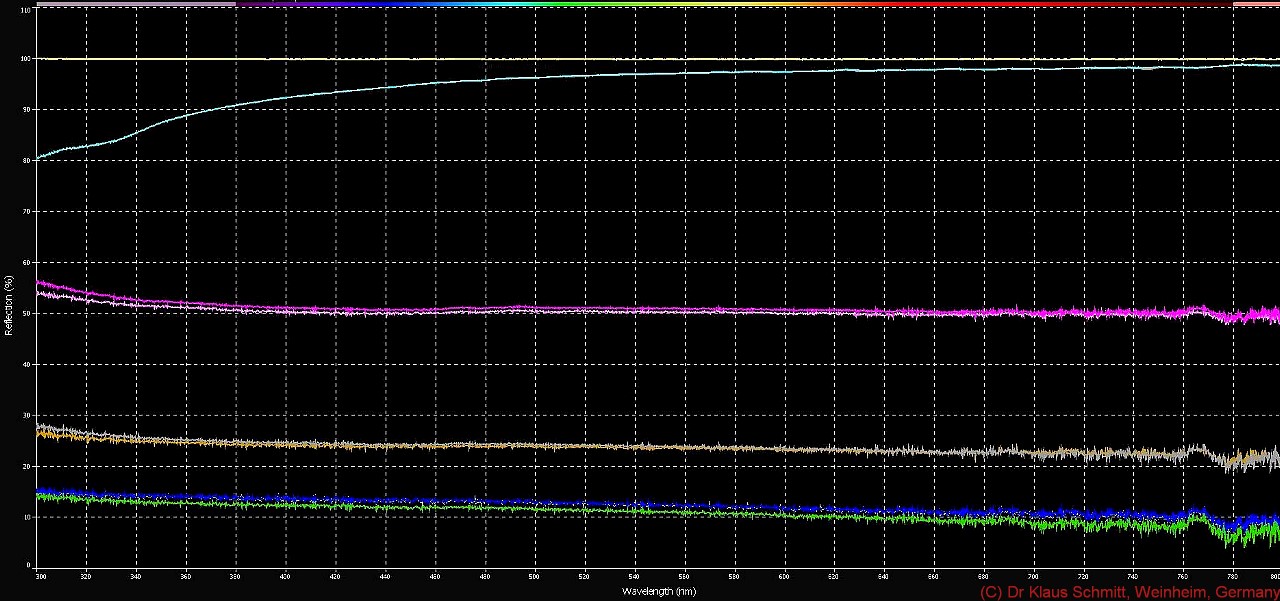
(double lines are repeated measurements using a different distance)


But it gets rather obvious now, that this used standard must have aged quite a bit or some substance had penetrated its once white surface, as it still looks a bit yellowish and the reflectance measuerement clearly shows that, especially in UV.

I may have to repeat the sanding down process, but this time I will have to take away much more from its surface, using clean sanding paper, ending with 240 and 480 grit, to keep it matted.

Never touch that surface with bare fingers, only rinse with clean alcohol and or purified water and let it dry, don't use pressured air as it often contains oil droplets.

Labsphere has some information on their products as well as about proper handling HERE.

I have written about white balancing before HERE

Stay tuned, more will follow on that fascinating subject...

More info on this very interesting field may be found on my site http://www.pbase.com/kds315/uv_photos

Monday, June 12, 2017

White balancing options: SPECTRALON (R) versus sintered PTFE versus virgin white PTFE / Teflon (R)

Today a spectrometric test of materials used for white balancing of reflected UV photography: SPECTRALON (R) calibrated reflection standard made and sold by company LABSPHERE, sintered porous PTFE (porous filter discs, as used in filters for chemical processes and medicine) and virgin white PTFE (white extruded industrial material for various purposes sold as plates, cut discs etc.) to see which of these materials would be suitable for the UV-VIS range of 300 - 700nm. Many years ago I had proposed to use virgin white Teflon (R) / PTFE as a cheap and easy to get material.

[click on image to see a larger one]


The 100% (green, hard to see) line is the reflection of the SPECTRALON (R) reflection standart as sold by LABSPHERE and is used as a refence. The yellow line indicates the reflection of some seemingly sintered PTFE, now sold as white balance filter mounted into filters rings (52mm in this case), originally made and sold as 50mm porous filter material for chemical and medical purposes. This latter material reflects rather evenly between 80-83%. The virgin PTFE in comparision has a more uneven reflection of 72-75% (>320nm), down to 68% below 320nm. For amateur photographic purposes the two cheaper materials provide sufficient evenness, with an edge in favour of the sintered PTFE. For professional applications, both are however no alternative to the industry standard SPECTRALON (R) which shows outstanding evenness.

Remark: all such materials are extremely sensitive to dirt, fingerprints etc. which reduces the UV reflection massively, so have to be kept clean at all times and need to be cleaned asap if so contaminated. Best to clean is to brush with purified water, a detergent and ethanol, then rinse with purified water, then let dry in a dust and lint free environment or dry with pressured clean air.

Stay tuned, more will follow on that fascinating subject...

More info on this very interesting field may be found on my site http://www.pbase.com/kds315/uv_photos

Thursday, July 7, 2011

Wednesday, July 6, 2011

[UV] whitebalancing using a 35mm wide angle lens for UV

Today I made some experiments using wide(r) angle lenses for shooting reflected UV using my UV sensitive camera.

I had previously written about proper whitebalancing to reach a standardized false color UV palette using a true apochromatically corrected UV lens and also about doing that for other wide angle lenses. Now I wanted to reach about the same "colors" using such a lens which transmits much less UV, in that case here a 35mm c-mount lens.

[click on images to see larger ones]

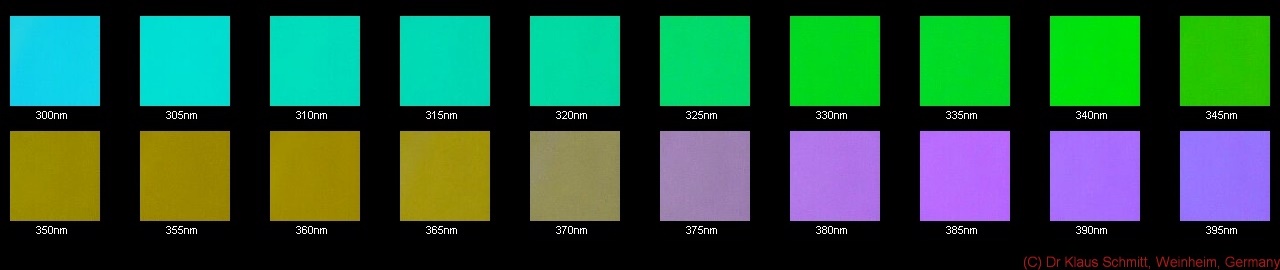
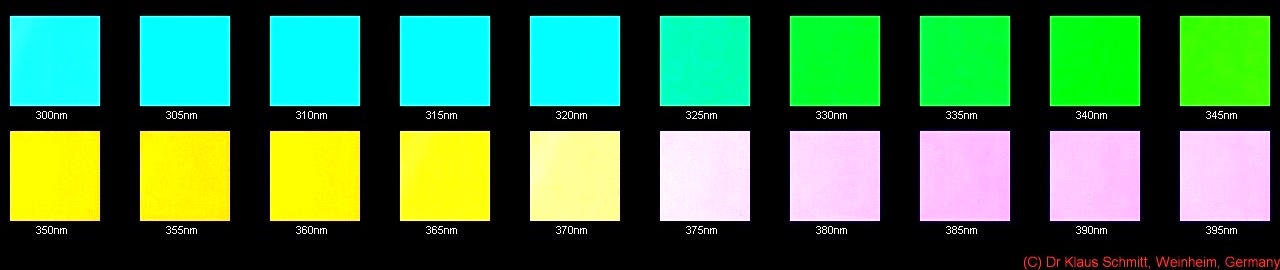
Standardized reflected false UV "colors" according to the previously described "UV color palette" related to wavelength.

The normal and high intensity palette:


The reflected UV images show a Rudbeckia hirta flower. Left the result before applying my whitebalancing procedure; on teh right after whitebalancing using my ReflectionDisc (and some special in-camera tweaking):

[the colors on the left image are NOT according to the standardized palette!]

Well, as you can see, about the same colors could be reached on the right image, still a little different, as some parts of the spectrum are missing (the shorter wave UV-A sub-bands more specifically, so there is no green as that lens only transmits to about 350nm). Still it gets evident that this Rudbeckia flower has a UV reflection from its petal tips of around 360nm.

Stay tuned, more will follow on that fascinating subject...

More info on this very interesting field may be found on my site http://www.pbase.com/kds315/uv_photos
Monday, June 6, 2011

[UV] on wide angle lens whitebalance using a GH1-UVIR

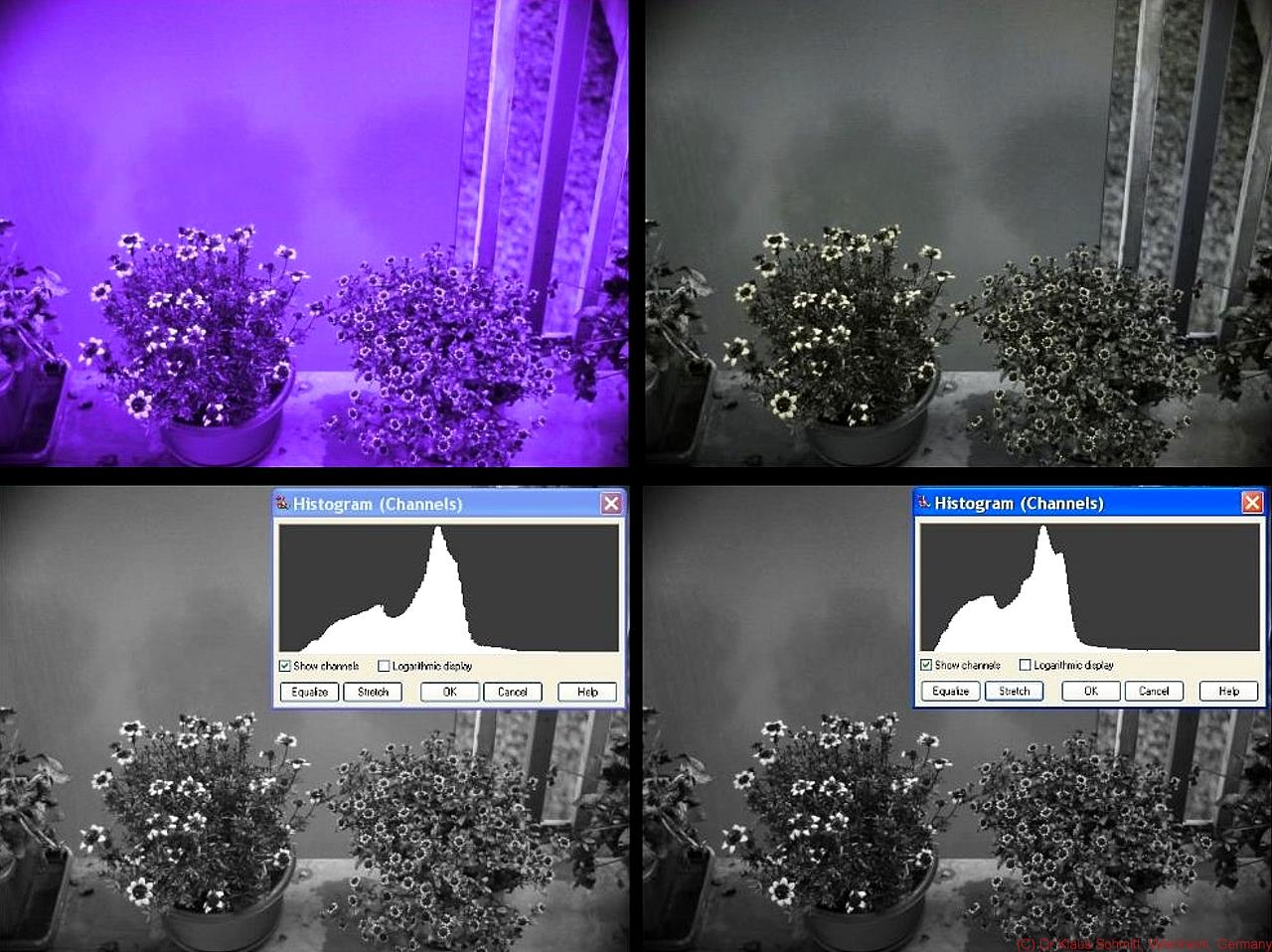
In previous posts on whitebalancing using my ReflectionDisc I warned about generalizing results and stated that it is only valid for that camera, that lens, that filter and that lighting situation. Well, I was curious, how much would change if two parameters were changed: a) using a wide angle lens (with substantial less UV transmission), b) lighting situation
So, using my GH1-UVIR, a Cerco 94mm lens, Baader-U filter and sunlight, I had preset a whitebalance for a similarely lit situation using my Reflection Disc, call that WB1 for now.

The weather today was very overcast and no sun, just about 250 microWatt/cm² UV-A (as measured using a calibrated Minolta UV-A meter).
The lens was changed, from a color corrected, flat transmitting (<300nm) quartz / fluorite lens to a non-color corrected not that much UV transmitting conventional wide angle lens, a 2.8/28mm in that case, which barely reaches about 350nm, to see which impact that would have. A set WB was done for that 28mm wide angle lens, call that WB2.
So what we see here is:
1) top left: previously set sunlight WB used (WB1)
2) top right: correct WB for that lighting situation set (WB2)
3) bottom left: previously set sunlight WB used (WB1), bw version with histogram
4) bottom right: correct WB for that lighting situation set (WB2); bw version with histogram
[click on image to see a larger one]


Here now quite some difference in whitebalancing may be noted; the preset WB1 was quite different from the correct WB2 for that lens (and lighting situation). Major impact had the lens change, not the changed lighting. As may be seen on the histogram, the correctly whitebalanced image is about 1/4 - 1/3 stop less exposed than the incorrectly one (both images were identically exposed at 1/1.6sec, same ISO) , so consequently using the correct WB at shooting time would require a somewhat higher exposure.

SUMMARY: UV whitebalance, for lenses having very different spectral (UV-) transmission, should be correctly set at exposure, not later in post processing and properly exposed (a tad more).
P.S.: I have tested at different exposure values (higher + lower) but the principal result remained the same.


Stay tuned, more will follow on that fascinating subject...

More info on this very interesting field may be found on my site http://www.pbase.com/kds315/uv_photos
Sunday, June 5, 2011

[UV] on whitebalance tolerance using a GH1-UVIR

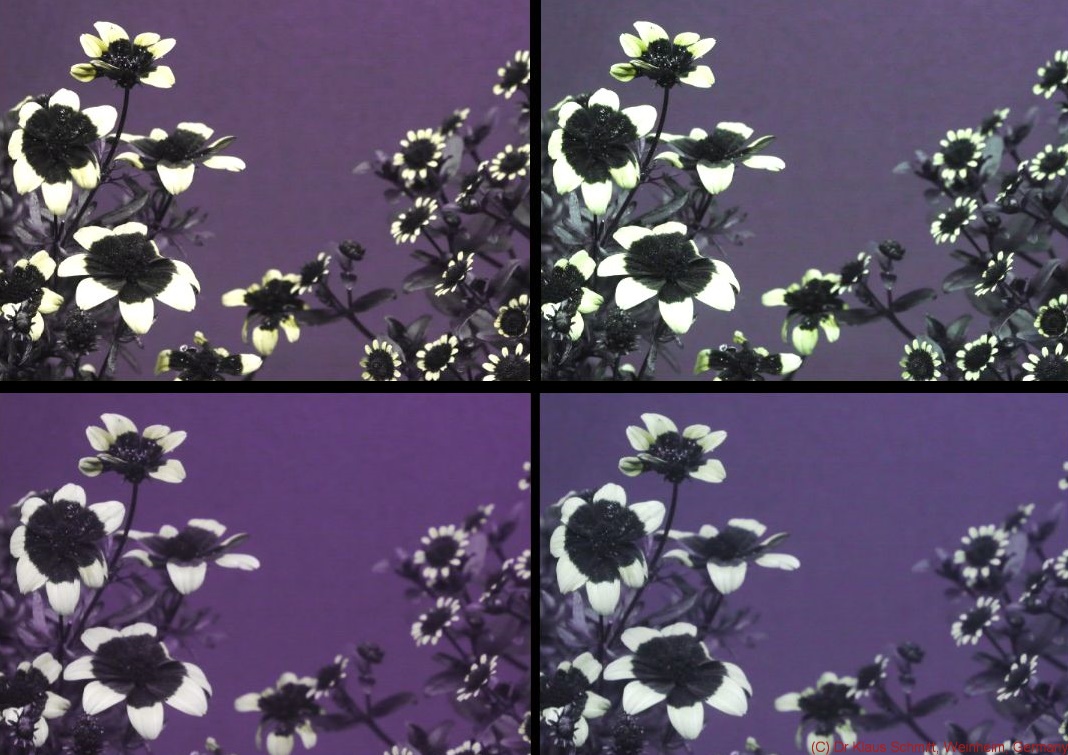
In previous posts on whitebalancing using my ReflectionDisc I warned about generalizing results and stated that it is only valid for that camera, that lens, that filter and that lighting situation. Well, I was curious, how much would change if two parameters were changed: a) lens in use, b) lighting situation

So, using my GH1-UVIR, a Cerco 94mm lens, Baader-U filter and sunlight, I had preset a whitebalance for that situation using my Reflection Disc, call that WB1 for now.

The weather today was different, quite well lit, but overcast and no sun. A set WB was done, call that WB2.
Also the lens was changed, form a color corrected, flat transmitting (<300nm) quartz / fluorite lens to a non-color corrected suitably UV transmitting conventional enlarger lens, which reaches about 350nm, to see which impact that would have. So what we see here is:
1) top left: Cerco 94mm lens, correct WB for that lighting situation set (WB2)
2) top right: Cerco 94mm lens, previously set sunlight WB used (WB1)
3) bottom left: 95mm enlarger lens, correct WB for that lighting situation set (WB2)
4) bottom right: 95mm enlarger lens, previously set sunlight WB used (WB1)
[click on image to see a larger one]


Interesting to note, that only the blue and red channels are shifted just a bit, which can easily be corrected afterwards in post processing, but the image out of the camera is still quite close to the "correct" one.

That's important if you're out in the field and the lighting situation changes and / or different lenses are used (as long as they are suitably UV transmitting; this may not work for white angle lenses having hardly any UV transmission). For critical scientific work I would of course always do proper whitebalancing upfront.

SUMMARY: UV whitebalance, once correctly set, works suitably well also under changed situations (light, lens)


Stay tuned, more will follow on that fascinating subject...

More info on this very interesting field may be found on my site http://www.pbase.com/kds315/uv_photos

Saturday, June 4, 2011

Saturday, May 21, 2011

[UV, VIS, NIR] WhiteBalancing options

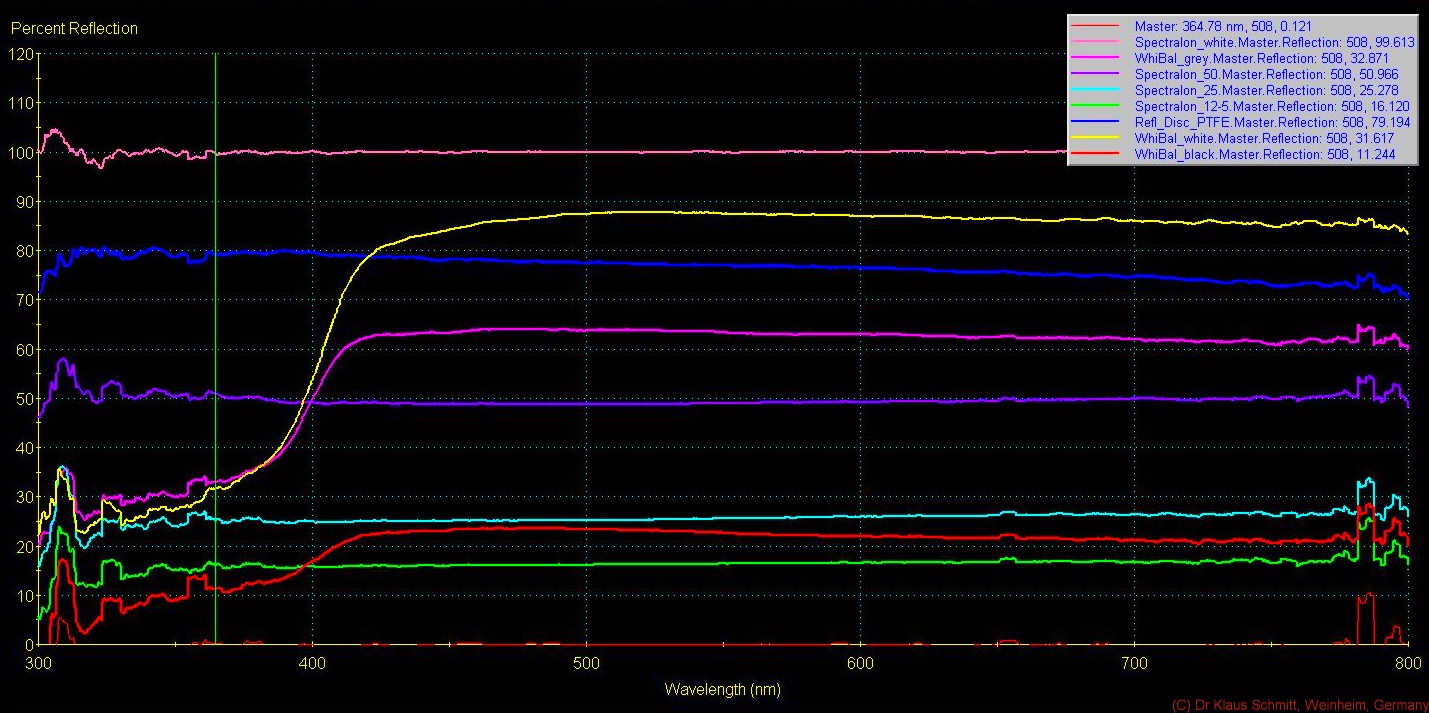
Well, I had presented my Reflection Disc solution, which had been tested against (R) Spectralon when a forum member came up with the remark, that there are commercially available gray cards available, claiming to also work equally well in UV. So of course I got one and run tests against the industry standard (R) Spectralon as well as against my Reflection Disc (approx 75% reflection). That WhiBal Card has a white, a black area also, as well as a large gray area - all have been measured.

Long story short, here are the results.

[click on image to see a larger one]


SPECTRALON (100=rose, 50=violet, 25=teal, 12.5%=green); ReflectionDisc=blue, Whibal Card (white = yellow, gray=pink, black=red)

[confidence area: approx. 360 - 775nm]

SUMMARY:

That WhiBal card is certainly useful for VIS + NIR, but not for UV.

The ReflectionDisc certainly is not perfect, but works quite well in practice and delivers jpgs directly out of the camera with acceptable whitebalance for UV, VIS and NIR, also for a quick exposure check.

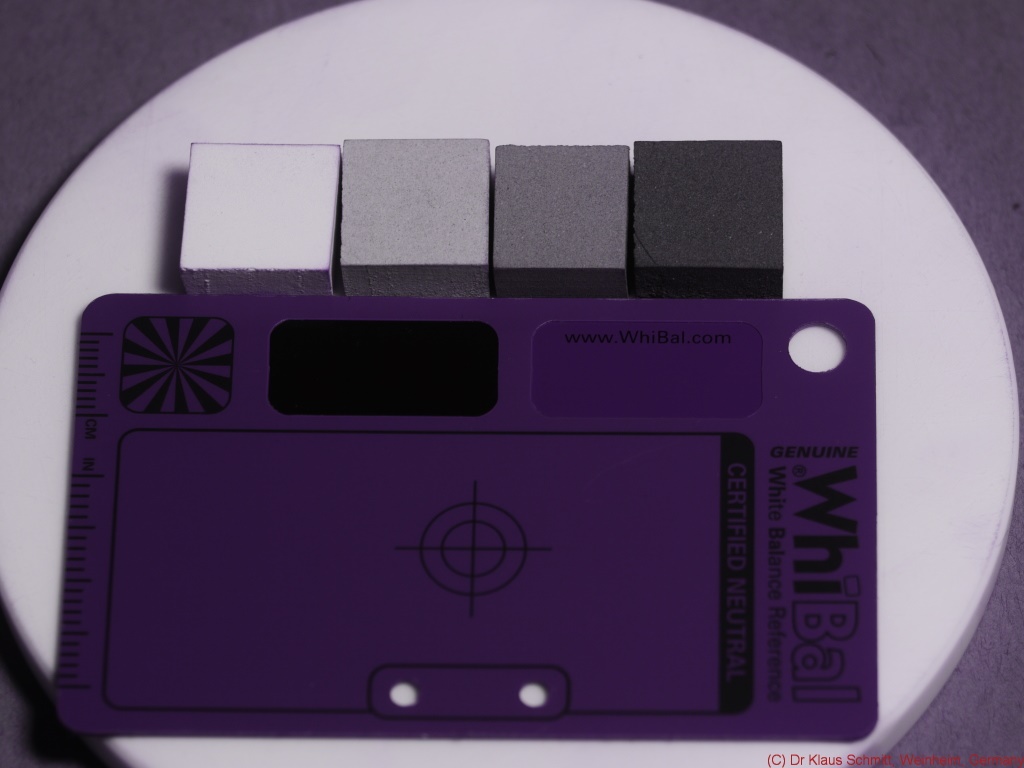
Here the photographic proof of the above - reflected UV using Baader-U filter and Xenon flash.


The card should be "white" or light gray, which it isn't. The cubes are Spectralon laying on my ReflectivityDisc.

It does work well in NIR though - here the card appears gray as it should be.


The cubes are Spectralon and my ReflectivityDisc stay the same color.


Stay tuned, more will follow on that fascinating subject...

More info on this very interesting field may be found on my site http://www.pbase.com/kds315/uv_photos