Showing posts with label Noflexar. Show all posts

Thursday, April 6, 2017

Petri Kuribayashi 35mm vs Kyoei W. Acall 35mm lens for reflected UV photography IV

Today a spectrometric test using that previously mentioned Petri Kuribayashi f3.5/35mm lens, compared to the W. Acall f3.5/35mm lens in Leica Thread Mount (LTM), as a proof that both actually have a very different lens transmission, especially in UV.

[click on image to see a larger one]


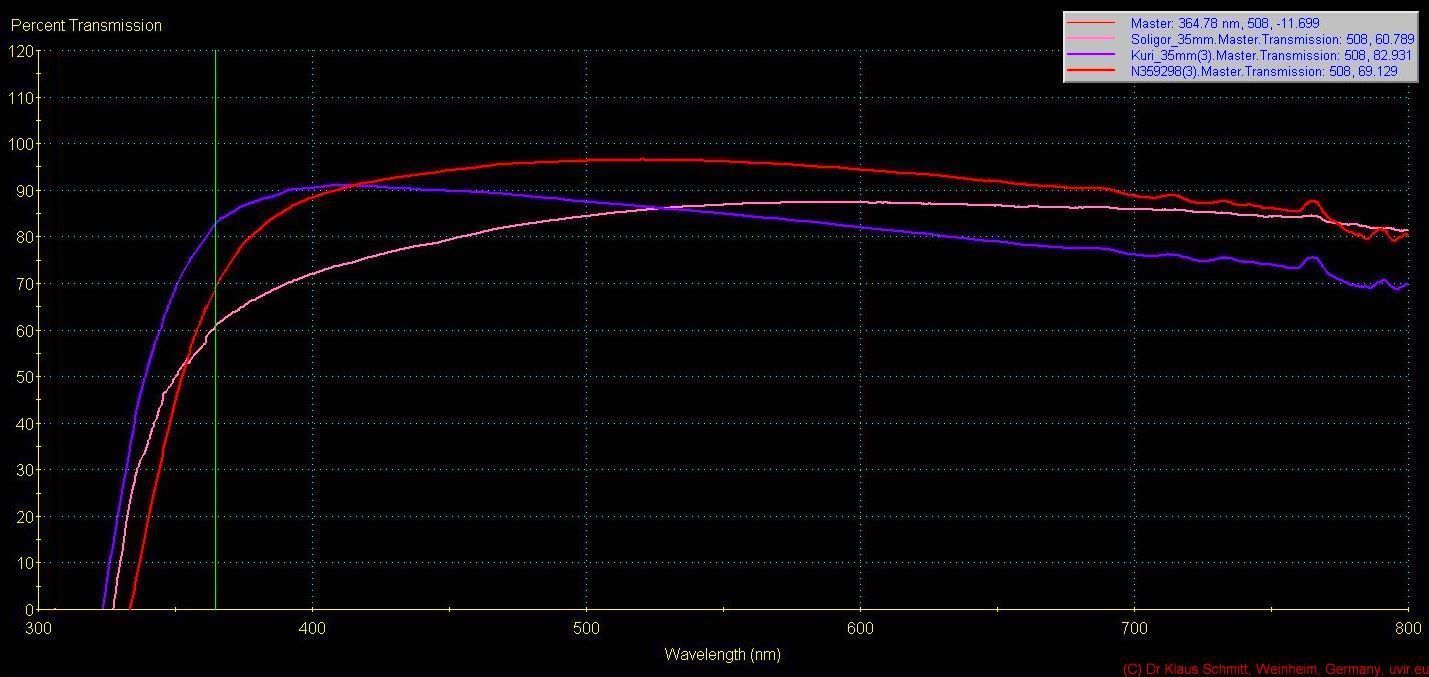
The Kuribayashi 35mm reaches much deeper into UV, even a bit below 320nm and shows a rather high UV at 365nm transmission of over 80%. However the similar looking W. Acall 35mm seems to be a very different beast, as it has at 365nm only approx 5% UV transmission, so basically none useful at all!

I have written about that lens before HERE

Stay tuned, more will follow on that fascinating subject...

More info on this very interesting field may be found on my site http://www.pbase.com/kds315/uv_photos

Friday, September 27, 2013

Orange coneflower - Rudbeckia fulgida in reflected ultraviolet photography and simulated bee vision VIII

Today more shots of that decorative flower Orange coneflower - Rudbeckia fulgida in reflected ultraviolet using Baader-U filter and in simulated bee vision using my XBV6 filter. Lens used was the now well known Novoflex Noflexar f3.5/35mm lens. Light source was Xenon flash. All shots were done at f8.

[click on image to see a larger one]

Visible light image:  

UV image using Baader-U filter (approx. 320-395nm, effective peak approx. 375nm):  

Simulated bee vision image using experimental XBV filter:  

Triptych of the above images:  


This attractive flower shows its very specific UV pattern, its petals have an UV dark pattern, invisible to us humans. This lens is a well known performer, also in UV and transmits up to approx. 330nm, is quite sharp and has virtually no focus shift, quite enough to make the UV pattern clearly visible.

I have previously written about this lens HERE and about that R. fulgida flower HERE.

Stay tuned, more will follow on that fascinating subject...

Monday, February 25, 2013

Soligor 35mm vs Kuribayashi 35mm lens for reflected UV photography

Today about the Soligor f3.5 / 35mm (older style) lens in comparison to the aforementioned Kuribayashi f3.5 / 35mm lens (also sold under the Petri brand name), a quite capable lens for reflected UV photography I have written about both lenses before here. I'm using a yellow/red Phalaenopsis flower for that and my "work horse" UV filter, the Baader-U filter plus the deeper reaching Jupiter-U filter. Light source was an UV enhanced Xenon flash. All shots done at f8 and presented on a side-a-side format for easier comparison, left the Soligor, right the Kuribayashi lens.

[click on image to see a larger one]

Visible light image:
 

UV image using Baader-U filter (approx. 320-395nm, effective peak approx. 375nm):
 

UV image using Jupiter-U filter (approx. 280-385nm, effective peak approx. 365nm):
 

SOLIGOR lens transmission:


As I have written before, the Kuribayashi 35mm lens is quite a useful one for UV, sharp and contrasty and only having a 1.03% focus shift. The Soligor 35mm shows 1.3% focus shift and also some other differences, like a needed 2/3 stop higher exposure, as its UV transmission is lower than the one of the Kuribayashi lens. In terms of sharpness they are about even, but the Kuribayashi has the higher contrast. So in total the Soligor 35mm is a useful lens, yet reaches not quite the Kuribayashi.


Stay tuned, more will follow on that fascinating subject...

More info on this very interesting field may be found on my site http://www.pbase.com/kds315/uv_photos

Saturday, July 28, 2012

Petri Kuribayashi 35mm vs CERCO quartz fluorite lens for reflected UV photography III

Here now a test using that previously mentioned Petri Kuribayashi f3.5/35mm lens when used with the standard UV transmission filter, the Baader-U as well as my shorter wave Jupiter-U filter, compared to the Noflexar f3.5/35mm lens, but now also in comparison to a quartz fluorite lens, here the CERCO f4.1/94mm.

[click on image to see a larger one]


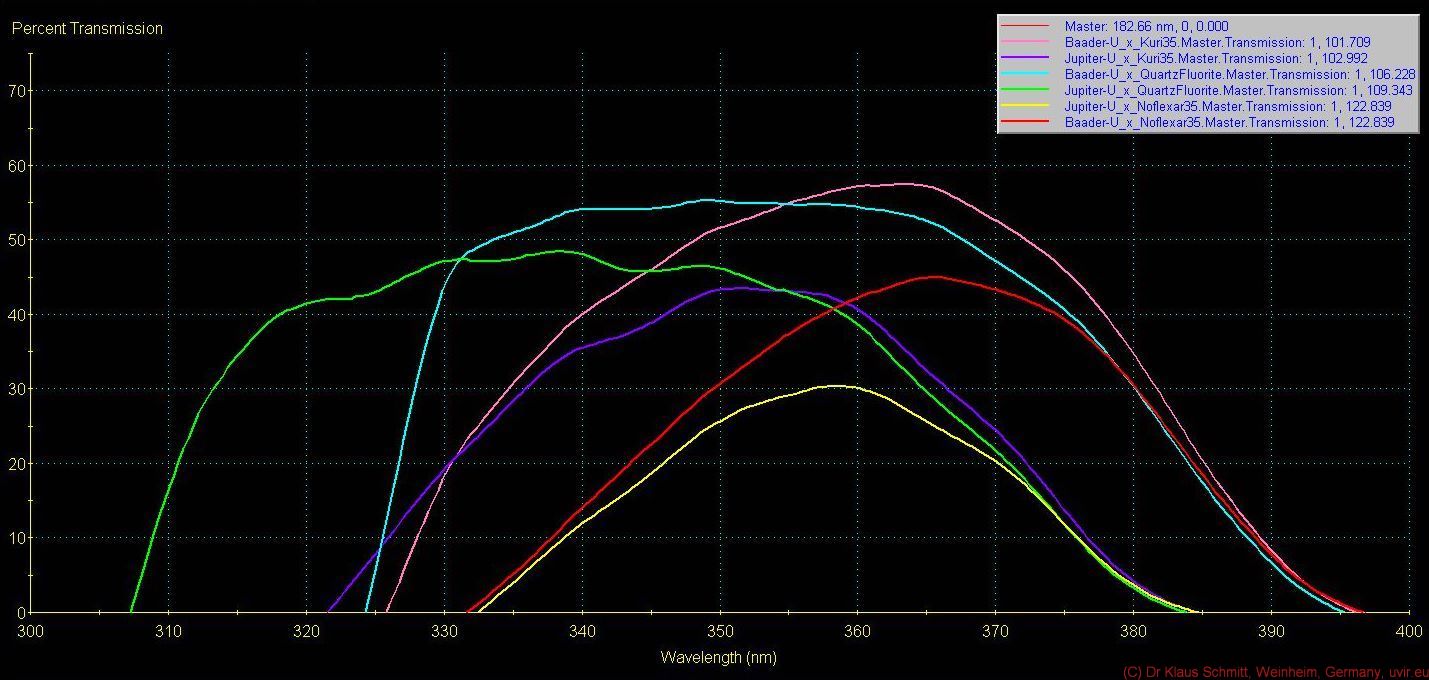
The CERCO 94mm delivers a peak transmission of about 55% at 350nm when used with the Baader-U filter and about 48% at 338nm when using the Jupiter-U filter. That compared to the Kuri 35mm which has a peak transmission of about 58% at 362nm, wheras the Noflexar 35mm shows one of about 45% at 365nm when teh Baader-U filter is used. And when using the Jupiter-U filter, the Kuri 35mm has a peak transmission of about 43% at 350nm, wheras the Noflexar 35mm shows one of about 30% at 358nm.

So using the very same filters, the CERCO 94mm reaches much deeper into UV, which could have been expected, based on its flat UV transmission. However it is a much more expensive lens and quite hard to find, so the Kuri 35mm certainly is a welcome new find for the aspiring UV shooter, also considering that it virtually has no focus shift between UV and visible light.


Stay tuned, more will follow on that fascinating subject...

More info on this very interesting field may be found on my site http://www.pbase.com/kds315/uv_photos

Petri Kuribayashi f3.5/35mm lens for reflected UV photography

Now this today was based on an information I got from a forum,  that the Petri Kuribayashi f3.5/35mm lens was very capable of working for reflected UV photography.

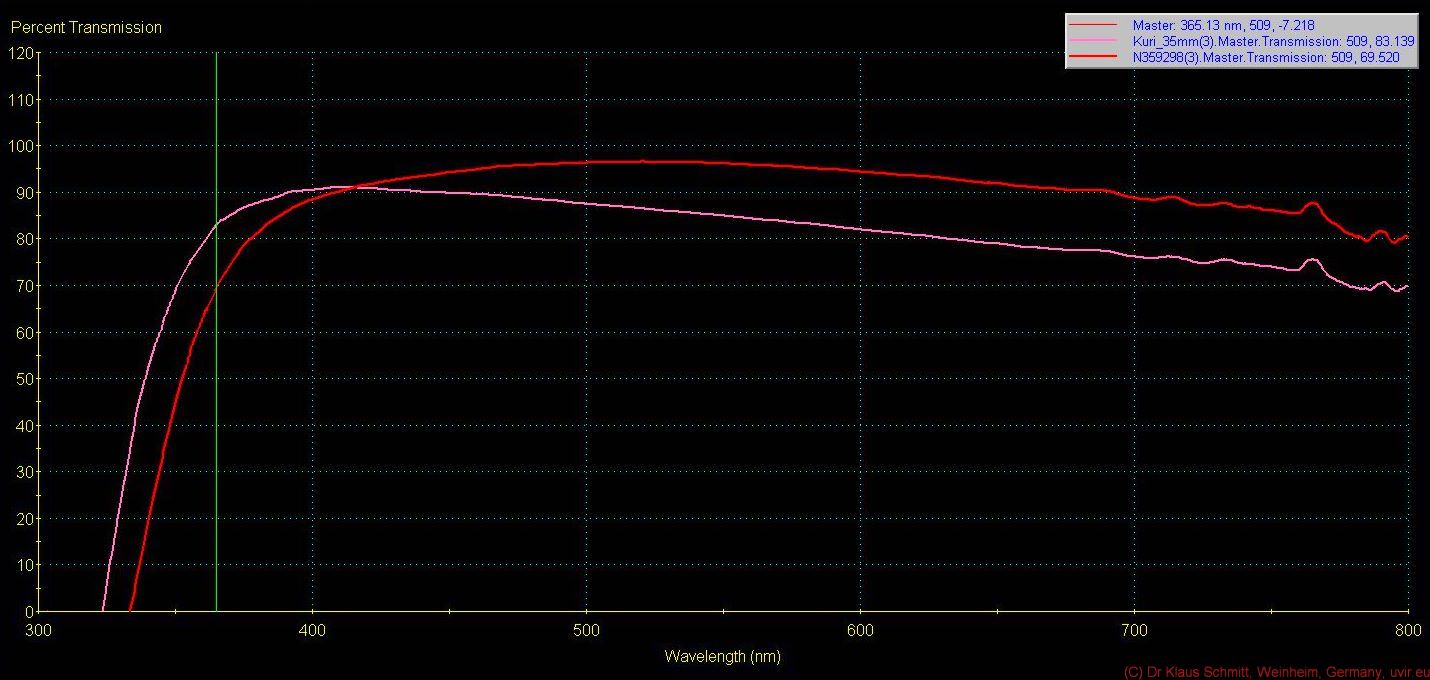
I tested that lens and it performed even better (pink line) than the well known Noflexar f3.5/35mm lens (red line), reaching down into UV to about 320nm. At 365nm it even has a 12% higher transmission (1/4 stop).

[click on image to see a larger one]


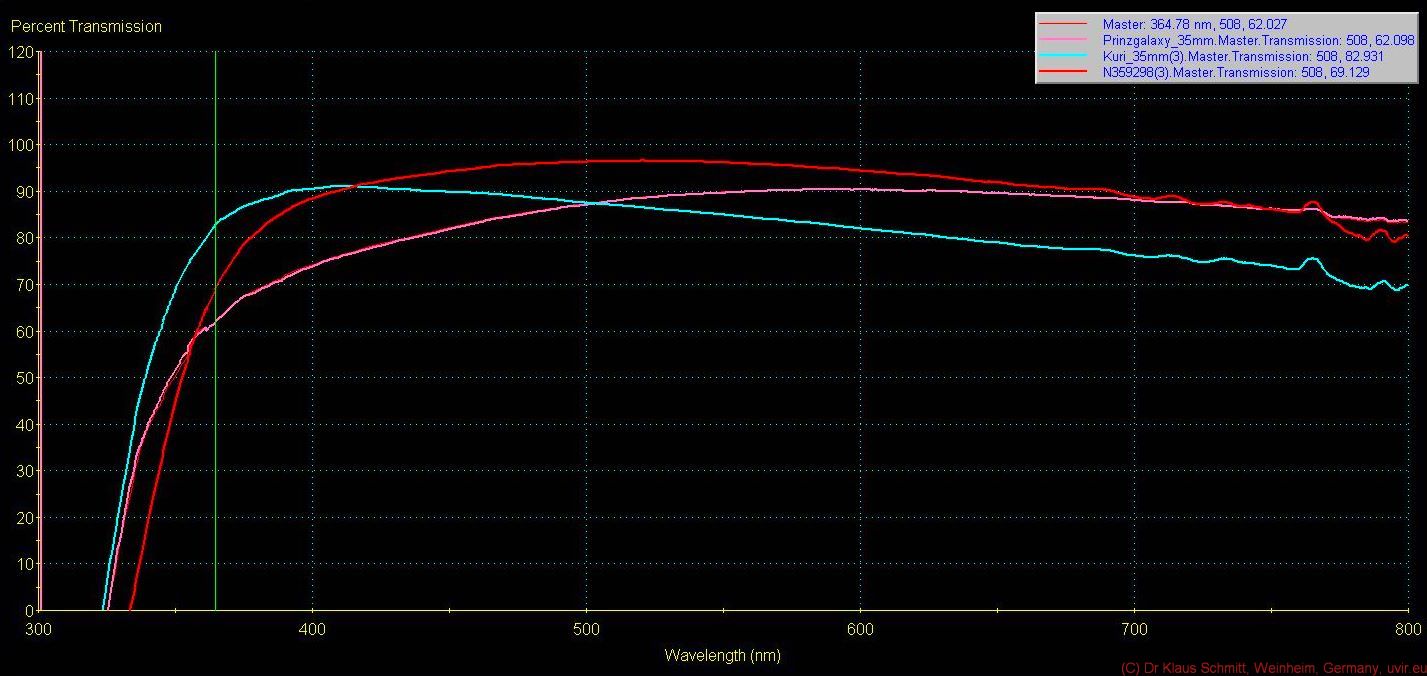
There are a few similar looking re-branded emanations of that Kuri lens, but with lesser performance, so be aware of that. These and a few other emanations of basically the same lens were not my finds, but Boon Tang and Alex Holovachov deserve the credit for those finds and bringing it to my attention. I'm not sure if later made models may have the same good transmittance, as the coating may have been changed to more modern ones that unfortunately suppress UV to pass (blue coating color is an indication for that). Here for instance the Prinzgalaxy f3.5/35mm in comparison, that shows a about 20% lower transmission at 365nm, but still useful (1/2 stop less):


And here one of SOLIGOR brand:


Here now a quick photographic test of that original Kuribayashi 35mm lens, which shows virtually no focus shift (1.03%), as well as very good sharpness and very good contrast in reflected UV using the Baader-U filter:


Here the visual shot for comparison:


The little downside that it only focuses to about one meter (3 ft) can be overcome by using a small helicoid or tube, if so needed. Here the Noflexar 35mm has an edge, as it has a built in close focus ability to about 1:2 (0.5x) magnification.

So this "zebra" barrel styled Kuribayashi lens from the 50ies / 60ies is a very welcomed new lens to the very few "normal" i.e. non quartz fluorite ones that does perform very well.

There is a part II about this lens HERE.

Photographic comparison between the Kuribayashi and the Soligor lens is HERE.


Stay tuned, more will follow on that fascinating subject...

More info on this very interesting field may be found on my site http://www.pbase.com/kds315/uv_photos

Tuesday, March 20, 2012

[UV] Noflexar 35mm with Focal Reducer for Ultraviolet Photography

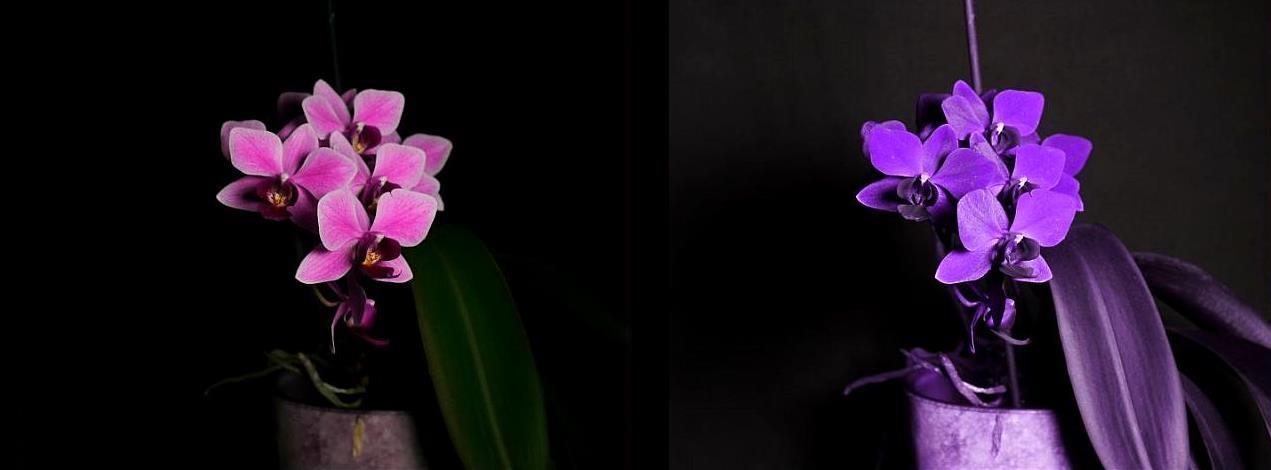
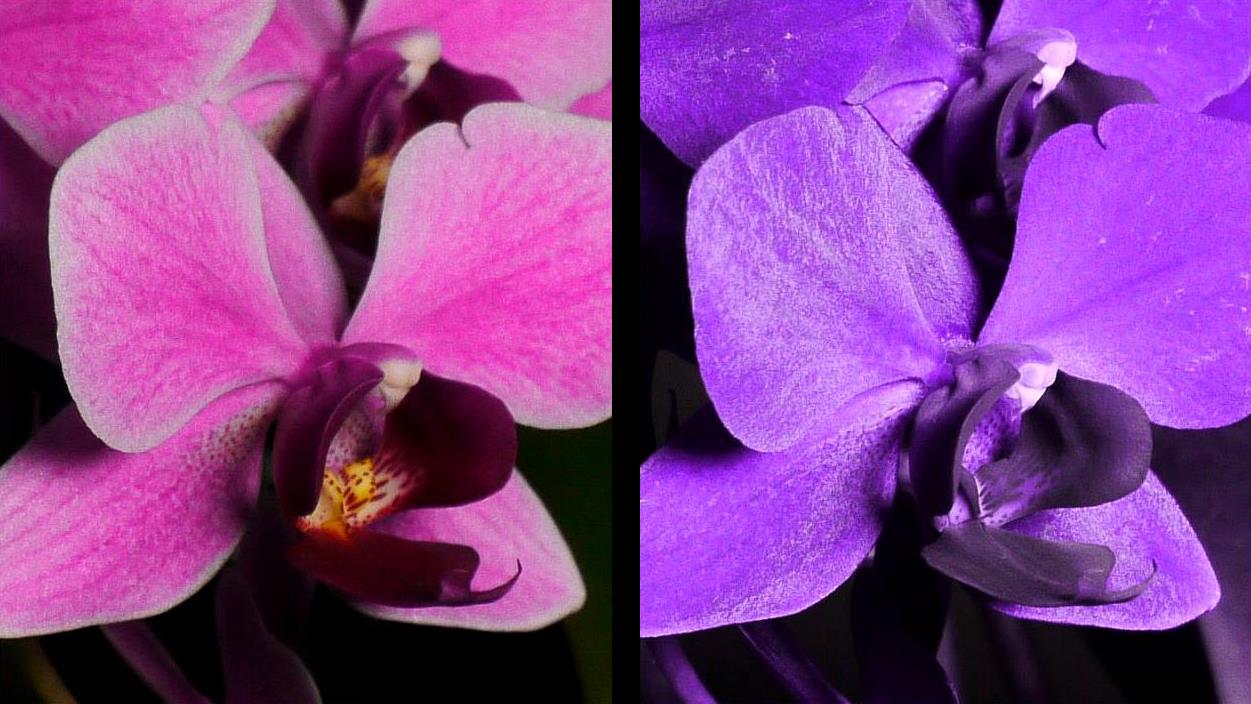
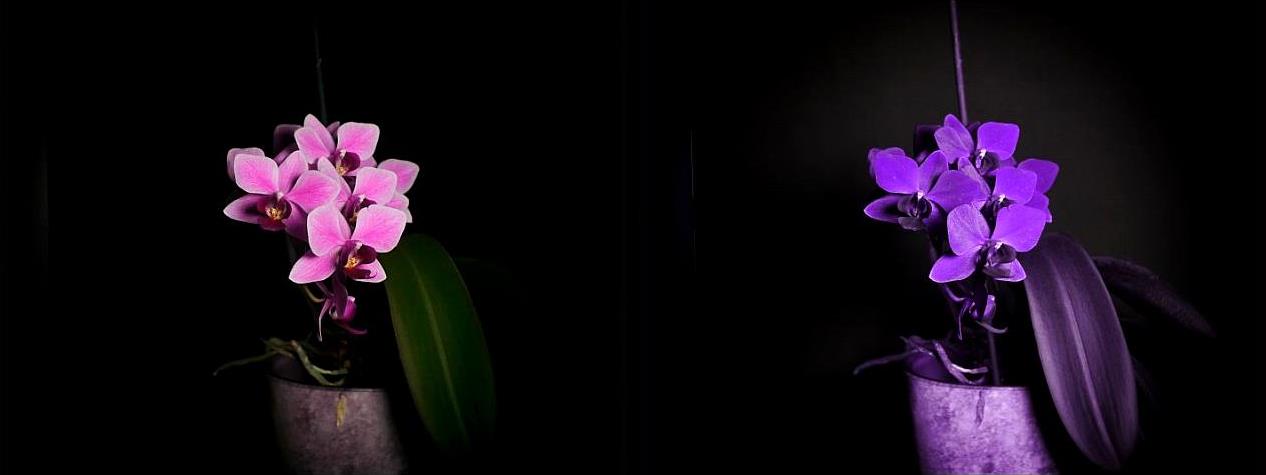
Here after having previously tested that with a quartz / fluorite achromat, now about using this focal reducer method to change the focal length of a Noflexar f3.5/35mm lens, a very well used lens for UV photography, to widen the field of view. This is also known as telecompressor in astronomy and it is the opposite of a (negative) Barlow lens. Here a positive (quartz in that case) element is used which achieves a 0.86x reduction, hence the lens now behaves as a f3/30mm lens. Here some results using some Phalaenopsis orchids.

[click on image to see a larger one]

no reducer full format:


no reducer 100% crop:


0.86x reducer full format:


0.86x reducer 100% crop:


As you may see, the image quality is hardly affected, even by this simple solution. Focus shift is a little increased, but hardly visible. Next step would be to try out a larger reduction factor. The visible vignetting is caused by a too small reducer lens and will disappear once I have a larger quartz reducer lens one on hand.

P.S.: Just made a test with another quartz focal reducer lens, achieving a) a 0.78 reduction factor and b) the vignetting is gone. That now makes a f2.7/27mm lens out of the Noflexar f3.5/35mm.

Stay tuned, more will follow on that fascinating subject...

More info on this very interesting field may be found on my site http://www.pbase.com/kds315/uv_photos