Showing posts with label 105mm. Show all posts

Wednesday, November 28, 2018

[UV, VIS, IR] Lyman Alpha deep UV lenses IV - Oncostele orchid

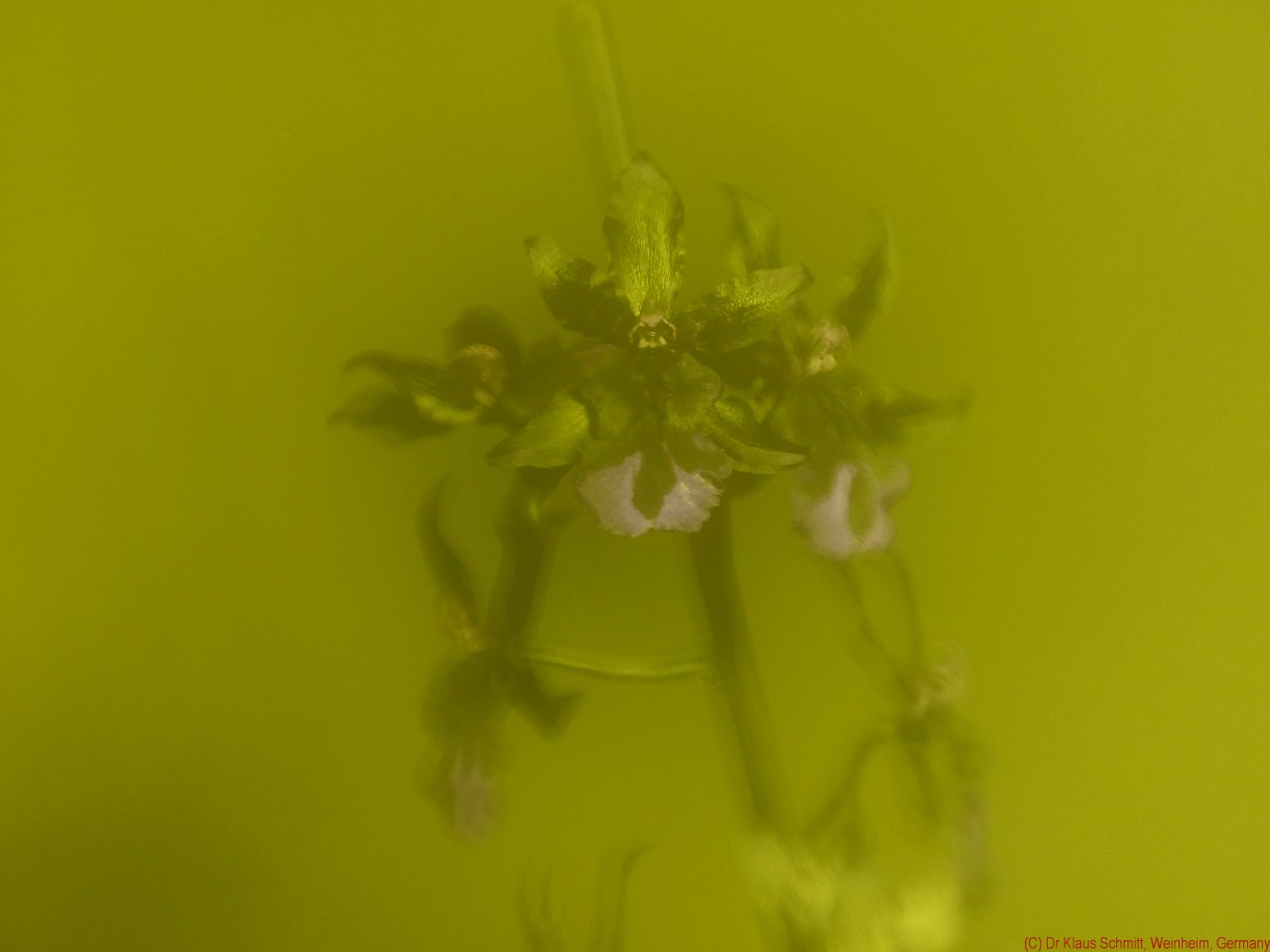
Today tests shots of a Orchid hybride (Oncostele Wildcat 'Golden Red Star') in reflected ultraviolet photography with a NYE OPTICAL Lyman-Alpha II f1.1/90mm UV-VIS-NIR lens in comparisoon with my UV-Nikkor 105mm lens. UV filters used was the Baader-U and the IDAS 340nm filter for the UV-Nikkor and a UV transmitting stack of UG11+S8612 as well as a 340nm filter for the Lyman Alpha 90mm, both rear mounted. All shots were done at f4.5 for the UV-Nikkor resp. f1.1 as the Lyman Alpha lens has no iris. Light source used was Xenon flash.

[click on image to see a larger one]

UV-Nikkor 105mm Visible Light:
 

UV-Nikkor 105mm Baader-U filter:
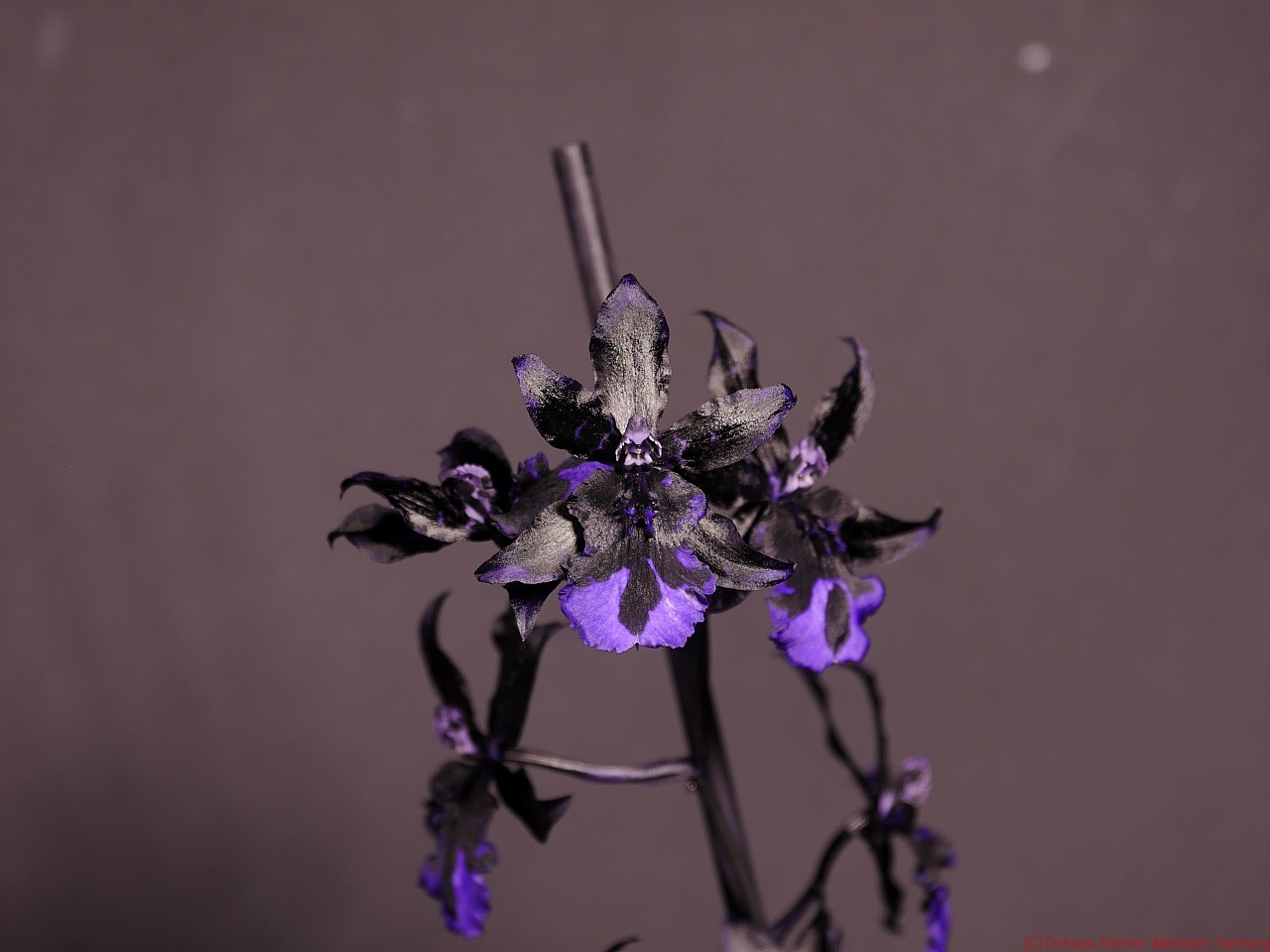
 

UV-Nikkor 105mm Baader-U filter (whitebalanced):
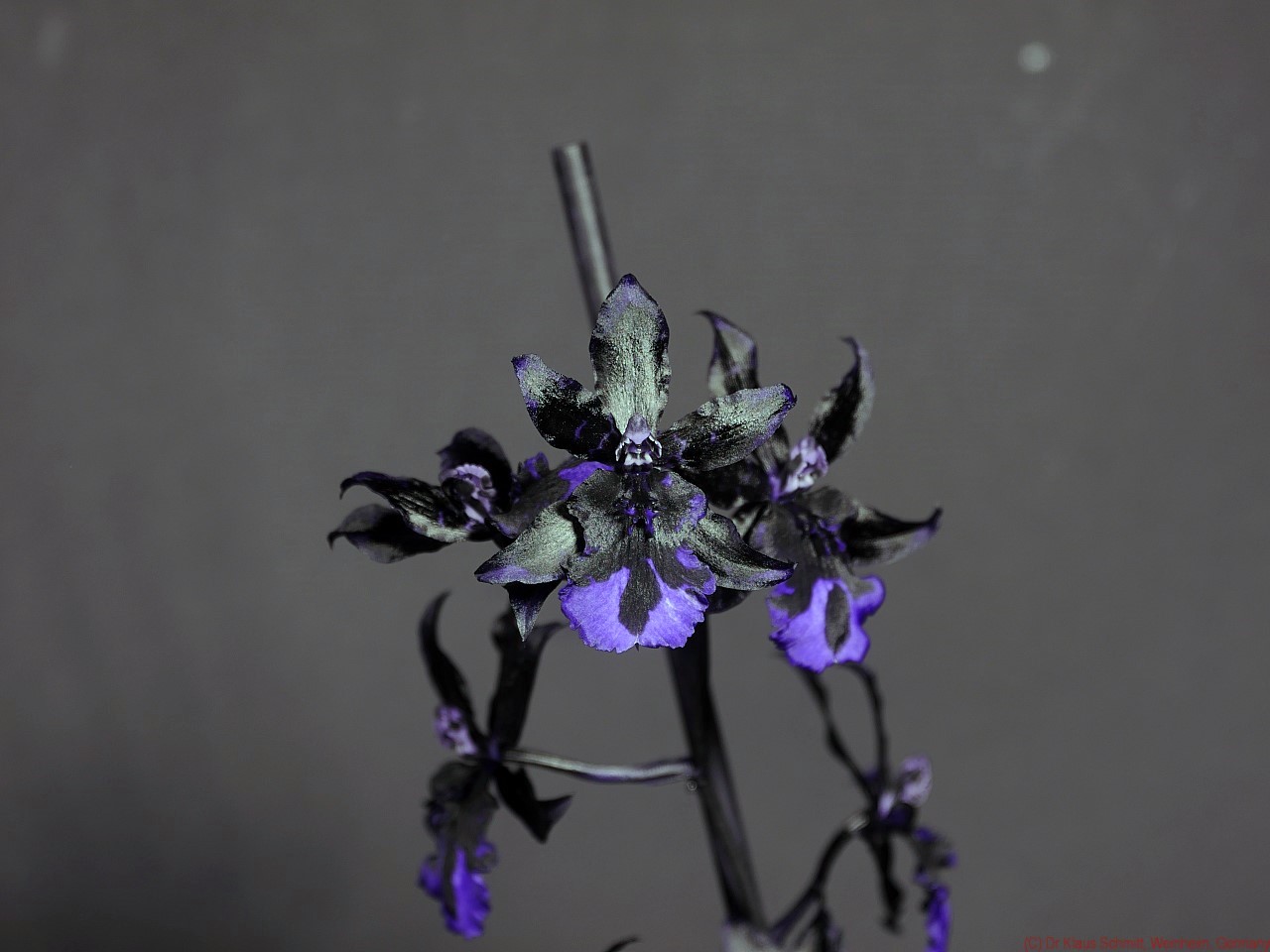
 

UV-Nikkor 105mm 340nm IDAS filter:
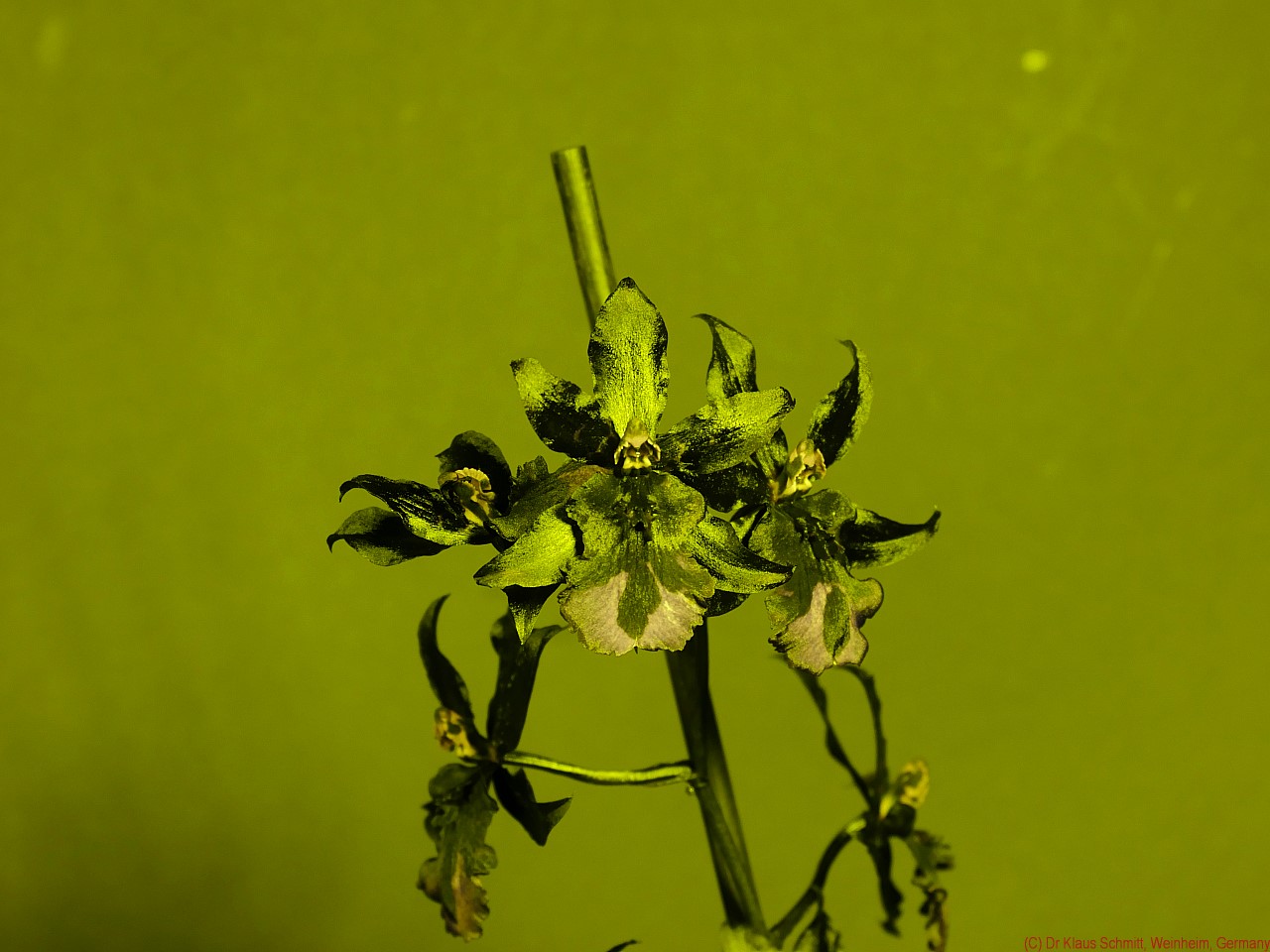
 

Lyman Alpha II 90mm UG11+S8612 filter:
 

Lyman Alpha II 90mm UG11+S8612 filter (whitebalanced):
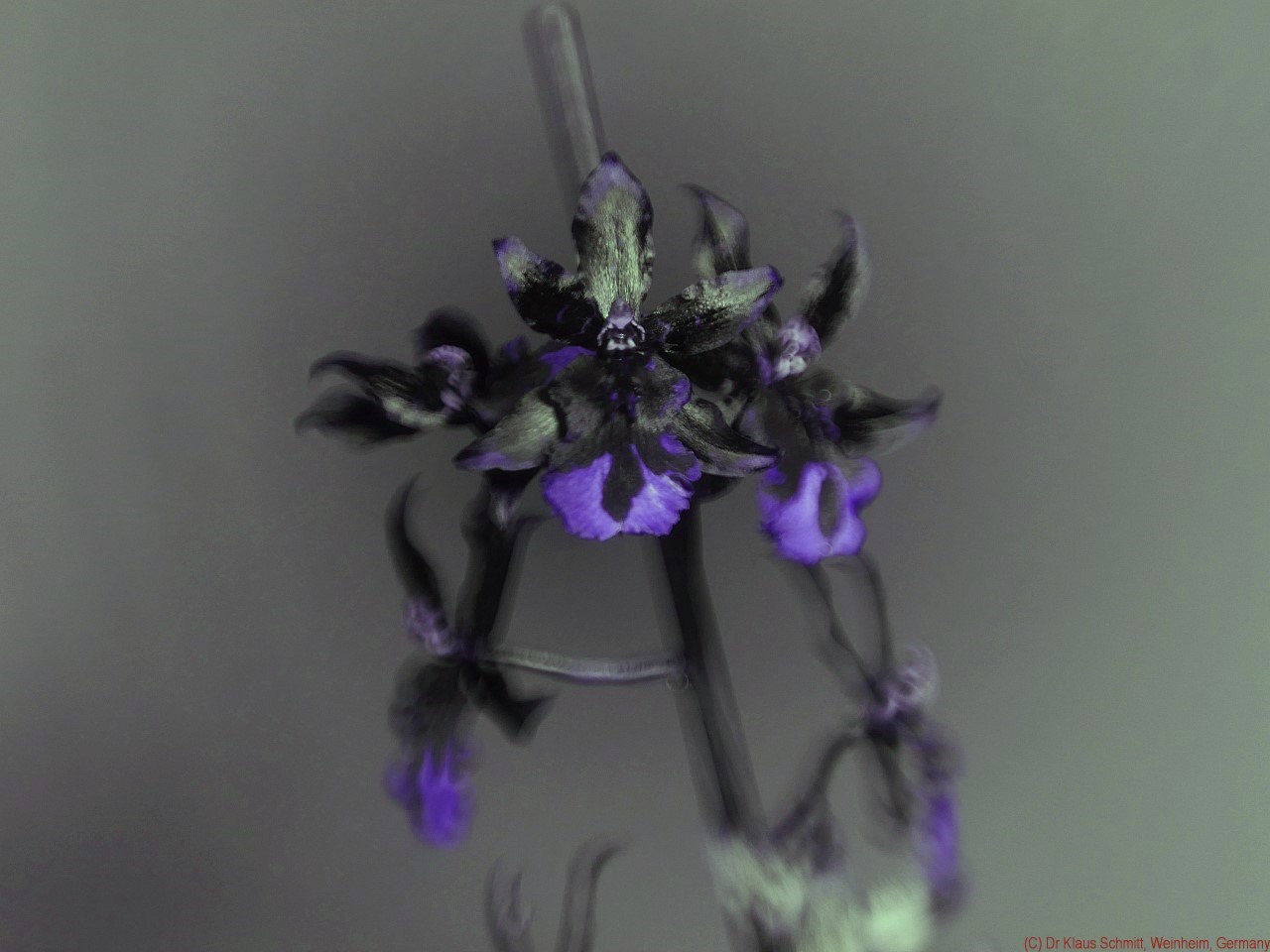
 

Lyman Alpha II 90mm 340nm filter:
 

UV-Nikkor vs Lyman Alpha II 90mm in UV:
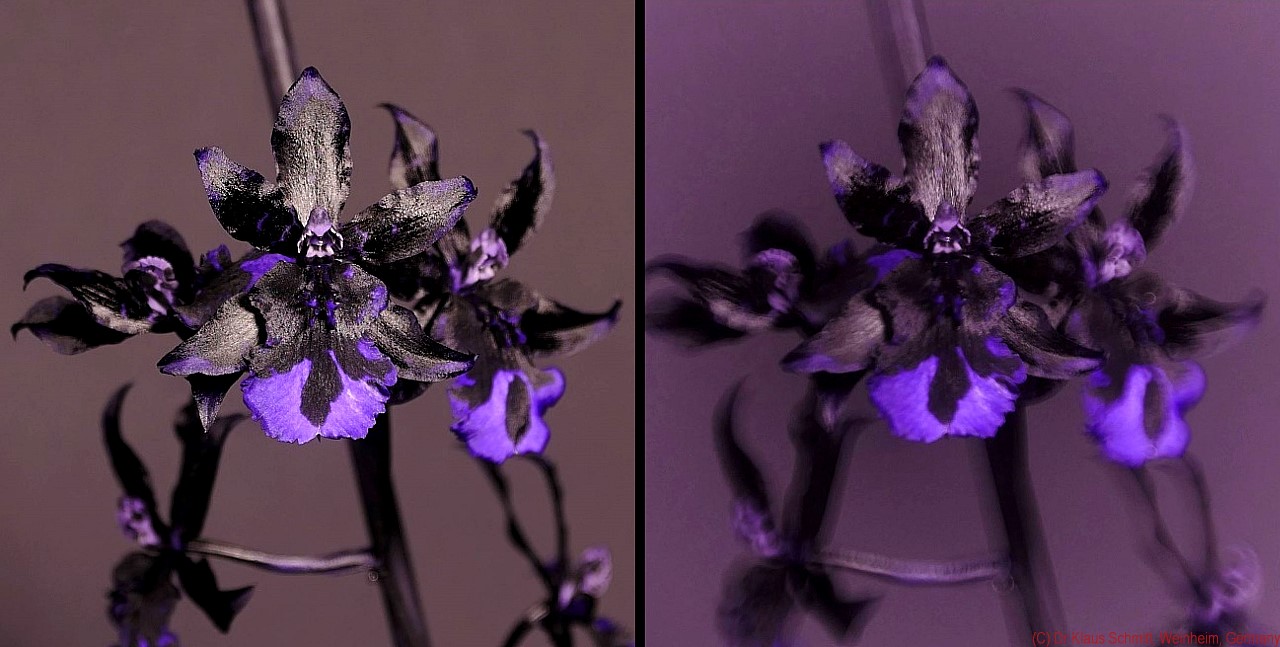
 

UV-Nikkor vs Lyman Alpha II 90mm in UV (whitebalanced):
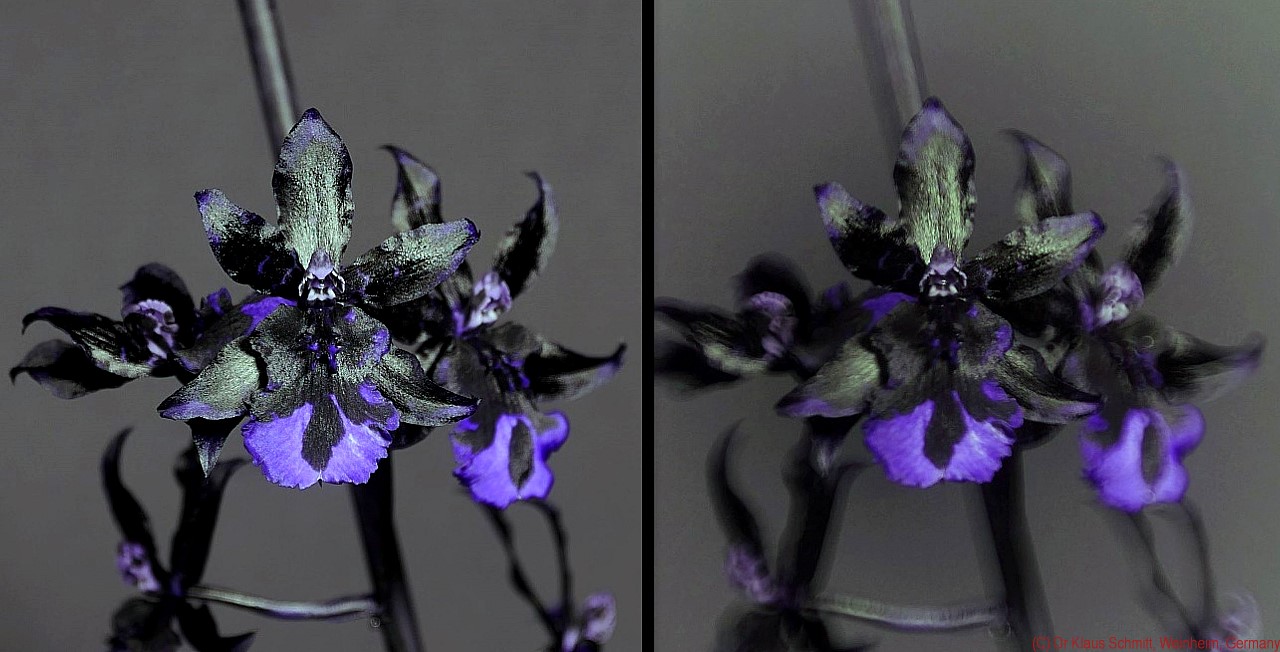
 

UV-Nikkor vs Lyman Alpha II 90mm in UV (340nm):
 
This orchid has a very specific UV pattern, its petals are very UV dark, but its lower petal lip has on the lower center a very UV bright spot as well as on its center "nose" formation an UV reflecting spot and all this gets nicely visible.

Both lenses are very different animals so to speak, that Lyman Alpha II f1.1/90mm has extremely shallow DOF as compared to the f4.5 / 105mm UV-Nikkor lens, as well as some bent field, but it shows a very useful UV transmission. That rear mounted 340nm seems not to be the clearest filter, as the resulting image was a bit cloudy, not the fault of the lens.

I have written about the Nye Lyman-Alpha lenses previously HERE and about this Orchid HERE
 
Stay tuned, more will follow on that fascinating subject...

More info on this very interesting field may be found on my site http://www.pbase.com/kds315/uv_photos

Tuesday, July 28, 2015

European Magpie - Pica pica in reflected ultraviolet photography

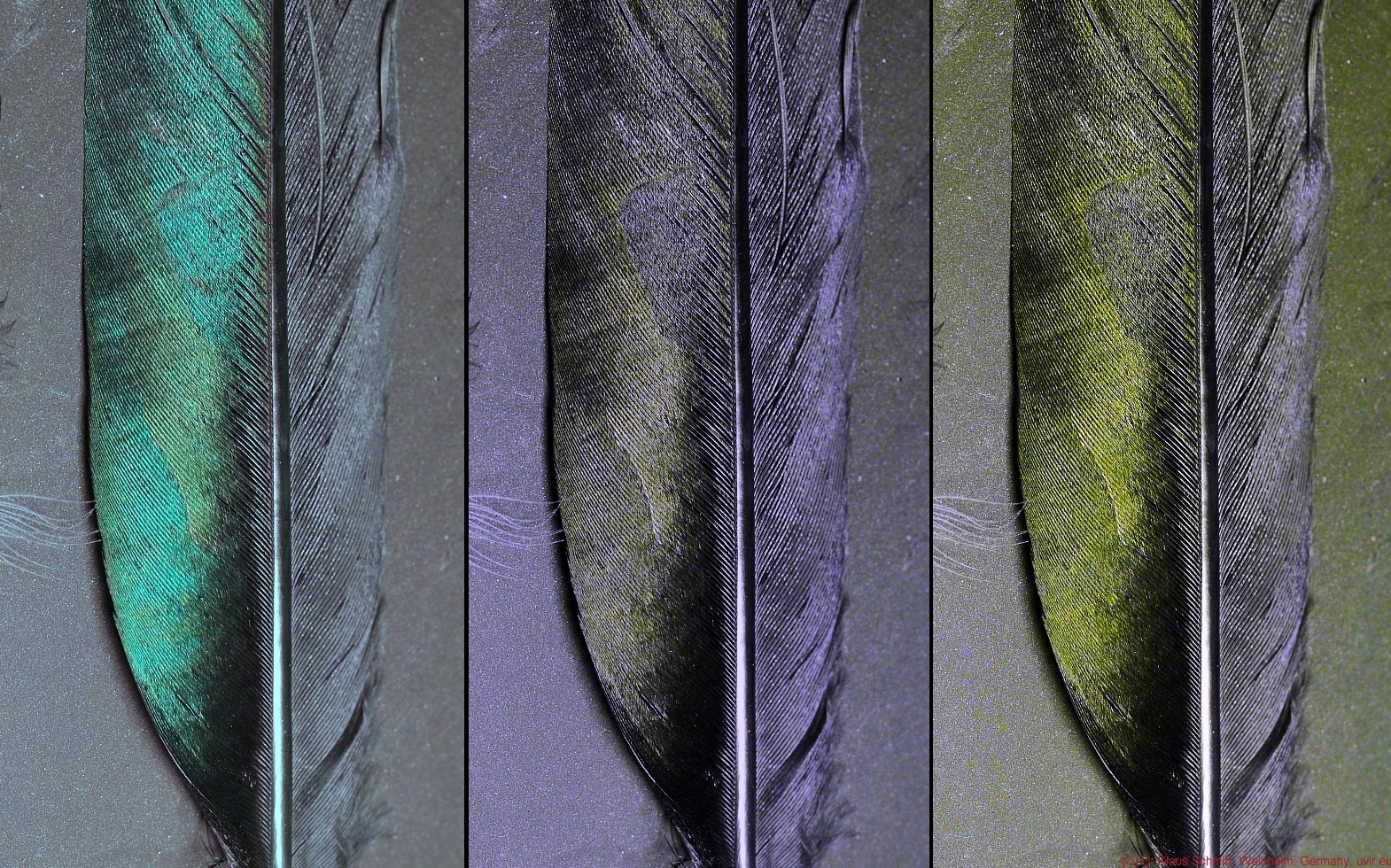
Today shots of quite pretty feathers of an European Magpie - Pica pica in reflected ultraviolet photography using my "work horse" UV filter, the Baader-U filter and a longer wave UV. Lens was my UV-Nikkor 105mm quartz flourite lens. Light source was a modified for high UV output Xenon flashlight. All shots were done at f8.

[click on image to see a larger one]

Triptych (left to right): Human vison, reflected UV (longer wave), reflected UV (Baader-U filter):


Diptych (left to right): closeup Human vison, reflected UV(Baader-U filter):


Triptych (left to right): Human vison polarization 0 degrees, rotated 45 degrees, 90 degrees:


This attractive bird has iridescent feathers with a metallic green and blue shine maximized under a 45 degree reflection angle, however it also reflects UV quite well peaking at around 365nm (left) and to some lesser amount 385nm (right), invisible to us humans, and all this gets nicely visible.

Stay tuned, more will follow on that fascinating subject...

Sunday, July 26, 2015

Snakeshead - Arum maculatum in reflected ultraviolet photography and simulated bee vision

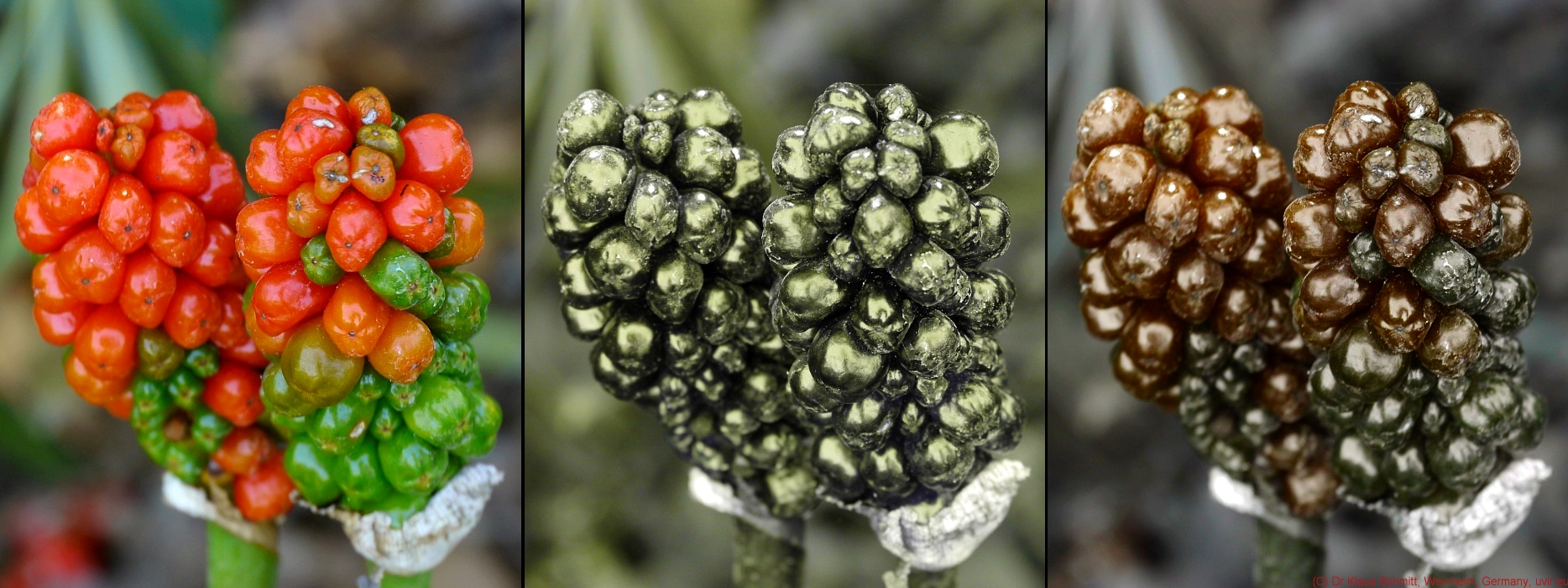
Today shots of the very decorative late summer berries of the Snakeshead - Arum maculatum in reflected ultraviolet photography using my "work horse" UV filter, the Baader-U filter, as well as in simulated bee vision using my proprietary XBV filter. Lens was my UV-Nikkor 105mm quartz flourite lens. Light source was sunlight. All shots were done at f8.

[click on image to see a larger one]

Triptych (left to right): Human vison, reflected UV, simulated bee vision:


This attractive berries shows no prominent UV pattern, but a metallic like shine, peaking at around 365nm, invisible to us humans, and all this gets nicely visible.

Stay tuned, more will follow on that fascinating subject...

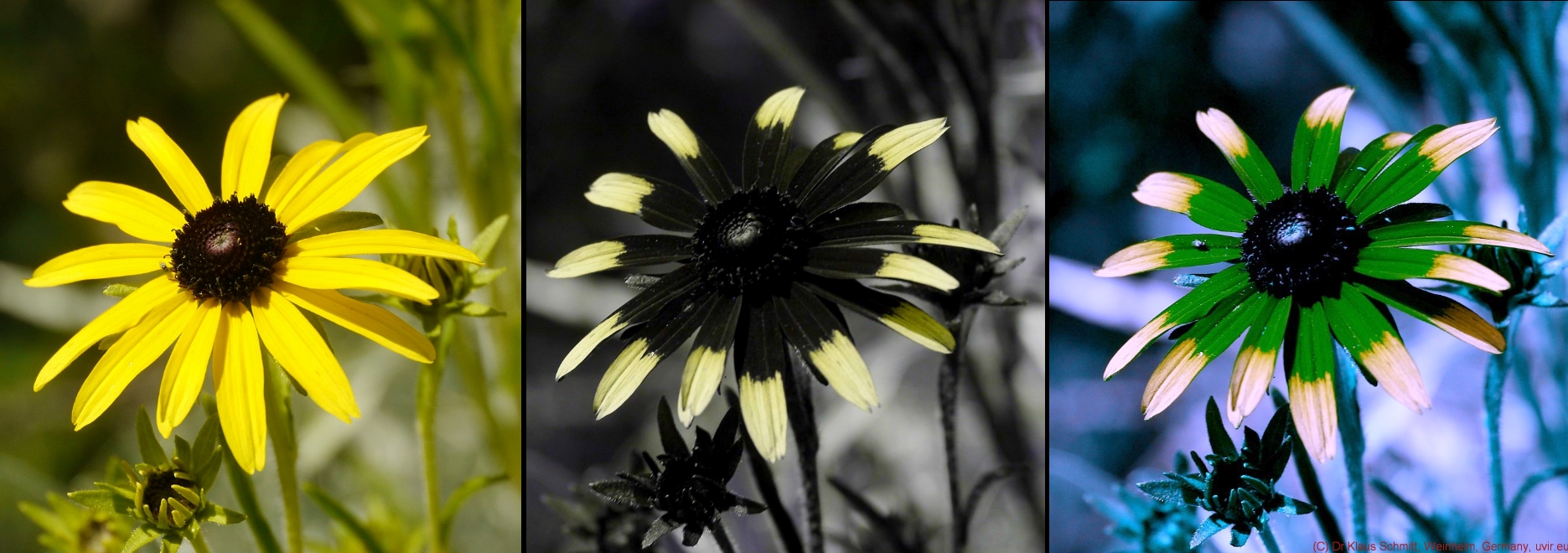
Missouri Coneflower - Rudbeckia missouriensis in reflected ultraviolet photography, simulated butterfly and bee vision III

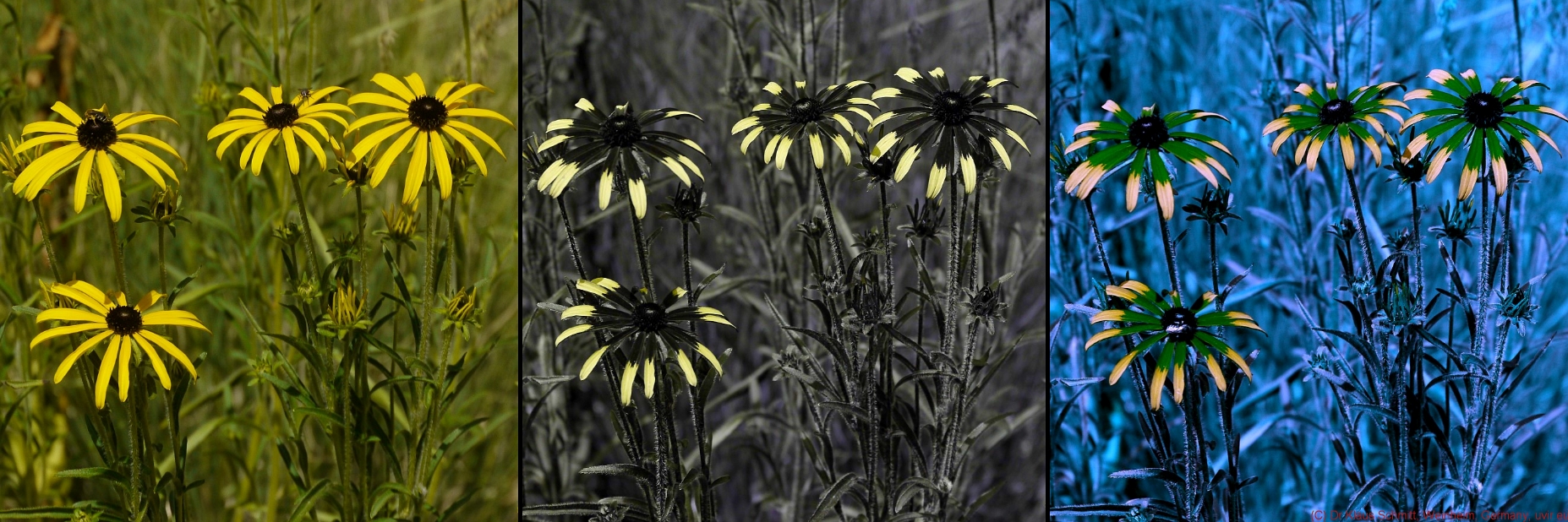
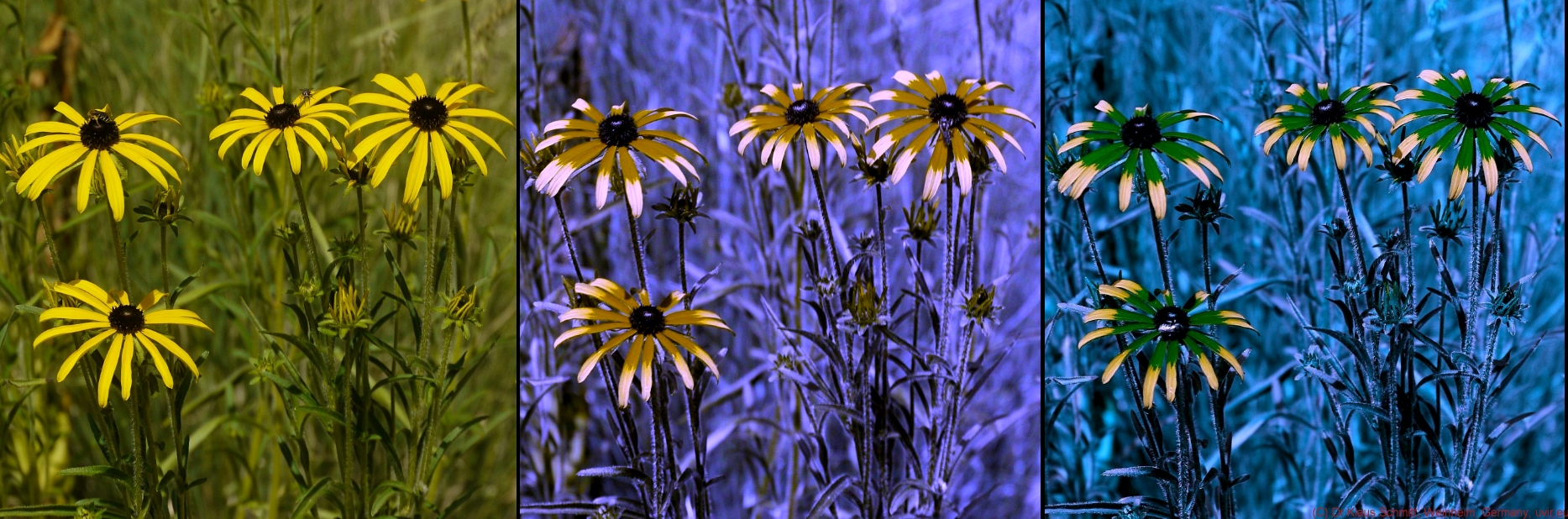
Today more shots of a group of decorative summer flowers Missouri Coneflower - Rudbeckia missouriensis in reflected ultraviolet photography using my "work horse" UV filter, the Baader-U filter, as well as in simulated butterfly and bee vision using my proprietary XBV filter. Lens was my UV-Nikkor 105mm quartz flourite lens. Light source was sunlight. All shots were done at f8.

[click on image to see a larger one]

Triptych (left to right): Human vison, reflected UV, simulated bee vision:


Triptych (left to right): Human vison, simulated butterfly vision, simulated bee vision:
 

This attractive flower shows its very prominent UV bullseye pattern, its petals have an UV dark bottom and very UV bright tips (around 365nm), invisible to us humans, and all this gets nicely visible in this group shot.

I have written about this flower previously HERE
 
Stay tuned, more will follow on that fascinating subject...

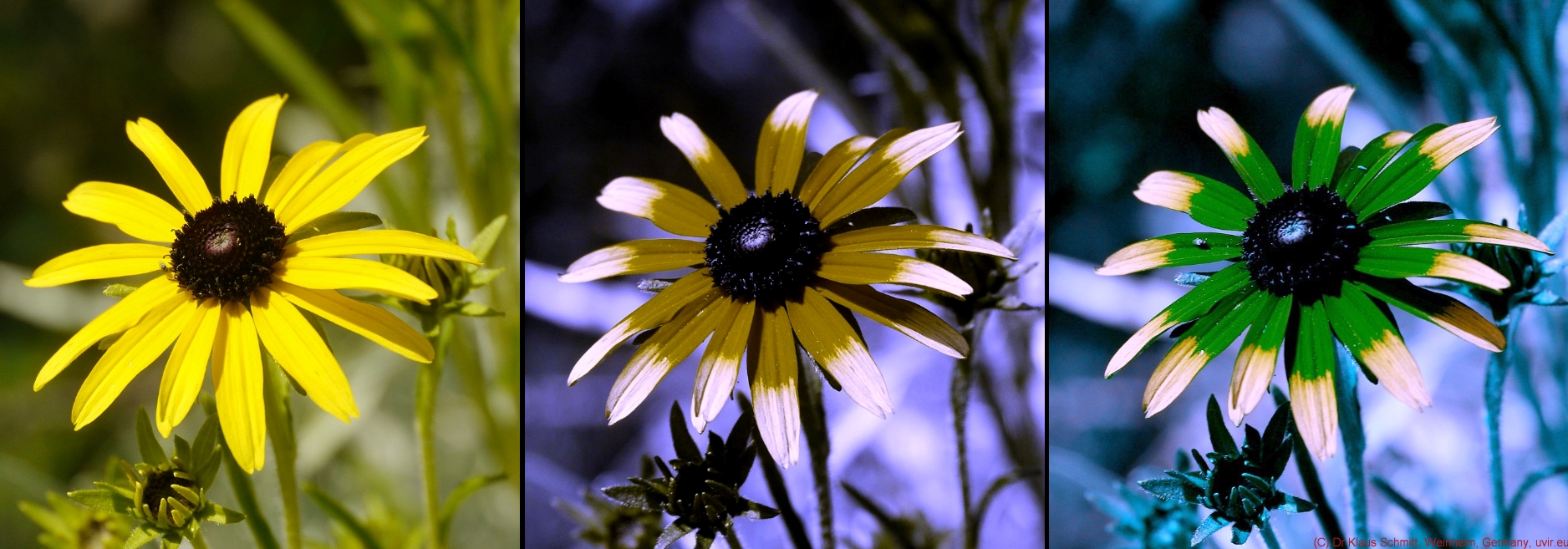
Missouri Coneflower - Rudbeckia missouriensis in reflected ultraviolet photography, simulated butterfly and bee vision II

Today shots of a decorative summer flower Missouri Coneflower - Rudbeckia missouriensis in reflected ultraviolet photography using my "work horse" UV filter, the Baader-U filter, as well as in simulated butterfly and bee vision using my proprietary XBV filter. Lens was my UV-Nikkor 105mm quartz flourite lens. Light source was sunlight. All shots were done at f8.

[click on image to see a larger one]

Triptych (left to right): Human vison, reflected UV, simulated bee vision:


Triptych (left to right): Human vison, simulated butterfly vision, simulated bee vision:
 

This attractive flower shows its very prominent UV bullseye pattern, its petals have an UV dark bottom and very UV bright tips (around 365nm), invisible to us humans, and all this gets nicely visible.


Stay tuned, more will follow on that fascinating subject...

Orange coneflower - Rudbeckia fulgida in reflected ultraviolet photography, simulated butterfly and bee vision XII

Today shots of a decorative summer flower Orange coneflower - Rudbeckia fulgida in reflected ultraviolet photography using my "work horse" UV filter, the Baader-U filter, as well as in simulated butterfly and bee vision using my proprietary XBV filter. Lens was my UV-Nikkor 105mm quartz flourite lens. Light source was sunlight. All shots were done at f8.

[click on image to see a larger one]

Triptych (left to right): Human vison, reflected UV, simulated bee vision:


Triptych (left to right): Human vison, simulated butterfly vision, simulated bee vision:
 

This attractive flower shows its very prominent UV bullseye pattern, its petals have an UV dark bottom and very UV bright tips (around 365nm), invisible to us humans, and all this gets nicely visible.

I have previously written about this flower HERE

Stay tuned, more will follow on that fascinating subject...

Monday, July 13, 2015

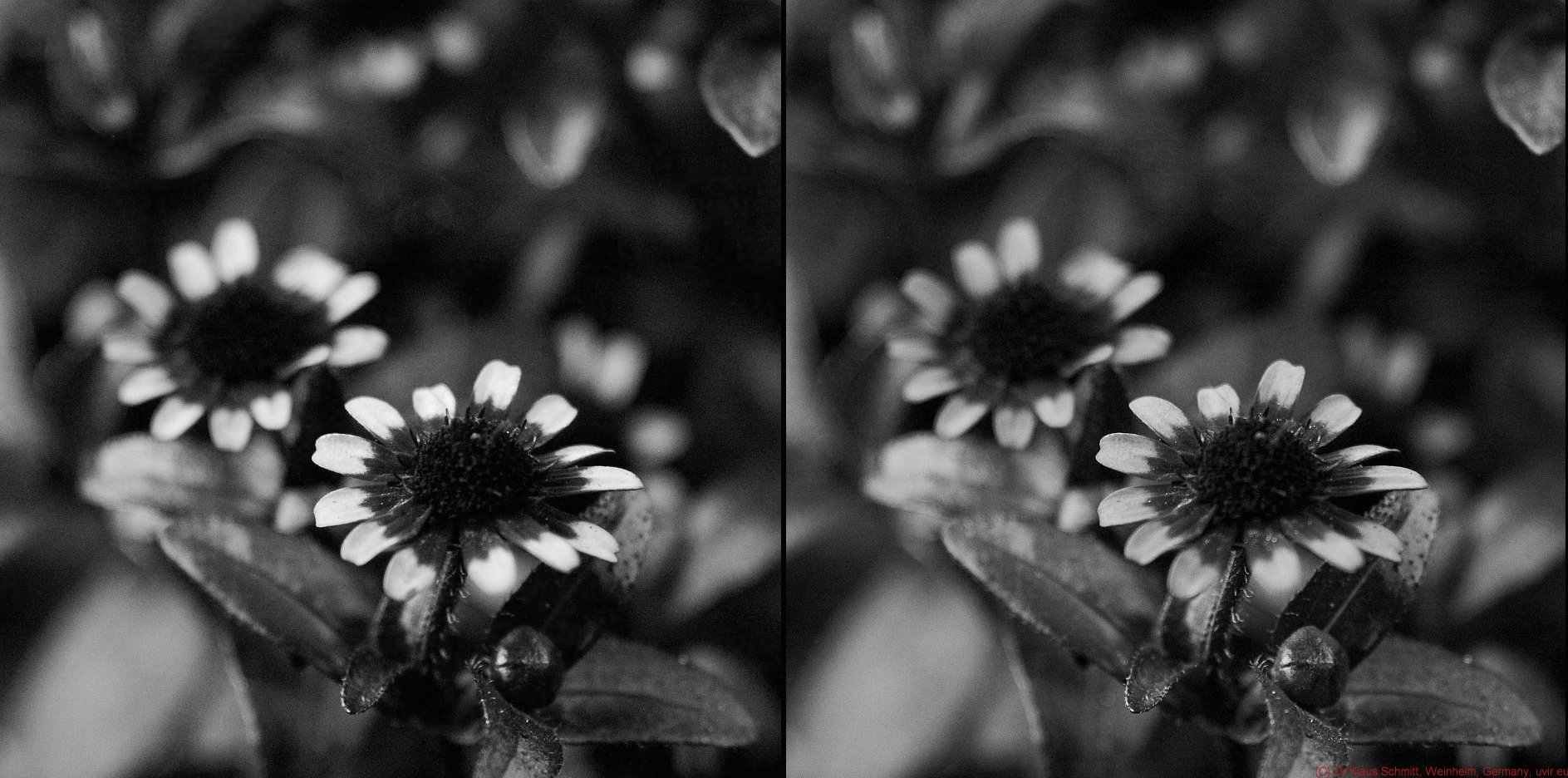
XNUV2 - a much faster filter for reflected ultraviolet (UV) photography

Today about another, faster filter for reflected UV photography, as there still seems to be some demand for handheld UV shooting or shooting at higher speeds for instance for video work. This here is the XNUV2, that I finally tested for the first time now using the Baader-U UV pass filter for comparison, a UV-Nikkor 105mm quartz flourite lens and my UV sensitive camera. Light was late evening light on a rather dull day.

[click on image to see a larger one]

Ultraviolet (UV) image using Baader-U left) and XNUV2 filter (right) - flower :

bw image shows that the UV content is basically identical:


Ultraviolet (UV) image using Baader-U left) and XNUV filter (right) - architecture:


What is important to notice is, that also the XNUV2 is also able to precisely reproduce this distinct flower UV pattern, as well as it shows good sharpness, as compared to the Baader-U filter. And most importantly it is 2.3 stops faster than using the Baader-U filter, which is quite an impressive result as it will make it much easier for video work.

I will report more about that filter here later, as more testing needs to be done.

I have written before about a faster XNUV filter HERE

Stay tuned, more will follow on that fascinating subject...

More info on this very interesting field may be found on my site http://www.pbase.com/kds315/uv_photos
Wednesday, July 8, 2015

Nikon UV-Nikkor f4.5 105mm vs CERCO f4.3 94mm

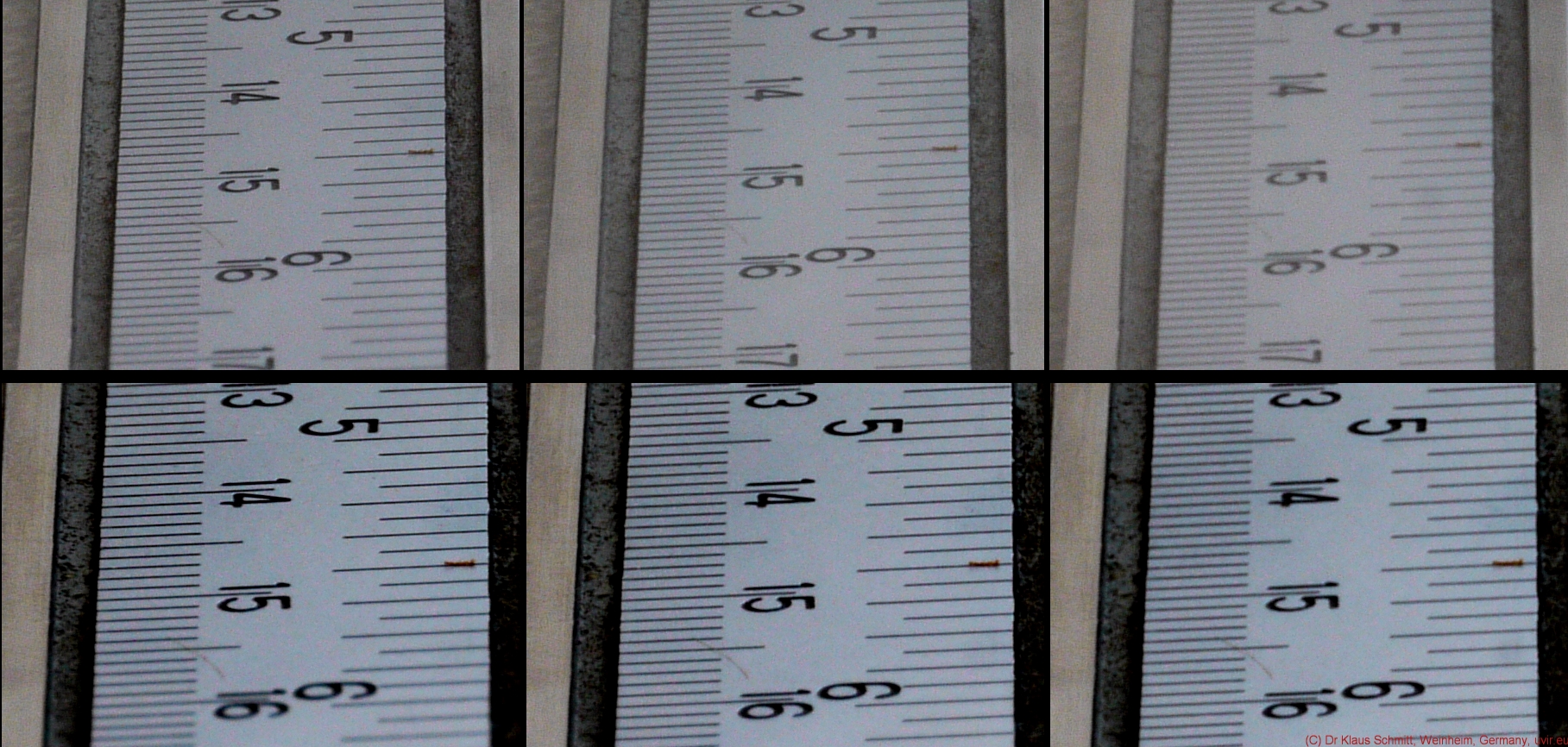
As I was testing a Nikon UV-Nikkor f4.5 105mm, I thought it would be interesting to compare it to my CERCO f4.3 94mm workhorse lens, especially about possible chromatic aberration, sharpness and contrast. Target was a metallic precision ruler, light was sunlight. Only visible light photograhy was done here.

[click on image to see a larger one]

CERCO top, Nikon bottom. Increasing f-stop setting towards the right, starting fully open leftmost.


Both lenses do not show CA. But interesting to note, how much higher the contrast of the UV Nikkor is. The CERCO shows futher decreasing contrast when stopping down (to the right) although flare control was used by using a deep hood against stray light. Both lenses are very sharp, but overall the Nikkor seems to be the clear winner here and it also covers FF sensors, which the CERCO does not do. Both are excellent lenses in terms of sharpness, but contrast and flare always need special attention, especially when using the CERCO multispectral lens.

I have compared quartz fluorite lenses in terms of their transmissions HERE

Stay tuned, more will follow on that fascinating subject...

More info on this very interesting field may be found on my site http://www.pbase.com/kds315/uv_photos

Thursday, December 12, 2013

EADS SODERN CERCO f4.1 94mm vs Coastal Optical Systems Inc. 105mm f/4 UV-Micro-Apo lens for reflected ultraviolet photography

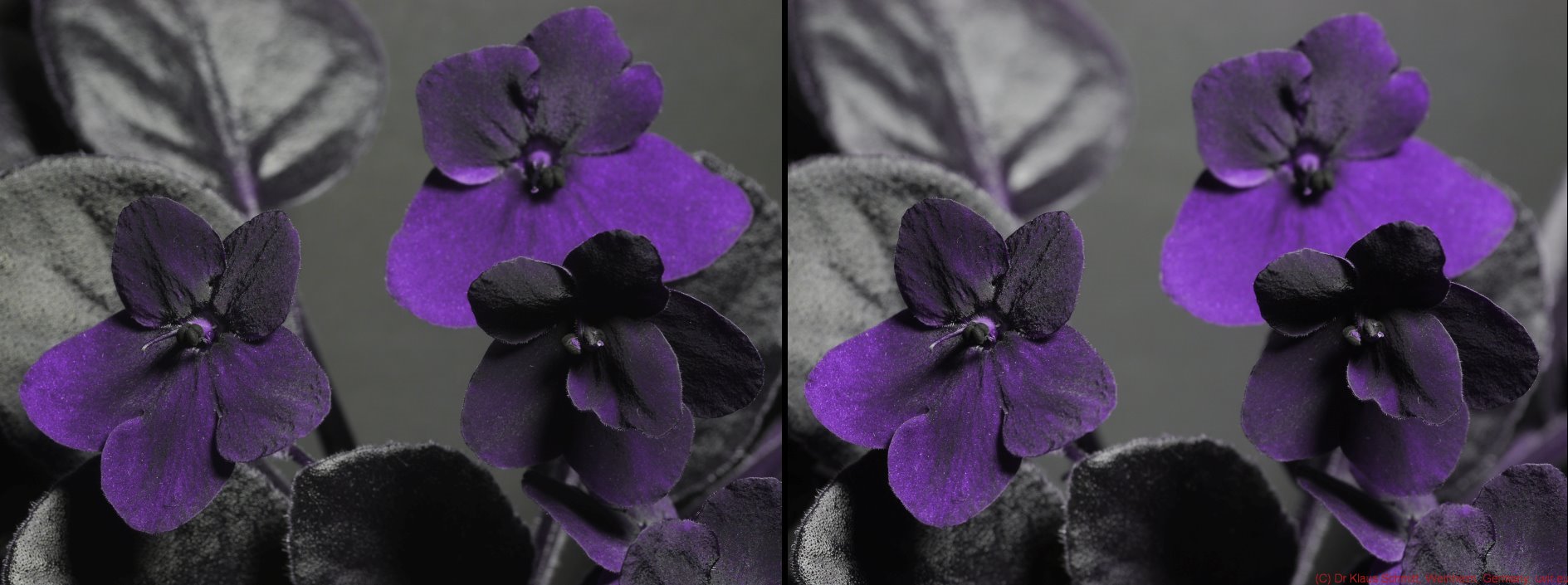
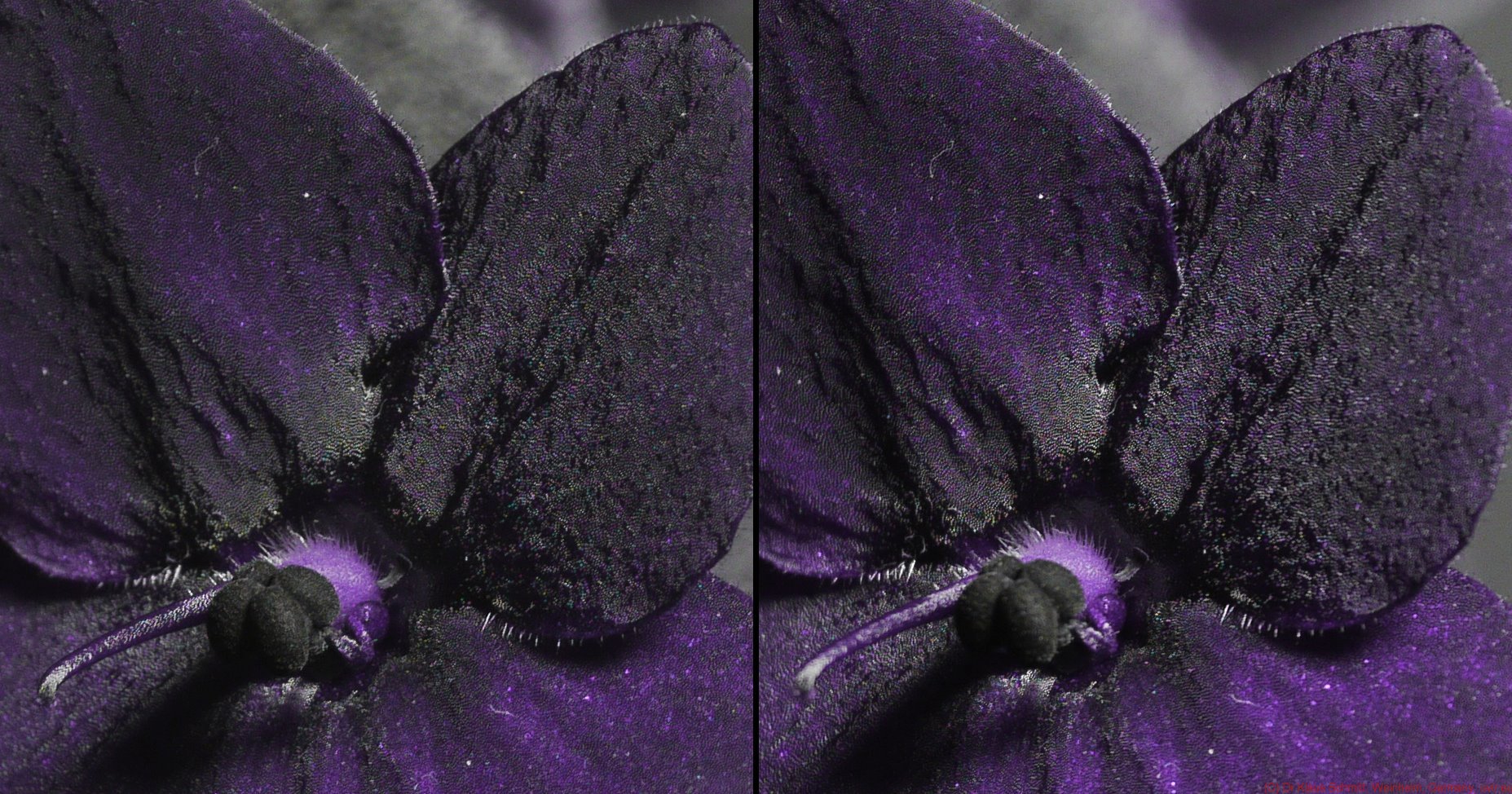
Today about two specialized UV lenses, the EADS SODERN CERCO type 2085 f4.1 94mm and the Coastal Optical Systems Inc. (COSI) 105mm f/4 UV-Micro-Apo apochromatic quartz fluorite lenses. In lack of a flower with UV pattern, I'm using a African violet hybride flower for that test as well as my "work horse" UV filter, the Baader-U filter. Light source was Xenon light. All shots were done at f5.6.

[click on image to see a larger one]

Diptych image CERCO 94mm (left) vs COSI 105mm lens (right), Visual light:
 

Diptych image CERCO 94mm (left) vs COSI 105mm lens (right), reflected UV using Baader-U filter (approx. 320-395nm, peak approx. 350nm):
 

Diptych detail image CERCO 94mm (left) vs COSI 105mm lens (right), reflected UV using Baader-U filter (approx. 320-395nm, peak approx. 350nm):
 

The comparison images clearly show that both lenses work exceptionally well for reflected UV as for visual photography and deliver sharp images rich in contrast and detail. I had to adjust the camera position to equalize the focal length differences, so this is not a scientific lens test, but the view of a user. Both come in Nikon-F mount, but the COSI lens covers full format sensors, the CERCO only about the smaller APS-C format (25mm image diameter).

P.S.: The images were not re-adjusted in focus between UV and VIS shots, to show that there is no focus shift between VIS and UV.

P.P.S.: those images accidentially work as 3D crosseye stereo images...

Stay tuned, more will follow on that fascinating subject...

More info on this very interesting field may be found on my site http://www.pbase.com/kds315/uv_photos

Tuesday, November 12, 2013

Old 105mm + 75mm Helioplan enlarger lenses for reflected ultraviolet photography

Today about some older, quite capable UV transmitting Helioplan enlarger lenses. I'm using a Gazania rigens flower for that test as well as my "work horse" UV filter, the Baader-U filter. Lenses used were older 75mm and 105mm Helioplan enlarger lenses of dialyte construction. Light source was Xenon light. All shots were done at f11.

[click on image to see a larger one]

Diptych image using 75mm lens, Visual and reflected UV using Baader-U filter (approx. 320-395nm, peak approx. 350nm):
 

Diptych image using 105mm lens, Visual and reflected UV using Baader-U filter (approx. 320-395nm, peak approx. 350nm):
 

Diptych image 75mm vs. 105mm lens, both reflected UV using Baader-U filter:
 

The comparison images clearly show that the 75mm has an edge over the 105mm lens in terms of UV tramsission, but also in terms of sharpness. Both lenses are nevertheless quite capable, despite their 50++ years of age.

P.S.: The visual images were not re-adjusted in focus, to show the small focus shift between VIS and UV.

Stay tuned, more will follow on that fascinating subject...

More info on this very interesting field may be found on my site http://www.pbase.com/kds315/uv_photos
Monday, February 18, 2013

Soligor / Kyoei 105mm lens for reflected UV photography II

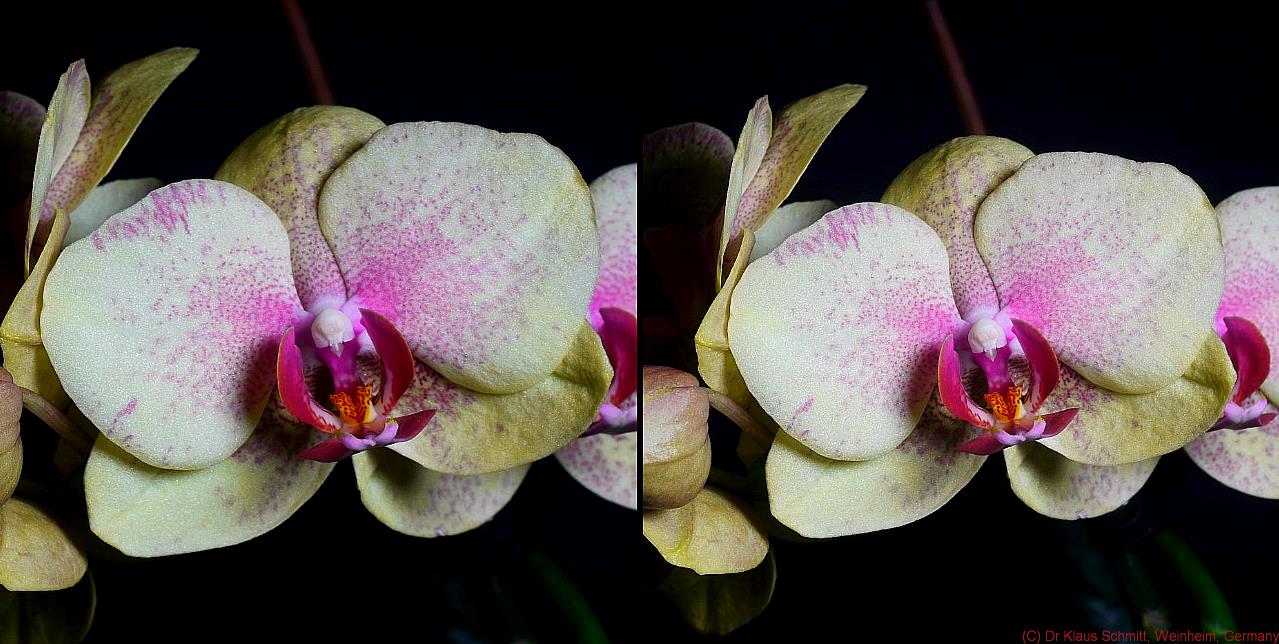
Here again about the Soligor (also sold as Kyoei) f3.5 / 105mm, a quite capable lens for reflected UV photography I have written before here. This time in comparison with my all day UV lens, the CERCO 94mm quartz fluorite lens. I'm using a yellow/red Phalaenopsis flower for that and my "work horse" UV filter, the Baader-U filter plus the deeper reaching Jupiter-U filter. Light source was an UV enhanced Xenon flash. All shots done at f8 and presented on a side-a-side format for easier comparison, left the Soligor, right the CERCO lens.

[click on image to see a larger one]

Visible light image:
 

UV image using Baader-U filter (approx. 320-395nm, effective peak approx. 375nm):
 

UV image using Jupiter-U filter (approx. 280-385nm, effective peak approx. 365nm):
 

Also this comparison confirms, that it is a very sharp and seemingly deep into UV reaching lens, with only some 0.9% focal shift. Of course it does not reach as deep into UV as the CERCO lens, but nevertheless quite a useful lens!


Stay tuned, more will follow on that fascinating subject...

More info on this very interesting field may be found on my site http://www.pbase.com/kds315/uv_photos
Soligor / Kyoei 105mm lens for reflected UV photography

Today about the Soligor (also sold as Kyoei) f3.5 / 105mm, a quite capable lens for reflected UV photography, discovered a while ago by a forum colleague, who also discovered the Kuribayashi / Kyoei 35mm lens from the same lens family. I'm using a yellow/red Phalaenopsis flower for that and my "work horse" UV filter, the Baader-U filter plus the deeper reaching Jupiter-U filter. Light source was an UV enhanced Xenon flash. All shots done at f8 and presented on a side-a-side format for easier comparison.

[click on image to see a larger one]

Visible light image vs UV image using Baader-U filter (approx. 320-395nm, effective peak approx. 375nm):
 

Visible light image vs UV image using Jupiter-U filter (approx. 280-385nm, effective peak approx. 365nm):
 

UV images, Baader-U vs Jupiter-U filter:
 

A very sharp and seemingly deep into UV reaching lens, with only 0.9% focus shift. Quite a useful lens!


Stay tuned, more will follow on that fascinating subject...

More info on this very interesting field may be found on my site http://www.pbase.com/kds315/uv_photos
Wednesday, October 1, 2008

Lens Comparison: UV Nikkor 105mm, COSI 105mm, B&L 9"

Today I got an old lens, which was made many years ago by famous lens maker Bausch & Lomb, Rochester NY. It is a golden color single coated, heavy and well made f4.5 9" lens which attracted me, since it was made to record images emitted by a P-16 phosphor screen. Nothing special actually, but P-16 radiates at about max. 380nm, so now you know what attracted me most...

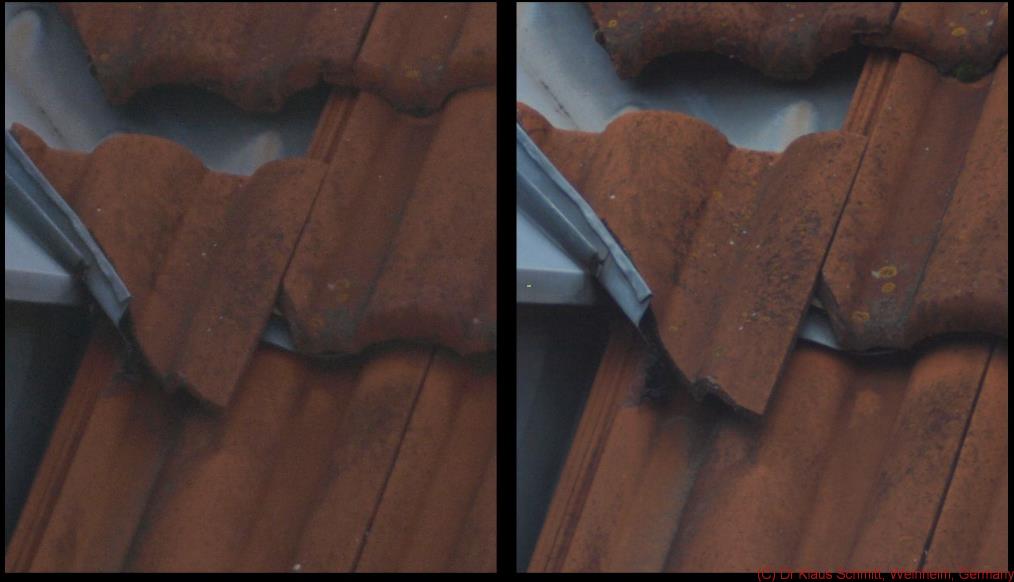
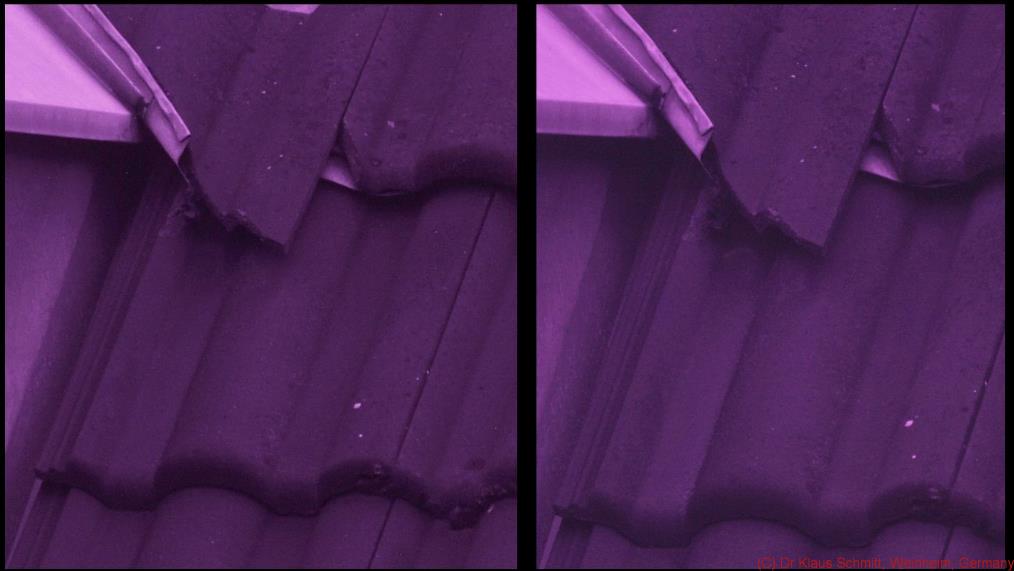
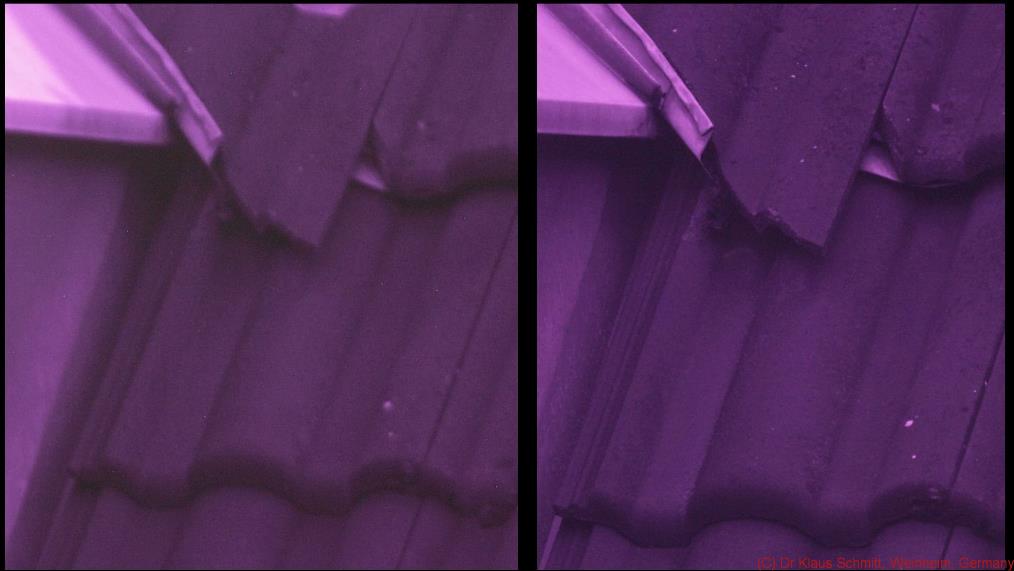
I ran a quick test using my "standard test subject", a roof of the neighbours house against the Coastal Optics Micro Apo 105mm and the Nikon UV Nikkor 105mm. The B&L lens results are shown on the right side of the comparison images. The B&L images have been scaled down to match the shorter focal length of the other two lenses. These are 100% center crops. The Baader U-filter (310 - 390nm) was used for the reflected UV shots. [click on image gets you a larger image]

Here the results in visible light for the UV Nikkor (left):


and for the Coastal Optics 105mm (left):


Here the results in reflected UV light using the Baader U-Filter (310 - 390nm) for the UV Nikkor (left):


and for the Coastal Optics 105mm (left):


So now it is up to you to understand my surprise, how amazingly sharp this B&L lens is....

Stay tuned, more will follow on that fascinating subject...

More info on this very interesting field may be found on my site http://www.pbase.com/kds315/uv_photos