Showing posts with label UV lens transmission spectra. Show all posts

Wednesday, February 17, 2021

A few quartz flourite UV lenses on the bench for lens transmission measurements II

A few years ago I was taking transmission measurements of some special quartz-fluorite lenses for reflected UV photography. This included the then Coastal Optics UV-VIS-NIR Apo 60mm lens, after the merger now called Jenoptik CoastalOpt® UV-VIS-IR 60 mm 1:4 APO Macro. 

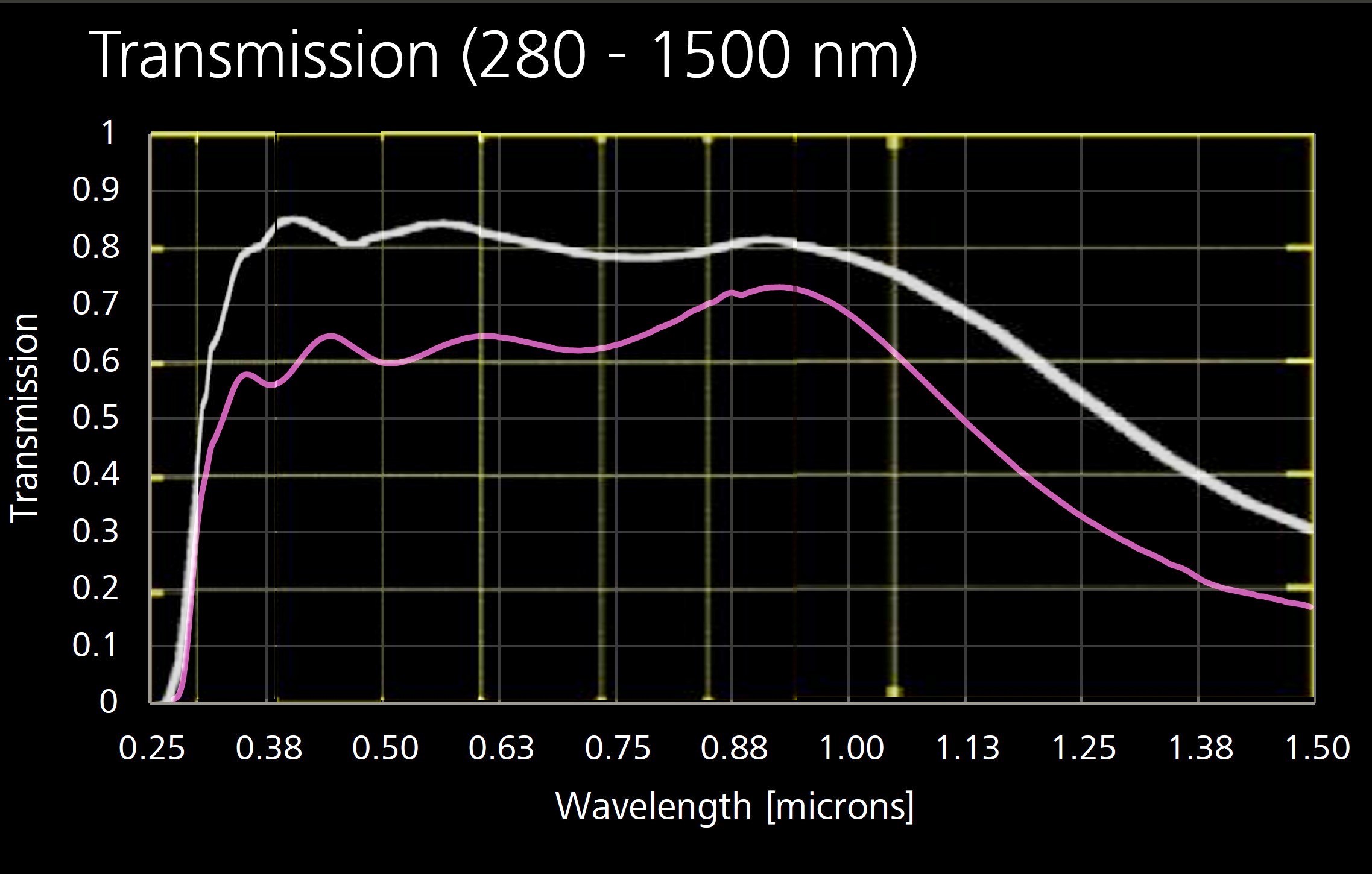
So since I just recently bought that CoastalOpt® lens, I measured it (amongst others) with my newer spectrometric setup and compared my results with their published data. Surprisingly enough, my older and newer measurements of that CoastalOpt® 60mm Apo lens correlate very well - but not with their now officially published data on their site which shows much lower transmission values. Their formerly published data however showed much better spectral transmission, which correlated well with my own measurements.

[click on image to see a larger one]

Here in comparison the former (white) and now published data (magenta) superimposed:
My own measurements back then were these (amongst some other lenses):


[validity: approx 310 - 750nm]

and my newer current measurements (reaching deeper into UV) are these:
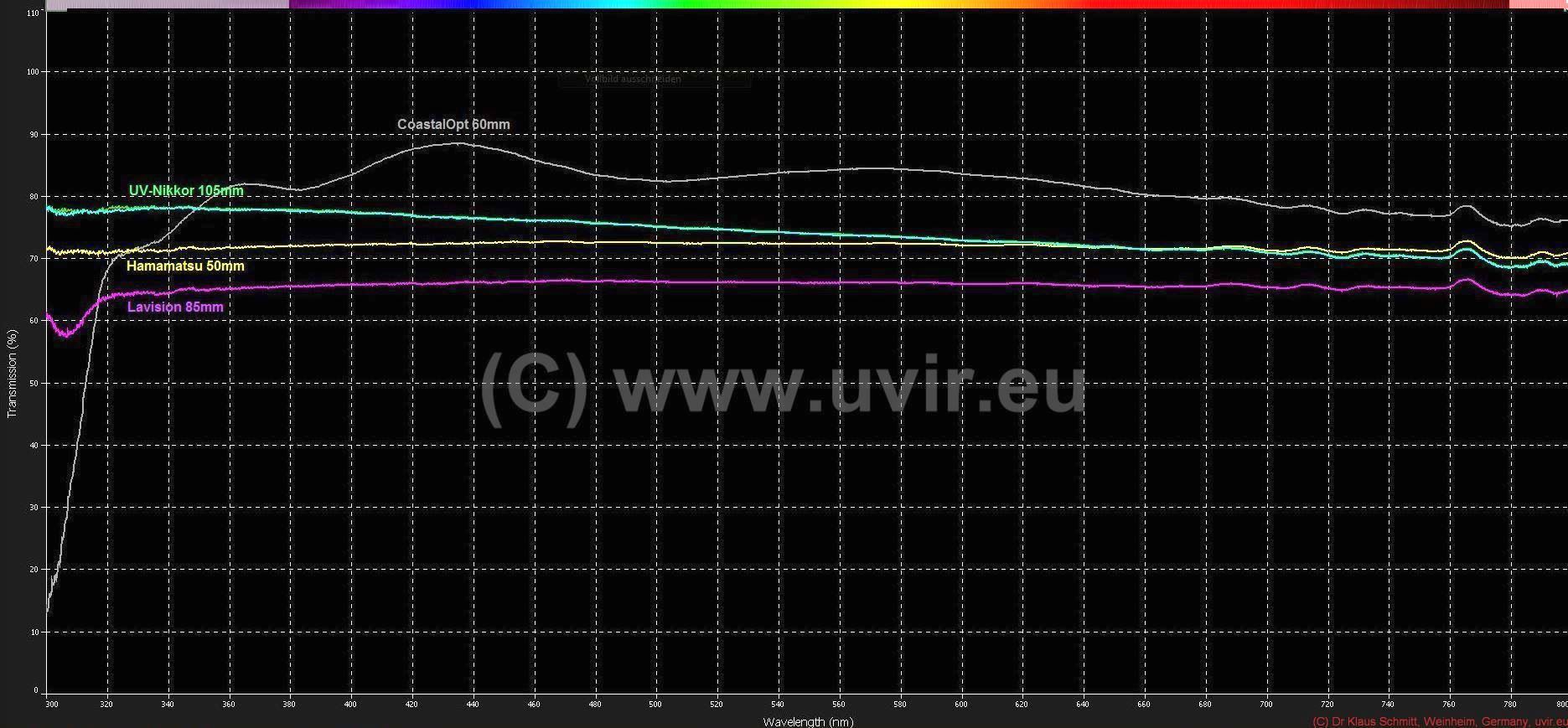
[validity: approx 300 - 750nm]

The differences in transmission of both my measurements are rather small. It is beyond my understanding how these new and quite different measurements (about 20% less) happened; I am just wondering why such an excellent lens is not represented well enough....

I have written about this lens before HERE.

Stay tuned, more will follow on that fascinating subject...

More info on this very interesting field may be found on my site http://www.pbase.com/kds315/uv_photos


Sunday, January 31, 2021

Lens Transmissions of specialized Lenses for reflected UV Photography

So today my first post in 2021 about some UV-VIS-NIR measurements of some highly specialized lenses, which were specifically developed for reflected ultraviolet (UV) photography.

Usually a photographic lens should reproduce visible images, which is the wavelength band of about 400-700nm. This is why lens makers apply a special multicoating (aside from achieving higher light transmission), which usually blocks light outside this visible waveband. For biological reflected UV photography however, the UV-A band (300 - 400nm) is the interesting one. So using such a modern UV lens and that (de facto "standard" UV transmitting) Baader U-filter  will work very well together, if both lens + filter have a high enough transmission. Culprit is, that coating for such a wide range is tricky, so quite a few of those lenses are still uncoated.

Here now I have used my UV-VIS-NIR spectrometer system consisting of a stabilized Xenon light source connected with a quartz fiber to a quartz-fluorite condensor which generates a fine parallel output ray shining through the lens to be tested and a receiving Spectralon (R) coated integrating sphere which captures all the light of that diverging beam exiting the measured lens and transmits this via a quartz fiber to the digital spectrometer.

The following lenses have been measured (links lead to my macrolenses site with lens data):

- CoastalOpt (Jenoptik) f4 / 60mm UV-VIS-NIR Macro Apo (Nikon-F mount)

- UV-Nikkor f4.5 / 105mm (Nikon-F mount)

 (identical to the RAYFACT f4.5 105mm sold by Nikon TOCHIGI)

- Lavision f2.8 / 85mm UV (Nikon-F mount)

- Hamamatsu A4869 f3.5 / 50mm (c-mount)

 [click on image to see a larger one]

All these lenses show a rather high UV transmisison, the CoastalOpt 60mm especially, as it seems to have a modern BBAR coating, but its downside is that its transmission only starts from about 320nm onwards, suitable for UV-A photography for biologic studies, but less suitable for technical studies like combustion analysis etc. which demands a suitable transmission in the UV-B (also sometimes UV-C) range which the other three lenses are capable of, reaching down to about 200nm.

The Hamamatsu 50mm is a c-mount lens and covers 1" sensors, the Lavision 85mm covers APS-C format. UV-Nikkor 105mm and CoastOpt 60mm are full format lenses.

Just a remark, as a high UV transmission is a must for a suitable UV lens, but also good sharpness, high contrast, flare resistance, no hot-spots, etc. are requirements such a UV lens has to meet, and I have not jet mentioned an important point - focus shift. Most of these modern quartz-fluorite lenses have no or very little focus shift, but that depends on the wavelength range they are corrected for. 

There ia a part II of this covering 85mm lenses for UV HERE

Stay tuned, more will follow on that fascinating subject...

More info on this very interesting field may be found on my site http://www.pbase.com/kds315/uv_photos

Wednesday, May 25, 2011

A few quartz flourite UV lenses on the bench for lens transmission measurements

As I was taking some measurements with the Coastal Optics UV-VIS-NIR Apo 60mm, I thought why not also testing a few other fully color-corrected lenses while I'm at it... (forgot the Coastal Optics 105mm, unfortunately...)

[click on image to see a larger one]


[validity: approx 310 - 750nm]
Interesting to note, how similar the older designs (Zeiss UV-Sonnar 105mm and LOMO UFAR-12 41mm) are, but the Pentax Ultra Achromatic Takumar 85mm has a notch in terms of transmission. Then comes the UV-Nikkor 105mm and the newer CERCO 94mm; the newest and best being the most advanced development, the Coastal Optics UV-VIS-NIR Apo 60mm.

Stay tuned, more will follow on that fascinating subject...

More info on this very interesting field may be found on my site http://www.pbase.com/kds315/uv_photos

Tuesday, September 11, 2007

A new apochromatic 60mm UV lens

Just today Coastal Optics has officially announced that they will release soon a new "UV-VIS-IR 60mm 1:4 Apo Macro high performance UV-VIS-IR lens for forensics, science, and fine art" in Nikon F mount (w. built in chip) for UV-VIS-IR covering a wavelength range of 315-1100nm.
It also sports an advanced floating element design for excellent close-up reproduction up to 1:1.5 magnification and consists of 10 lens elements in 9 groups. The chromatic error in the 315-1100nm range is said to be virtually zero. The design covers the full 24x26mm format which would make it suitable for all available UV capable cameras like the Nikon D200, D40, D70(s), the Fuji S3UVIR and S5UVIR. [Lens Image (C) Coastal Optics]


Informed sources mentioned, that the lens will be available in production quantities first quarter 2008.

Here is the link to download the published document on that new lens:
http://www.coastalopt.com/index.php?option=com_docman&task=doc_download&gid=29&Itemid=68


****** NEWS as of June 2009 ******
It has turned out a few days ago, that this high rated lens has a  serious hotspotting issue (UV+IR) from 1:1.5 to about 1:3 magnification especially at small apertures. It hasn't been noticed before by Pro's and ambitioned amateurs, so that comes as a big suprise. Coastal Optics made this issue public and is working hard to get that issue fixed which hopefully turns out not to be a design issue.
It will be reported here as soon as a solution has been found, so stay tuned!
****** NEWS as of January 2010 ******
Informed sources have stated that a solution has been found, yet officially Jenoptik (Coastal Optics new owner) was not willing to make a statement (yet),  if and when a lens without that hotspot will be available.
*********************************
In case you wonder about that hotspot and how that might look like, here an image shot at mag 1:1.5 and f11  (that hostspot is most prominent between 1:1.5 - 1:3, stopping down makes it more prominent)
Read more about it here.

(c) Andrea G Blum

 ****** NEWS as of  July 2013 ******

It has been found out that a very narrow sunshade is able to solve the hotspot issue satisfactory. The lens has not been modified in any way by the manufacturer so far.


Stay tuned, more will follow on that fascinating subject...

More info on this very interesting field may be found on my site http://www.pbase.com/kds315/uv_photos>