Showing posts with label wide angle. Show all posts

Thursday, February 28, 2019

Hypergon 26mm ultra wide angle lens for 3D Stereo

More today about that ultra wide angle large format lens I found a while ago which I have published about here: HYPERGON lens I have published before.

It turned out that it seems to be a quite useful lens for VIS and also for UV and IR on my UV camera(s), although it has quite some focus shift in UV and IR (as expected from that simple design). The focal length has been confirmed by further measurements to be around 25 - 26mm, so let's stay with 26mm.

Here (again) that technical article of my friend Marco Cavina, that covers such ultra wide angles nicely with lots of images and diagrams as well as showing never finished prototypes.

Now a photographic result of a spring crocus taken a few days ago ... [click on image to see a larger one]


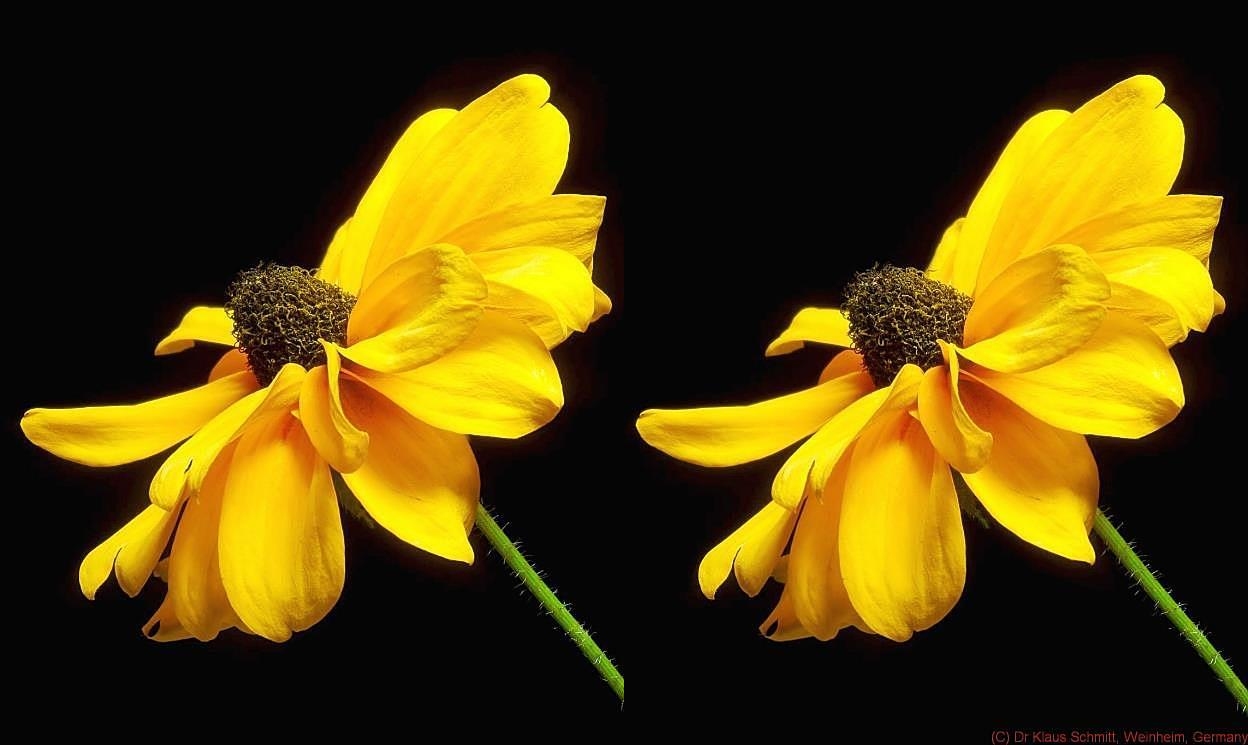
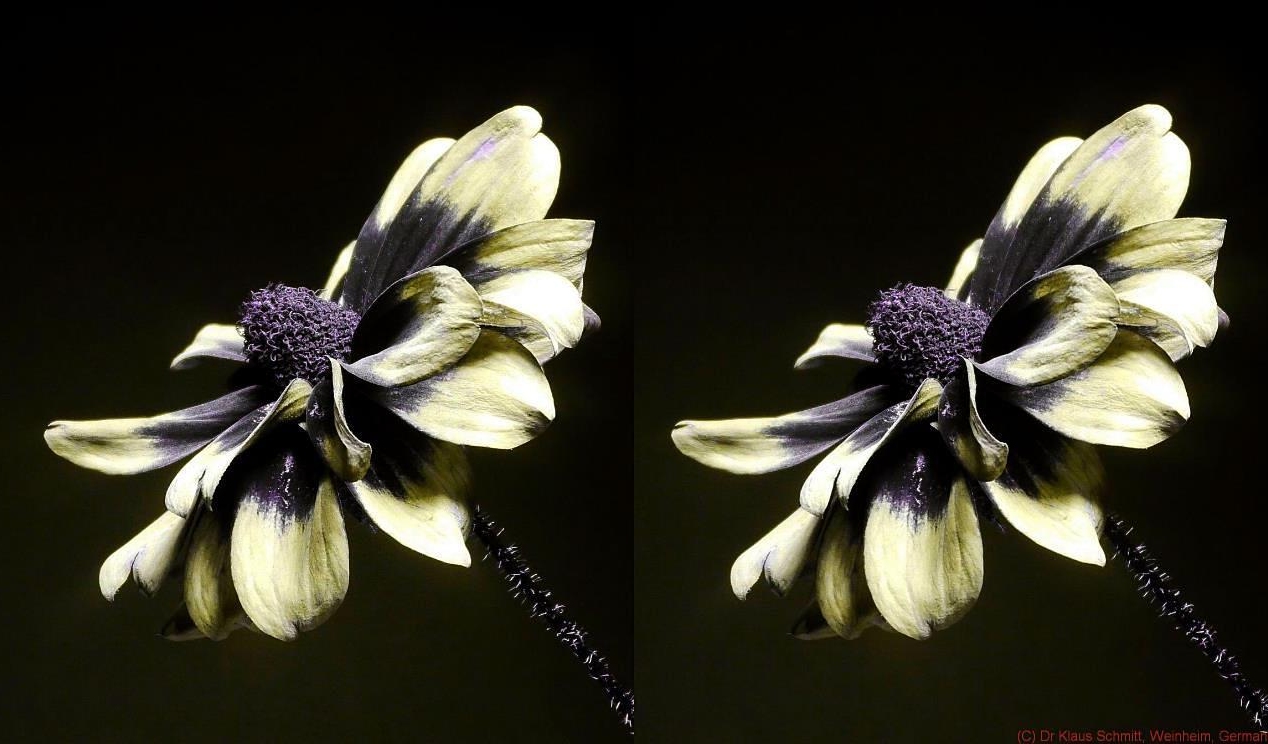
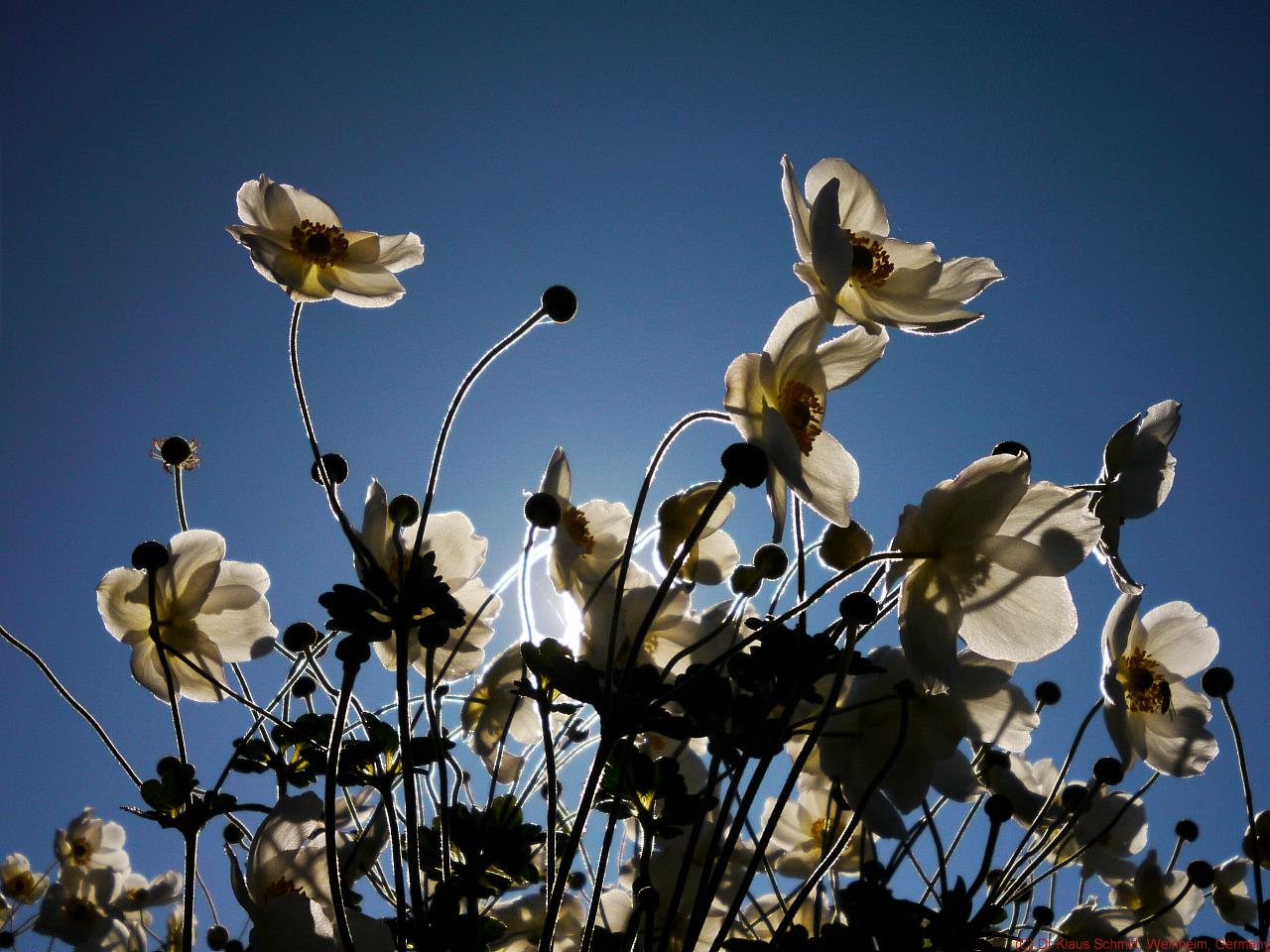
This lens works very well for 3D stereo images, as it is sharp all over. I will certainly also this year do some UV work using this lens....

Just in case you are not able to see that crosseye 3S stereo image, here some instructions which may help:
1) look at the image, center on the middle gap between them (with your glasses on that you need for reading this test sharp = in focus)
2) place the pointer finger at your nose tip without changing your viewing
3) now still looking straigt to the image, try to focus on your finger
4) move the finger towards the gap between the images
5) follow the finger while keeping focused on it
6) at a certain moment an image "between the images" will appear (looking three dimensional); your finger will be approx. 20cm = 8 inches away from your nose (depending on viewing distance from screen)
7) move your concentration towards that "image between the images" and leave it there (and remove your finger then...)
8) that's it...

Stay tuned, more will follow on that fascinating subject...

More info on this very interesting field may be found on my site http://www.pbase.com/kds315/uv_photos

Thursday, June 18, 2015

Wide angle lens for reflected ultraviolet photography and simulated bee vision

Today no flowers shots, but instead testing a f3.5 / 20mm wide angle lens for usefulness in UV and BV, for reflected ultraviolet photography using my "work horse" UV filter, the Baader-U filter as well as my XBV filter for simulating bee vision. Light source was sun. All shots were done at about f3.5.

[click on image to see a larger one]

Triptych of human vision, UV and simulated bee vision (left to right):
 

Well, its gets obvious that this lens has a useful UV transmittance and is quite sharp also in ultraviolet light.

Stay tuned, more will follow on that fascinating subject...

More info on this very interesting field may be found on my site http://www.pbase.com/kds315/uv_photos

Friday, November 25, 2011

[UV] Tested transmittance of eight 35mm wide angle lenses for reflected UV

I conducted a test today to measure the UV transmittance of some older manual focus lenses I had sitting around, all f = 35mm and all having either M39mm or M42mm thread mount, so may easily be adapted onto modern DSLR's, if their back focal length fits the camera register.

Be reminded that this is only a test of the suitable UV transmittance, not of other important parameters for UV photography (sharpness, contrast, freedom of flare or hotspots etc.)


Of course the well known Novoflex Noflexar 35mm stands out as a very well transmitting lens and it is actually not a surprise that the Staeble Lineogon does about equally well - it is the same optics inside as Novoflex subcontracted to the German company Staeble to design their optics, which my own research concluded. Be reminded that the Lineogon was made for the PAXETTE camera with M39 thread mount, but for a 44mm register (so is NOT Leica compatible, but helps to adapt as it allows for 15mm more space).


Stay tuned, more will follow on that fascinating subject...

More info on this very interesting field may be found on my site http://www.pbase.com/kds315/uv_photos

Wednesday, October 19, 2011

[IR, VIS] Hypergon 26mm ultra wide angle also for IR

More today about that ultra wide angle large format HYPERGON lens I have published before.

It turned out that it seems to be a quite useful lens for VIS and now also IR on my UV camera(s), although it has quite some focus shift also in IR (expected from that simple design). The focal length has been confirmed by further measurements to be around 25 - 26mm, so let's stay with 26mm.

Here is a technical article of my friend Marco Cavina, that covers such ultra wide angles nicely with lots of images and diagrams as well as showing never finished prototypes.

Transmission:

[note: measured at f11]

Now more photographic results.... [click on image to see a larger one]

VIS/IR:


Detail:


Quite acceptable also for IR I'd say, even if there is some loss in sharpness and contrast...


Stay tuned, more will follow on that fascinating subject...

More info on this very interesting field may be found on my site http://www.pbase.com/kds315/uv_photos

Wednesday, October 12, 2011

[UV, VIS] Hypergon 26mm ultra wide angle

I found and adapted a previously unknown (in that focal length) ultra wide angle large format lens, obviously a Hypergon design, which Emil von Höegh invented around 1900 for the GOERZ company [he also invented the famous DAGOR lens for them] which was later taken over by ZEISS. Based on that Hypergon design, Robert Richter later in 1934 developed the famous TOPOGON lens for ZEISS, which became the classic aerial imaging lens for quite some time. The earlier Hypergon I have here was made approx. 1950 I would guess with a diagonal angle of view of about 120° (on its designed format of about 145mm image circle).

It turned out that it seems to be a quite useful lens for VIS and UV on my UV sensitive cameras, although it has quite some focus shift in UV (expected from that simple design). The focal length is an estimate, it is somewhere between 24 - 26mm from my measurements. I show the lens aberrations in the following screenshot (scaled to fit that smaller sensor, hence smaller used image angle and object at infinity; for an f11 aperture, which is the optimum for that lens):


Here is a technical article of my friend Marco Cavina, that covers such ultra wide angles nicely with lots of images and diagrams as well as showing never finished prototypes.

Now some photographic results.... [click on image to see a larger one]

VIS/UV:


Transmission:

[note: measured at f11]

These were also shot using it:


and despite the well known aberrations, using it results in quite useful images, also for visible light photography, thanks to its good contrast and sharpness:


and its good flare resistance:


Quite a nice find I'd say...


Stay tuned, more will follow on that fascinating subject...

More info on this very interesting field may be found on my site http://www.pbase.com/kds315/uv_photos

Monday, June 20, 2011

[UV] influence of ray angle when using the Baader-U or classic UV filter

Today again about the "workhorse" of reflected UV photography, the Baader-U "Venus" filter. The old Baader-U had 40 dichroitic layers, the new and currectly sold one has about 100 layers of dichroitic coatings, but on an ionic colored substrate (Schott UG11). That dichroitic coating is only applied to block the IR leakage that SCHOTT UG11 filter glass has, but not to define the filter characteristics itself, as in the case of a pure dichroitic filter on a transparent substrate.

It has been argued that dichroic filters are sensitive to the angle of incidence of the light and that the filter pass-band would be shifting towards shorter wavelengths. What was argued is, that if using wide angle lenses (which hardly exist for transmitted UV anyway), rays may enter the filter at such a high angle of incidence, that the filter transmittance and overall filter characteristics would severely be altered.

That mentioned effect is there of course, but in practice (at least in mine), I have never noticed a negative effect, also since my shortest focal length was about 28mm only and the largest sensor used APS format. At much wider angles and using a full format sensor it would certainly have more impact.

But let's just see how much impact in practice that really has...

Here a spectrometric measurement done in my optical lab (at 0-degrees and 45-degrees incident angle) to show the influence the angle of rays has.

[click on image to see a larger one]


So we see that about 10% in transmittance are lost at 45 degrees, which equals about -1/8 EV and so that has no real relevance on the photographic result. There is also some shift towards shorter wavelengths, but actually it is more a broadening of the total transmission band towards shorter wavelengths of some 13nm (325nm --> 312nm) on the left filter shoulder, whereas the right filter shoulder nearly remains the same (390nm --> 388nm) using the 10% transmittance values - that actually being a positive effect.

In summary the total transmitted energy (= proportional to the area under that curve) should stay about the same, so no effect on the exposure time should be expected, but an ever so slightest change in colors towards the edges of the image might be noticed, if using a full format sensor and a wide angle lens for reflected UV photography - which I have never noticed in my photographic practice.

Well and then there was a thought in the back of my head and I wondered what a ray at an incident angle of say 45 degrees would have to suffer if it had to pass through much more ionic classic "normal" i.e. uncoated colored filter glass at that angle in comparison to a ray at 0 degrees angle...

Here's the result, same setup as with the previously tested Baader-U filter, using the same basic filter glass: SCHOTT UG11


Interesting 12% peak transmittance loss, but no broadening of the transmitted band and no change in shape. In total also only about -1/8EV loss of transmittance, so not really of photographic relevance.

Stay tuned, more will follow on that fascinating subject...

More info on this very interesting field may be found on my site http://www.pbase.com/kds315/uv_photos
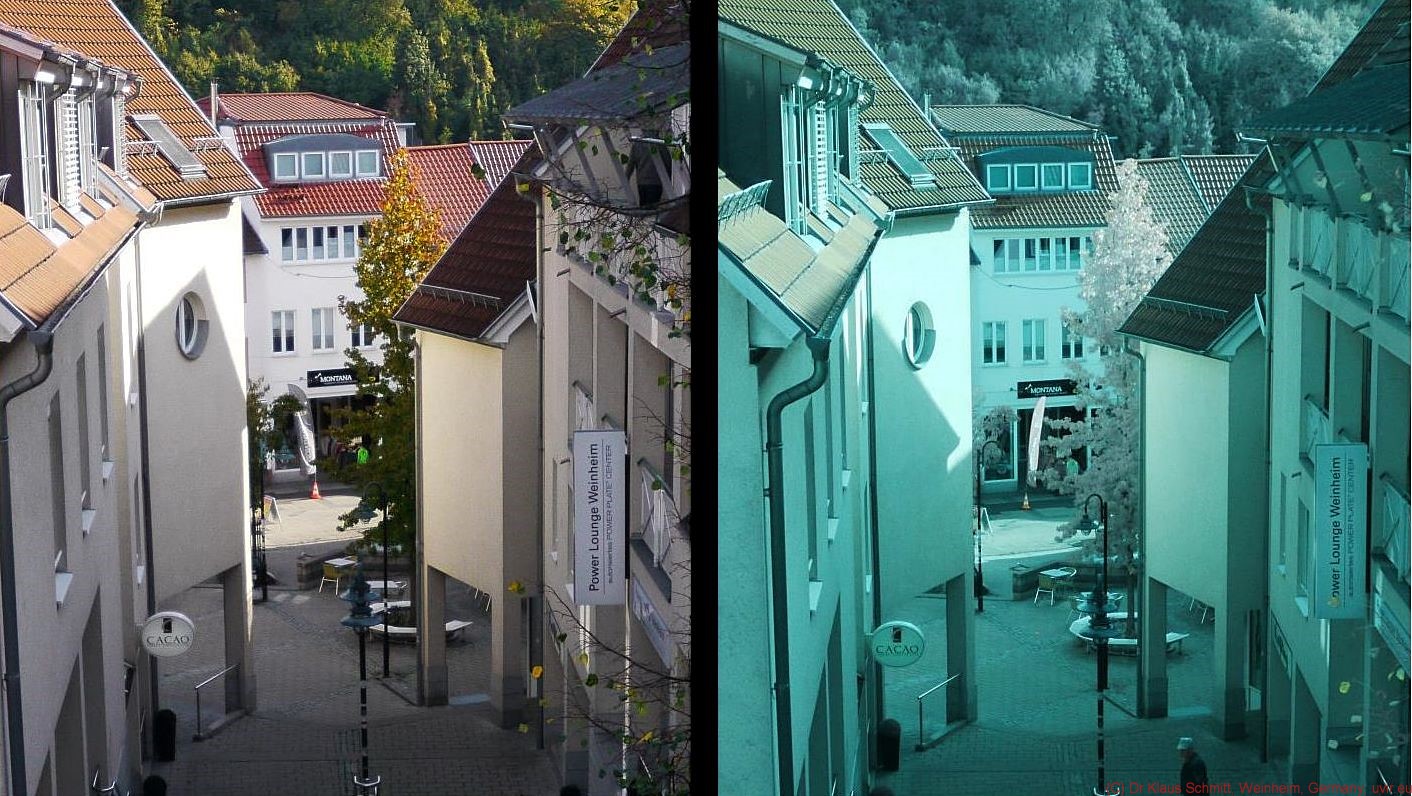
Monday, June 6, 2011

[UV] on wide angle lens whitebalance using a GH1-UVIR

In previous posts on whitebalancing using my ReflectionDisc I warned about generalizing results and stated that it is only valid for that camera, that lens, that filter and that lighting situation. Well, I was curious, how much would change if two parameters were changed: a) using a wide angle lens (with substantial less UV transmission), b) lighting situation
So, using my GH1-UVIR, a Cerco 94mm lens, Baader-U filter and sunlight, I had preset a whitebalance for a similarely lit situation using my Reflection Disc, call that WB1 for now.

The weather today was very overcast and no sun, just about 250 microWatt/cm² UV-A (as measured using a calibrated Minolta UV-A meter).
The lens was changed, from a color corrected, flat transmitting (<300nm) quartz / fluorite lens to a non-color corrected not that much UV transmitting conventional wide angle lens, a 2.8/28mm in that case, which barely reaches about 350nm, to see which impact that would have. A set WB was done for that 28mm wide angle lens, call that WB2.
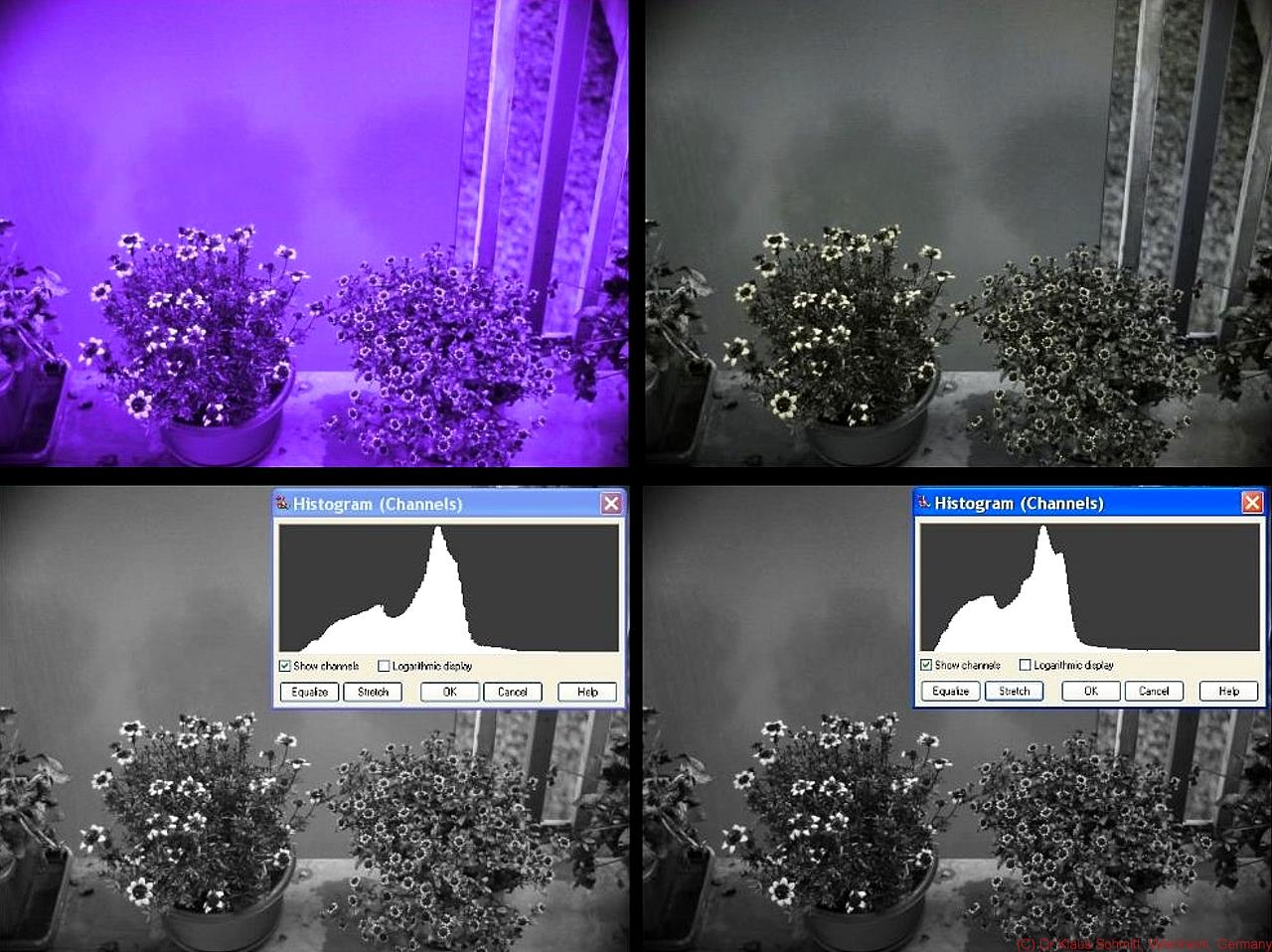
So what we see here is:
1) top left: previously set sunlight WB used (WB1)
2) top right: correct WB for that lighting situation set (WB2)
3) bottom left: previously set sunlight WB used (WB1), bw version with histogram
4) bottom right: correct WB for that lighting situation set (WB2); bw version with histogram
[click on image to see a larger one]


Here now quite some difference in whitebalancing may be noted; the preset WB1 was quite different from the correct WB2 for that lens (and lighting situation). Major impact had the lens change, not the changed lighting. As may be seen on the histogram, the correctly whitebalanced image is about 1/4 - 1/3 stop less exposed than the incorrectly one (both images were identically exposed at 1/1.6sec, same ISO) , so consequently using the correct WB at shooting time would require a somewhat higher exposure.

SUMMARY: UV whitebalance, for lenses having very different spectral (UV-) transmission, should be correctly set at exposure, not later in post processing and properly exposed (a tad more).
P.S.: I have tested at different exposure values (higher + lower) but the principal result remained the same.


Stay tuned, more will follow on that fascinating subject...

More info on this very interesting field may be found on my site http://www.pbase.com/kds315/uv_photos