Showing posts with label 365nm. Show all posts

Saturday, October 24, 2020

Reflected UV photography + videography using a MCP Amplified Camera System III

Today more about an experiment I have done, using a light amplification device in front of a normal visible light camera for recording reflected UV footage. This device uses a MCP (multi channel plate) with UV sensitive photocathode (approx. 190nm - 650nm), amplifies light by approx. 20-50.000 and shows the resulting image on a green phosphor screen. 

Using a suitable optical system, I relayed this image to my normal, visible light camera. UV filter used was a fully IR blocked (OD6) UV transmission filter (peak at 250nm). Target was a tea candle.

Using a f3.5/50mm quartz fluorite lens and an extension tube to get higher magnification.

1) Visible / IR light recorded w/o filter on full spectrum camera:


2) UV light recorded with a (fully blocked to 1100nm) 311nm filter on full spectrum camera: 

It gets rather obvious that the 311nm line is - as expected - quite intense on the visible left and right outsides of the candle, where the UV emission of the OH (hydroxyl) radicals happens.

3) UV light recorded with a (fully blocked to 1100nm) Baader-U (320-395nm) filter on full spectrum camera:

The reaction of the CH (hydrocarbon) radicals however emit UV around 385-395nm mostly on the top, which can be shown using the Baader-U UV transmitting filter (320-395nm).

I have written about this system doing still UV photography HERE.

I have done similar with a different amplified camera system before which did not allow to have an external camera attached, with just a TV output HERE

Stay tuned, more will follow on that fascinating subject...

More info on this very interesting field may be found on my site http://www.pbase.com/kds315/uv_photos

Tuesday, April 28, 2020

Enhancing the visibility of fossil tissue structures using UV reflected and UV stimulated visible flourescence photography II

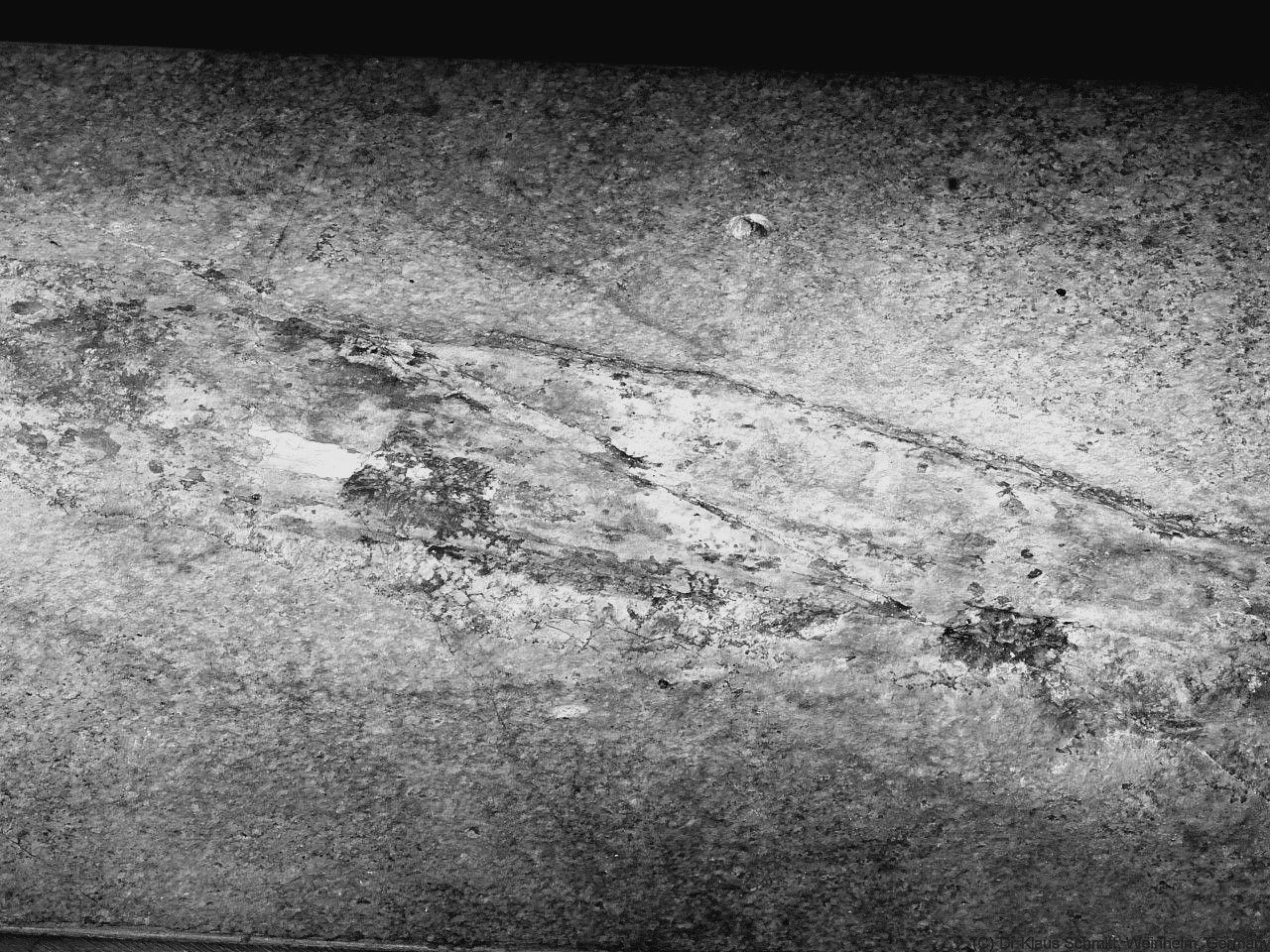
A while ago I had the honor to work with Neal Larson on a paper on fossilized cephalopods found in Hajoula, Lebanon. Today it is again about enhancing the visibility of fossil bone and tissue structures using reflected UV and UV stimulated visible fluorescence photography, but as it is some years later, using more modern equipment now. Lens used was my UV-Nikkor 105mm quartz fluorite lens, light sources were a modified high power Xenon flash, as well as a NICHIA 365nm LED. Filters used were the Baader-U filter as well as a 420nm Long Pass filter. Target was a fossilized squid from the Upper Cretaceous period, approx. 90 million years old.

[click on image to see a larger one]

Visible light image using UV/IR Cut filter:


Reflected UV image using Baader-U filter (310-390nm) with 365nm UV LED: 


Reflected UV image using Baader-U filter (310-390nm) with 365nm UV LED (in bw):


UV stimulated visible Fluorescence image with 420nm Longpass filter: 


UV stimulated visible Fluorescence image, 2nd version, with UV-IR Cut filter:


It gets nicely visible that using UV light photography brings out much more details than normal visible light photography and by doing so, enhances the visibility quite a bit.

I have written more about fossils HERE

Stay tuned, more will follow on that fascinating subject...

More info on this very interesting field may be found on my site http://www.pbase.com/kds315/uv_photos

Friday, December 23, 2016

Deep UV Ultraviolet Reflected Light Photography at UV-B and UV-C recording with candle light

Today another proof that reflected UV photography is doable at UV-B and UV-C using several special, up to NIR blocked, narrowband filters and a very different UV camera, an amplified 190-650nm MCP equipped video camera. Lens used was a CERCO f1.8/45mm quartz flourite lens. Light source was a candle flame.

[click on image to see a larger one]

This reveals, that the deeper one looks into UV, the area where the candle flame emits that UV moves from the top of the flame down to the sides of the flame. Pretty amazing how sensitive this type of camera is, as the needed amplification was still just in the lower 30% of the total available range.

I have a newer system HERE with a normal camera attached to the MCP amplification device.

I have previously written more about combustion and UV HERE.

Btw. Michael Faraday has in 1848 given six famous lectures about the chemical history of the candle, which may be read about HERE

Stay tuned, more will follow on that fascinating subject...

Sunday, November 16, 2014

Enhancing the visibility of fossil tissue structures using UV reflected and UV stimulated visible flourescence photography

A while ago I had the honor to work with Neal Larson on a paper on fossilized cephalopods found in Hajoula, Lebanon. Today it is again about enhancing the visibility of fossil bone and tissue structures using UV reflected and UV stimulated visible fluorescence photography, but as it is some years later, using more modern equipment now. I will also use my remapping technology consisting of a visible image, a reflected UV image and an UV stimulated visible fluorescence image and combine them into multispectral images.

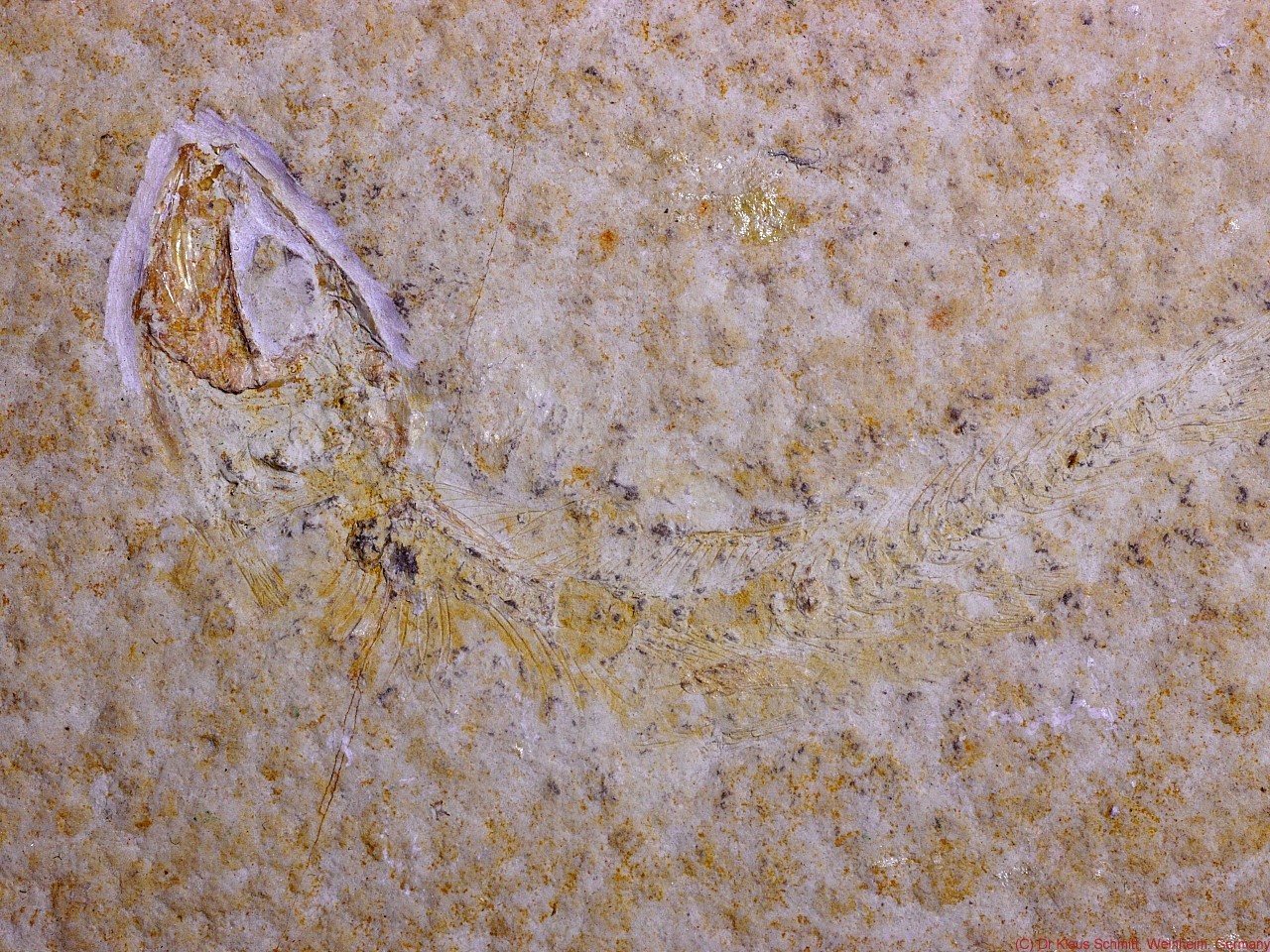
Lens used was my CERCO f4.1 / 94mm quartz fluorite lens, light sources were a modified high power Xenon flash, as well as a NICHIA 365nm Power LED. Target was a fossilized fish from Solnhofen, Germany, approx. 100 Mio years old.

[click on image to see a larger one]

Visible light image using UV/IR Cut filter:


Reflected UV image using Baader-U filter (310-390nm): 


UV stimulated visible fluorescence (FL) using Nichia 365nm UV LED:


Combined VIS - FL multispectral image: 


Combined VIS - UV multispectral image::


Combined FL - UV multispectral image::


It gets nicely visible that using UV light photography brings out much more details than normal visible light photography and by doing so, enhances the visibility of preserved bone and tissue structures quite a bit. Combining those different images into falso color multispectral images  enhances the structures even more.

Stay tuned, more will follow on that fascinating subject...

More info on this very interesting field may be found on my site http://www.pbase.com/kds315/uv_photos

Friday, January 11, 2013

Quartz lens for reflected UV photography?

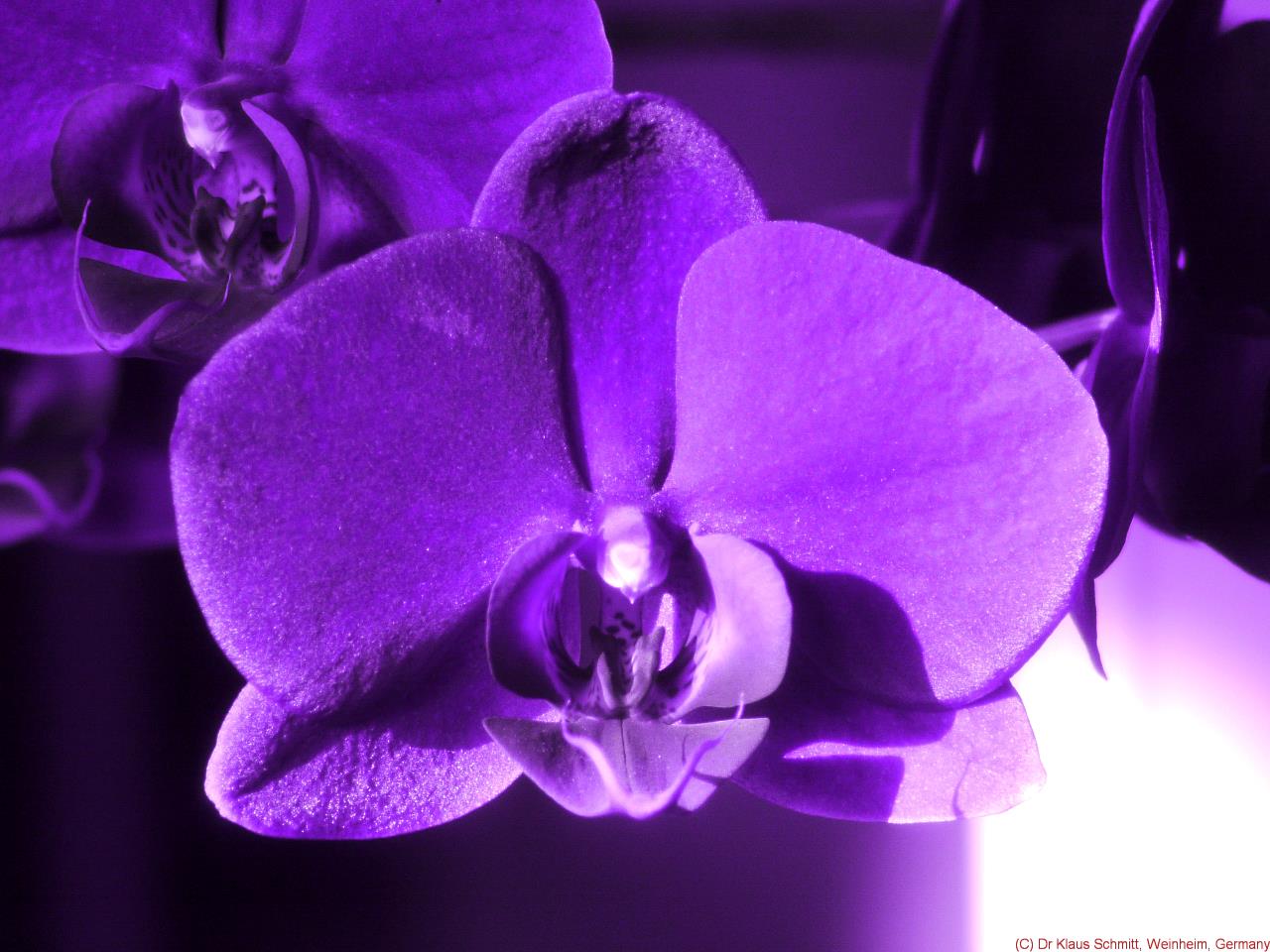
Today about using a quartz lens for reflected UV photography. I'm using quite rare Quartz Takumar f3.5 85mm for this and one of the few flowers available, a Phalaenopsis orchid, as well as my "work horse" UV filter, the Baader-U filter. Light source was sunlight and a Nichia UV LED (365nm). The questions was, how the image quality would turn out, knowing that such lenses should only be used for a quite narrow wavelength band (literature states between 10nm and 20nm depending on source), as these lenses are not chromatically corrected. All shots were done stopped down to f8, which is a usual working aperture to get enough DOF and sharpness.

[click on image to see a larger one]
Here some results:
visible light image using UV/IR cut filter:
 

multispectral image (i.e. unfiltered) and sunlight:
 

UV image using Baader-U filter and sunlight:
 

UV image using Baader-U filter and sunlight + 365nm UV LED:
 

Findings:
1) There is a substantial focusing difference, here 5mm between the UV (95mm) and the VIS image (100mm between front and camera mount), resulting in a 5% different image size when focused both (UV image is smaller). Distance orchid - camera was 700mm.
2) When white light is being used for visible photography, the 400-750nm band is quite broad, i.e. 350nm, which leads to quite visible CA (around edges), soft image and loss of contrast.
3) When white light is being used for multispectral (i.e. unfiltered ca 300-1100nm) photography, that band is even broader, leading to even softer images and loss of contrast.
4) Also the UV image taken in sunlight using a Baader-U filter (320-395nm i.e. 75nm bandwith) leads to rather soft images, but a bit better as the band is narrower, only 75nm wide.
5) The UV image taken in UV LED light at 365nm (ca 20nm bandwith) using a Baader-U filter leads to the best image, as here only the narrow 20nm bandwith of the UV LED around 365nm plays a role. The image is crisp, sharp (see structures on petals) and has a rather high contrast.

Conclusion is, that only if quasi monochromatic photography is being done (either using narrowband UV filters or narrowband UV light), acceptable results can be expected. For broadband UV photography, chromatically corrected UV lenses are required, such as quartz fluorite lenses.

Stay tuned, more will follow on that fascinating subject...

More info on this very interesting field may be found on my site http://www.pbase.com/kds315/uv_photos
Friday, September 14, 2012

Nichia 365nm flashlight: Beam Homogenizer for reflected UV photography and UV induced visible fluorescence

Today, after having previously shown the Nichia based NC4U133 (365nm) / NC4U134 (385nm) systems and my newest High Power UV LED Radiation System with easily exchangeable radiation heads for nominal wavelength of 365nm, 385nm, 395nm, 400nm and 405nm using the most modern 40W UV LEDs, I present something much easier: a simple beam homogenizing solution for the meanwhile quite commom 365nm Nichia flashlights which use the single dice NCSU033A and NCSU033B chips.

After a long search I finally located a specifically designed beam homogenizing solution that sufficiently transmits UV and allows to generate a quite even radiation field, which is beneficial to have, especially for photography which usually requires even illumination of the target.

I have also tested it working with the newer 4 dice Nichia NC4U133 (365nm) and NC4U134 (385nm) chips, but those are not used for portable flashlights yet as far as I know.

[click on image to see a larger one]

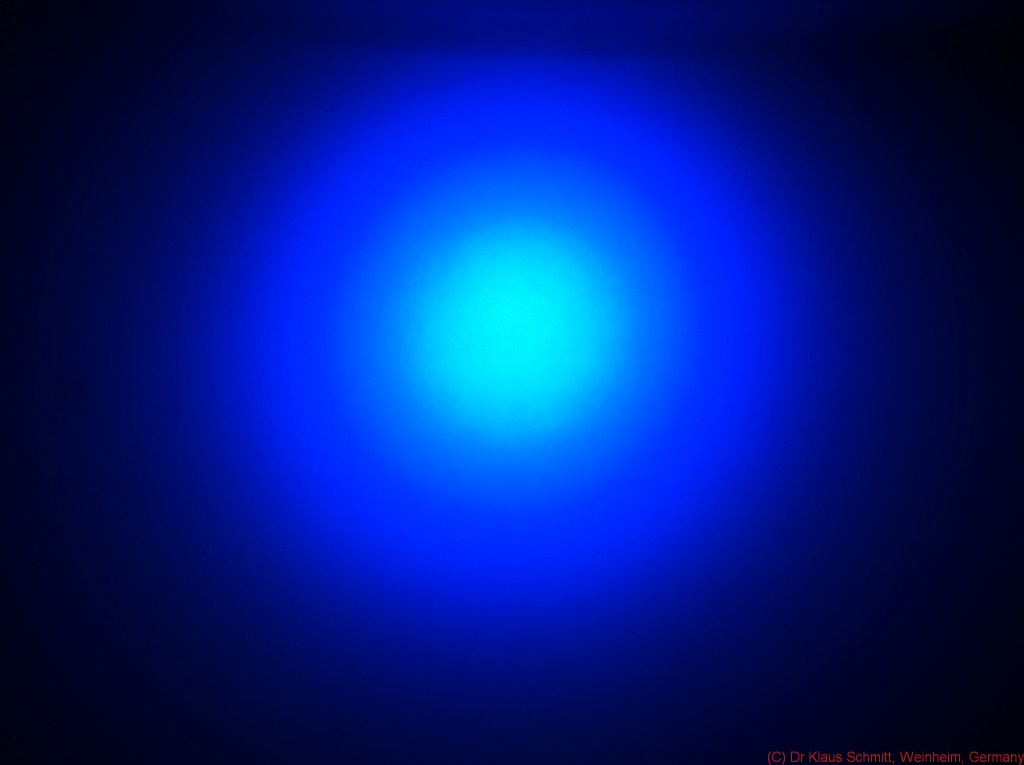
Radiation field without homogenizing solution: 


Radiation field with homogenizing solution: 


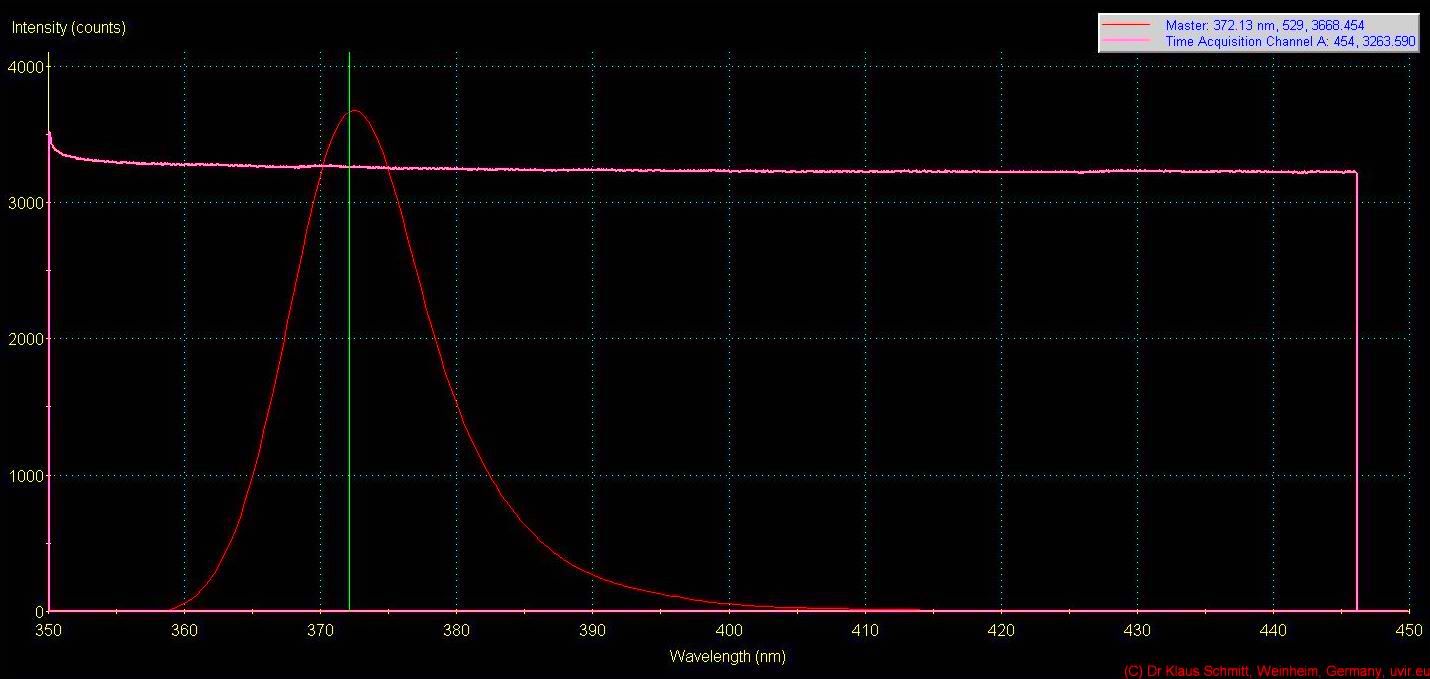
Transmission of the homogenizing solution in use:


Theses simple flashlights are useful for different applications, such as stimulating visible fluorescence, reflected UV photography, forensic, dermatological and detal examinations and photographic recording, curing of UV glue / bonding, as well as leakage detection etc.

Stay tuned, more will follow on that fascinating subject...

More info on this very interesting field may be found on my site http://www.pbase.com/kds315/uv_photos

Wednesday, September 12, 2012

High Power UV LED Radiation System: 365nm 385nm 395nm 400nm 405nm

Today, after having previously shown the Nichia based NC4U133 (365nm) / NC4U134 (385nm) systems, I present here my newest High Power UV LED Radiation System with easily exchangeable radiation heads for nominal wavelength of 365nm, 385nm, 395nm, 400nm and 405nm using the most modern 40W UV LEDs. [Other visible or IR wavelngth also possible as well as high power white light for comparison studies. Optional: infrared or wire remote system control]

A specifically designed beam homogenizing system allows a very even radiation field that can be factory adjusted to a desired size. One example being a 365nm (nominal) head with a 55mm radiation field, evenness of radiation <20%, precisely adjustable radiation strength 2 ... 30mW/cm². The AC operated system is cooled and has been designed for long term radiation sessions up to several hours.

[click on image to see a larger one]

Radiation Head with mounted homogenizing optics:


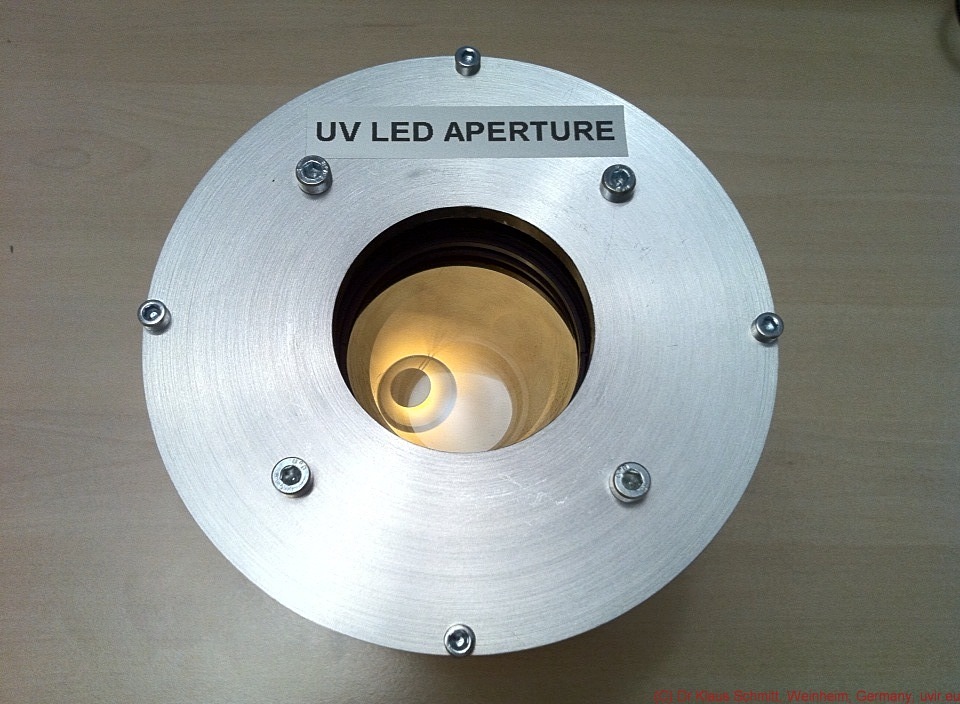
Homogenizing optics, beam exit aperture showing UV coated fused silica optics:


System in stable operation for some 10.000sec (3h) at full power:


The system is useful for different applications, such as very even UV radiation for photocatalytic processes, to stimulate visible fluorescence, for reflected UV photography, forensic, dermatological and detal examinations and photographic recording, curing of UV glue / bonding, as well as leakage detection etc.

Stay tuned, more will follow on that fascinating subject...

More info on this very interesting field may be found on my site http://www.pbase.com/kds315/uv_photos

Saturday, August 4, 2012

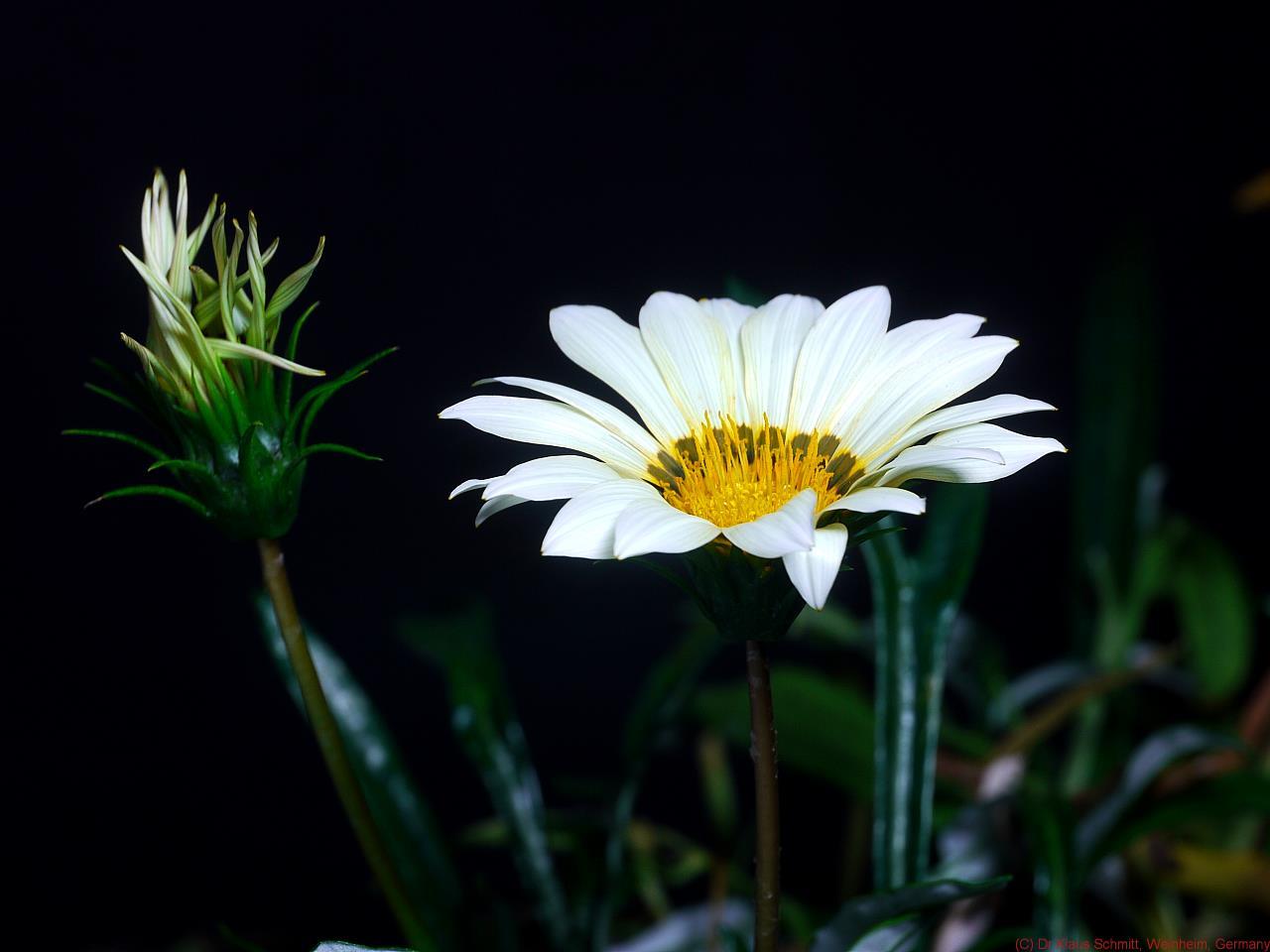
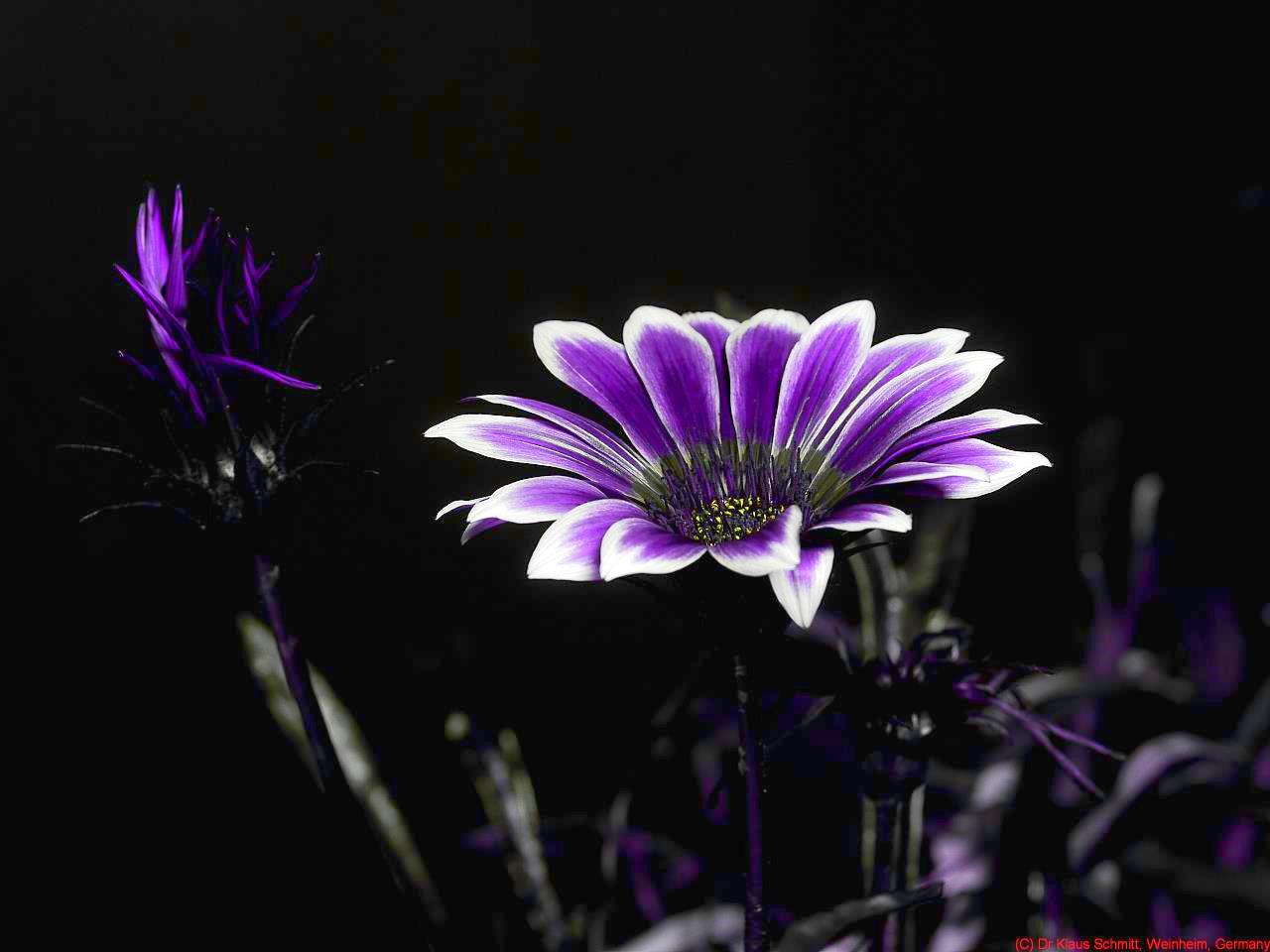
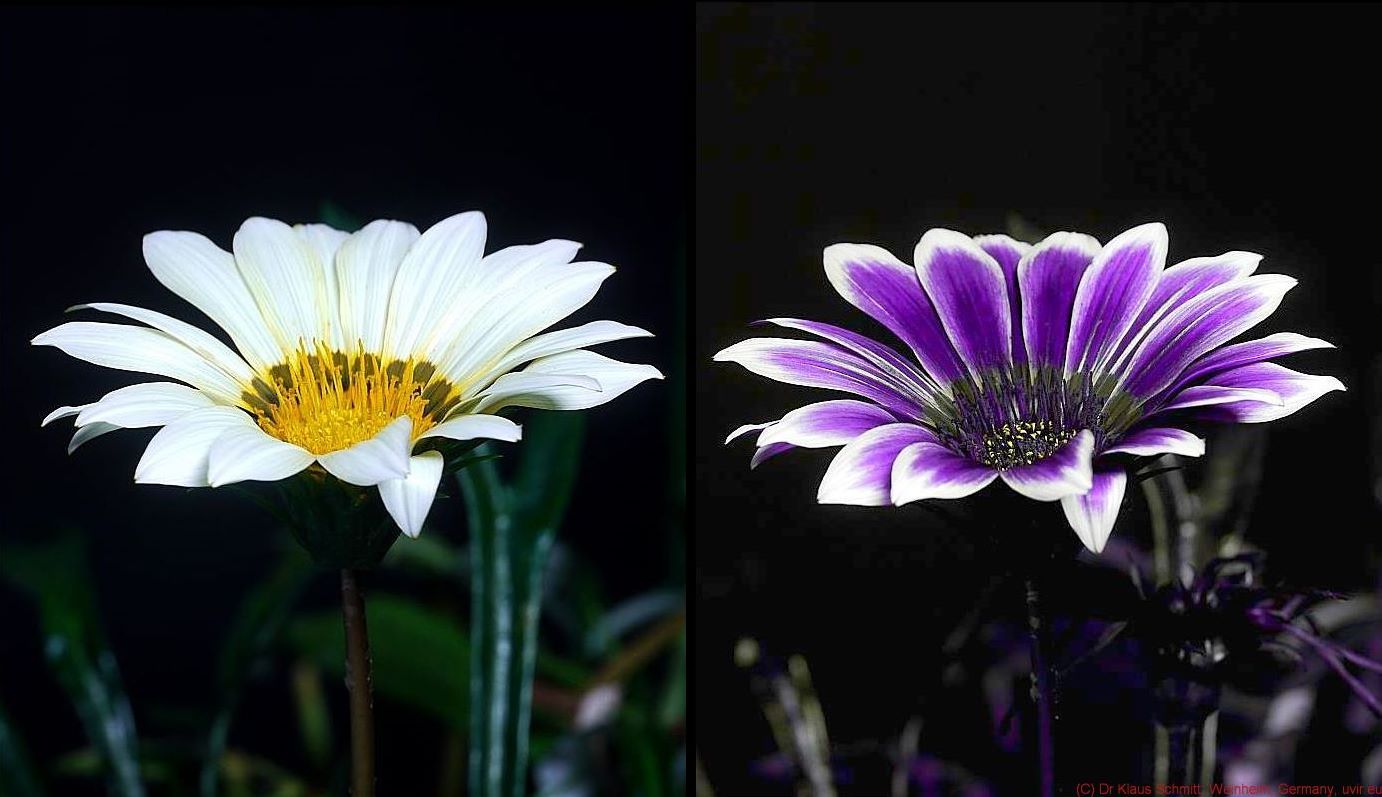
White Gazania rigens flower: Baader-U filter for reflected UV ultraviolet photography

More about a white Gazania flower, most likely Gazania rigens. Shot in visible and ultraviolet light, using the Baader-U filter and a high power Xenon flash as well as an UV sensitive camera.

[click on image to see a larger one]

Visible light image:


Ultraviolet (UV) light image:


Diptych VIS - UV:


The petals of this white Gazania are quite special, since they show in UV an otherwise invisible bright rim (reflecting around 370nm) against a UV darker, but still reflective (around 385nm) inside. The stigmas are also very UV bright, whereas the stamen are quite dark so overall create quite distinct UV nectar guides for their pollinators.

Stay tuned, more will follow on that fascinating subject...

More info on this very interesting field may be found on my site http://www.pbase.com/kds315/uv_photos
Friday, May 25, 2012

[UV] Sedum flower: Baader-U vs Jupiter-U filter for reflected UV ultraviolet photography

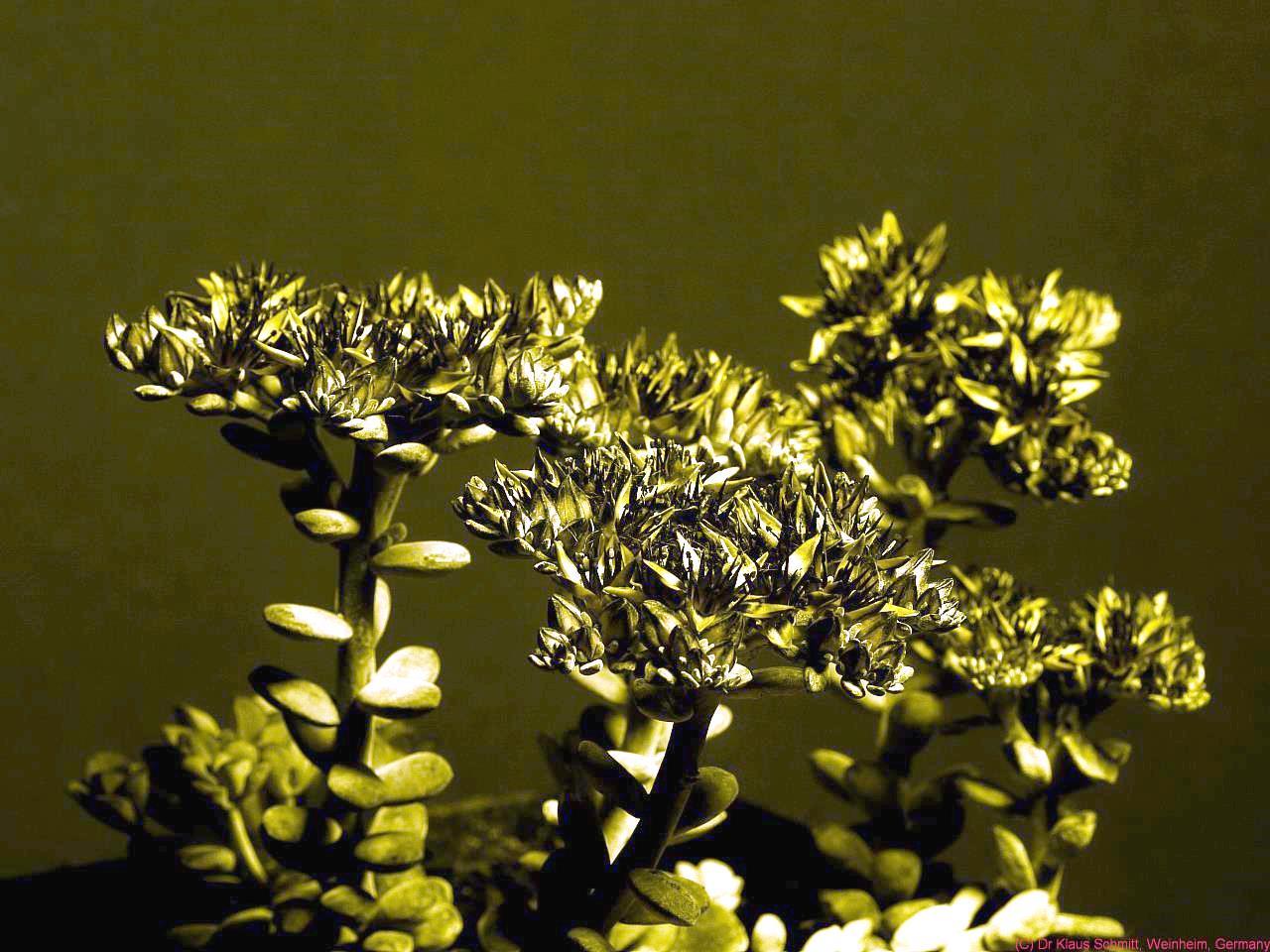
Again more about that new Jupiter-U filter of mine. This time it is about a yellow Sedum spathulifolium flower, that I bought at a nursery (Huben, Ladenburg, Germany)

[click on image to see a larger one]

All triptychs are presented VIS left, Baader-U middle, Jupiter-U right:


Although this one has an overall 365nm main reflection, inside that flower is some long wave (around 385nm I'd say) UV reflection visible, that only the longer wave Baader-U filter is able to reveal.

Here details of that flower...

using the Baader-U filter:


and the Jupiter-U:


Overall this interesting plant looks like this (VIS, Baader-U, Jupiter-U)


Might it be that the unusual high UV reflection of its leafs aims at protecting it from too much UV radiation? Here how that looks like in closeup (VIS / UV):


Mother nature has quite good ideas!


Stay tuned, more will follow on that fascinating subject...

More info on this very interesting field may be found on my site http://www.pbase.com/kds315/uv_photos

Wednesday, May 23, 2012

[UV] Cinquefoil or Potentilla flower: Baader-U vs Jupiter-U filter for reflected UV ultraviolet photography

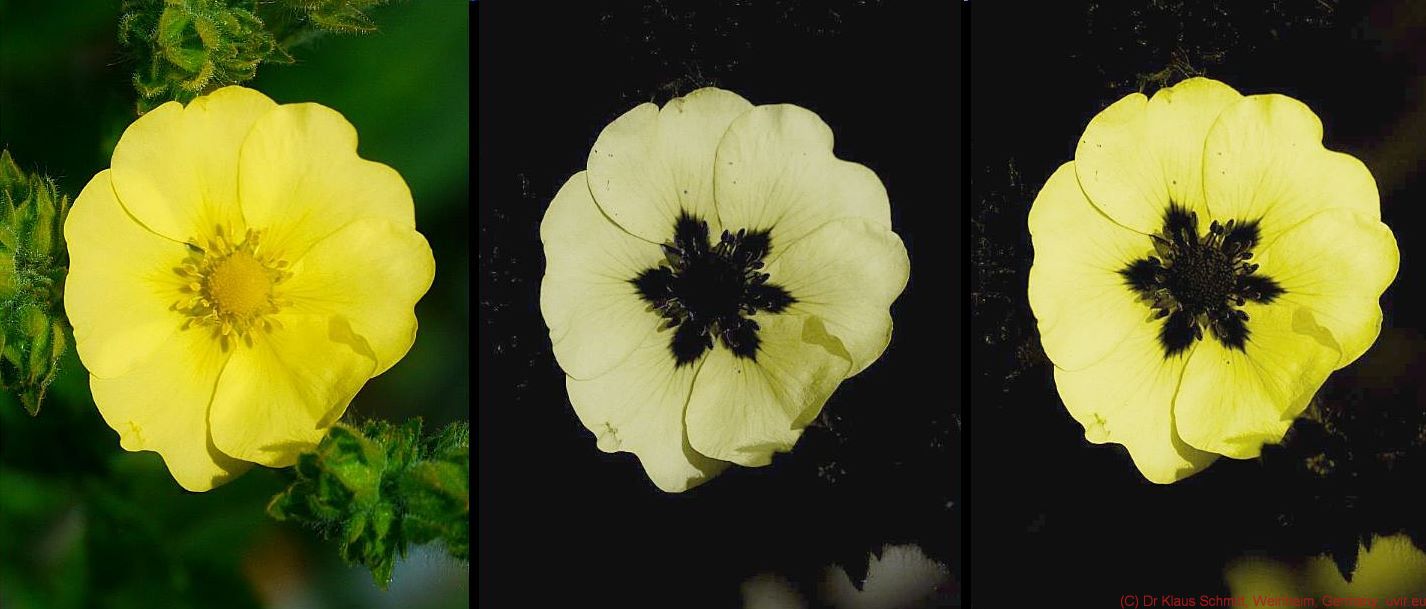
Again more about that new Jupiter-U filter of mine. Also those shots were taken at the wonderfully blossoming Hermannshof, Weinheim, Germany. This time it is about a yellow Potentilla flower.

[click on image to see a larger one]

All triptychs are presented VIS left, Baader-U middle, Jupiter-U right:


Potentilla has a very strong UV reflection around 365nm, so much that it actually overpowers all around.

Stay tuned, more will follow on that fascinating subject...

More info on this very interesting field may be found on my site http://www.pbase.com/kds315/uv_photos

Monday, May 21, 2012

[UV] Gazania flower: Baader-U vs Jupiter-U filter for reflected UV ultraviolet photography

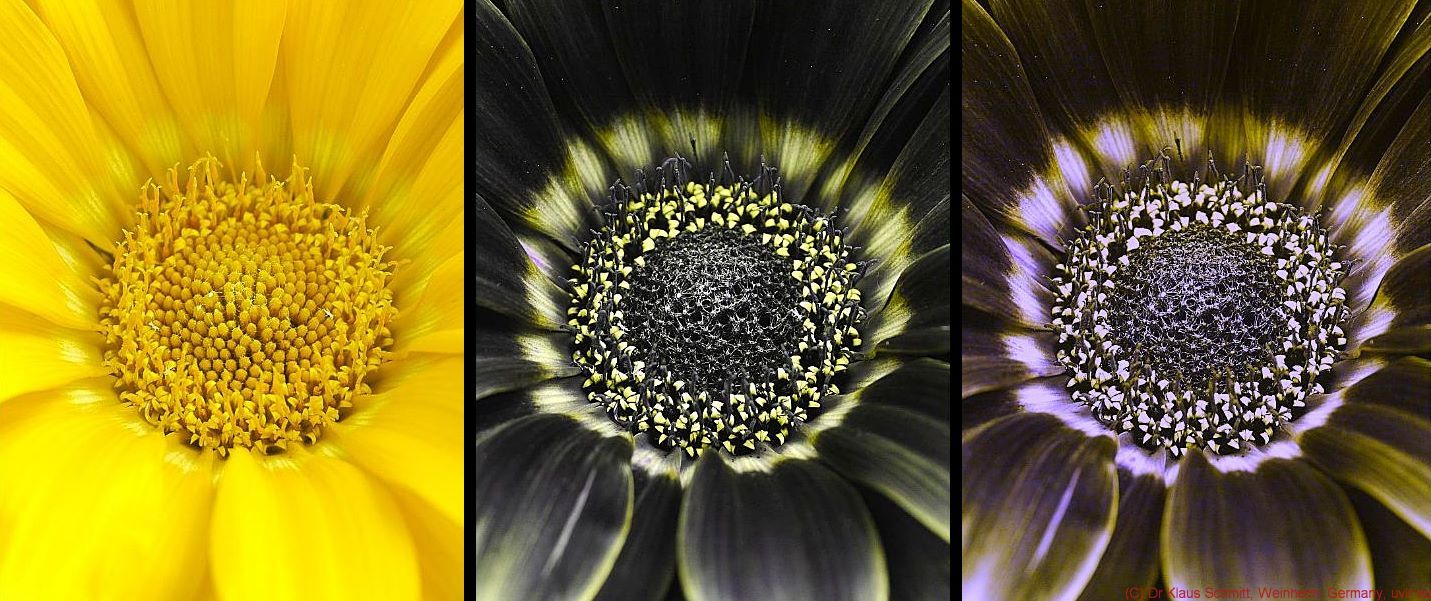
Again more about that new Jupiter-U filter of mine. This time it is about a yellow Gazania flower, most likely Gazania rigens.

[click on image to see a larger one]

All triptychs are presented VIS left, Baader-U middle, Jupiter-U right:


Center detail (different shots):


and even more detail:


Here the difference between the results of these two UV filters is not great, since the main UV reflection is around 365nm, which both filters transmit equally well. The petal tips and bottoms, as well as the stamens in the center reflect UV quite strongly around 365nm and create quite distinct UV nectar guides for their pollinators.

Stay tuned, more will follow on that fascinating subject...

More info on this very interesting field may be found on my site http://www.pbase.com/kds315/uv_photos

Sunday, May 6, 2012

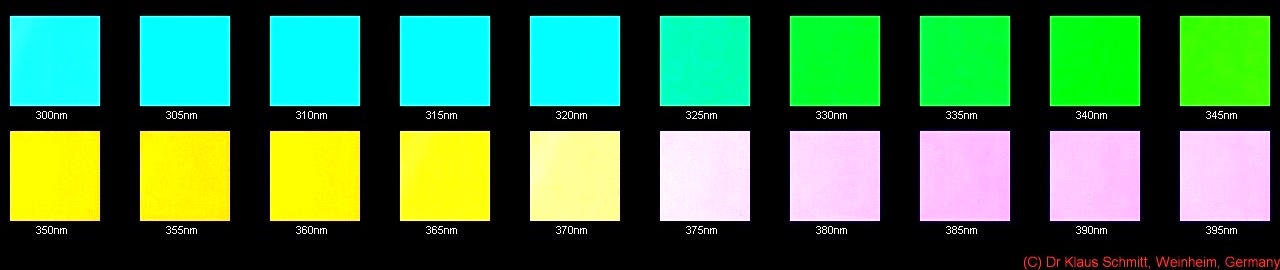
[UV] filters for recording deep(er) reflected UV for peak 375nm, 365nm, 350nm, 325nm

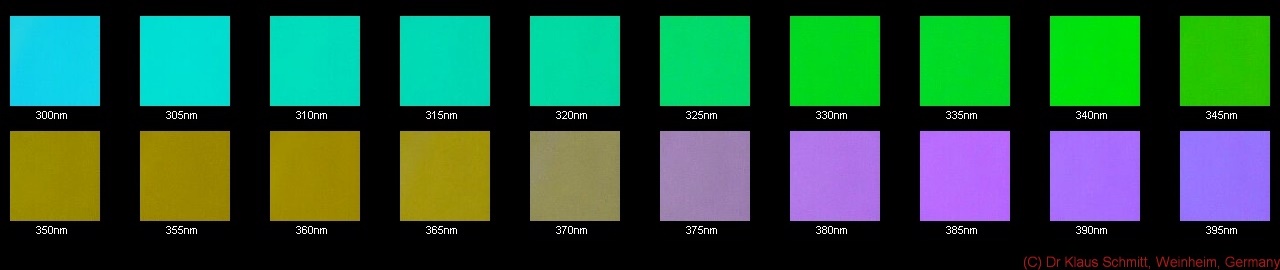
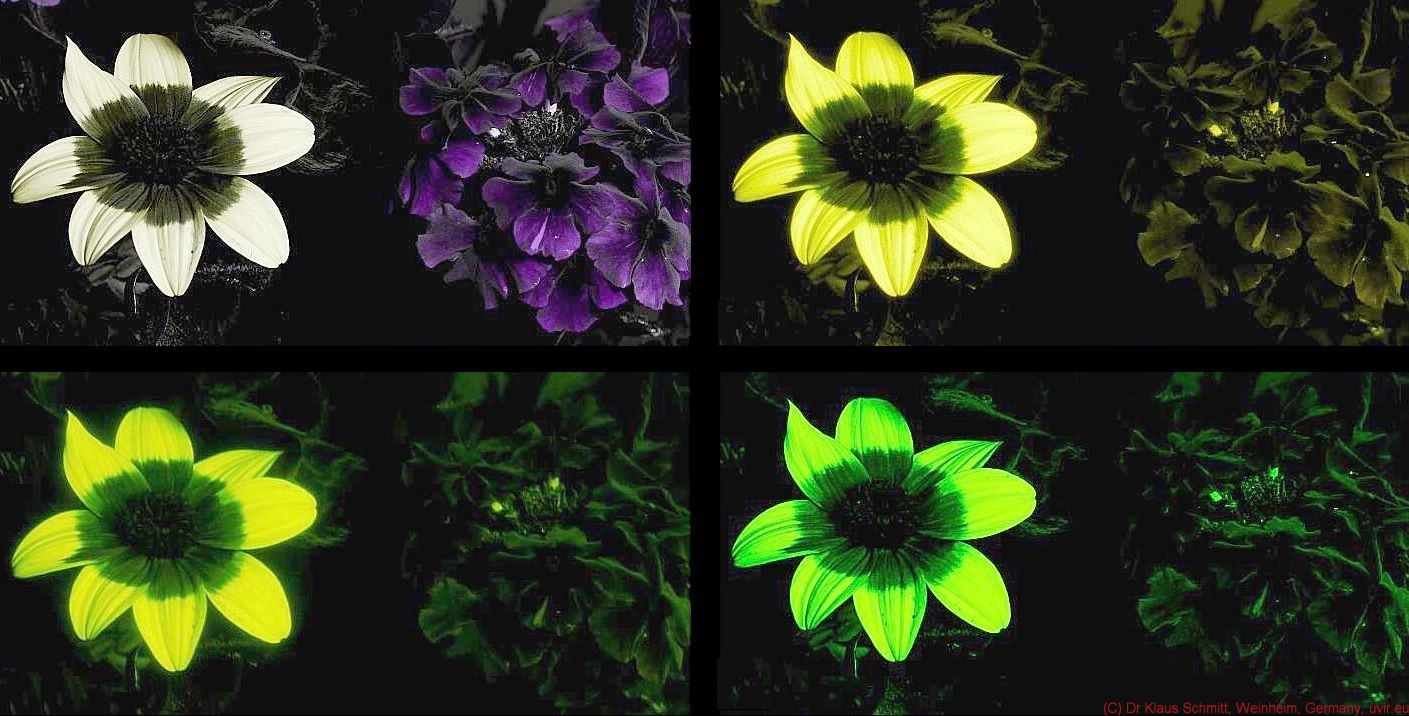
Here a comparison of the false UV colors to expect using the Baader-U white balance setting when using specific short wave filters for deeper reflected UV recording with the effective [*] peaks: 375nm, 365nm, 350nm, 325nm. It includes that new Jupiter-U filter of mine.

[click on image to see a larger one]

The UV images here also uses my standardized false UV color normal + high intensity palette:


top left: Baader-U (effective peak approx. 375nm), top right: Jupiter-U (effective peak approx. 365nm)
bottom left: filter stack I (effective peak approx 350nm), bottom right: filter stack II (effective peak approx. 325nm)
[ignore quality issues please, these latter three are experimental versions]

Interesting to note, that the red channel looses on intensity when the wavelength gets shorter, the green channel stays about constant, the blue channel declines first, then later on (325nm) recovers slightly.

Note that the exposure of these 4 images are not the same; I tried to get about equal exposed results.

[*]In that context "effective" means what the combination of filter, lens, sensor results in (for a given light source: sun / Xenon in that case) as a peak wavelength for that combination (lens is a flat transmitting quartz fluorite lens, Cerco 94mm in that case) as per my simulation system.

So, now the question arises of course, if such deep UV explorations is only for the the priviledged owners of a quartz fluorite lens. Well, have a look at that following test result using a common 35mm lens and the same filter sequence as above.


Of course there are differences, especially in exposure, but in principle, it seems doable. Don't get too excited, please, the exposure difference is a massive one.

I will reveal more about these experimental filters of mine here later, once they have proven their usefulness and when acceptable photographic quality has been achieved.

Stay tuned, more will follow on that fascinating subject...

More info on this very interesting field may be found on my site http://www.pbase.com/kds315/uv_photos

Sunday, April 11, 2010

[FL] Another Bouquet: Gerber Daisy, Hyacinth, Roses,...

Here a UV induced visible fluorescence shot of another flower bouquet using Nichia 365nm UV LED and a 400-700nm UV/IR Cut filter.

[click on image to see a larger one]


and here for comparison the white light (5600K LED) shot


closer to see more details...


Well and here as another comparison, what happens when a Xenon flash with UV filter is used to stimulate fluorescence.

UV Xenon flash, but that leads to IR + red contamination as may be seen here:


and here now using a BG filter to compensate for that


but in overall comparison, the Nichia UV LED wins hands down IMHO!


Stay tuned, more will follow on that fascinating subject...

More info on this very interesting field may be found on my site http://www.pbase.com/kds315/uv_photos

Tuesday, July 14, 2009

Blue Bananas?

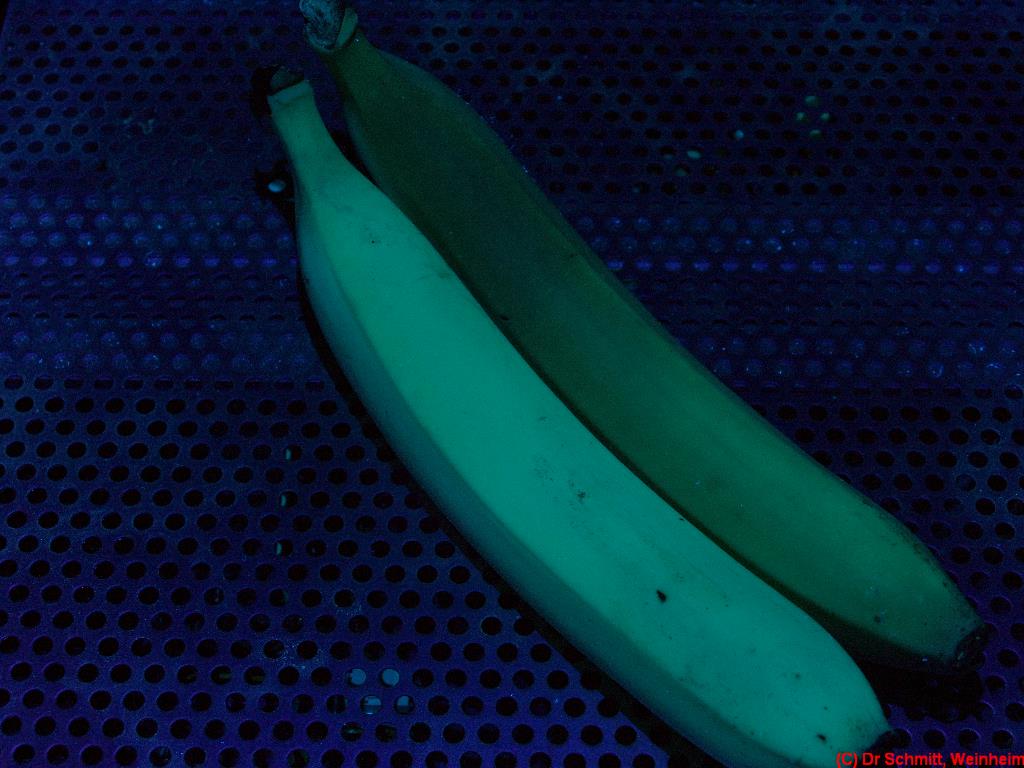
Well, something interesting and kind of funny today. I read on the net, that scientists in Innsbruck, Austrai and Columbia University, New York have found, that bananas emit blue fluorescence light when radiated with UV light of 365nm, but depending on the degree of ripeness of the banana. This is caused by breaking down of the green chlorophyll and these byproducts accumulate in the peel. So why not try to make that visible, since I have that equipment anyway here for my UV photography...

[click on image to see a larger one]

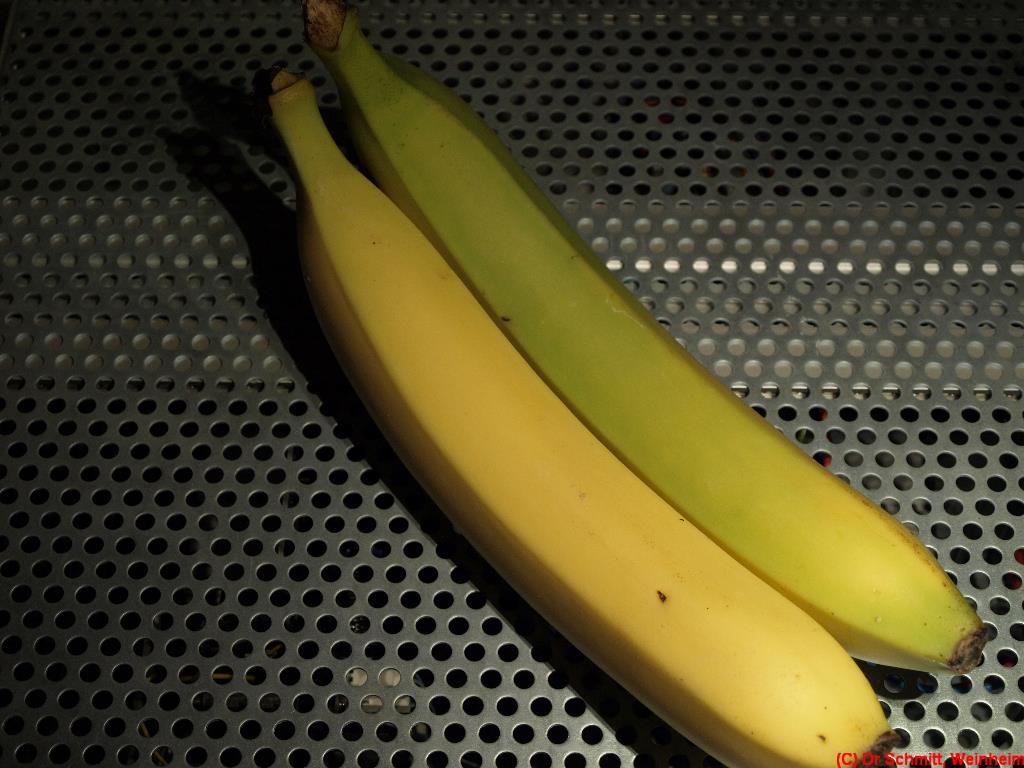
The bananas as we all know them in visible light:


Now radiated with my 365nm Nichia UV LED and with UV blocking filter in front of the camera lens:


Just looking at the blue channel makes it even more prominently visible:


So obviously bananas do fluorescence and it gets very obvious that the one in front is the ripe one, wheras the one in the back is the green, unripe banana. So have your UV light ready when shopping for bananas next time...!!

Stay tuned, more will follow on that fascinating subject...

More info on this very interesting field may be found on my site http://www.pbase.com/kds315/uv_photos

Tuesday, July 29, 2008

Dive into the Beauty of Rudbeckia fulgida flower

So, again, the same setup as before - how boring? I'm just excited (pun intended, since it is fluorescenece...) about that beauty of that Rudbeckia fulgida flower, so let's dive into that a bit more, using some old lens I always wanted to try out, and voíla, that is one great little razor sharp gem (and no, it it not one of my loved Zeiss Luminars)!
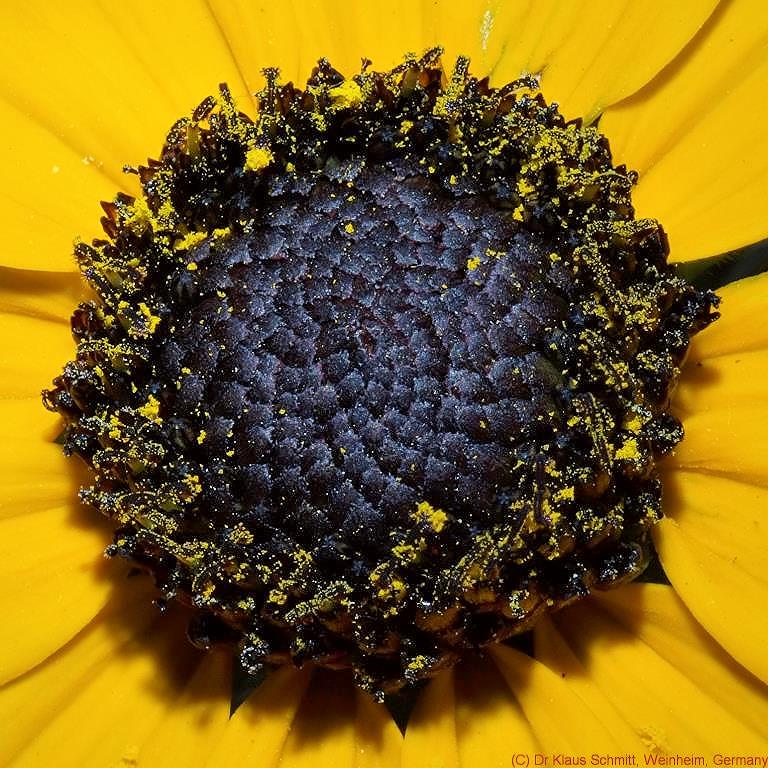
What we see in the second picture is UV induced visible fluorescence, using my Nichia 365nm UV LED lamp as exciter. No filter was used in that case, so what we see here is a mix of visual and some reflected UV light.

The flower center, as may be seen in the second shot, has a very strong UV reflectance, even if it appears dark brown/black in the visible shot. One may assume that this is intended together with the highly reflective UV pattern at the end of the flower petals, to attract pollinators like a "helicopter landing port".

[As usual, a click on an image opens up a larger one.]

Visual shot:


UV induced fluorescence shot:


So I hope you like it as much as I do....

Stay tuned, more will follow on that fascinating subject...

More info on this very interesting field may be found on my site http://www.pbase.com/kds315/uv_photos