Showing posts with label IR leakage. Show all posts

Tuesday, October 27, 2020

A simple tutorial for reflected UV photography IV (upd October 2020)

- UPDATE October 2020 -

Well, I thought it was about time to go over my "cook book style" tutorial on UV photography again, which I did quite some time ago. I also wrote about the system lens + filter for UV. But meanwhile (2020) things have changed more, even more research has been done, so I thought it would be time for version IV. So here it is, all based on my personal experiences, research and, of course, likes.  [last previous update was: 06/2017 about white balancing]

1) get a suitable lens for UV: I made a comprehensive list of lenses tested good for UV here. The truly excellent  EL-Nikkor enlarger lens 5.6/80mm and 5.6/105mm (both ONLY the earlier black/chrome version!) have proven to not only have the highest UV transmission, but also to be virtually free of focus shift. Those two and all enlarger lenses without focusing ability additionally need a focusing helicoid. Alternatively get the Novoflex Noflexar 3.5/35mm lens which also has a very high UV transmission, is virtually free of focus shift and allows close-up shots up to 1:2 (0.5x) without additional tubes or helicoids. Both lenses are ($)$$, easy to find and may be suitably mounted to achieve infinity focus. If you need an even higher transmitting, yet rather affordable (unfortunately prices have gone up) but a bit rare lens, get the original KURIBAYASHI or KYOEI 3.5/35mm lens. If you need a true wide angle lens, that's a bit more difficult, but there are some. Still the best and the "industry and scientific standard UV lens" is the discontinued Nikon UV Nikkor 4.5/105mm, or the mechanical + optical identical, still available from stock Tochigi Nikon UV 4.5/105mm  (also sold as RAYFACT UV 4.5/105mm). Also still available from stock are the JENOPTIK Coastal Optics 4/105mm UV-Micro Apo and 4/60mm UV-VIS-IR Apo Macro (both unfortunately having some hotspot + mechanical issues) but all those four quartz flourite lenses are a quite costly in the higher $$$$ range, but are a true investment and only fit Nikon cameras directly, but other cameras with easy to find (ONLY lensless!!) adapters. The new mirrorless Nikon Z and Canon EOS M cameras have much shorter register lengths (flange focal distance of 16mm resp. 18mm), now allowing lenses not useable before! And then there are the FF cameras of the L-Mount Alliance (Leica, Panasonic, Sigma) with 18mm resgister. [upd 10/2020]

2) get a suitable filter: The 2" Baader U-filter still today is the best filter you can get, better than 80% and 325...395nm transmission band, IR excellently suppressed below 1.0exp-3 (OD3), which is important for most DSLRs due to their high IR and low UV sensitivity, especially if your camera has the internal filter removed. Be prepared to expose 8-10 stops more (newer cameras 6-8 stops) than normal. My usual setting on an sunny to overcast day is 2...4" @ f8-11 ISO200 using an older type Nikon D70 or converted D200 but 1/2-1/4" @ f8-11 ISO400 on a converted Panasonic Lumix mft camera. Modern converted cameras have lifeview for UV, which also works considerably well in A-mode and using those purely manual lenses. Best is to have that filter built into a filter slider (from astro shops, unfortunately not for lenses with rotating front) or a Nikon AF-1 gel filter holder, which needs a 60mm (male) - 48mm(female) and 48mm (male) - 52mm (female) step ring to mount the filter inside and also allows to mount a 52mm sunshade outside. That contraption allows to flip down the filter, adjust focus, take a VIS shot if needed for comparison studies, flip up and take a UV shot. Magnetic filter holding ring sets (Manfrotto XUME) are a rather new development, which works very well and saves quite some time (I only use those now). But also screwing in and out of the UV filter works reasonably well, if done with care. Should you have a full spectrum converted camera (with clear fused silica filter/window inside), an external filter which compensates that is needed, so as to be able to shoot normal visible photos with it (as before the conversion). I recommend to use an external 2mm thick SCHOTT S8612, SCHOTT BG40 or SCHOTT BG39 or  Schott BG38 (in that sequence of usefulness) for that purpose and adjust white balance accordingly. Some companies offer such "compensating filters", but basically it is just the filter glass I have mentioned. Cheap UV filter glass from China is being curretly offered, it quality is not great, has streaks in the glass and transmission overall is not as good as SCHOTT or HOYA glass, so personally I stay away from those. For beginners SCHOTT UG11 / HOYA U340 in 2mm thickness stacked with SCHOTT BG40 in 2mm works rather well with approx 60% peak transmission @350nm as a cheaper alternative. Remember to demand from any UV transmitting filter an IR suppression of at least OD3, but better OD4! And btw. DO USE A SUITABLE SUNSHADE in front of the filters (attach also using magnetic adapter rings!) as this increases contrast oftne dramatically and reduces flare! [upd 10/2020]

3) get a suitable UV enabled camera: My finding is that today converted mft (micro four third) or Sony NEX cameras are so far the best cameras for UV and allow a plentitude of lenses using suitable cheaply available adapters. Their short register length (around 20mm) allow to use many lenses which a DSLR cannot use. Still the older type Nikon D70(s) is the best value for money for UV as is the D40, since both work off the shelf unmodified. D80 and D200 work well either as well as teh modern D800/810 ones, [these are older camera types , not recommended anymore] but all need the internal filter exchanged against a clear fused silica filter first  (use a professional service for that: maxmax and lifepixel in the US. The Nikon D7000 (and other modern Nikon cameras) has turned out to be a very useful camera for UV, but needs a converting company, that can deal with the internal IR leakage caused by Nikon's IR shutter monitor (I have reported about that here in detail). CANON shooters - it does not work well with older Canon DSLRs, their filters and CMOS chips do not allow to record UV in an acceptable manner (see the test I have published here; extremely long exposure, high ISO, noisy results), but the newer types, due to different sensor seem to work quite well - I have no personal experience with that.There are also monochrome converted Nikon + Canon cameras (with Bayer pattern removed), with an astonishing 6-8 stops higher sensitivity, but the results are of course monochrome images only. Now in 2020 there are even more and better choices, being the mirrorless Nikon Z-series and the Canon EOS M series, as well as the FF L-Mount Alliance (Leica, Panasonic, Sigma [upd 10/2020]

4) get a suitable UV light source: the sun is of course the best, but not always available. Xenon flashes come next as they have a very similar spectrum than the sun has. Most need the front filters removed, some even need the golden UV suppressing coating on the Xenon tube partially (leave a bit on the back or it does not ignite anymore!!) polished off (using fine Cerium oxide powder) or erased using HCL acid (dangerous!!). A well known candidate is the good and cheap Vivitar 285HV flash (use 2 or 3 if needed), as it already has a clear tube and a low trigger voltage which is safe for modern DSLRs. Another one would be the stronger Nikon SB-14 hammer head flash, but here the tube needs polishing for higher UV output. Another alternative are modern UV LEDs, built into LED flashlights, here especially the Nichia 365nm types (the modern Nichia equipped CONVOY S2 is one of the cheapest around $20-30 and are rather small, strong and good). These are available nowadays easily (ebay, amazon etc.), so are easy to use and not that expensive anymore. There are even some with UV filter glass in front, to suppress any visible light leaking (good for UV induced visible fluorescence!). Stay away from other cheap Chinese UV torches, not really worth the money and the claimed tech. data often do not hold. There are also more advanced systems available of course, which even use the most recent 4 dice high power UV LEDs but those (actually all those UV LED torches) are quite dangerous to the naked eye and should only be used be experienced users and ALWAYS USE EYE PROTECTING UV GOGGLES when working with those. Ethically I find it unacceptable to use strong UV LED torches aimed at living beings, even insects etc. as they get blind. [upd 11/2019]

5) get a suitable white balancing disc: to be able to do a custom white balance for your filter/lens/camera combination, see http://photographyoftheinvisibleworld.blogspot.de/2017/06/white-balancing-options-spectralon-r.html as your images without that will come out rather red or violet depending on camera and sensor used. This is needed to be done for EVERY lens + filter combination (and also basically for every changed lighting situation, but not as critical as lens+filter)! Ideally then stored as a preset within your camera and written down to remember. A simpler and cheaper solution is to use VIRGIN WHITE TEFLON for white balancing which is nearly as good. Be reminded to wash all of them with Ethanol, then rinse with purified water and let dry on air AND DO NOT TOUCH THEM ANYMORE except on the rim, as fingerprints leave nasty invisible UV marks which would falsify the white balancing result. SHOULD THIS EVER HAPPEN, repeat the cleaning process above and if this does not work (test by taking an UV image) then SAND IT DOWN with some fine sanding paper (400 grit in Europe) and repeat the cleansing process mentioned above. [upd 10/2020]

6) get a sturdy tripod: you need usually at least 1/2-1/4" / 2...4" [this has reduced considerably using higher but noiseless ISO enabled cameras] exposure time (depending on camera used) in full sun outside, sometimes even longer, which calls for a sturdy setup on a tripod. UV is strongest 90 degrees to the sun where the sky is the bluest; avoid to shoot in bright midday sun, due to high IR content present (although no longer a big problem with the new Baader 2" U-Filter, but still IR leakage may happen in rare cases). Using Xenon flash brings exposure time down to 1/200, but the flash needs to be strong and quite close to the subject, which is not always doable and with living beings I find it ethically unacceptable (as well as using strong UV LED lights for that). A few flashes wilts a flower quickly, so imagine what it does to an animal or insect eye.

7) get a suitable shooting habit: for comparison shots I shoot visual light first and then switch to UV filter and shoot UV with exactly the same framing. Be careful not to move the camera. Should you be using using an older lens which most likely has focus shift, focus closer. This needs to be tested out, my finding is that the f8...f11 position on the DOF scale works best (similar to an IR mark on some lenses) but could also calibrated for that lens (like a IR mark but for UV). Shoot RAW files or high resolution JPEGs. Some Pro's do RAW (I usually don't), but for first tests JPEG will do. Set camera white balance to 2500 degrees Kelvin to avoid a blown red channel (Nikon only) or use UNI white balance.

8) get the results processed: Upload pictures to your PC and process them. They will look very red or violet / magenta (if using Nikon DSLRs, other DSLRS produce blue or magenta looking results), but what you see is UV, depending on camera (and only if a good UV filter with no IR leakage has been used, like the Baader-U) . Then either you process them to black/white or white balance them using a Virgin White Teflon disc or a (rather expensive) SPECTRALON (R) target. Then adjust to taste. UV has no "color" by definition, so you may set what you prefer. I have been using BibblePro  its "click white" operation and the built in denoisifier. Others are more happy to use Nikon NX-D. Today I use Capture One Pro.

9) get help and discuss results: exchange and discuss your results on one of the few UV forums on the net: UltravioletPhotography.comnikonians.com, nikoncafe.com and openphotographyforums.com. Quite a bit of my old content resides on the Nikon-only forum  nikongear.com.

This is in condensed form the result of some years of research and testing and of course only reflects my personal opinion as of 2020 - others may think differently. No warranty given or implied for all being mentioned here, and YOU TAKE FULL RESPONSIBILITY WHAT YOU DO with that. 

If you need some rare equipment, let me know, I may be able to help. I have plenty of filters, lenses etc. available for sale, or may be able to direct to a source. 

I also do engineering and photographic consultation on a professional basis about any UV related subject.


All my works shown here on my BLOG, my pbase.com site or my macrolenses.de site carry my copyright, so if you like to use any of my graphs or any of my pictures, please do ask me for my explicit permission first.

Stay tuned, more will follow on that fascinating subject...

More info on this very interesting field may be found on my site www.pbase.com/kds315/uv_photos

Tuesday, December 11, 2018

Baader-U Venus filter versus OPTOLONG Venus-U filter

Today about a new (to me) UV transmitting filter for reflected ultraviolet (UV) photography: the 2" OPTOLONG VENUS-U filter. This filter I have compared here with my work-horse UV filter, the 2" Baader-U Venus filter.

First it is about the resulting images and of course if there might be any IR leakage. The latter is quite important, as in early morning or late evening sunlight, where IR is predominant or when shooting against the sun or when reflective elements are present in an image,  IR leakage may lead to loss of contrast, or even obscuring the wanted UV details.

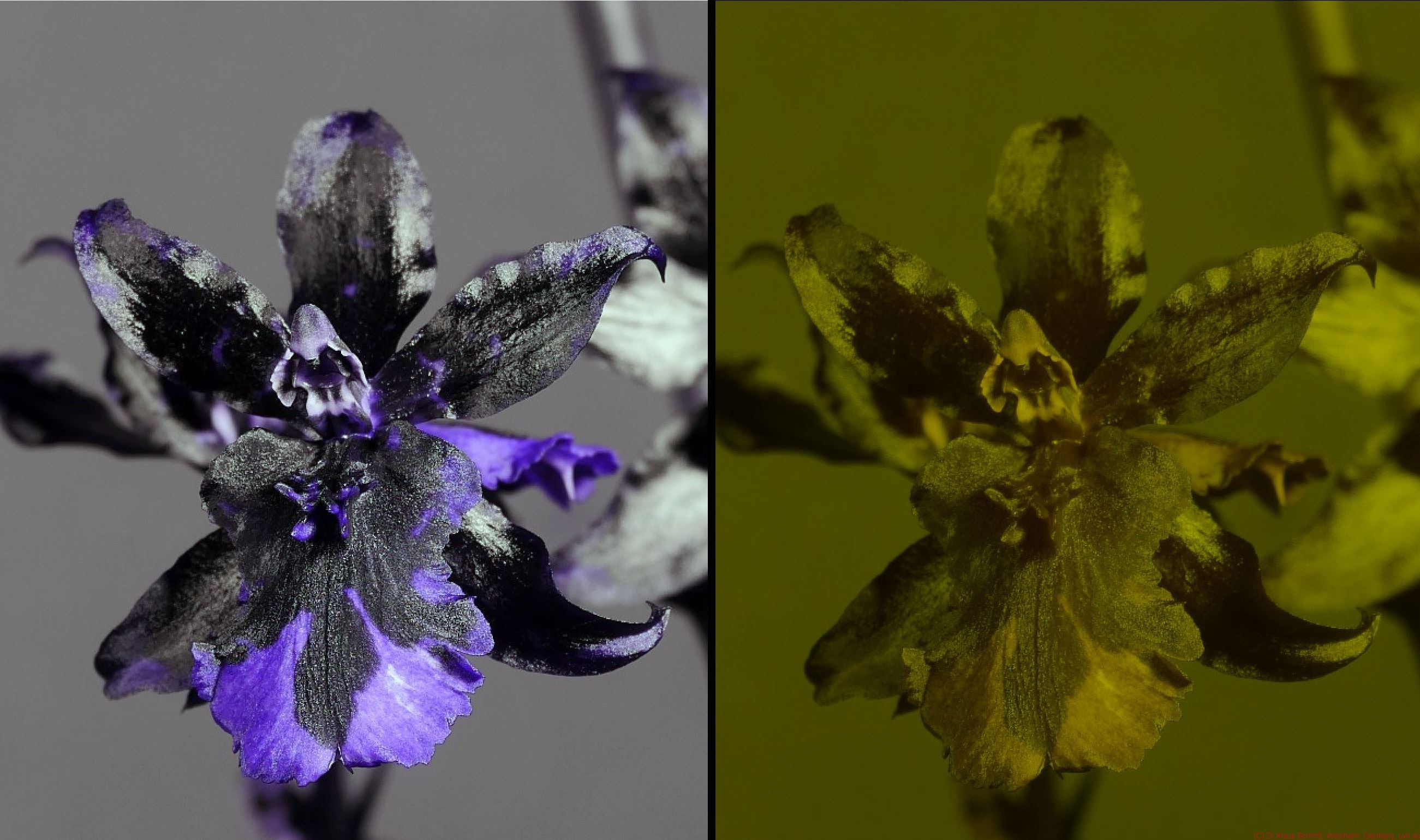
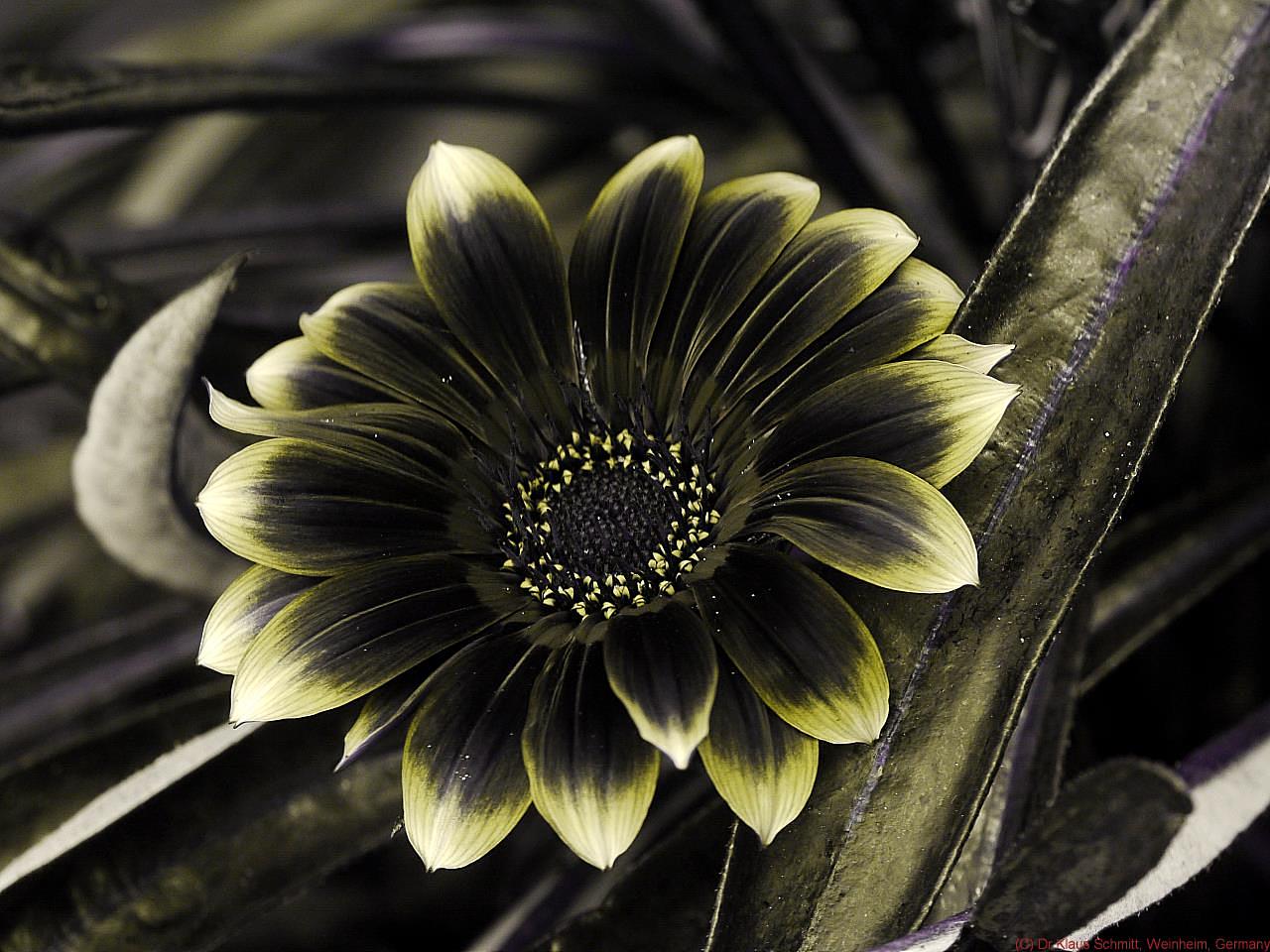
Now on to my tests which have been done using as a target an Oncostele orchid which has quite some prominent UV marks. Lens used was an UV-Nikkor 105mm, camera a modified Panasonic GH4, light a modified for high UV output Xenon studio flash. All shots were one at f8.

[click on image to see a larger one]

Baader-U filter (left) vs Optolong Venus filter (right:

Baader-U filter (left) vs Optolong Venus filter (right) - whitebalanced against gray BG:


It gets quite obvious that there is something going on here in terms of leakage, as the image shot with the Optolong Venus filter shows some blueish hint visible all over the orchid and also there is some central flare visible, wheras the Baader-U Venusfilter delivers a tack sharp and high contrast image. After whitebalacing against the gray background, which obviously was not possible with the Optolong filter, the result gets even worse, a rather muddy looking image results from the Optolong filter. In terms of exposure, the Baader U filter also has a slight 0.3 stop advantage over the Optolong filter.

Once I will have done some spectrometric transmission measuerements, I will certainly post those here later.

So please draw your own conclusions from this, if you would consider this a valuable filter for reflected UV photography. I will certainly continue to use my "work-horse" UV filter, the Baader-U.

I have written about IR leakage in filters for reflected UV photography HERE

Stay tuned, more will follow on that fascinating subject...

More info on this very interesting field may be found on my site http://www.pbase.com/kds315/uv_photos

Friday, July 15, 2016

A simple tutorial for reflected UV photography III (upd November 2019)

- UPDATE November 2019 -

Well, I thought it was about time to go over my "cook book style" tutorial on UV photography again, which I did quite some time ago. I also wrote about the system lens + filter for UV. But meanwhile (2016) things have changed more, even more research has been done, so I thought it would be time for version III. So here it is, all based on my personal experiences, research and, of course, likes.  [last update: 06/2017 about white balancing]

1) get a suitable lens for UV: I made a comprehensive list of lenses tested good for UV here. The EL-Nikkor enlarger lens 5.6/80mm and 5.6/105mm (both ONLY the earlier black/chrome version!) have proven to not only have the highest UV transmission, but also to be virtually free of focus shift. Those two and all enlarger lenses without focusing ability additionally need a focusing helicoid. Alternatively get the Novoflex Noflexar 3.5/35mm lens which also has a very high UV transmission, is virtually free of focus shift and allows close-up shots up to 1:2 (0.5x) without additional tubes or helicoids. Both lenses are ($)$$, easy to find and may be suitably mounted to achieve infinity focus. If you need an even higher transmitting, yet rather affordable but a bit rare lens, get the original KURIBAYASHI or KYOEI 3.5/35mm lens. If you need a wide angle lens, that's a bit more difficult, but there are some. Still the best and the "industry and scientific standard UV lens" is the discontinued Nikon UV Nikkor 4.5/105mm, or the mechanical + optical identical, still available from stock Tochigi Nikon UV 4.5/105mm  (also sold as RAYFACT UV 4.5/105mm). Also still available from stock are the JENOPTIK Coastal Optics 4/105mm UV-Micro Apo and 4/60mm UV-VIS-IR Apo Macro (both unfortunately having some hotspot +ΓΌ mechanical issues) but all those four quartz flourite lenses are a quite costly in the higher $$$$ range, but are a true investment and only fit Nikon cameras directly, but other acemars with easy to find (ONLY lensless!!) adapters. [upd 11/2019]

2) get a suitable filter: The 2" Baader U-filter still today is the best filter you can get, better than 80% and 325...395nm transmission band, IR excellently suppressed below 1.0exp-3 (OD3), which is important for most DSLRs due to their high IR and low UV sensitivity, especially if your camera has the internal filter removed. Be prepared to expose 8-10 stops more (newer cameras 6-8 stops) than normal. My usual setting on an sunny to overcast day is 2...4" @ f8-11 ISO200 using an older type Nikon D70 or converted D200 but 1/2-1/4" @ f8-11 ISO400 on a converted Panasonic Lumix mft camera. Modern converted cameras have lifeview for UV, which also works considerably well in A-mode and using those purely manual lenses. Best is to have that filter built into a filter slider (from astro shops, unfortunately not for lenses with rotating front) or a Nikon AF-1 gel filter holder, which needs a 60mm (male) - 48mm(female) and 48mm (male) - 52mm (female) step ring to mount the filter inside and also allows to mount a 52mm sunshade outside. That contraption allows to flip down the filter, adjust focus, take a VIS shot if needed for comparison studies, flip up and take a UV shot. Magnetic filter holding ring sets (manfrotto XUME) are a rather new development, which works very well and saves quite some time (I only use those now). But also screwing in and out of the UV filter works reasonably well, if done with care. Should you have a full spectrum converted camera (with clear fused silica filter inside), an external filter which compensates that is needed, so as to be able to shoot normal visible photos with it (as before the conversion). I recommend to use an external 2mm thick SCHOTT S8612, SCHOTT BG40 or SCHOTT BG39 or  Schott BG38 (in that sequence of usefulness) for that purpose and adjust white balance accordingly. Some companies offer such "compensating filters", but basically it is just the filter glass I have mentioned. Cheap UV filter glass from China is being curretly offered, it quality is not great, has streaks in the glass and transmission overall is not as good as SCHOTT or HOYA glass, so personally I stay away from those. For beginners SCHOTT UG11 / HOYA U340 in 2mm thickness stacked with SCHOTT BG40 in 2mm works rather well with approx 60% peak transmission @350nm as a cheaper alternative. Remember to demand from any UV transmitting filter an IR suppression of at least OD3, but better OD4! [upd 11/2019]

3) get a suitable UV enabled camera: My finding is that today converted mft (micro four third) or Sony NEX cameras are so far the best cameras for UV and allow a plentitude of lenses using suitable cheaply available adapters. Their short register length (around 20mm) allow to use many lenses which a DSLR cannot use. Still the older type Nikon D70(s) is the best value for money for UV as is the D40, since both work off the shelf unmodified. D80 and D200 work well either as well as teh modern D800/810 ones, [these are older camera types , not recommended anymore] but all need the internal filter exchanged against a clear fused silica filter first  (use a professional service for that: maxmax and lifepixel in the US. The Nikon D7000 (and other modern Nikon cameras) has turned out to be a very useful camera for UV, but needs a converting company, that can deal with the internal IR leakage caused by Nikon's IR shutter monitor (I have reported about that here in detail). CANON shooters - it does not work well with older Canon DSLRs, their filters and CMOS chips do not allow to record UV in an acceptable manner (see the test I have published here; extremely long exposure, high ISO, noisy results), but the newer types, due to different sensor seem to work quite well - I have no personal experience with that.There are also monochrome converted Nikon + Canon cameras (with Bayer pattern removed), with an astonishing 6-8 stops higher sensitivity, but the results are of course monochrome images only. [upd 11/2019]

4) get a suitable UV light source: the sun is of course the best, but not always available. Xenon flashes come next as they have a very similar spectrum than the sun has. Most need the front filters removed, some even need the golden UV suppressing coating on the Xenon tube partially (leave a bit on the back or it does not ignite anymore!!) polished off (using fine Cerium oxide powder) or erased using HCL acid (dangerous!!). A well known candidate is the good and cheap Vivitar 285HV flash (use 2 or 3 if needed), as it already has a clear tube and a low trigger voltage which is safe for modern DSLRs. Another one would be the stronger Nikon SB-14 hammer head flash, but here the tube needs polishing for higher UV output. Another alternative are modern UV LEDs, built into LED flashlights, here especially the Nichia 365nm types (the modern Nichia equipped CONVOY S2 is one of the cheapest around $20-30 and are rather small and good). These are available nowadays easily (ebay, amazon etc.), so are easy to use and not that expensive anymore. There are even some with UV filter glass in front, to suppress any visible light leaking (good for UV induced visible fluorescence!). Stay away from other cheap Chinese UV torches, not really worth the money and the claimed tech. data often do not hold. There are also more advanced systems available of course, which even use the most recent 4 dice high power UV LEDs but those (actually all those UV LED torches) are quite dangerous to the naked eye and should only be used be experienced users and ALWAYS USE EYE PROTECTING UV GOGGLES when working with those. Ethically I find it unacceptable to use with living beings even insects etc. as they get blind. [upd 11/2019]

5) get a suitable white balacing disc: to be able to do a custom white balance for your filter/lens/camera combination, see http://photographyoftheinvisibleworld.blogspot.de/2017/06/white-balancing-options-spectralon-r.html as your images without that will come out rather red or violet depending on camera and sensor used. This is needed to be done for EVERY lens + filter combination (and also basically for every changed lighting situation, but not as critical and lens+filter)! Ideally then stored as a preset within your camera and written down to remember.A simpler and cheaper solution is to use VIRGIN WHITE TEFLON for white balancing which is nearly as good. Be reminded to wash all of them with Ethanol and rinse with purified water and let dry on air AND DO NOT TOUCH THEM ANYMORE except on the rim as fingerprints leave nasty invisible UV marks which would falsify the white balancing result [upd 11/2019]

6) get a sturdy tripod: you need usually at least 1/2-1/4" / 2...4" exposure time (depending on camera used) in full sun outside, sometimes even longer, which calls for a sturdy setup on a tripod. UV is strongest 90 degrees to the sun where the sky is the bluest; avoid to shoot in bright midday sun, due to high IR content present (although no longer a big problem with the new Baader 2" U-Filter, but still IR leakage may happen in rare cases). Using Xenon flash brings exposure time down to 1/200, but the flash needs to be strong and quite close to the subject, which is not always doable and with living beings I find it ethically unacceptable (as well as using strong UV LED lights for that). A few flashes wilts a flower quickly, so imagine what it does to an animal or insect eye.

7) get a suitable shooting habit: for comparison shots I shoot visual light first and then switch to UV filter and shoot UV with exactly the same framing. Be careful not to move the camera. Should you be using using an older lens which most likely has focus shift, focus closer. This needs to be tested out, my finding is that the f8...f11 position on the DOF scale works best (similar to an IR mark on some lenses) but could also calibrated for that lens (like a IR mark but for UV). Shoot RAW files or high resolution JPEGs. Some Pro's do RAW (I usually don't), but for first tests JPEG will do. Set camera white balance to 2500 degrees Kelvin to avoid a blown red channel (Nikon only) or use UNI white balance.

8) get the results processed: Upload pictures to your PC and process them. They will look very red or violet / magenta (if using Nikon DSLRs, other DSLRS produce blue or magenta looking results), but what you see is UV, depending on camera (and only if a good UV filter with no IR leakage has been used, like the Baader-U) . Then either you process them to black/white or white balance them using a Teflon disc or (rather expensive) SPECTRALON (R) target. Then adjust to taste. UV has no "color" by definition, so you may set what you prefer. I have been using BibblePro  its "click white" operation and the built in denoisifier. Others are more happy to use Nikon NX-D. Today I use Capture One Pro.

9) get help and discuss results: exchange and discuss your results on one of the few UV forums on the net: UltravioletPhotography.comnikonians.com, nikoncafe.com and openphotographyforums.com. Quite a bit of my old content resides on the Nikon-only forum  nikongear.com.

This is in condensed form the result of some years of research and testing and of course only reflects my personal opinion as of 2016 (upd. 2019) - others may think differently. No warranty given or implied for all being mentioned here and you take full responsibility for all you do with that. If you need some rare equipment, let me know, I may be able to help. I have plenty of filters, lenses etc. available for sale, or may be able to direct to a source. I also do engineering and photographic consultation on a professional basis about any UV related subject.


All my works shown here on my BLOG, my pbase.com site or my macrolenses.de site carry my copyright, so if you like to use any of my graphs or any of my pictures, please do ask me for my explicit permission first.

Stay tuned, more will follow on that fascinating subject...

More info on this very interesting field may be found on my site www.pbase.com/kds315/uv_photos

Saturday, March 2, 2013

Filter leakage in reflected UV ultraviolet photography - unsuitable UV vs Baader-U filter III

Today again about IR leakage in reflected UV photography and how to deal with it. I have posted about that before here.

So what I wanted to show to today is, how different reflected UV images look like with and without IR leakage, so to enable a potential UV shooter to detect that. Images are presented in a side-a-side waqy, to make comparisons easier.

[click on image to see a larger one]

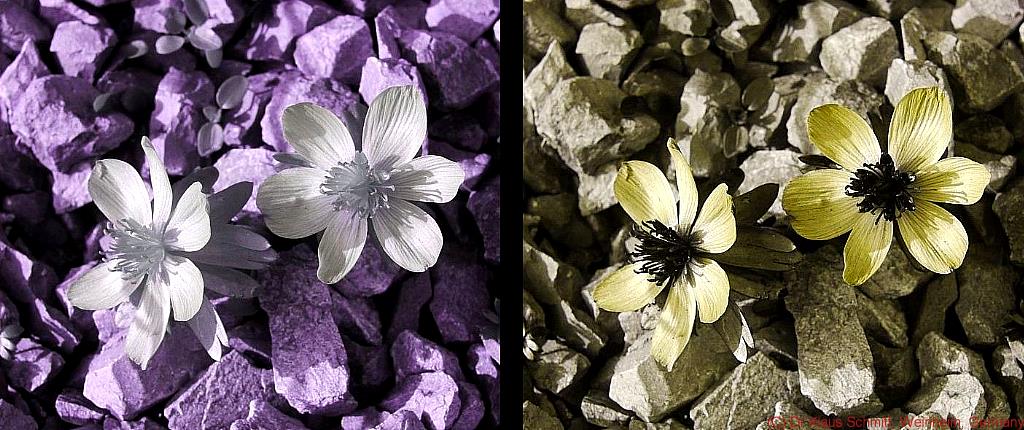
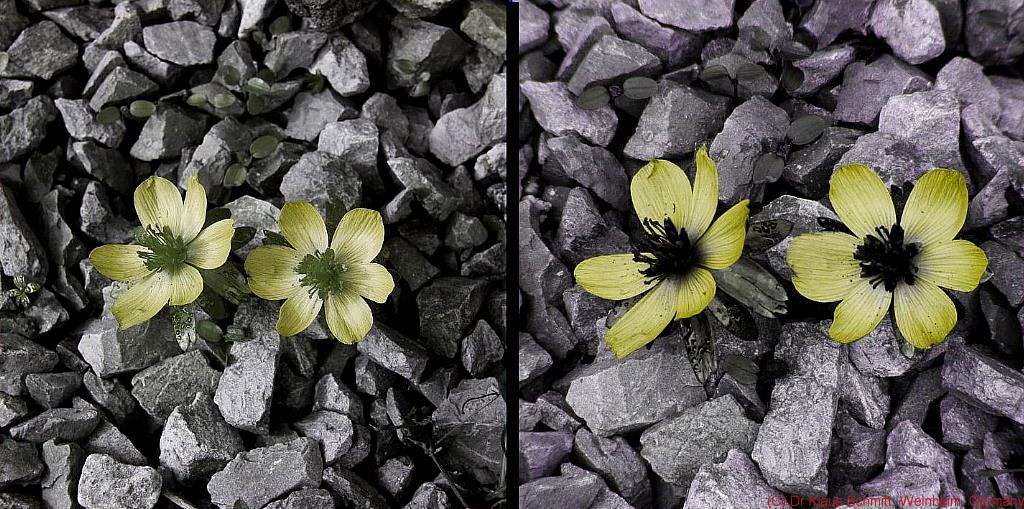
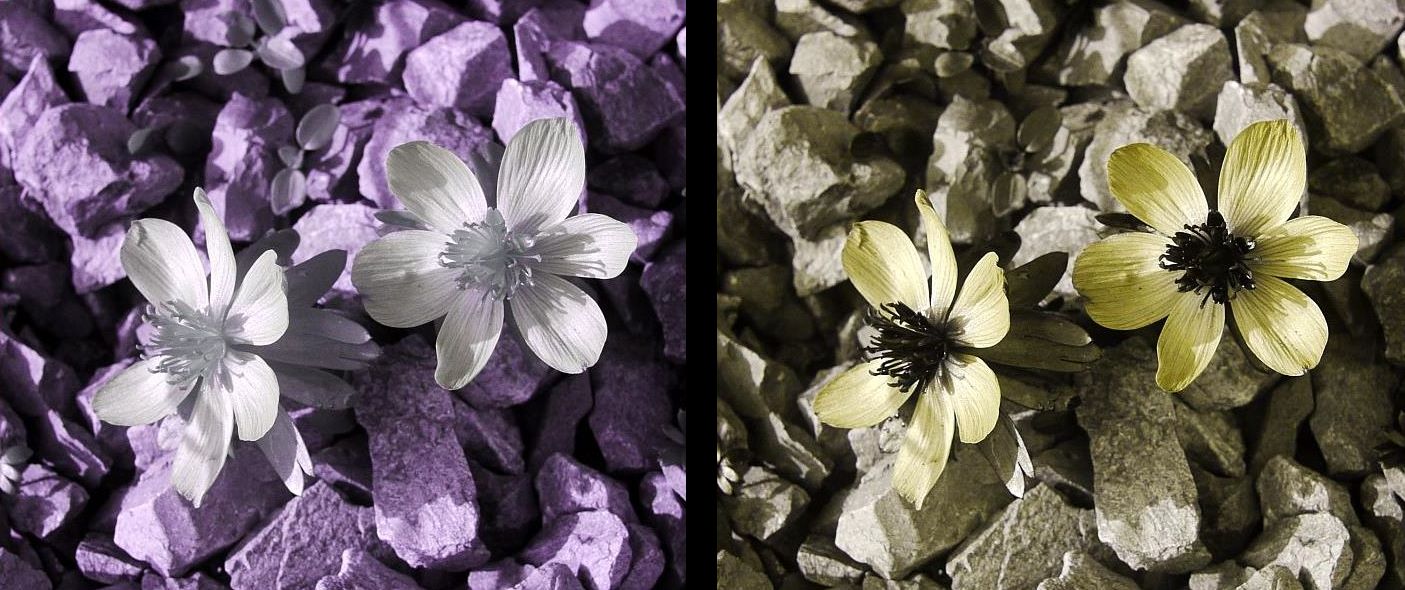
Here now the comparison with a commercially available UV filter, that not only leaks IR but also some blue vs the Baader-U 2" filter, Winter Aconite as target:

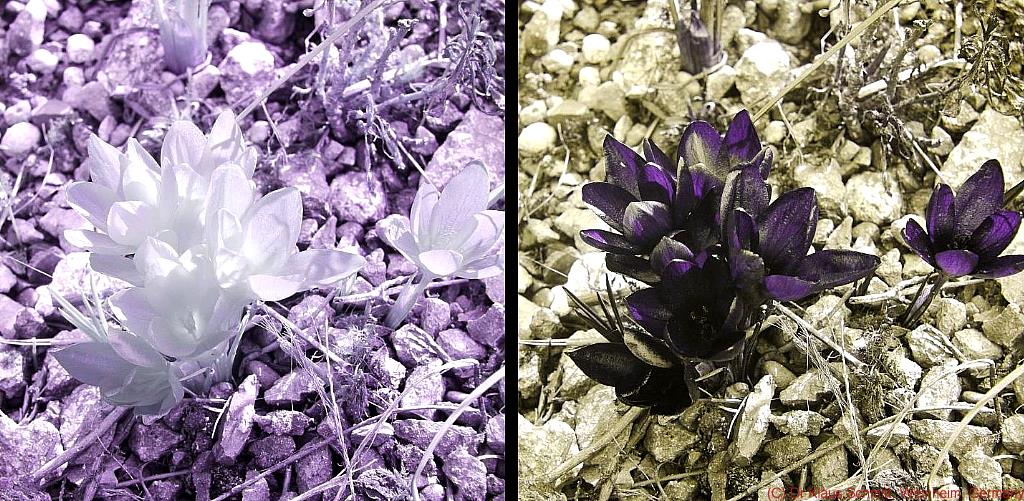
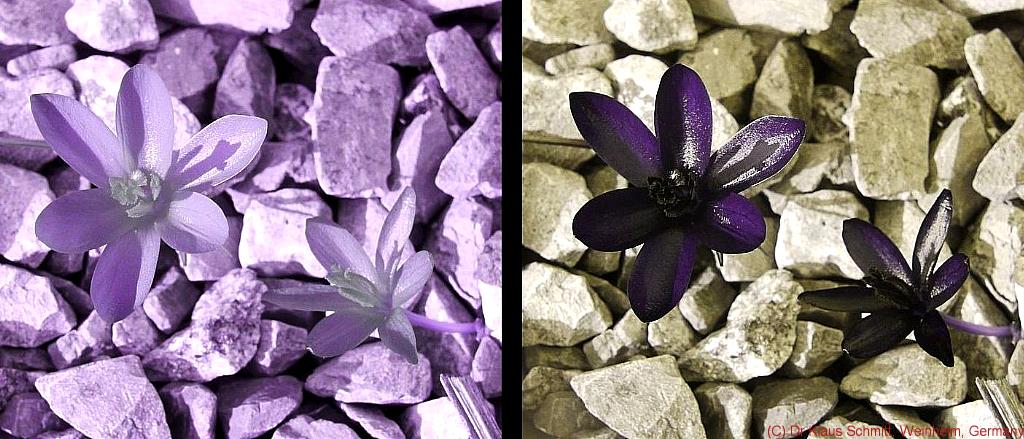
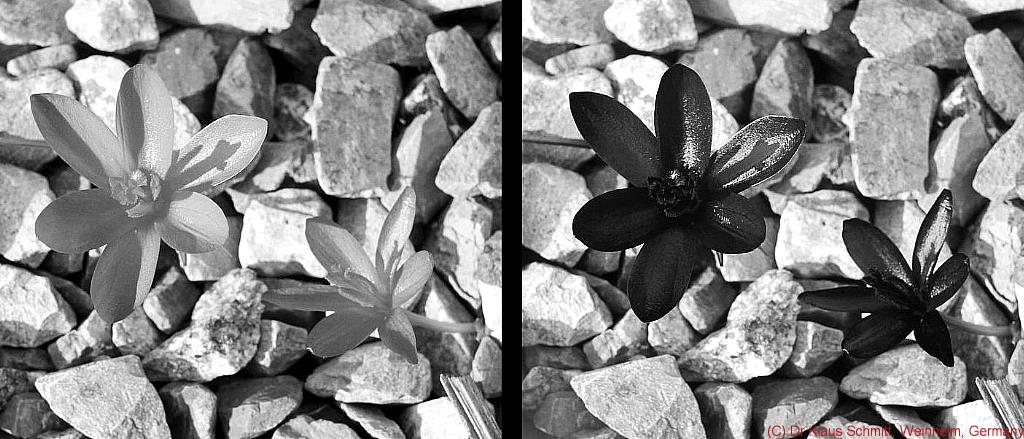
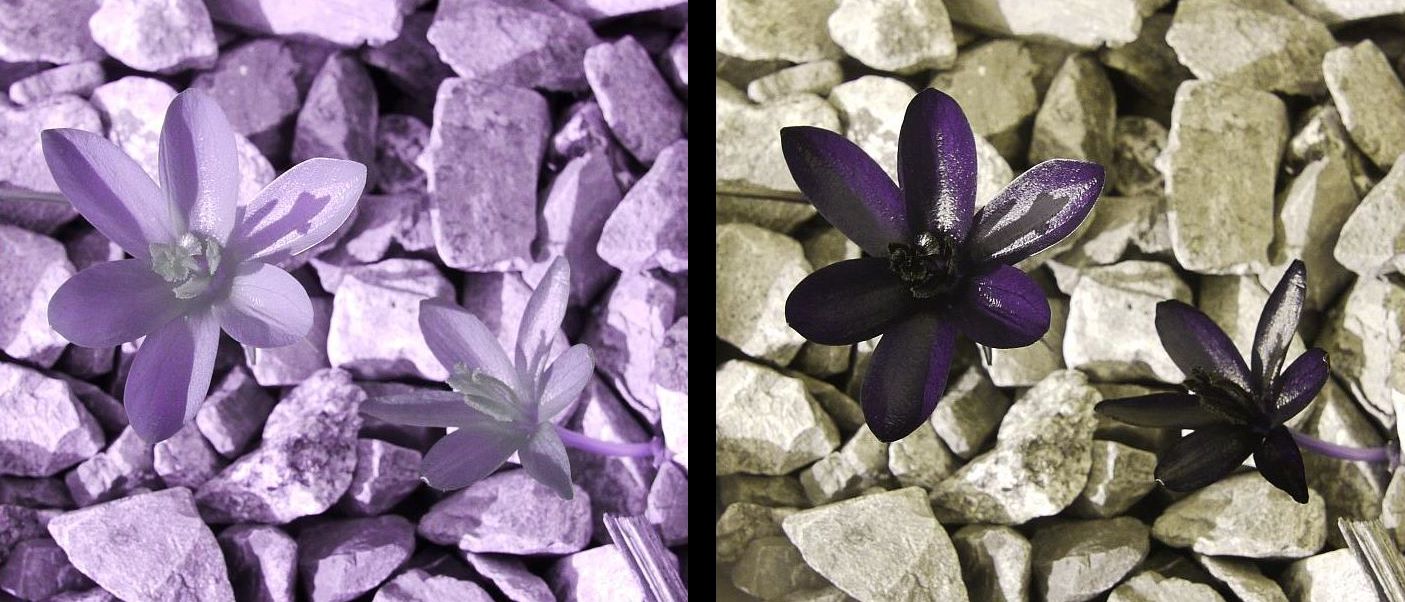
So here another example for very strong IR leakage (left), vs correct UV recording using a Baader-U 2" filter (right) using a strongly IR reflecting spring crocus as a target:


Same situation, but different angle and different crocus:

here in bw version, that shows that exposure was identical, but the pattern and structure is completely washed away by that IR leakage::

This following last example now shows the results of two different UV transmitting astro filters, left one with just a little IR leakage, but still enough to render the result useless, right the currently best filter for reflected UV in my opinion, the Baader-U 2", again using Winter Aconite as target:


Well, it was my goal to bring the attention to an often overlooked, but very important fact: IR leakage in reflected UV photography. Often beginners try to experiment with cheap UV transmitting filters, hoping to get some useful results. Unfortunately due to the very high IR sensitivity of modern sensors, just the tiny fraction of 0.1% leakage leads to useless results. So there is no way other than using highest quality UV transmission filters to secure useful results. Demand at least a IR suppression of OD3 from any UV transmitting filter, better even OD4!

Stay tuned, more will follow on that fascinating subject...

More info on this very interesting field may be found on my site http://www.pbase.com/kds315/uv_photos

Monday, September 10, 2012

Filter leakage in reflected UV ultraviolet photography - DIY filter vs Baader-U II

Today again about leakage in reflected UV photography and how to deal with it. I have posted about that before here.

I wanted to show here some examples using SCHOTT UG11 in comparison with using IR suppressing SCHOTT S8612 filter glass of different thickness and to show how such IR leakage can be efficiently cured - at least for most normal shooting conditions. In early morning or late evening sunlight, where IR is predominant or when shooting against the sun or when reflective elements are present in an image, that won't work then, sometimes not even when using the otherwise excellent Baader-U filter.

[click on image to see a larger one]

So here an example for strong IR leakage using only 2.5mm SCHOTT UG11:

So how does that picture should look like? Here what the Baader-U filtered result looks like:


And here the result of my shorter wave, IR leak proof Jupiter-U filter:


It is pretty obvious, that IR leakeage virtually destroys the importatnt aspect of that image, as well as it softens the image, i.e. a strong lack of contrast is caused.
So let's see if stacking 1mm of SCHOTT S8612 filter onto the UG11 filter solves the problem:


Nice, but was it enough? Let's see what 2mm of SCHOTT S8612 will bring us:


Much better now, as the contrast is strongly enhanced, the UV pattern on petals is quite nicely present. So what I can recommend is stacking 2mm of SCHOTT S8612 filter glass onto SCHOTT UG1, UG11 UV transmissive filter glass (also works with HOYA U-340), but unfortunately if total cost are taken into account, this is not really far from getting a Baader-U filter...

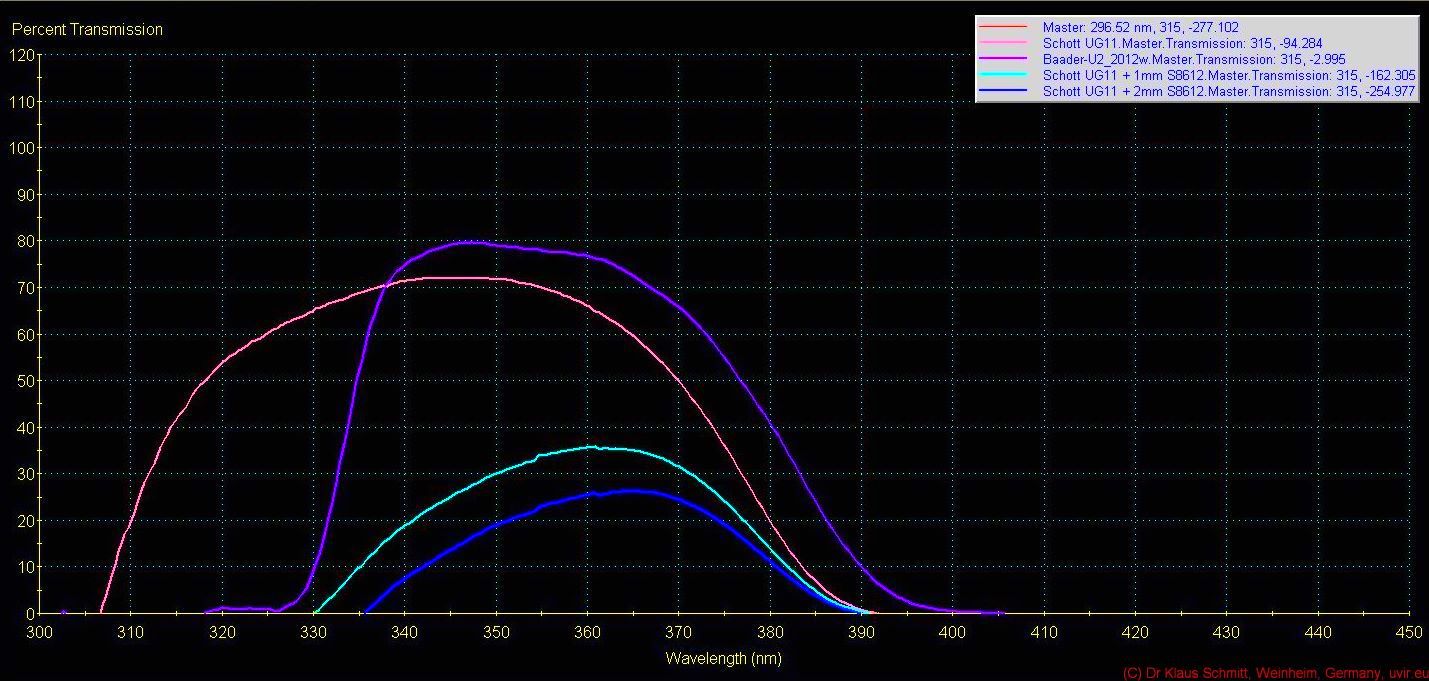
And there is another BUT, the lower overall transmission caused by stacking such filters. Have a look at my measurements here, which clearly shows, that controlling leakage using ionic colored filter glass comes at a considerable transmission loss:


In that case, one of about 1.7 stops mathematically; in real use due to the sensor sensitivity curve, it is less than that, but still a significant one. And I haven't even talked about ghost images when stacking uncoated filters or the reflectance loss of about 8% per filter glass. So company Baader obviously made her homework very well, if you compare the results of the graph above (Baader-U is denoted by the violet line, the SCHOTT UG11 stacked with 2mm SCHOTT S8612 is denoted by the blue line), showing the very high reached UV transmission, rather flat broadband. It does not reach very deep into UV, but most UV sensitive cameras will anyway not be able to reach that deep and/or when using normal glass based lenses, where even the best of those barely reach beyond 330nm.

CAVEAT: on 2nd thought there seems to be something wrong with these S8612 filters I got from a US filter making company, as the resulting UV transmission is much lower than expected when compared to results of the SCHOTT filter calculation software. In principle only the UV transmission seems to be affected, not the leakage suppressing part, so the made statements are all valid, except the possible 1.7 stop loss. I will update about that here, as soon as I have found out about it. Btw. SCHOTT BG40 may be used as a replacement for S8612, but needs about double the thickness.
UPDATE as of 09-2012: As it turns out, these S8612 filters were cladded on both sides using some optical glass (B270) to prevent them from graying (an oxidation process this S8612 filter glass type shows) and this cladding has been attached to the S8612 using some UV cured adhesive. Most likely that B270 glass used and/or the used adhesive absorb UV more than expected, hence leading to the results measured above. So if you would like to use S8612 filter glass, make sure you get uncladded filters (and have to accept the fact that it may over the years need repolishing).


There is a newer part III about IR leakage in UV photography here.

Stay tuned, more will follow on that fascinating subject...

More info on this very interesting field may be found on my site http://www.pbase.com/kds315/uv_photos
Thursday, August 2, 2012

Filter leakage in reflected UV ultraviolet photography - DIY filter vs Baader-U

Today about leakage in reflected UV photography and how to detect it. When I started many years ago, non-UV leakage effects in supposedly purely reflected UV photography was a big issue before the now "standard" UV transmission filter, the Baader-U filter was brought to the market by the company Baader-Planaterium, Germany based on intensive research of astronomer Mr Thomas Baader, who combined Schott filter glass with a multilayered, dichroic overcoating to suppress IR leakage. The method before was using for instance filter stacks consisting of a IR leaking UV filter, SCHOTT UG1 or UG11, plus IR suppressing SCHOTT S8612, BG38 or BG40 filter glass. The downside was, that the suppression was far from being optimal and under certain shooting conditions one could get massive IR leakage. It takes a bit of experience to see that though and even today one can see a lot of such supposedly "UV images", but basically it is a mix of UV and near IR (NIR), if not often nearly purely NIR.

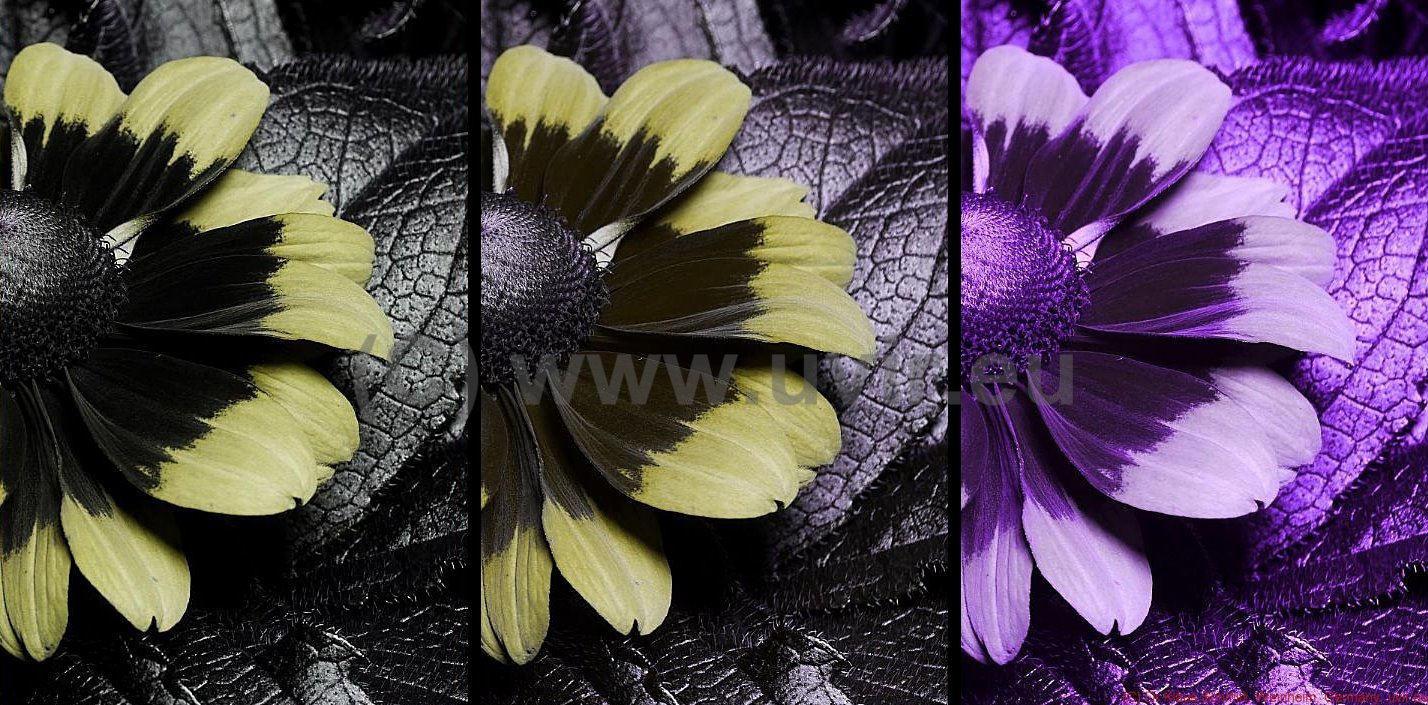
So how does a contaminated UV image look like? A first indication is that non UV reflecting parts (of a flower), that should look very dark, appeared lightened up. A good example to test is Rudbeckia (R. hirta was used here), as it has nearly completely UV absorbing petals in its lower petal parts towards the center, wheras the petal tips are very UV bright. My spectrometric research has confirmed that many times for different Rudbeckia species. Here an example for that:
[click on image to see a larger one]


Its gets pretty obvious, that the petal mid and base have very low reflection (pink line), wheras the petal tip (lilac line) has quite a UV reflection peak around 365nm. Now have a look at the right side of the graph, the visible (VIS) and near infrared (NIR) part of that spectra, from approx. 520nm onwards the reflection rapidly gets quite high, approaching some 50-60%). So any filter, that does not perfectly block these non-UV parts will show leakage i.e. flower parts that should be (very) dark will appear lightened up. Here an example for that:


Left shows the Baader-U filter used, middle and right show the results of using more (right) or less (middle) leaking UV filter stacks, here based on SCHOTT UG11 filter glass and a S8612 blocking filter glass (two different thicknesses were used, 2mm for the middle and 1mm for the right image). The flower petal parts that should be very dark, appear in a brownish red. [btw. stacking the two 1mm + 2mm S8612 filters onto the UG11 filter solves the problem, another proof for the leakage]

Remark: the actual color is irrelevant, as based on the whitebalance used, it could be basically any color. Important only is the intensity of these petal parts, which should be quite low, but isn't. Here another example for that, again Baader-U was used on the left image, middle and right are filter stacks (it is the same image, just differently white balanced).


Here another example, this time a Hemerocallis (Day Lily), left Baader-U, right a leaking filter stack was used:


All these images were shot using my UV camera and a flat, beyond 300nm transmitting CERCO f4.1/94mm quartz fluorite lens.

These filter stacks work basically the following way, explained using SCHOTT's filter calculation program for a similar filter stack. The obvious weakness for that case is around 700nm:

[courtesy and (c) SCHOTT]

So, be aware of these effects when assembling your own filter, or buying commercially available filters, as you may end up with useless "UV images", but they may look interesting nevertheless ;)

A hint and a simple explanation: a classic transmission chart of a filter in 0-100% linear scale does not show possible leakage issues. The exposure difference between UV photography and VIS/NIR photography is in the range of 8-12 exposure stops more for UV, so if a filter transmits in the VIS or NIR region more than OD3 (1E-03 or 0.001) it will most likely leak, since 10 stops equal a factor of 1024 i.e. 2exp(10), so 1/1024 = 0.001 that means a normal exposed UV image at -10EV and one through a filter that transmits 0.001 will be about equally exposed. But 0.1% in a linear 0-100% chart is pretty impossible to see, or can you see it here?

[courtesy and (c) SCHOTT]

It is the same example as shown above, just in the usually presented linear graph, so be aware.

There is a continuation of this article HERE.

Stay tuned, more will follow on that fascinating subject...

More info on this very interesting field may be found on my site http://www.pbase.com/kds315/uv_photos

Saturday, March 3, 2012

[UV] IR leakage and how to avoid it

One of the most important issues to take care of in reflected UV photography is to avoid IR leakage. Here and example why this is the case.

[click on image to see a larger one]

This left image shows massive IR leakage, whereas the one on the right has none and properly shows the black flower center on this Winter Aconite.


and crocus (which is highly IR reflective) here:


The key is avoiding situations with strong sunlight, using a suitable sunhood and especially using the right UV transmission filter, the new 2" Baader U filter in this case, which has a very good IR suppression up to 1100nm. I had already written about that fact in my article: Principle Thoughts about Lenses + Filters for UV


Stay tuned, more will follow on that fascinating subject...

More info on this very interesting field may be found on my site http://www.pbase.com/kds315/uv_photos

Tuesday, January 18, 2011

A simple tutorial for reflected UV photography II

I have been asked to write down a simple "cook book style" tutorial on UV photography, which I did quite some time ago. I also wrote about the system lens + filter for UV. But meanwhile some things have changed, more research has been done, so I thought it would be time for a version II. So here it is, based on my personal experiences and likes.  [last update: 2012-09-16]

1) get a suitable lens for UV: I made a comprehensive list of lenses tested good for UV here. The EL-Nikkor enlarger lens 5.6/80mm has proven to not only have the highest UV transmission, but also is virtually free of focus shift. That and all enlarger lenses without focusing ability additionally need a focusing helicoid. Alternatively get the Novoflex Noflexar 3.5/35mm lens which also has a very high UV transmission, is virtually free of focus shift and allows close-up shots up to 1:2 (0.5x) without additional tubes or helicoids. Both lenses are ($)$$, easy to find and may be suitably mounted to achieve infinity focus. If you need a wide angle lens, that's a bit more difficult, but there are some. Still the best and the "industry and scientific standard UV lens" is the discontinued Nikon UV Nikkor 4.5/105mm, or the identical, still available from stock Tochigi Nikon UV 4.5/105mm. Also still available from stock are the JENOPTIK Coastal Optics 4/105mm UV-Micro Apo and 4/60mm UV-VIS-IR Apo Macro but those four lenses are a quite costly $$$$ investment and only fit Nikon cameras directly.

2) get a suitable filter: The 2" Baader U-filter still is the best filter you can get, better than 80% peak and 325...395nm transmission band, IR excellently suppressed, which is important for most DSLRs due to their high IR and low UV sensitivity, especially if your camera has the internal filter removed. Be prepared to expose 8-10 stops more than normal. My usual setting on an sunny to overcast day is 2...4" @ f8-11 ISO200 using a Nikon D70 or converted D200. Best is to have that filter built into a Nikon AF-1 gel filter holder, which needs a 60mm (male) - 48mm(female) and 48mm (male) - 52mm (female) step ring to mount the filter inside and also allows to mount a 52mm sunshade outside. That contraption allows to flip down the filter, adjust focus, take a VIS shot if needed for comparison studies, flip up and take a UV shot. But also screwing in and out of the UV filter works reasonably well if done with care - I do that all the time. Should you have a full spectrum converted camera (with clear filter inside), an external filter which compensates that is needed, so as to be able to shoot normal visible photos with it (as before the conversion). I recommend to use an external 2mm thick SCHOTT BG40 or SCHOTT BG39 or  Schott BG38 (in that sequence of usefulness) for that purpose and adjust white balance accordingly. Some companies offer such "compensating filters", but basically it is just the filter glass I have mentioned.

3) get a suitable UV enabled camera: My finding is that the Nikon D70(s) is the best value for money for UV as is the D40, since both work off the shelf unmodified. D80 and D200 work well either, but need the internal filter exchanged against a clear quartz glass filter first (use a professional service for that: maxmax and lifepixel in the US, Optik Makario in Germany for instance). CANON shooters - it does NOT work with Canon DSLRs, their filters and CMOS chips do not allow to record UV in an acceptable manner (see the test I have published here; extremely long exposure, high ISO, noisy results). Some Pentax, Sony , Panasonic and Olympus DSLRs also work, but all need to be converted first. Recently the Nikon D7000 has turned out to be a useful camera for UV, but needs a converting company, that can deal with the internal IR leakage caused by Nikon's IR shutter monitor (I have reported about that here in detail).

4) get a suitable UV light source: the sun is of course the best, but not always available. Xenon flashes come next as they have a very similar spectrum than the sun has. Most need the front filters removed, some even need the golden UV suppressing coating on the Xenon tube partially (leave a bit on the back or it does not ignite anymore!!) polished off (using fine Cerium oxide powder). A well known candidate is the good and cheap Vivitar 285HV flash (use 2 or 3 if needed), as it already has a clear tube and a low trigger voltage which is safe for modern DSLRs. Another one would be the stronger Nikon SB-14 hammer head flash, but here the tube needs polishing for higher UV output. Another alternative are modern UV LEDs, here especially the Nichia 365nm types. These are available nowadays built into torches, so are easy to use and not that expensive anymore. There are also more advanced systems available of course, which even use the most recent 4 dice high power UV LEDs.

5) get a sturdy tripod: you need usually at least 2...4" exposure time in full sun outside, sometimes much longer though, which calls for a sturdy setup on a tripod. UV is strongest 90 degrees to the sun where the sky is the bluest; avoid to shoot in bright midday sun, due to high IR content present (although no longer a big problem with the new Baader 2" U-Filter, but still IR leakage may happen). Using Xenon flash brings exposure time down to 1/200, but the flash need to be strong and quite close to the subject, which is not always doable.

6) get a suitable shooting habit: for comparison shots I shoot visual light first and then flip up the UV filter and shoot UV with exactly the same framing. Be careful not to move the camera. Should you be using using an older lens which most likely has focus shift, focus closer. This needs to be tested out, my finding is that the f8...f11 position on the DOF scale works best (similar to an IR mark on some lenses) but could also calibrated for that lens (like a IR mark but for UV). Shoot RAW files or high resolution JPEGs. Pro's do RAW, but for first tests JPEG will do. Set camera white balance to 2500 degrees Kelvin to avoid a blown red channel (Nikon only) or use UNI white balance.

7) get the results processed: Upload pictures to your PC and process them. They will look very red (if using Nikon DSLRs, other DSLRS produce blue or magenta looking results), but what you see is UV, depending on camera (and only if a good UV filter with no IR leakage has been used, like the Baader-U) . Then either you process them to black/white or white balance them. Then adjust to taste. UV has no "color" by definition, so you may set what you prefer. For critical pictures I use BibblePro and use its "click white" operation and the built in denoisifier. Others are more happy to use Nikon NX2.

8) get help and discuss results: exchange and discuss your results on one of the few UV forums on the net,  nikonians.com (where I am a moderator), nikoncafe.com and openphotographyforums.com. Quite a bit of my old content resides on the Nikon-only forum  nikongear.com but I am no longer contributing there.

This is in condensed form the result of some years of research and testing and of course only reflects my personal opinion - others may think differently. No warranty given or implied for all being mentioned here and you take full responsibility for all you do with that. If you need some advice or equipment, let me know, I may be able to help. I have plenty of filters, lenses etc. available, since I tested so much for the last years or may be able to direct to a source.


All my works shown here on my BLOG, my pbase.com site or my macrolenses.de site carry my copyright, so if you like to use any of my graphs or my pictures, please do ask me for my explicit permission first.

Stay tuned, more will follow on that fascinating subject...

More info on this very interesting field may be found on my site www.pbase.com/kds315/uv_photos