Showing posts with label crosseye. Show all posts

Friday, September 6, 2019

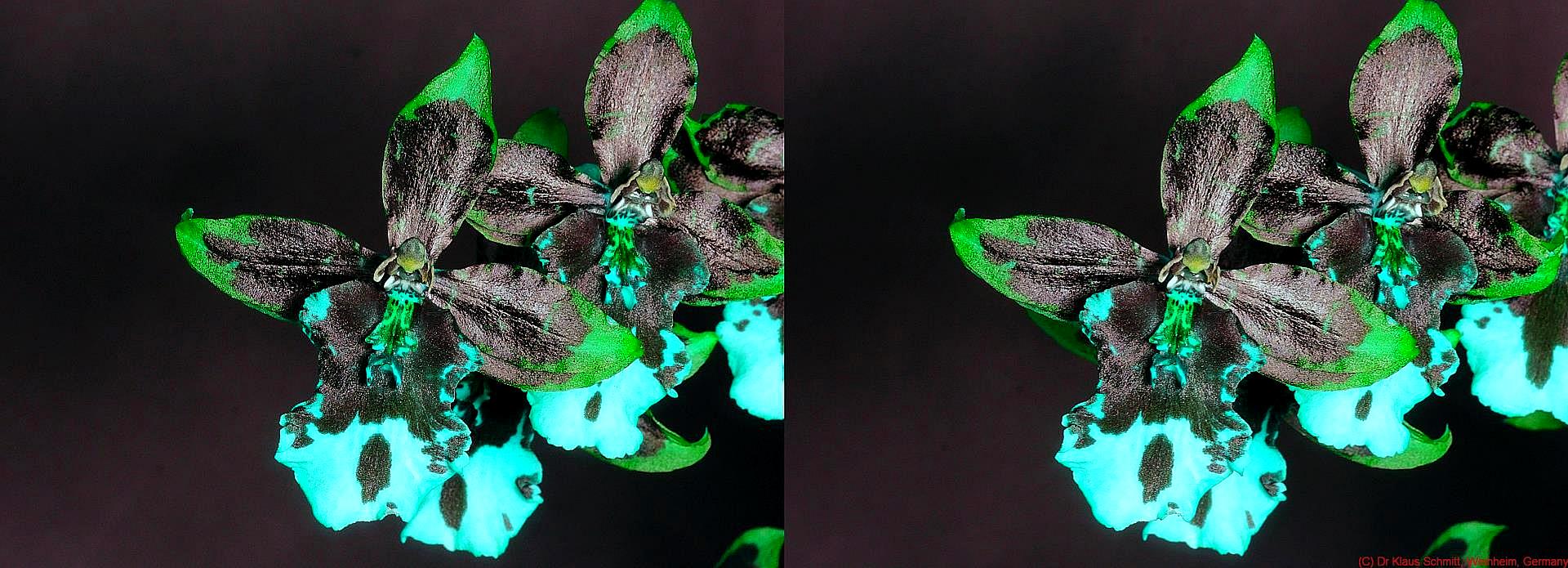
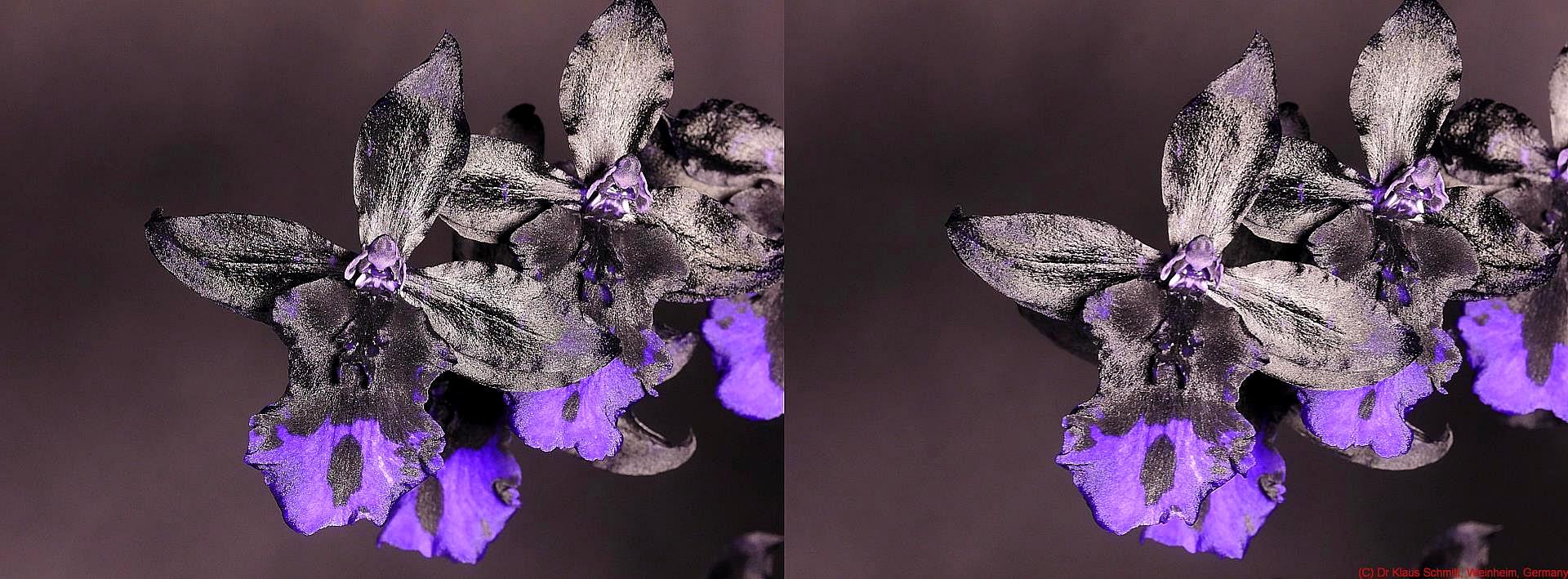
Oncostele Wildcat 'Golden Red Star' in visible, reflected UV, simulated bee and butterfly vision - 3D Stereo

Today shots of an Orchid hybride, Oncostele Wildcat 'Golden Red Star' in reflected ultraviolet photography as well as simulated bee and butterfly vision  - but also in 3D stereo crosseye presentation. UV filter used was the Baader-U filter, my "work horse" filter for reflected UV as well as my proprietary XBV filters. All shots were done at f8 using an UV-Nikkor f4.5/105mm lens. Light source used was a modified for high UV output Xenon flash.

[click on image to see a larger one]

Human Vision (VIS):
 

Reflected UV (Baader-U):
 

Simulated Butterfly Vision:
 

Simulated Bee Vision:
 

Quadriptych of the above (non-stereo):
 

This orchid has a very specific UV pattern, its petals are very UV dark, but the lower petal lip has on its lower center a very UV bright spot, as well as on its center "nose" formation an UV reflecting spot and all this gets nicely visible, also in 3D stereo (UV reflection shows as light blue)

I have written more about this orchid HERE and about Differentials HERE

Stay tuned, more will follow on that fascinating subject...

More info on this very interesting field may be found on my site http://www.pbase.com/kds315/uv_photos

Thursday, December 12, 2013

EADS SODERN CERCO f4.1 94mm vs Coastal Optical Systems Inc. 105mm f/4 UV-Micro-Apo lens for reflected ultraviolet photography

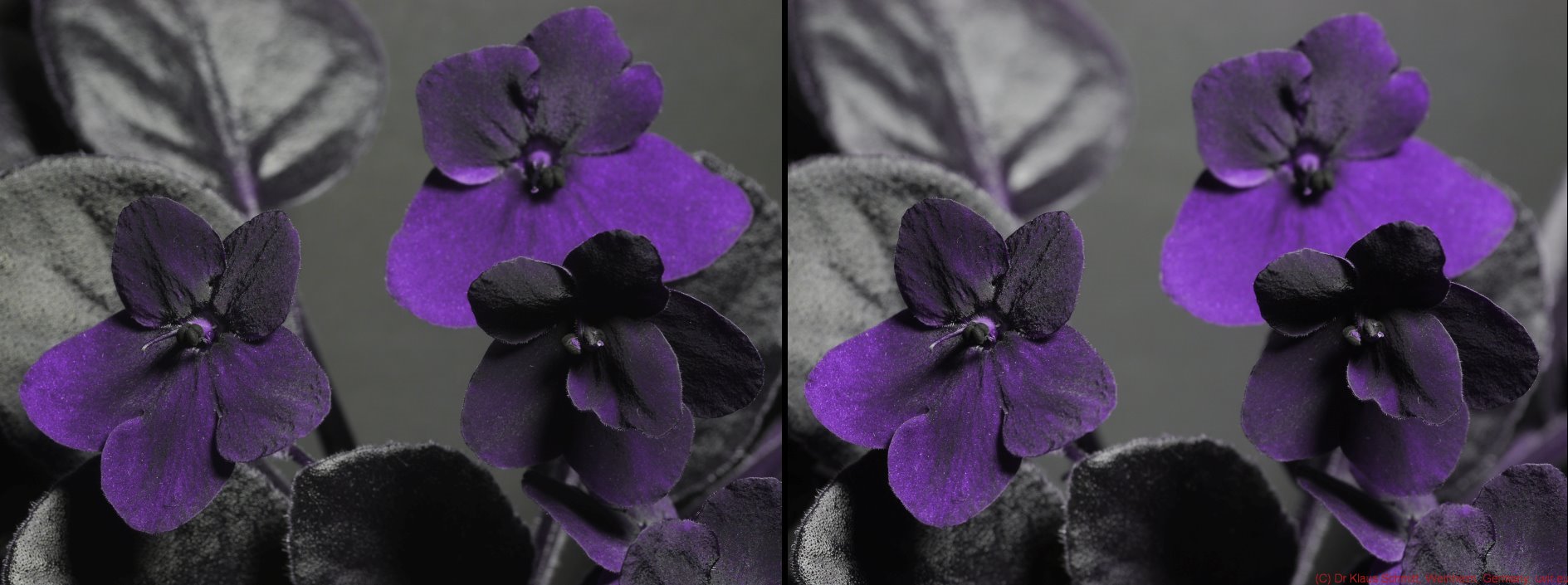
Today about two specialized UV lenses, the EADS SODERN CERCO type 2085 f4.1 94mm and the Coastal Optical Systems Inc. (COSI) 105mm f/4 UV-Micro-Apo apochromatic quartz fluorite lenses. In lack of a flower with UV pattern, I'm using a African violet hybride flower for that test as well as my "work horse" UV filter, the Baader-U filter. Light source was Xenon light. All shots were done at f5.6.

[click on image to see a larger one]

Diptych image CERCO 94mm (left) vs COSI 105mm lens (right), Visual light:
 

Diptych image CERCO 94mm (left) vs COSI 105mm lens (right), reflected UV using Baader-U filter (approx. 320-395nm, peak approx. 350nm):
 

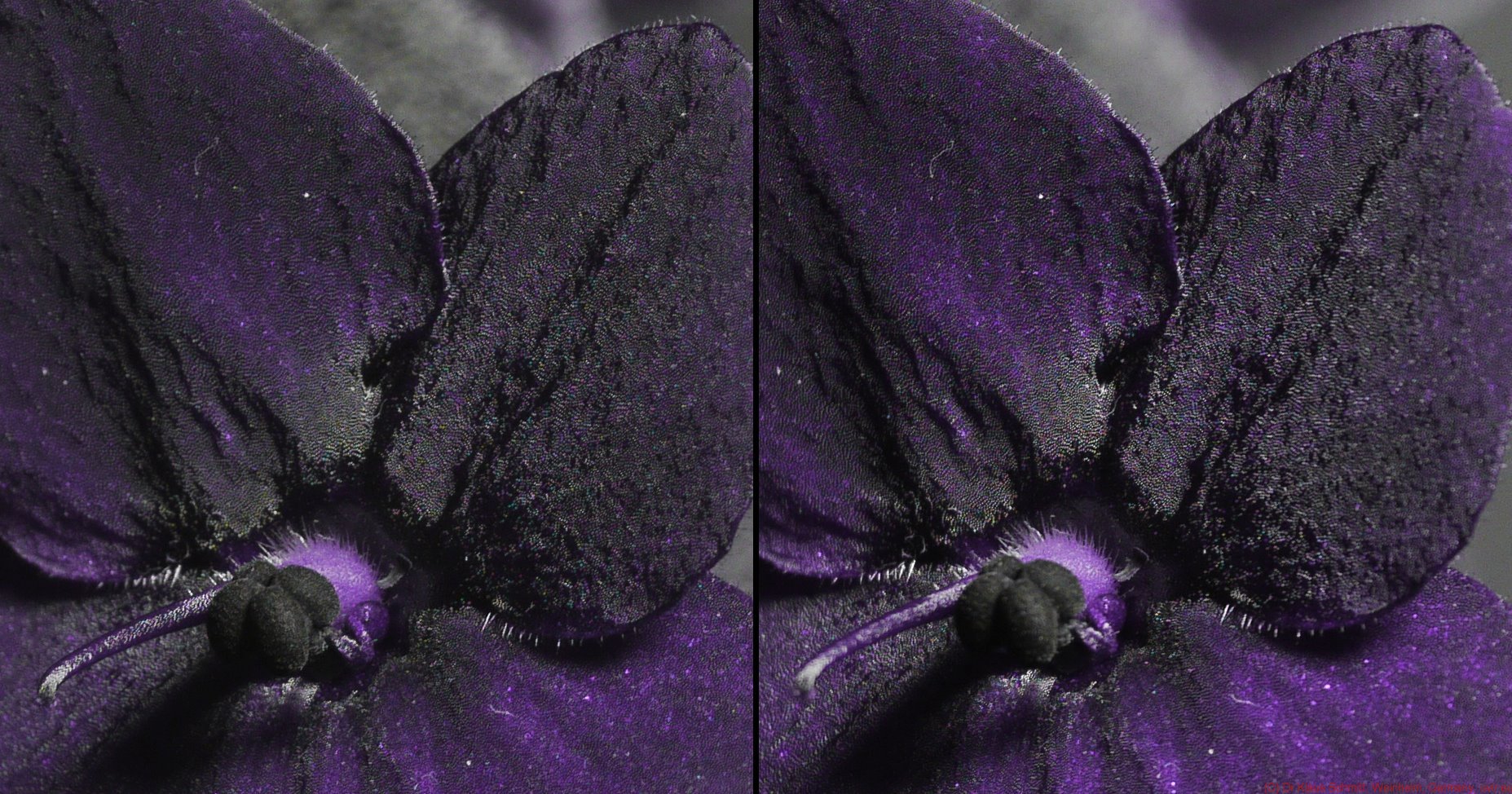
Diptych detail image CERCO 94mm (left) vs COSI 105mm lens (right), reflected UV using Baader-U filter (approx. 320-395nm, peak approx. 350nm):
 

The comparison images clearly show that both lenses work exceptionally well for reflected UV as for visual photography and deliver sharp images rich in contrast and detail. I had to adjust the camera position to equalize the focal length differences, so this is not a scientific lens test, but the view of a user. Both come in Nikon-F mount, but the COSI lens covers full format sensors, the CERCO only about the smaller APS-C format (25mm image diameter).

P.S.: The images were not re-adjusted in focus between UV and VIS shots, to show that there is no focus shift between VIS and UV.

P.P.S.: those images accidentially work as 3D crosseye stereo images...

Stay tuned, more will follow on that fascinating subject...

More info on this very interesting field may be found on my site http://www.pbase.com/kds315/uv_photos

Wednesday, July 18, 2012

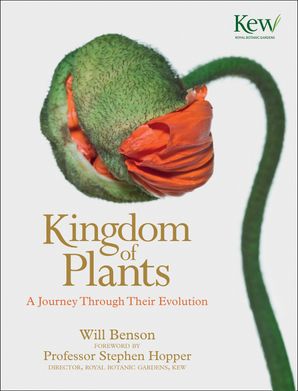
"Kingdom of Plants: A Journey Through Their Evolution" - new book by Will Benson

I have already written here a few times about that "Kingdom of Plants 3D" three episode series narrated and written by well reputed Sir David Attenborough, which mainly is about Kew Gardens in the UK and the evolution of plants. The series was produced by Atlantic Productions for SKY 3D TV and directed by Martin Williams and from what I heard will later also be shown in some IMAX theaters. Sir David Attenborough is the presenter and guide through the episodes. Now Will Benson, one of the staff members at the time of production, has written this wonderful book about it.

It is 256 pages, 3 pounds heavy (also also available in electronic form) and it includes four pages about insect and animal UV vision and two pages have some of my images in it from that 3D film. Here is one of it, showing a Rudbeckia hirta in visible and UV light:
[click on any image to see it larger]


and here for the experienced 3D crosseye viewer, the stereo version:


(quote - from amazon)
This book accompanies the landmark television series Kingdom of Plants 3D: With David Attenborough. In the last 500 million years, plants have undertaken an epic journey that has not only spanned the ages but has altered the very make-up of the planet. It was a journey that began in a dark and barren world, and has culminated in a planet that is draped in rich colours, and overflowing with a diversity of mystifying orchids, exploding seed pods and snapping carnivorous plants. But plants are far more than just beautiful and bizarre. Through the chapters of this book we uncover how plants first began to live on land, how they have become linked with a multitude of animal and fungi partners, and how ultimately they have shaped both landscapes and cultures. With an introduction by Professor Stephen Hopper, Director of the Royal Botanic Gardens at Kew, as well as contributions from leading botanists and horticulturists, this book unpicks the strands of our planet's network of botanical life. Through its pages we reveal the extraordinary ways in which plants have come to live and thrive in all habitats, and we discover how they can provide us with answers to many of the problems that face humanity in our modern age.(unquote)

Kingdom of Plants Site
Here is more about the book on the publisher site:
Kingdom of Plants at HarperCollins
Available now in printed or electronic form also from
amazon (US) or from amazon (UK) amazon (UK)

Front Page:

(c) HarperCollins

A wonderful book, not just for the coffee table. I'm sure you'll like it as much as I do!

Stay tuned, more will follow on that fascinating subject...

More info on this very interesting field may be found on my site http://www.pbase.com/kds315/uv_photos


Thursday, July 8, 2010

Rudbeckia hirta Stereo Butterfly Vision

This is about a Rudbeckia hirta flower shot in human vision and (simulated) butterfly vision.
I'm always amazed about the differences in our human perception and how that very same flower would look like if seen through insects eyes (butterflies in that case).
[click on image to see a STEREO image in large]

Human Vision: 


Butterfly Vision (simulated, UV mapped as blue) 


Stay tuned, more will follow on that fascinating subject...

More info on this very interesting field may be found on my site http://www.pbase.com/kds315/uv_photos