Friday, April 10, 2009

Happy Multispectral Easter!

Easter is here again and I would like to take the opportunity to thank you all for reading my BLOG and be with me on my journey to these unknown lands of UV photography. I am surprised that after some years there are still areas which are completely new to me and I like that a lot! So that might be the reason for my "standard" closing sentence:
"Stay tuned, more will follow on these fascinating subjects..."

So again, Happy Easter to you and your family!

[as usual, a click on the image opens up a larger view]


UV + IR remapped into one visible image....


More info on this very interesting field may be found on my site http://www.pbase.com/kds315/uv_photos

Sunday, April 5, 2009

Where to go....XUVIR full spectrum filter

A very short contribution here, a test using my new XUVIR full spectrum filter, using a Nikon D70s (mod. with clear quartz glass window >270nm) and a soft focus lens f2.5 85mm. [click on image to see a larger one]


[UV: blue, VIS:green, IR:red]

I won't comment on that for now....


Stay tuned, more will follow on that fascinating subject...

More info on this very interesting field may be found on my site http://www.pbase.com/kds315/uv_photos

Friday, April 3, 2009

You like Flyfishing? UV helps you be more successful!

You like flyfishing?

Well, UV photography can help you be successful doing that!

If you ask why, the simple reason is, that the scientific work on fish vision tells us that fish (some) have four receptors in their eyes, one each for blue, green and red (as we humans have) plus they have a forth, UV sensitive one!

I have been contacted by someone who wanted to find out, why some artifical flies work so very well, when some others don't at all. He sent me a package of very different ones, to test them out using reflected UV photography.

Lens used was my calibrated for UV X35 lens plus for the UV shot the Baader 2" U-filter. Light source used was my high power UV flash system.

So 'nuff talked, lets see some results! [click on image to see larger images]

Here now the comparison shot, the visual shot and the UV shot. VIS first then UV (color versions - UV has no color, so ignore that please!!) 


and here the black and white version of above for easier comparison of the different reflection patterns these flies have. VIS first, then UV:


It gets quite obvious, that a bright fly in visual light does not necessarily have a high UV reflection. Compare for instance the two leftmost flies in the top row. That artificial prawn left is highly reflective in visible and UV light, but the same light fish like fly one to the right is not at all in UV! But if you look at the bottom row, that dark two-colored fly (2nd from the right) is very bright in UV!


Stay tuned, more will follow on that fascinating subject...

More info on this very interesting field may be found on my site http://www.pbase.com/kds315/uv_photos

Tuesday, March 31, 2009

UV images exhibition - Hutter im Schloss, Weinheim, Germany

[click on image to see a larger one]

Well, in case you are around our wonderfull small town Weinheim, Germany, I invite you to pay a visit to our famous top class restaurant "Hutter im Schloss" http://www.hutter-im-schloss.de/

and to have a look at six of my UV works which are on display there now. 

The restaurant is wonderfully set as part of the historic ensemble of  "Schloss Berckheim" which forms the center of the historic center of Weinheim on top of a local hill and streches into the wondefully set "exotic park" which was the hobby of the nobles who lived there many years ago. So you will find 50 meters tall redwoods from the US westcoast, trees from China and all over the world. The largest Lebanese cedar tree north of the alps also grows here since 300 years.

Well certainly worth a walk and a nice rest at that fine restaurant with local foods and some inspiration from Spain (Perelada region), where the Chef, Jan Hutter, has worked many years and brought some nice recipes with him. 

Thursday, March 26, 2009

Multispectral UV+VIS+NIR in just one shot II

Now this is about multispectral imaging again.

Well, you know what an effort multispectral UV+VIS+NIR imaging is.Take three shots with different filters, modify them, transform them to bw and assemble them into one RGB image. Biggest thing actually is to take matching shots outside considering wind, changing light conditions etc.

So while I was playing around and doing tests using that FOVEON based Sigma SD-14, I had this idea if I could find a suitable filter, which would allow me to do it all in just one shot. I mean the following mapping: UV-> blue, Vis->green, NIR->red.

So after even more mumbling and grumbling, many calculations and stressing out my electronic spectrometer, I finally found a working filter combination. The issue to solve is, that the UV sensitivity is about 8...10EV lower than the visible one, the NIR is 1..2EV more than the visible one, so that filter has to stretch over 12 EV (!!!) taking into account that special sensitivity profile of that camera (internal filter removed, which can be done yourself in just 2 seconds!!). So in simple words, that needs to pass lots of UV, a bit of visible and just a tiny bit of NIR.

So 'nuff talked, lets see some results, using a daffodil (Narcissus jonquilla) as a target.

Camera used Sigma SD-14, unclipped internal filter, X35 lens, high power Xenon UV flash (unfiltered at 200Ws), 1/160sec at ISO 200 and f16.

This result came out of the Sigma SD-14 using a UV/IR blocking filter, i.e. the VIS shot:


This now is the (blue adjusted) UV-VIS-NIR result using my XUVIR filter:


and here the unadjusted UV-VIS-NIR image:


The RGB channels of that unadjusted UV-VIS-NIR image looks like this:

Plus a shot outside using sunlight, proving that these images may be achieved with reasonable exposure times. Lens used in this case: Pentax Ultra Achromatic Takumar 4.5 85mm at f11, 1/30sec, XUVIR filter, ISO200 :


Well, it may not be a perfect scientific mapping, but from an "artsy" standpoint it looks acceptable to me.

But the real idea behind that is to find a way to map "bee vision" in just one shot ... watch out here, more to come on that.


Stay tuned, more will follow on that fascinating subject...

More info on this very interesting field may be found on my site http://www.pbase.com/kds315/uv_photos

Monday, March 16, 2009

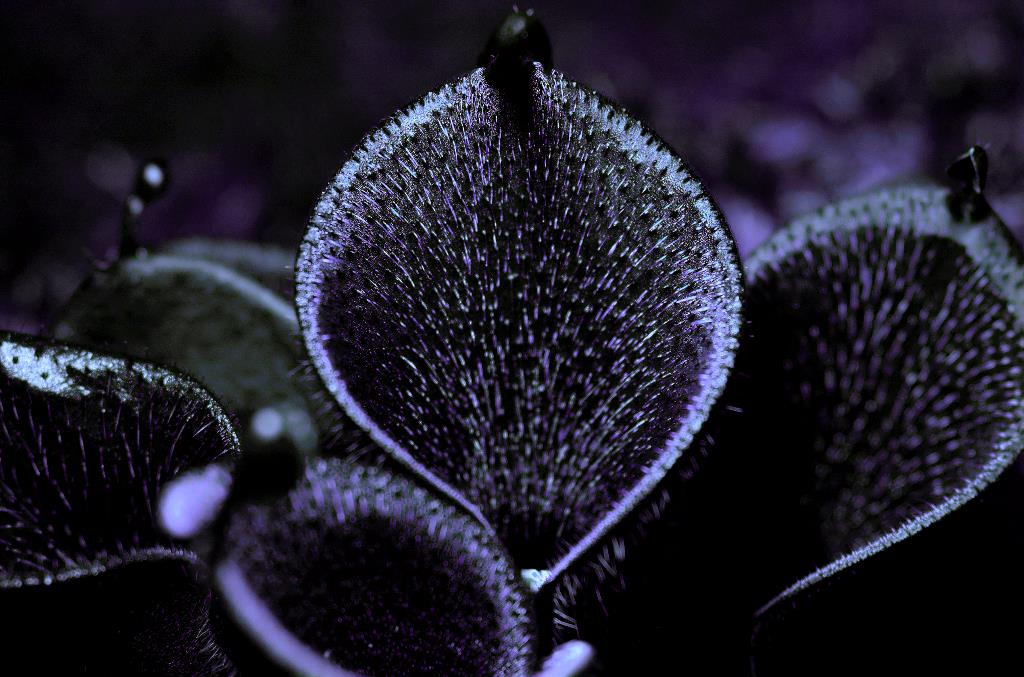
Carnivore plant shows UV pattern

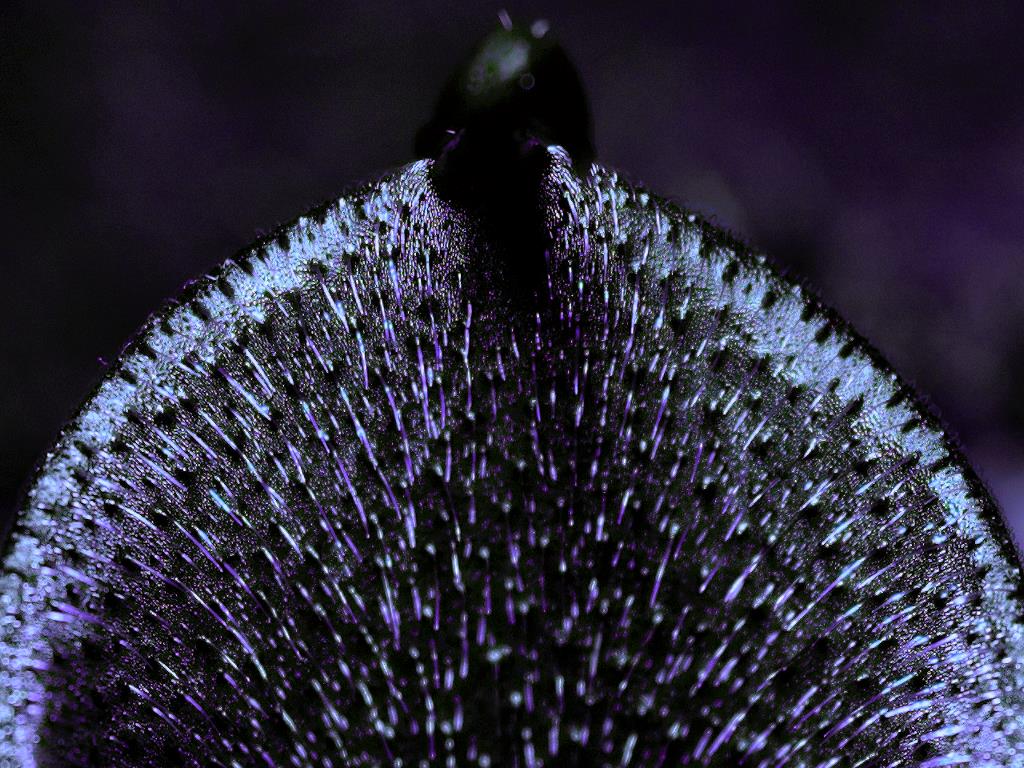
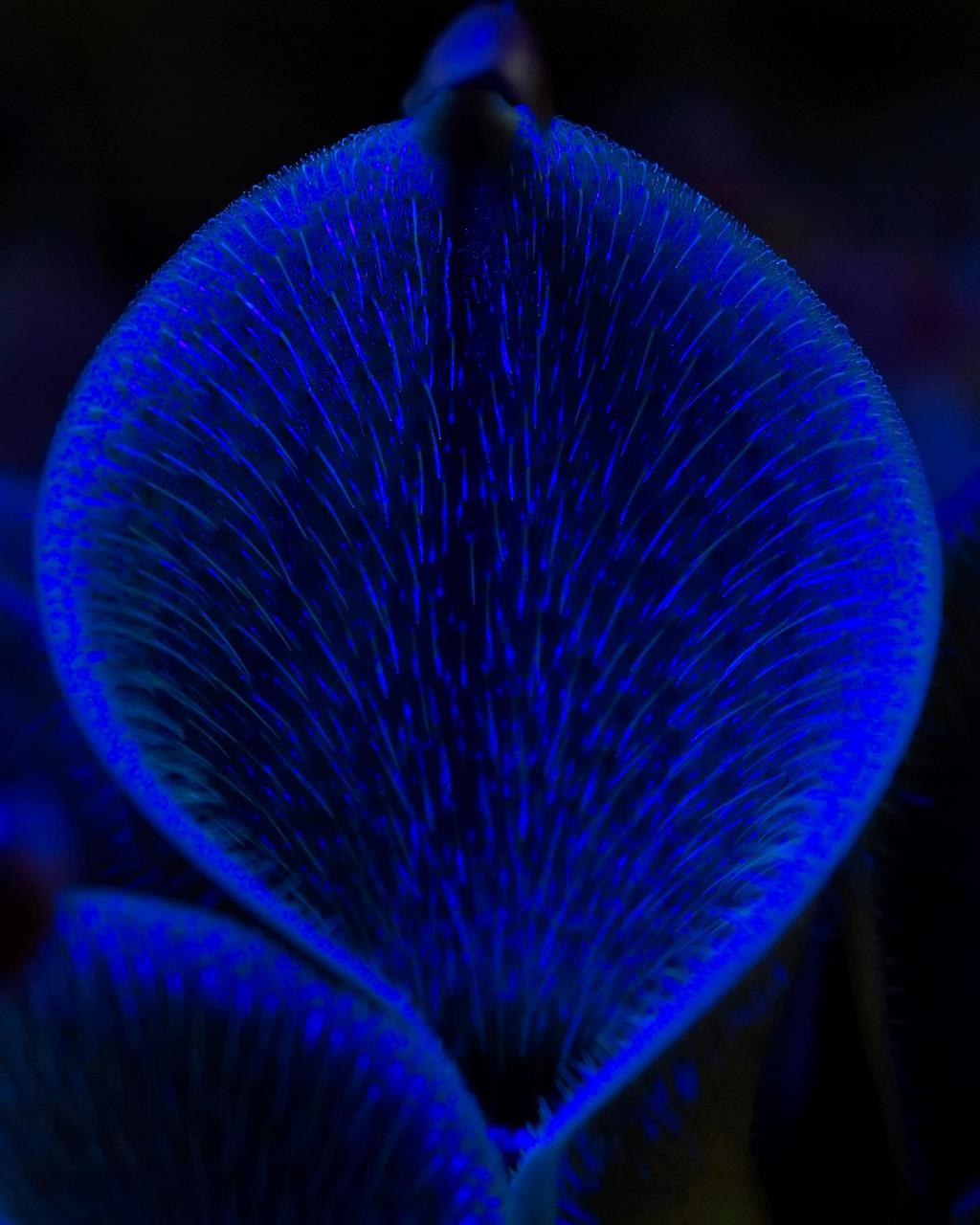
A friend of mine, Dr. Andreas Wistuba, collects and breeds special forms of carnivore plants and we were both wondering if some would show some UV reflective patterns. Well indeed, some do on these "needles" which prevent their prey to escape!!

Shot using off the shelf D70, UV-Nikkor 105mm, SB-140 flash + 2" Baader U-filter (310-390nm) (resp. UV blocking filter for the fluorescence shot)
[click on image to see a larger one]
UV shot:


UV shot detail:


Fluorescence shot:

Not sure what caused that, but evolution surely had a reason to develop that UV pattern!

Stay tuned, more will follow on that fascinating subject...

More info on this very interesting field may be found on my site http://www.pbase.com/kds315/uv_photos

Normal 135mm lenses for UV?

I invested some time today and measured the spectral transmissions of some 135mm lenses I had around.
[click on graph gives a larger image]


Top to bottom:
1) Pentax Takumar f2.5 135mm, multicoated (white)
2) X135 f2.8 135mm calibrated for UV lens, coated (turquise)
3) Enna f3.5 135mm lens from the 50ies, single coated (violet)
4) modern M42 non-name japanese f2.8 135mm lens, multicoated (orange)
5) Steinheil Quinar f3.8 135mm lens, multicoated (blue)

[please ignore the dips and jitter of the measured curves, that comes from that setup/Deuterium lamp used, this can also bee seen on that red 100% line w/o lens...]
I took the 365nm line as the wavelength to decide about the usebility of such a lens, since it is the center transmission of that famouns 2" Baader U-filter I mostly use for UV photography.  The X135 @365nm reaches 73% UV transmission (and it transmits down to about 320nm which correlates fine with the end of the UV sensitivity of an UV sensitive camera such as the Nikon D790 or D70s), wheras the next best one has only 39% (Quinar). Lens No.1 is a good example of what could be expected from a modern, multicoated lens in terms of UV transmission - not much actually since the multicoating and internal cemented lenses efficiently block UV, thus leaving such a lens quite useless for UV photography as compared to #2!
Please bear in mind that a useful UV transmission is just ONE criteria (but an important one) for successful UV photography. Resolution, sharpness, contrast, stray light and flare control, lack of hotspots etc. and focus shift of course are other important factors to consider.

HERE is a list of all lenses good for UV photography.

Stay tuned, more will follow on that fascinating subject...

More info on this very interesting field may be found on my site http://www.pbase.com/kds315/uv_photos