Tuesday, February 23, 2010

Influence of Filters on Image Sharpness

In my previous Blog entry, I had presented how an orchid will look like in simulated bee vision using that "multispectral in one shot" XBV2 filter. Strangely enough the resulting "bee vision" images looked a bit soft, so I wondered what caused that. So let's analyze the influence of filters on the sharpness of the resulting image a bit....

The first idea which might have caused softness was IR leakage, but since that special XBV2 filter stack used includes an IR suppressing filter, this was not the reason.

Since I have an alternative filter stack called XBV2a, I tested it against it - with a a big surprise: A much sharper result could be obtained.

All shot using UV-Rodagon 105mm at f8 using Xenon high Power flash and otherwise identical conditions except the filters used. 


[click on image to see a larger one]

XBV2 (left) versus XBV2a (right):


It gets very obvious, that the use of the XBV2a filter results in much improved sharpness, whereas the XBV2 filter result looks rather soft (1:1 pixel presentation).

Here now the two images full size:

XBV2 (old version):


XBV2a (new version):


Well, I'm not yet completely done finding out the reason for the softness of the XBV2 filter stack, so... 


Stay tuned, more will follow on that fascinating subject...

More info on this very interesting field may be found on my site http://www.pbase.com/kds315/uv_photos

Tuesday, February 16, 2010

Orchid in simulated Bee Vision

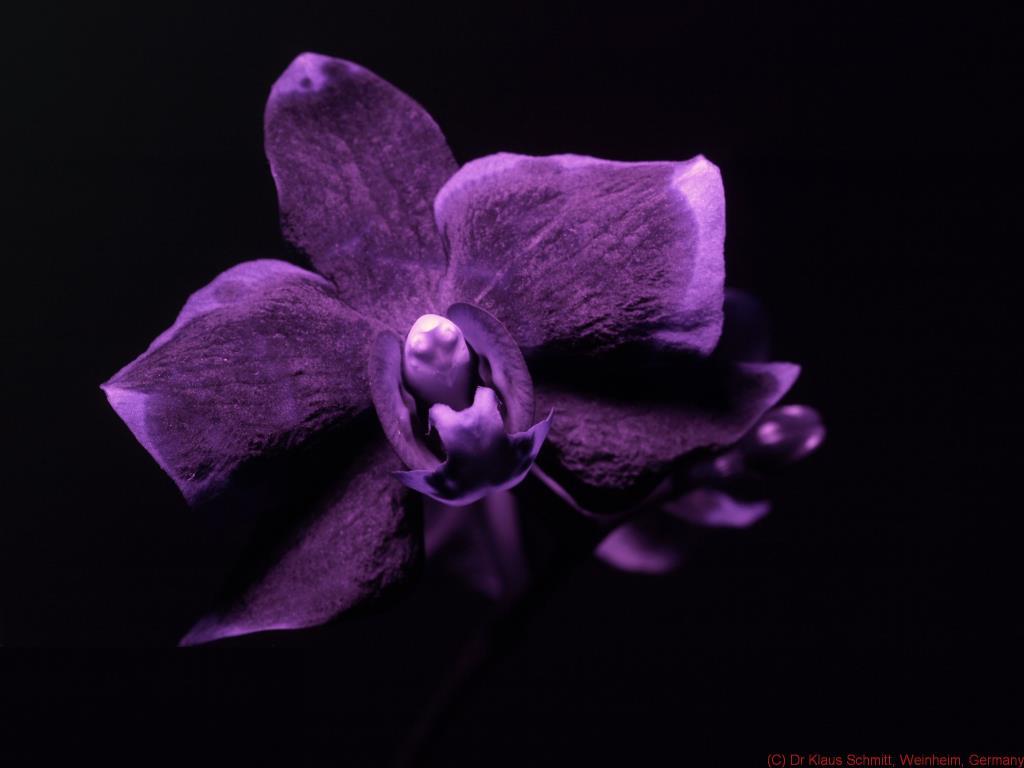
An inspiration by Bob Friedmann showing his excellent VIS and UV images on nikongear.com. I wondered how orchids would look like in simulated bee vision using my "multispectral in one shot" filter XBV2.

Here it is, simulated Bee Vision shot using XBV2 filter, high power UV flash, UV-Rodagon 5.6/105mm....and no focus shift.

[click on image to see a larger one]

VIS: 


Simulated Bee Vision using XBV2 filter: 


UV using Baader-U filter: 


Stay tuned, more will follow on that fascinating subject...

More info on this very interesting field may be found on my site http://www.pbase.com/kds315/uv_photos

Tuesday, February 9, 2010

UV-Rodagon Brothers

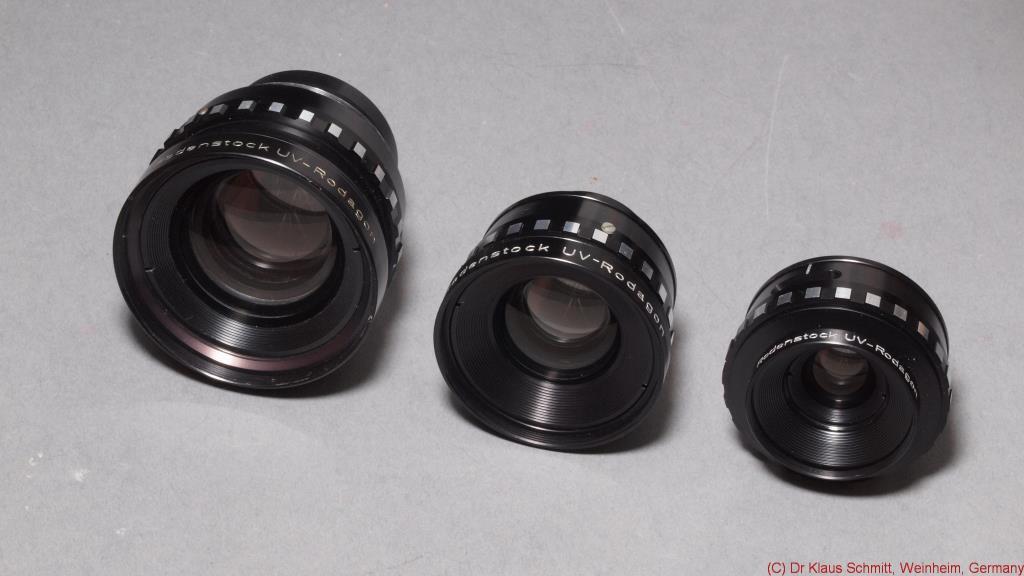
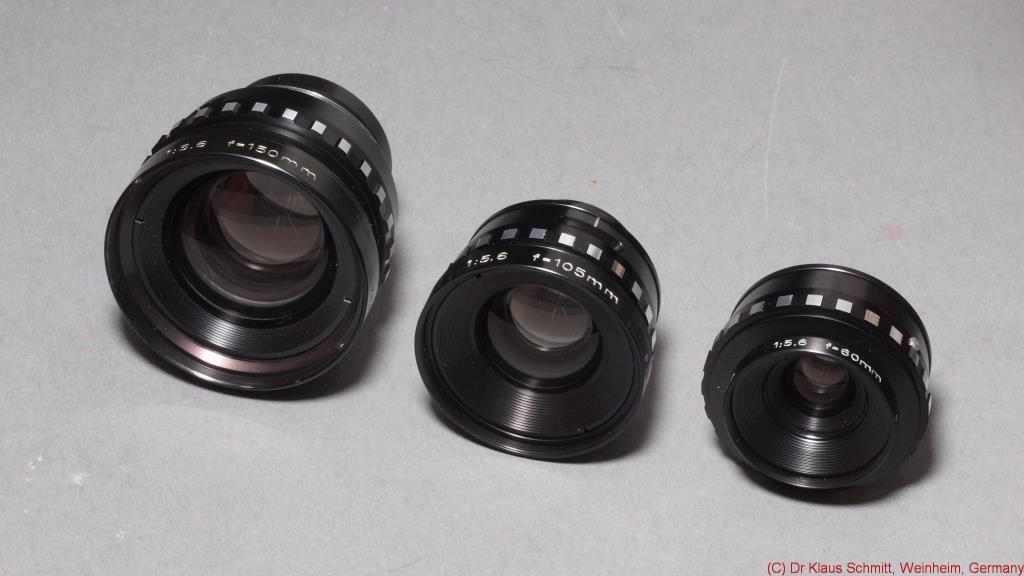
A buddy of mine and avid lens collector once mentioned the credo of all collectors: "everything comes to him, who can wait long enough...". Well, I must have waited long enough, since after some years, the brothers finally found each other..

[click on image to see a larger one]


Of course I had to test them, although the 60mm and 105mm have never been used before, MINT in makers box. Only about 25 or so have ever been made I was told, decades ago.

Measured UV-transmission (-3EV) is: 150mm: 320nm; 105mm: 315nm; 60mm: 310nm, but they do well up to 700nm (NIR)

Focus shift between UV and VIS is hardly measurable, fractions of mm only.


Stay tuned, more will follow on that fascinating subject...

More info on this very interesting field may be found on my site http://www.pbase.com/kds315/uv_photos

Monday, February 1, 2010

BBC1 announced Richard Hammond's Invisible Worlds - HDTV UV video

BBC London has finally announced its new trilogy "Invisible Worlds", now called "Richard Hammond's Invisible Worlds" since it will be presented by famous "Top Gear" presenter Richard Hammond on BBC1 "World of Wonder" in the UK and Discovery Channel in the USA.

The series is directed by Dan Clifton.

The DVD is already on pre-order at amazon UK here (PAL version).

Quite a while ago BBC asked me to contribute my knowhow and some of my work of the invisible to their new three part science series "Invisible Worlds". The first part of the series will be about the natural world and things we humans cannot see, but other species can, like bees, birds, butterflies, spiders, mice etc. because it may be in a spectral area not accessible to our human eyes, but to them.

The challenge was, to transfer my special still life photographic technique of the ultraviolet into the world of HDTV film, but after some weeks of intensive work, especially on lenses, filtering and lighting, I found working solutions for all that.

Using special lenses + filters I have developed, it is now also possible to show (simulated) how bees, butterflies, birds etc. may see the world in comparison to how we do see it - and all in HDTV format.

The following image is a test image, not related to or used from the BBC series but one of my test stills from that time I worked on that... (yellow flower = as we humans see it; right blueish part of the flower and butterfly = simulated tetrachromatic butterfly vision; UV = blue)

[click on image to see it larger]


If you like to see a glimpse of my work, have a look at this test HDTV video snippet on youtube directly ...or click on the following small embedded version. Notice how the butterfly patterns change and the all yellow flower petals in the visual show the typical white tipped UV pattern, invisible to us humans, but made visible as a simulation of tetrachromatic butterfly vision, where UV is shown as blue.


[this is a test shot from my own lab while preparing, not from the final series and unrelated to BBC, just to be clear...]

I would like thank Dan and his great team of "Invisible Worlds" for the opportunity to contribute to that series. It was my great pleasure to work side-a-side with such a professional and committed team!

Stay tuned, more will follow on that fascinating subject...

More info on this very interesting field may be found on my site http://www.pbase.com/kds315/uv_photos

Tuesday, January 26, 2010

A Study of 50 wide + normal Lenses for UV Photography

[click on image to see a larger one]
Over the last many months I have been researching some shorter focal length lenses (wide + normal) for reflected UV photography. Without much ado, here the results I found condensed into one graph. The right grey part of it shows where the lens transmits UV, the blue bar to the left where the lens blocks UV. Border was set at a -3EV transmission level (12.5% relative to the maximum transmission).
Personally I would rate a lens useful for UV, if it allows UV to transmit at least to 350nm. Bare in mind, that the available DSLRs today hardly even reach that far, the deepest I could ever record in UV was 320nm, which perfectly matches these available lenses.
This is far from being a complete list of course, but the idea behind that was to prove, that older lenses still have their right to be used today with modern digital cameras, since they have abilities, modern lenses often lack.
To be clear, a high UV transmission is just one prerequisite for a lens being able to be used for reflected UV photography - but the most important one. Further selection criteria must be sufficient high resolution and contrast, flare resistance etc. which would certainly narrow down the list of candidates. More about that later here...
[Most of these lenses don't have Nikon mount, so using adaptors would only allow their use for macro work. But some of them can be either converted dircetly to Nikon mount allowing infinity focus or by using a special UV enabled adaptor. Contact me, if that would interest you...]
Stay tuned, more will follow on that fascinating subject...

More info on this very interesting field may be found on my site http://www.pbase.com/kds315/uv_photos

Monday, January 18, 2010

X135 supports Transmediale 2010 Art Project "Invisible Cities"


In a few days the Transmediale 2010 Exhibition will open its doors in Berlin, Germany. A very creative young artist, Julius von Bismarck , will be  showing his newest art project there, the follow up of his "Fulgurator" and a very creative new piece of art as part of the "Invisible Cities" presentation named "The Space Beyond Me"


[simulation of the 2D film panorama developing based on pattern recognition as can be seen on the down left small image, not visible later. Idea, concept and realization as well as that image (c) Julius von Bismarck, Berlin, Germany assisted by Andreas Schmelas, computer programming]

There, a film will be projected to a circular projection screen. Nothing new you think? Well, I guess very much so, since it does not happen in the visible world, but the projected light is invisible and, you may have guessed it already, it is ultraviolet. The screen is covered with a fluorescent + phosphorescent substance, so when hit with UV light, it radiates visible light.

Now the very special idea of the artist is, to use that screen as a short term memory to develop a two-dimensional panoramic image of what is stored on that film on that fluorescent screen by detecting the structures of objects and subjects in each frame of that film and assigning it to a fixed position on that phosphorescent screen (so the film projector moves in two dimensions to "write that information on the wall" using some special software and 2D stepper motors which control the position of the projector). So frame for frame, the panorama develops on that screen, until finally all information contained on that film has been displayed and temporarily stored on that fluorescent screen until it fades away....

((quote)) The Space Beyond Me recreates a process in the human brain in which virtual three dimensional images are reconstructed from two dimensional information; a principle that enables us to vividly imagine a place where we have never been before, or a time that is already history. ((unquote))

And what has that to do with the X135 lens? Well, an affordable lens able to project a very sharp and contrasty UV image was needed by the artist to allow that fluorescent screen to function well (= bright enough). So a few tests I have conducted clearly showed, that compared to a normal camera lens, the X135 is able to project an image more that 100 times brighter. An X90 was also tested with the same good result.

In my former BLOG entries ("Thoughts about Lenses and Filters" and "Normal Lenses for UV"), the principal difficulties have been discussed and showed how to overcome these.

So if you have a chance to visit Berlin in February 2010, make sure to pay that very special event a visit!

See you February 7nd, 2010 in Berlin at the TRANSMEDIALE in Salon/K1!  Exhibition schedule is here (pdf).


Stay tuned, more will follow on that fascinating subject...

More info on this very interesting field may be found on my site http://www.pbase.com/kds315/uv_photos

Thursday, October 15, 2009

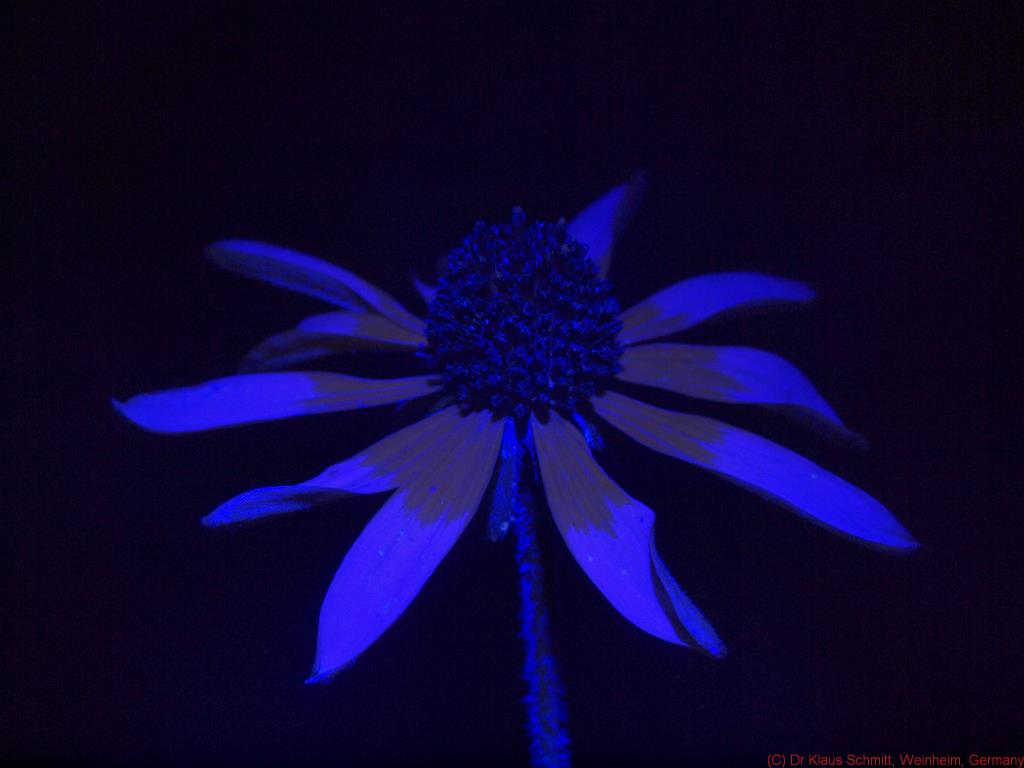
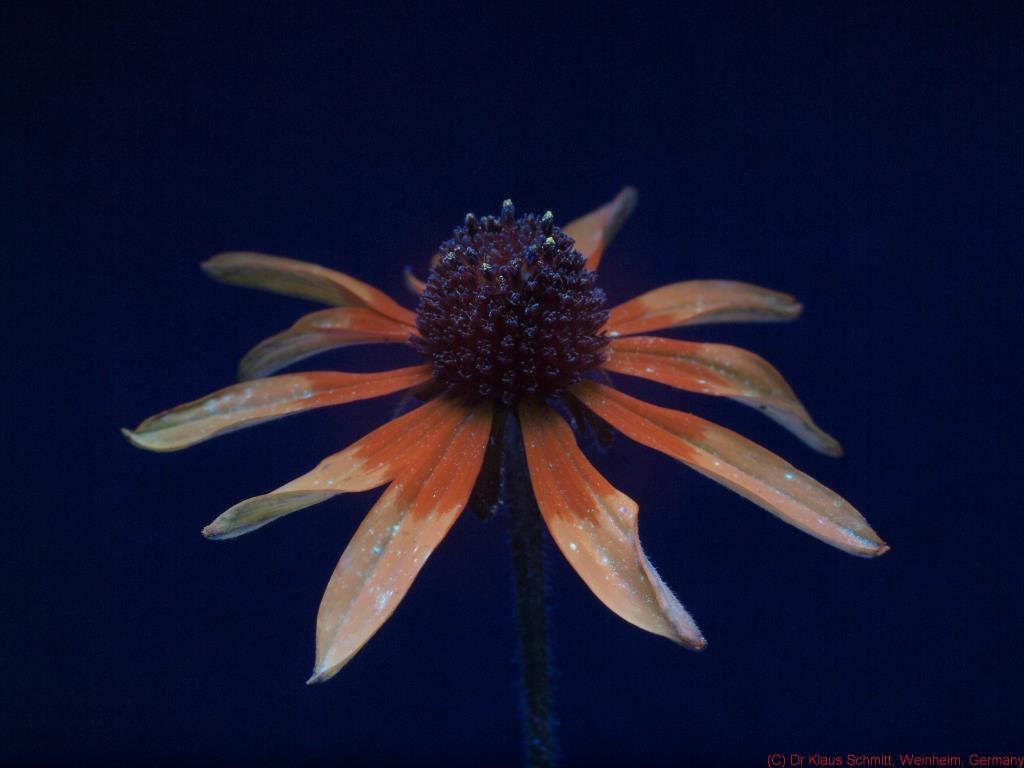
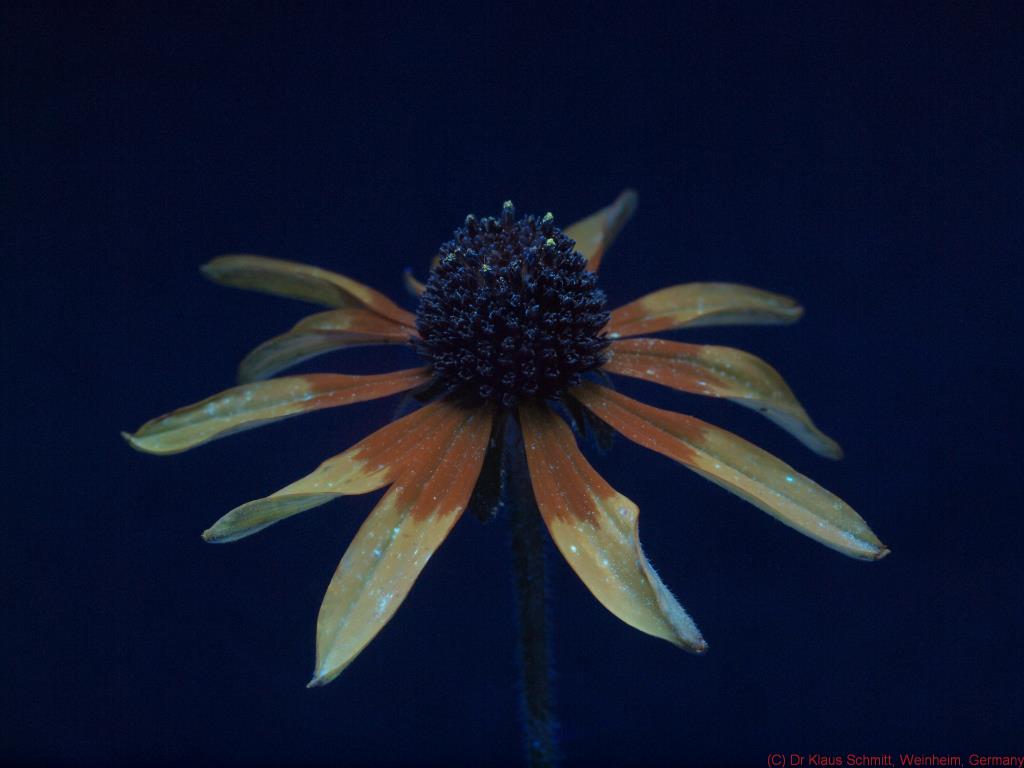
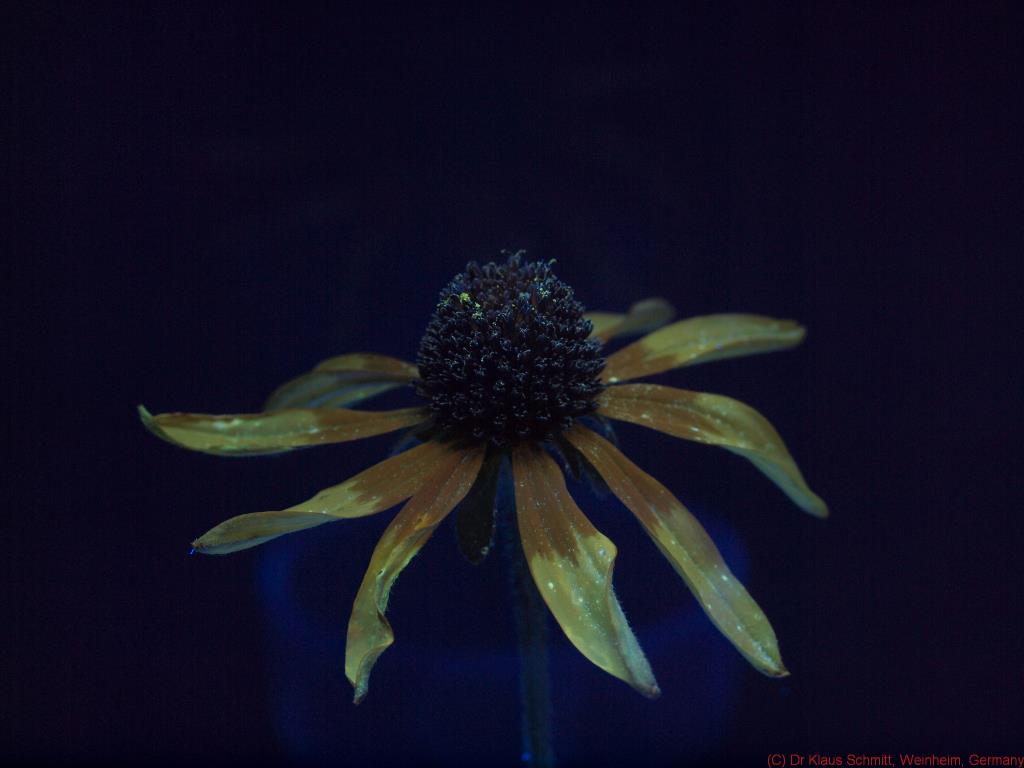
Fluorescence: Rudbeckia missouriensis using various light sources + filters

A quick series of tests done, showing the effects of various UV light sources + filters for UV stimulated visible fluorescence. Images just resized, straight from the cam.

[click on image to see a larger one]

0. Visible reference, 5600 Kelvin LED


1: Long wave UV lamp w. filtered mercury 2x 4 Watts lights ("blacklights"), 400-700nm dichroic cut filter on camera


2: Cree 385nm UV LED, 3 Watts, 400-700nm dichroic cut filter on camera (this LED leaks quite some blue light)


3: Cree 385nm UV LED, 3 Watts, filtered using 1.25" BaaderU-Filter , 400-700nm dichroic cut filter on camera


4: Nichia 385nm UV LED, 400-700nm dichroic cut filter on camera


5: Nichia 365nm UV LED, 400-700nm dichroic cut filter on camera


6: Nichia 365nm UV LED filtered using 1.25" BaaderU-Filter, 400-700nm dichroic cut filter on camera


7: High Power UV flash, filtered using Schott UG1, 400-700nm dichroic cut filter on camera


8: High Power UV flash, filtered using Schott UG1, Baader UV/IR cut filter on camera


9: High Power UV flash, filtered using Schott UG1, Schott BG38 + 400-700nm dichroic cut filter on camera


10: High Power UV flash, filtered using Schott UG1, 400-650nm dichroic cut filter on camera


Exposure times were between 15s (UV fluorescent lamp), 3-15s (UV LEDs) and 1/160s (Xenon flash), all shot using ISO400 and f11.

I did not try and make "the pattern" visible. The underlying assumption that the pattern using reflected UV and UV stimulated visible fluorescence should not be confused, since it is two completely different mechanisms and it might be just coincidential that both appear at the same time. It would be interesting to study that though, if these both are directly linked to each other (i.e. if the reflected UV pattern and the fluorescence pattern appear simultaneously and if so, why).

You may have noticed, that I tried to cut off the visible part of the exciting light source from about 395nm onwards using a 1.25" Baader U-filter in some of the tests. I wanted to see if that "leakage" of visble light (some blue usually) in the exciting light has an impact on the result - and quite obviously it has, with the exception of the Nichia 365nm UV LED, since that one has hardly any visible content. But still it makes a little, but noticeable difference.

The Xenon light source provides a continuous emission spectrum and using a UG1 like filter, I took out the UV part as exciting light. Now the question is, if the strong visible red in the results is a result of stimulated red+NIR fluorescence, or if it is caused by NIR leakage of the UG1 filter (i.e. reflected NIR). This is why I used three different  filters (BG38, Baader UV/IR cut and 400-650nm cut) to see the effect of them.

Here now the proof that IT IS indeed red/NIR leakage:

11: High Power UV flash, filtered using Schott UG1, 400-700nm dichroic cut filter on camera


12: High Power UV flash, filtered using Schott UG1 + UV passing IR blocking filter, 400-700nm dichroic cut filter on camera


Stay tuned, more will follow on that fascinating subject...


More info on this very interesting field may be found on my site http://www.pbase.com/kds315/uv_photos