My BLOG about my journey into the invisible world of ultraviolet UV photography, simulated bee, butterfly and animal vision photography and the special lenses, filters and lighting needed to make it work - also in HD video + 3D stereo.
The exhibition management of the Denver Botanic Gardens has contacted me about a forthcoming 2018 exhibut about pollinators. We have agreed that they will use some of my works to demonstrate how differently butterflies see the world compared to how we humans do.
These flowers will be on exhibit: Gaillardia, Linus, Rudbeckia, Crepis which are common in the Colorado wildlife area.
Gaillardia (top) and Rudbeckia (bottom) in human and simulated butterfly vision
Linus (top) and Crepis (bottom) in human and simulated butterfly vision
The exhibit will open in April 2018, so be sure to pay it and the Gardens a visit, certainly worth it!
Stay tuned, more will follow on that fascinating subject...
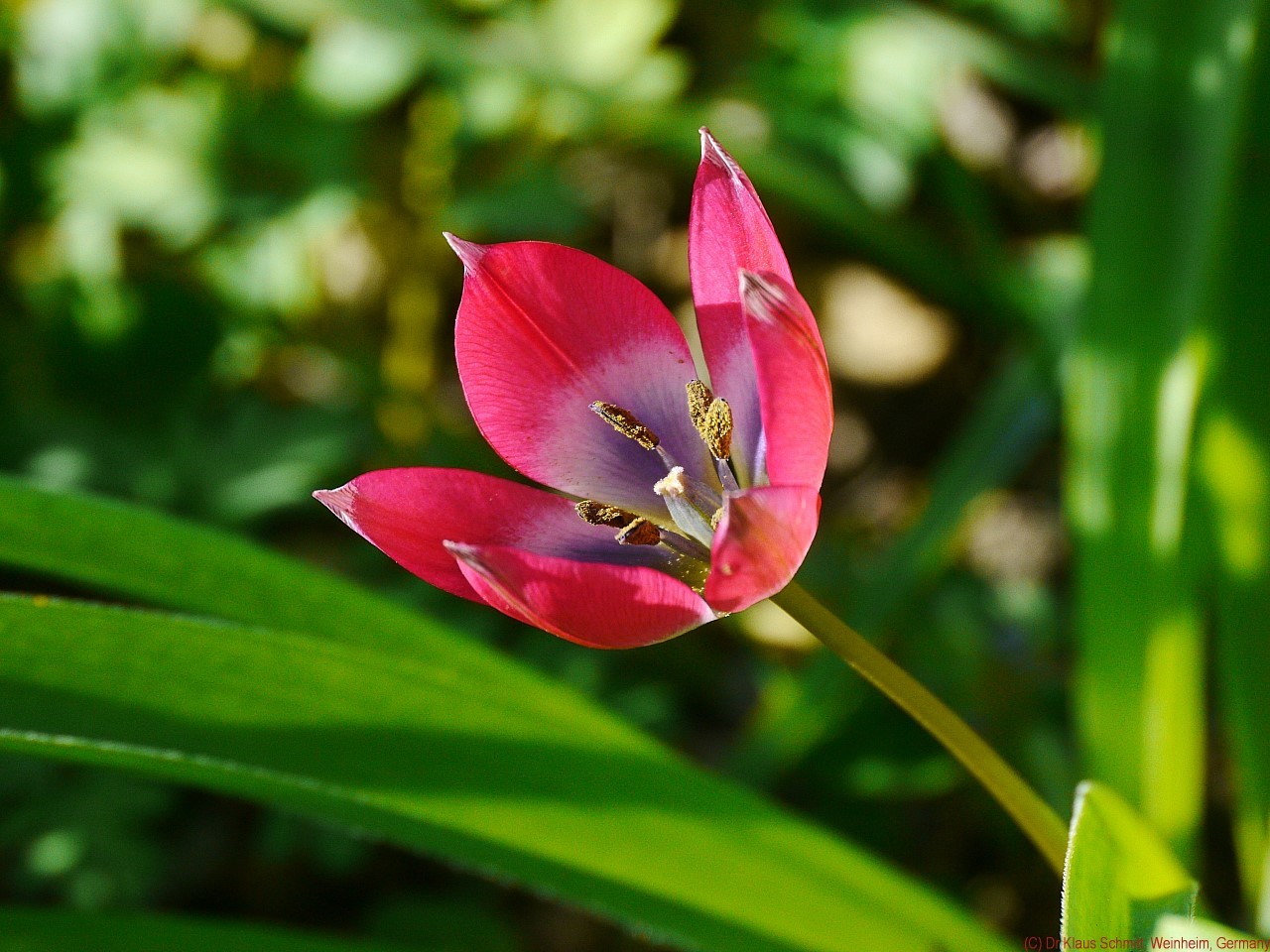
Today also about an early spring flower, I have written about before HERE, a Dwarf Tulip (Tulipa pulchella violacea) in reflected ultraviolet photography using my "work horse" UV filter, the Baader-U filter as well as my XBV filters for simulating butterfly and bee vision. Lens was a UV-Nikkor 105mm quartz fluorite lens. Light source was sunlight. All shots were done at f8.
[click on image to see a larger one]
Human Vision:
UV vision:
Simulated Butterfly vision:
Simulated Bee vision:
This dwarf tulip has a quite visible UV pattern, its center is UV bright, surrounded by long wave UV reflecting tips and all this gets quite nicely visible.
Stay tuned, more will follow on that fascinating subject...
Today more about that Quartz Fluorite catadioptric ZUFAR-2CA f4/350mm anastigmat lens which took me over 10 years to find. It had been developed for the Soviet MARS 2 to 5 missions to planet Mars, was made of synthetic Quartz and Calcium Fluorite (CaF2) crystals to be able
to work in UV and also visible light, thus allowing to take images 300-700nm without focus shift.
So today a few first test shots using this very special lens, due to lack of the mount which need to be designed and made, just some freelensing shots. "Freelensing" means holding the lens in front of the camera without any mount in between the two (!). Here some visible light shots, showing how this lens performs. This first one is about 150 meters away:
and the following one about 15 meters:
The lack of chromatic aberration gets easily visible on that golden ball as well as on these shiny stainless steel exhaust pipes. Now on to reflected UV images (300-400nm), here right out of camera:
and here with whitebalancing applied:
Being able to handheld a f4 350mm lens and shooting in reflected UV (300-400nm) is rather astonishing, a proof how much UV this lens is able to transmit. More about this lens will certainly follow here...
I have written about this lens before HERE
Stay tuned, more will follow on that fascinating subject...
Today about a Quartz Fluorite catadioptric ZUFAR-2CA f4/350mm anastigmat lens which took me over 10 years to locate. It had been developed for the Soviet MARS 2 to 5 missions to planet Mars.
It was made of synthetic Quartz and Calcium Fluorite (CaF2) crystals to be able
to work in UV and also visible light, 300-700nm without focus shift, so
actually is an apochromatic (APO) f4/350mm catadioptric lens. The whole
useful wavelength range is 230-700nm. Lens transmission is 60-65% and the lens resolution is 57 lpm in its center, 47 lpm in corners. Viewing angle is approx. 6 degrees. There has also been made a ZUFAR-1 lens with f4 / 500mm and 4 degrees viewing angle.
ZUFAR lenses have been designed in the 70s under the lead of Institute head and chief designer Prof. Volosov together with N. Khmelnikova, I. Driatskaya, K. Mikhailova at GOI, the russian state lens design institute in St. Petersburg / Leningrad. Details were published by Prof Volosov in 1974.
(Made for my use by my dear friend Marco Cavina)
Data of this lens, as well as its normal (= non catadioptric) quartz fluorite sister lenses with
shorter focal lengths may be found on my macrolenses database site HERE
This lens was made to be used on a very elaborate camera
system which could take multispectral images on film, develop that and scan it and send the scanned data back to Earth in selectable resolutions (up to 2000x2000 pix, which took over one hour to transmit).
NASA also wrote about this lens (quote): Zufar objectives were used on the television cameras carried by the
Mars-2, 3, 4, and 5 spacecraft. The compact catadioptric quartz-fluorite
anastigmat was developed as a result of research on the possible
optical arrangements of lens and mirror-lens systems meeting the rigid
criteria for spaceborne operation. The system is characterized by
precise correction of all aberrations over a broad spectral range, about
300-700 nm. The spectral transmission is about 60% over this range. The
Zufar-2CA version of the objective has a geometric aperture ratio of
1:4 and a focal length of 350 mm. The image format is 24 x 24 mm. The
housing is 164 mm long and 130 mm in diameter, and the mass of the
objective is 1500 g.
Here one of the published images from Mars taken on Mars-5 mission:
The lens will be given a suitable adaption to fit my digital multispectral cameras and I will certainly take multispectral photos with it as soon as possible and report about here later on.
There is more about this lens HERE including some first images taken with it.
Stay tuned, more will follow on that fascinating subject...
The exhibition project management of the American Natural History Museum had asked me to participate with some of my works for their forthcoming 2017-2019 exhibit "Our Senses", which has already opened its doors to the public November 20, 2017 and it will last until Sunday, January 6, 2019
(quote AMNH) Every day, we perceive the world around us through our senses - including
sight, smell, hearing, touch, balance, and taste. But as it turns out,
for humans “reality” isn’t ever exactly what it seems. In this highly
experiential exhibition, explore 11 funhouse-like spaces that dare you
to trust your senses - then show you how what we perceive is not simply a
window into the world around us but a product ofour brains. Plus,
discover why we have senses and what’s unique about human perception during an interactive session hosted by a live presenter. (unquote)
(c) AMNH
My contribution will be some of my multispectral Rudbeckia fulgida flower images, demonstrating the difference between our human vision and the vision of a butterfly and a honey bee (simulated).
(c) AMNH, Dr Klaus Schmitt
It also includes some images which help to understand what monach
butterflies may see, as it allows visitors by using a push button to
switch from their human vision into butterfly vision on 3D modeled
flowers.
(c) AMNH
I'm certain this exhibit is visually stunning, as well as highly educative since it is interactive and suited for interested individuals as well as families, their kids and school classes.
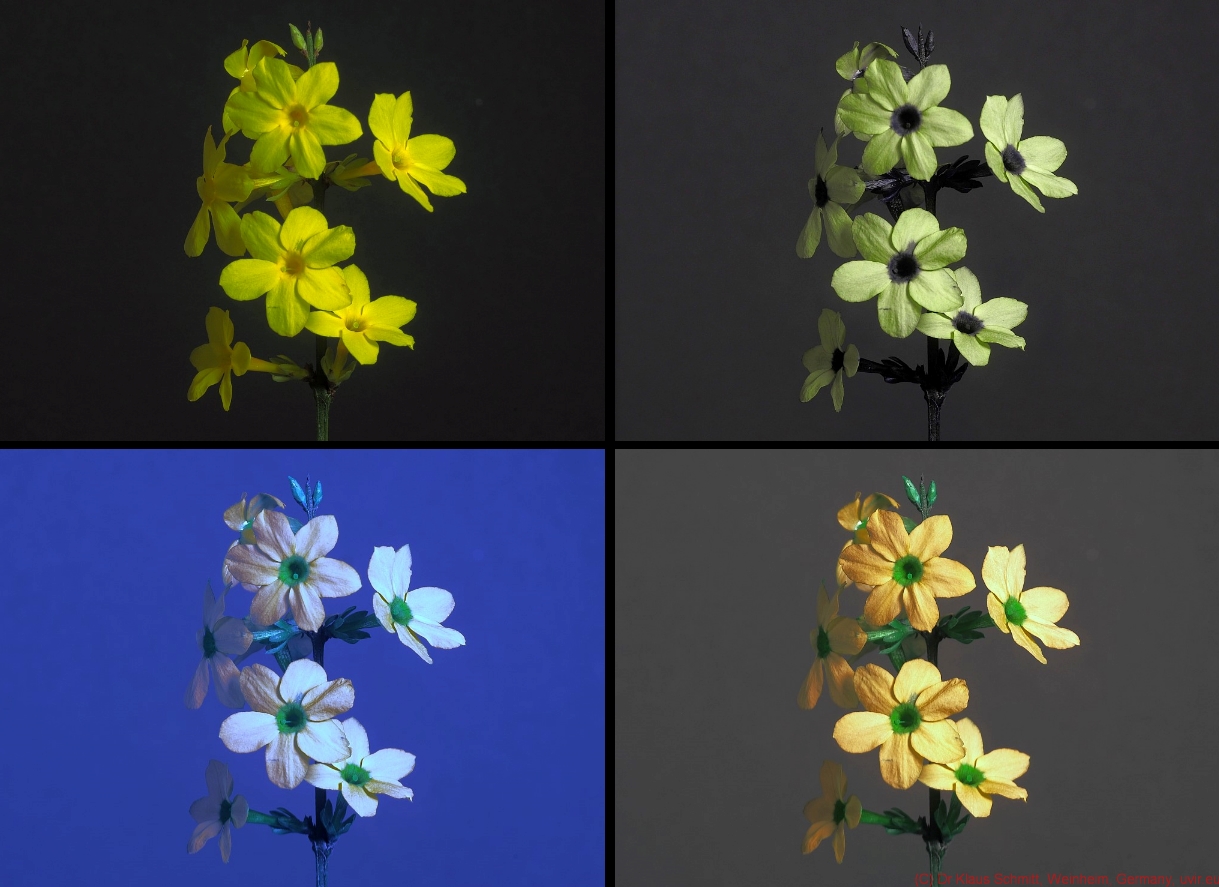
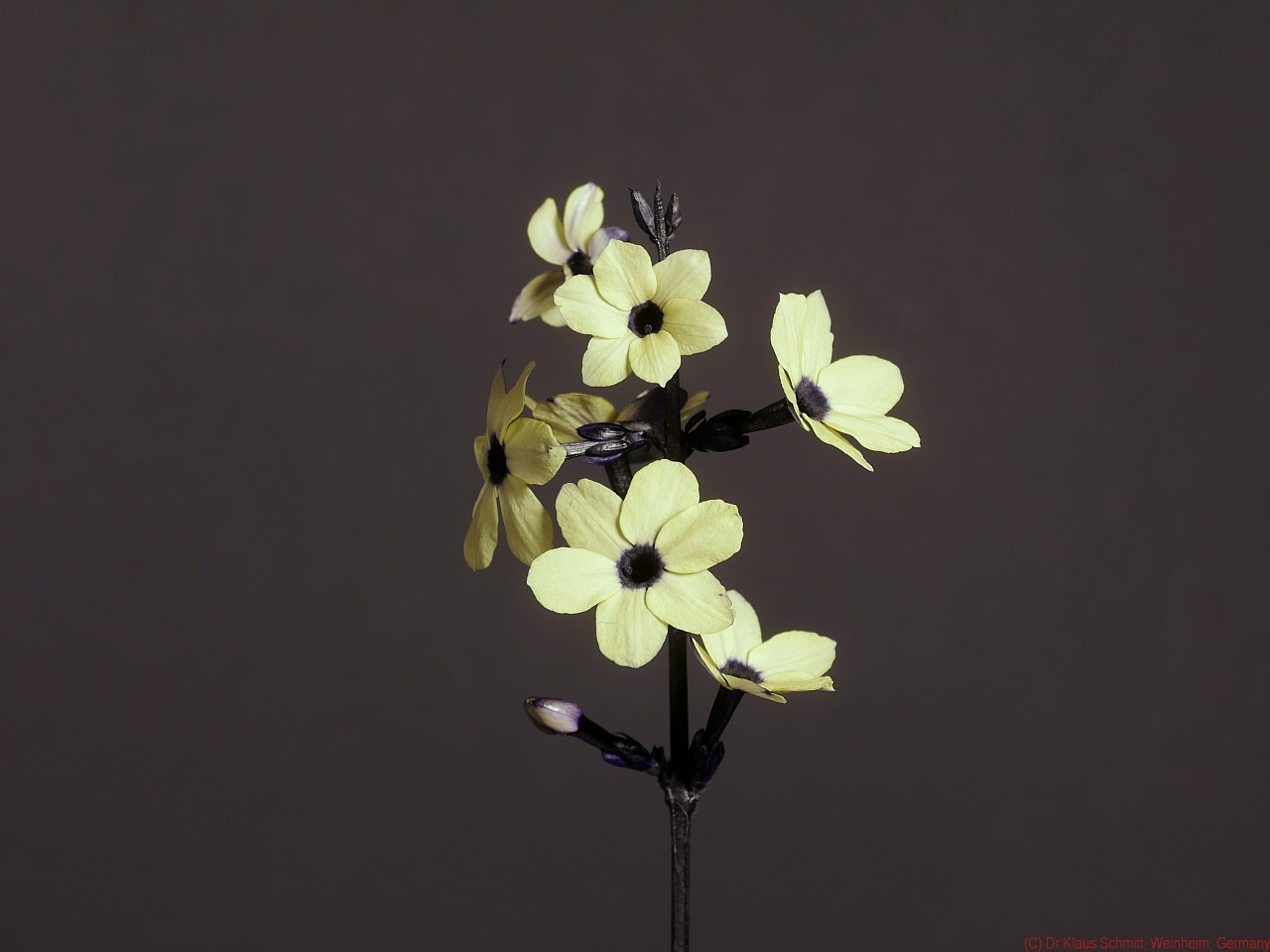
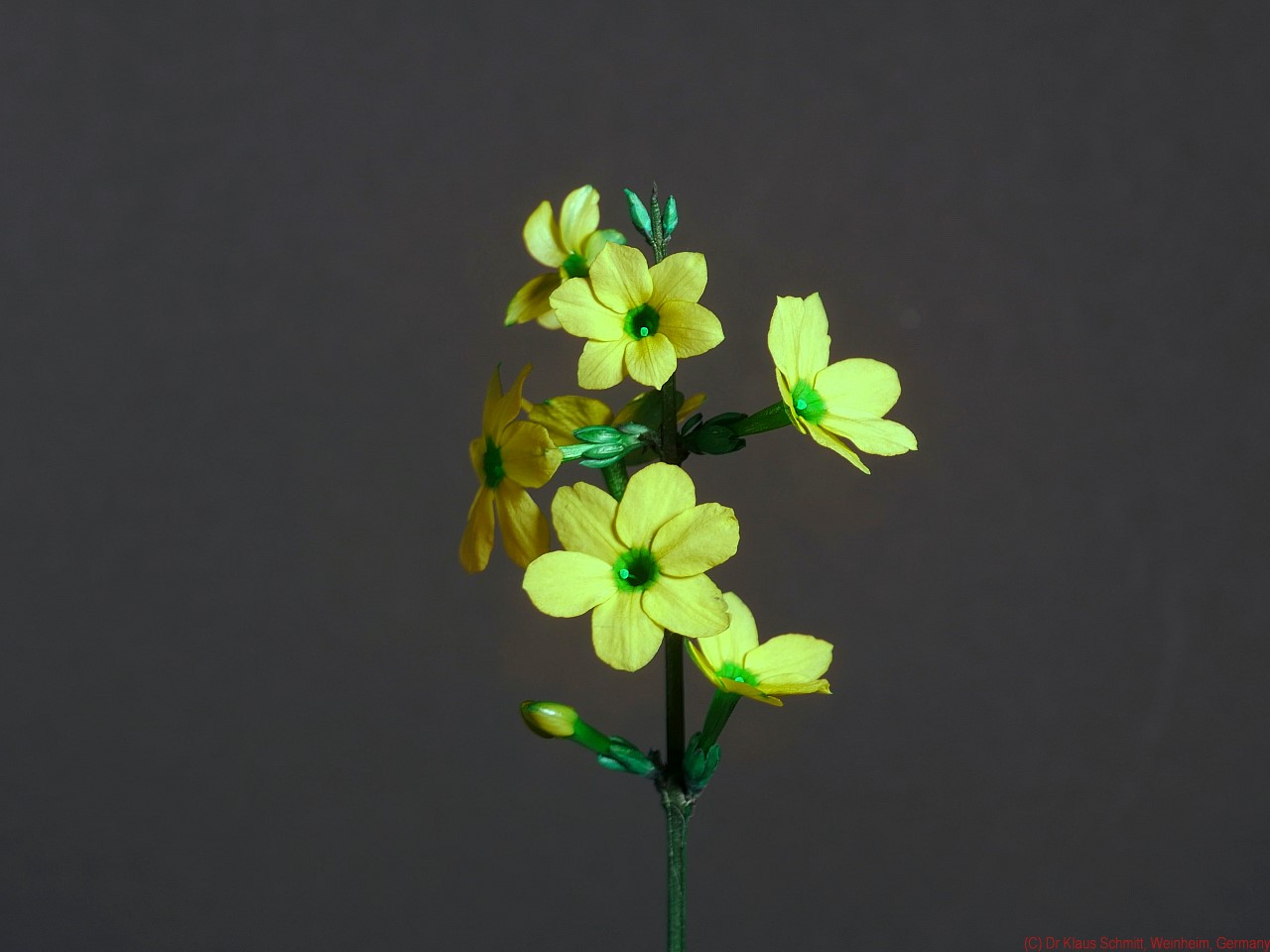
Today shots of a decorative winter flower Winter Jasmine - Jasminum nudiflorum in reflected ultraviolet photography using my "work horse" UV filter, the Baader-U filter as well as in simulated bee and butterfly vision using my XBV filters. All shots were done at f11. Lens was a UV-Nikkor 105mm quartz fluorite lens. Light source was a modified Xenon flash. Different camera system used with up to 80Mp resolution.
[click on image to see a larger one]
Human vision:
Reflected UV:
Simulated bee vision:
Simulated butterfly vision:
Quadriptych of human vision, UV, and simulated bee and butterfly vision (left to right, top to bottom):
This attractive winter flower shows its very specific "bullseye" UV pattern. Its center is UV dark, but its petals are strongly UV reflective around 365nm, ie. UV bright, both invisible to us humans and all that gets nicely visible also in simulated bee and butterfly vision also with this higher resolution camera system.
Today shots of a decorative winter flower Winter Jasmine - Jasminum nudiflorum in reflected ultraviolet photography using my "work horse" UV filter, the
Baader-U filter as well as in simulated bee and butterfly vision using
my XBV filters. All shots were done at f11. Lens was a UV-Nikkor 105mm
quartz fluorite lens. Light source was a modified Xenon flash.
[click on image to see a larger one]
Human vision:
Reflected UV:
Simulated butterfly vision:
Simulated bee vision:
Quadriptych of human vision, UV, and simulated butterfly and bee vision (left to right, top to bottom):
This attractive winter flower shows its very specific "bullseye" UV pattern. Its center is UV dark, but its petals are strongly UV reflective around 365nm, ie. UV bright, both invisible to us humans and all that gets nicely visible also in simulated bee and butterfly vision.
This is my blog about my film and photographic work in 3D, ultraviolet UV, infrared IR and fluorescence using special lenses and equipment. All text and images carry my copyright and I do not allow to link to or copy / download from my site or any parts thereof without my prior permission.
email me in case of questions or interest in my images (esp. for non-profit orgs) or if you need a complete camera + lens + filter + light set for UV photography:
postmaster AT macrolenses.de