Monday, May 5, 2008

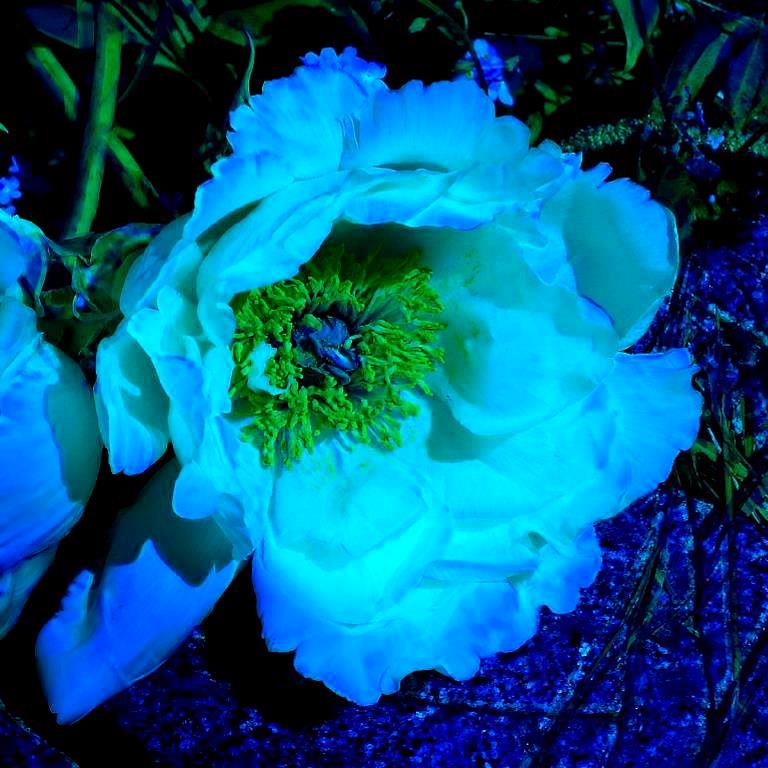
Peony - Bee Vision

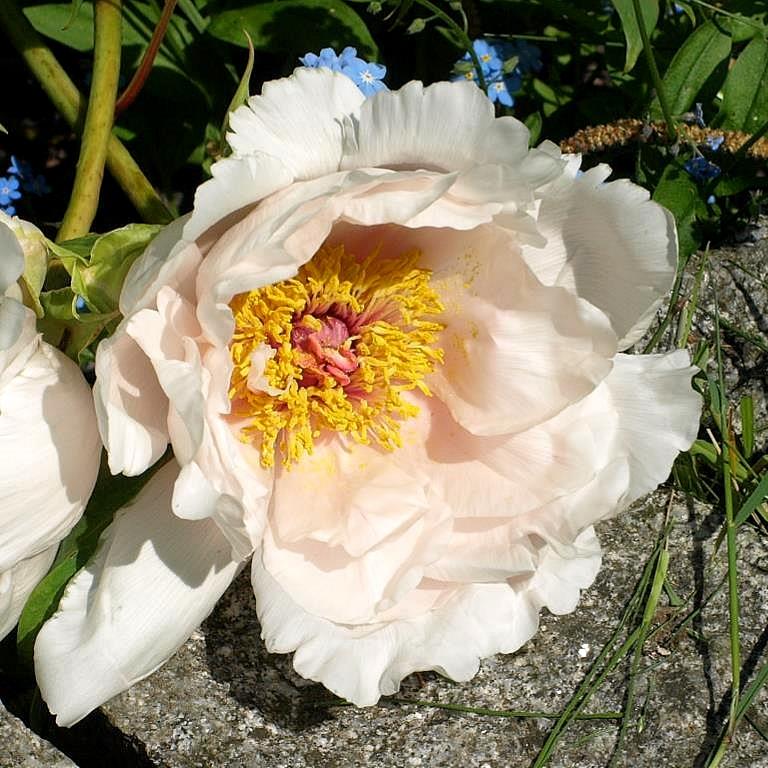
It is spring - finally - here and the Peonies explode their colors into the strong sun of spring. I wondered how bees would see that and took some shots today. To my surprise a creamy, otherwise all white Peony shows an UV pattern I haven't noticed before.


The outer petals reflect UV much stronger than the inside, thus creating some "landing spot" for their pollinators.


The synthesized bee vison version of that looks like that:


Stay tuned, more will follow on that fascinating subject...

More info on this very interesting field may be found on my site http://www.pbase.com/kds315/uv_photos

Waterlilly Reflections - remapped UV


Today it is just a picture, a remapped UV-to-visual image of waterlilly leaves in a pond nearby and some tree reflections. I found that visually appealing, so I hope you like it too:


This is also a remapped image, composed of two shots, a visual one and a reflected UV shot (310...390nm). UV was remapped into the visual domain as blue.

Stay tuned, more will follow on that fascinating subject...

More info on this very interesting field may be found on my site http://www.pbase.com/kds315/uv_photos

Saturday, April 26, 2008

Anamorphotic UV

After the successful wide angle shots, now to the panoramic view. No, not stitching UV shots, that would be too easy, let's try some anamorphotic UV shots.

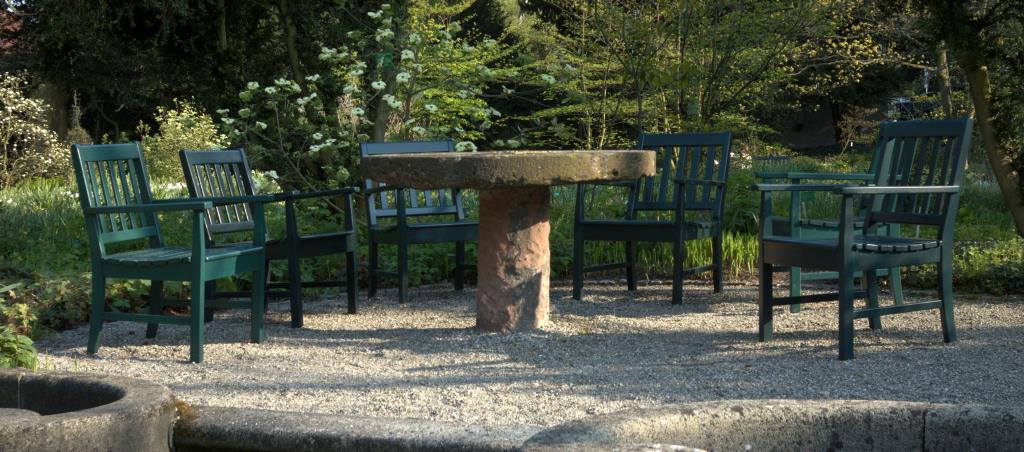
This was shot at our famous park Hermannshof, Weinheim. Some people where sitting there, resting and talking and enjoying the last rays of that beautiful spring day before the park closed. After they left, it felt as if their energy was still present and I took my shots using that 1.5x anamorphic setup I tried out that day. It was just very pieceful and quiet and this is what I wanted to seize in my shots.

Now as usual first the visual anamorphotic shot:


and this the UV shot [catched some flare on the left]:


and the UV remapped into the visual image as blue:


So, that seems to work, I need to do more like that!

Stay tuned, more will follow on that fascinating subject...

More info on this very interesting field may be found on my site http://www.pbase.com/kds315/uv_photos

Thursday, April 24, 2008

Bumble Bee vs.Mexican Zinnia II - spectrometric tests

Mexican Zinnias ("Creeping Zinnia", Sanvitalia procumbens) are quite fascinating little flowers, since they sport a very prominent UV pattern which can't be seen with the bare eye.

This is the visual appearance  [click on image to see it larger]


whereas in UV the flower shows that prominent pattern (like a heli landing platform for bees?)


Now I was curious to find out what the spectrometric reflection response would be, since that pattern must also show there. I used a Xenon full spectrum light source, an USB2000 UV-NIR spectrophotometer and a suitable fiber optic UV-NIR reflection probe.


The light pink curve shows the response of the flower center, not very strong, just reaching about 10% in the visual range and no UV response [for the sake of simplicity I will not comment on the NIR responses for now, this had to do with the used white reflection normal]. The petals however show something different. The ground of the petal (which appears dark in UV) only shows quite a strong visible response in the in the 500nm region and above (green curve), whereas the petal tip (which appears bright in UV) indeed shows quite some strong UV (and blue) reflectance between 330....430nm (dark pink curve) with a maximum at about 360nm. Interesting since one of the receptors have its maximum at about 340nm (300...400nm). But also the visible response of the petal tip is some 15% stronger than the base! For comparison I also recorded the green leaf response which is shown as the light blue curve, much weaker, only reaching a bit more than 25% in the green.

Now what's that violet curve now? The reflection of a white Bumble Bee "rear end". Remember what I showed a few days ago? This is the sythesized bee vision version of a bumble bee sitting on a Mexican Zinnia flower with a prominent UV pattern.


Interesting how that Bumble Bee's (Bombus terrestris) abdomen reflection pattern evenly covers the whole spectrum, but exactly starting at the UV maximum of 360nm of that petal tip up to deep into NIR. More research has to be done on that, it can't be just coincidence, or as Einstein put it, "nature does not play dice"....

Stay tuned, more will follow on that fascinating subject...

More info on this very interesting field may be found on my site http://www.pbase.com/kds315/uv_photos
Tuesday, April 22, 2008

Simulated Bee Vision IV - Buttercup (Caltha palustris)

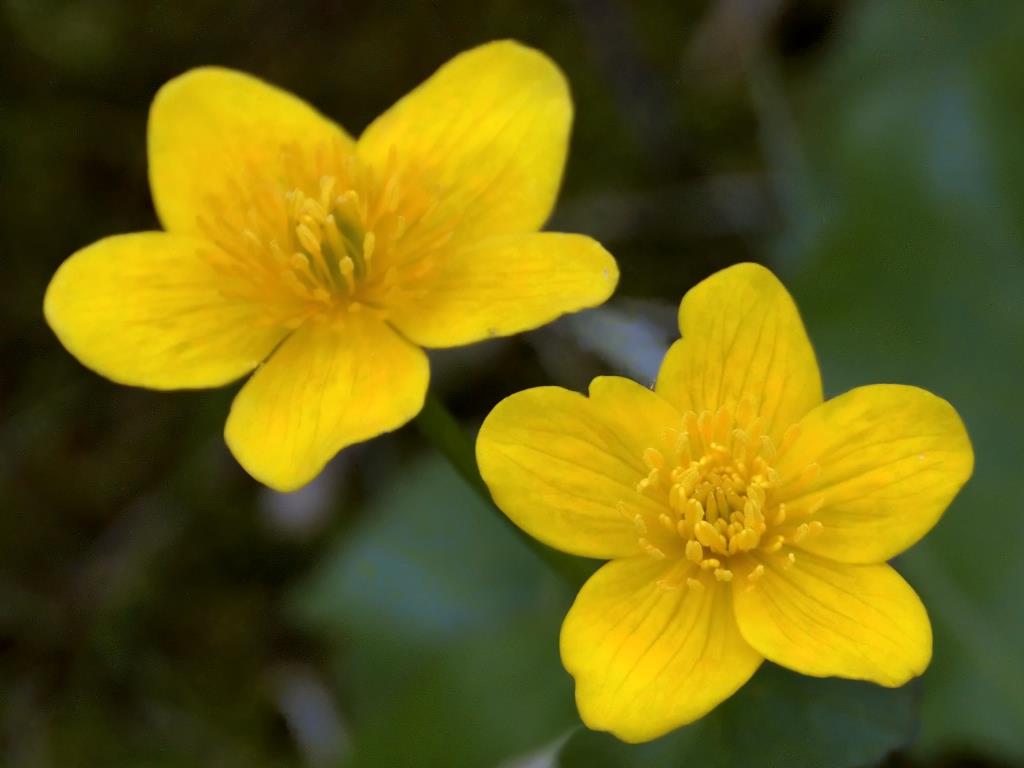
Today it is again about Bee Vision. The buttercups are in full blossom here and these flowers show some very prominent UV pattern which is completely invisible to the eye, so I took some shots to demonstrate that:

These first two images are the visual


and the reflected ultraviolet (310 ... 390nm) shot:


This following image now combines the visible and UV shot into a synthesized "Bee Vision Image" and  is the non-linear color mapping into our human color space. UV, which a bee can see is compressed into our visible spectrum as blue, at the same time the red, a bee can't see, is suppressed:


This, of course, is just my personal representation of what I believe respresents what a bee may see (aside from the aspect of a completely different optical apparatus of course...), transformed into our human color space.

Stay tuned, more will follow on that fascinating subject...

More info on this very interesting field may be found on my site http://www.pbase.com/kds315/uv_photos

Sunday, April 13, 2008

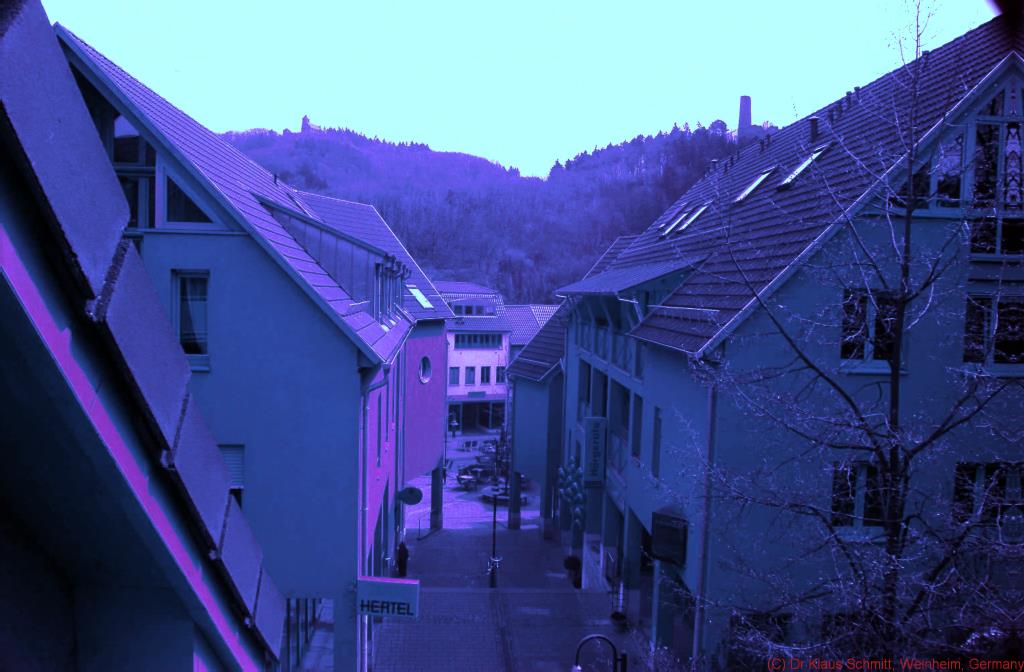
Very Wide for UV II

Now a few infinity shots on a somewhat sunny but cloudy day using that older ca. 25mm lens (equiv.); the camera was a Nikon D70 @ ISO400.

Visible image first:


Now the UV image:


To show how well the UV image matches the visual shot, I use my remapping technique:


Stay tuned, more will follow on that fascinating subject...

More info on this very interesting field may be found on my site http://www.pbase.com/kds315/uv_photos
Saturday, April 12, 2008

Very Wide for UV

I always wanted a decent wide angle lens for UV, so here is a first result with an older ca. 25mm lens (equiv.)

The shots were done outside on a somewhat sunny day, the camera was a Nikon D70 @ ISO400.

Visible image first:


Now the UV image:


And the "bee vision" version of that, with UV remapped into the visual image as blue:


I hope you liked the first results, very exciting!

Stay tuned, more will follow on that fascinating subject...

More info on this very interesting field may be found on my site http://www.pbase.com/kds315/uv_photos