Thursday, July 7, 2011
Wednesday, July 6, 2011
[UV] whitebalancing using a 35mm wide angle lens for UV
Today I made some experiments using wide(r) angle lenses for shooting reflected UV using my UV sensitive camera.
I had previously written about proper whitebalancing to reach a standardized false color UV palette using a true apochromatically corrected UV lens and also about doing that for other wide angle lenses. Now I wanted to reach about the same "colors" using such a lens which transmits much less UV, in that case here a 35mm c-mount lens.
[click on images to see larger ones]
Standardized reflected false UV "colors" according to the previously described "UV color palette" related to wavelength.
The normal and high intensity palette:


The reflected UV images show a Rudbeckia hirta flower. Left the result before applying my whitebalancing procedure; on teh right after whitebalancing using my ReflectionDisc (and some special in-camera tweaking):

[the colors on the left image are NOT according to the standardized palette!]
Well, as you can see, about the same colors could be reached on the right image, still a little different, as some parts of the spectrum are missing (the shorter wave UV-A sub-bands more specifically, so there is no green as that lens only transmits to about 350nm). Still it gets evident that this Rudbeckia flower has a UV reflection from its petal tips of around 360nm.
Stay tuned, more will follow on that fascinating subject...
More info on this very interesting field may be found on my site http://www.pbase.com/kds315/uv_photos
I had previously written about proper whitebalancing to reach a standardized false color UV palette using a true apochromatically corrected UV lens and also about doing that for other wide angle lenses. Now I wanted to reach about the same "colors" using such a lens which transmits much less UV, in that case here a 35mm c-mount lens.
[click on images to see larger ones]
Standardized reflected false UV "colors" according to the previously described "UV color palette" related to wavelength.
The normal and high intensity palette:
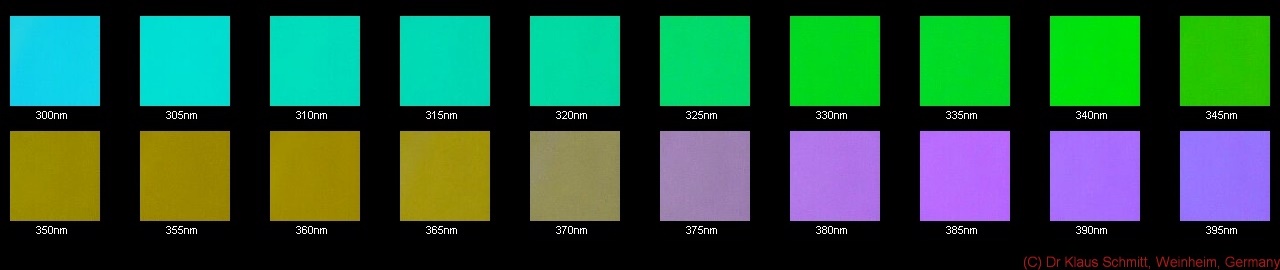
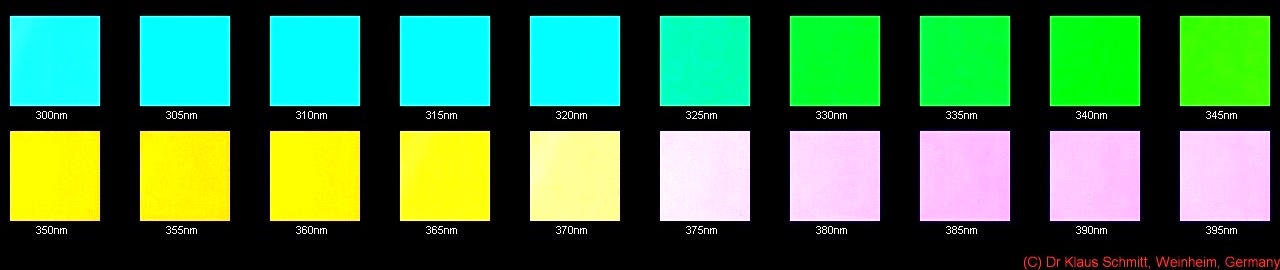
The reflected UV images show a Rudbeckia hirta flower. Left the result before applying my whitebalancing procedure; on teh right after whitebalancing using my ReflectionDisc (and some special in-camera tweaking):

[the colors on the left image are NOT according to the standardized palette!]
Well, as you can see, about the same colors could be reached on the right image, still a little different, as some parts of the spectrum are missing (the shorter wave UV-A sub-bands more specifically, so there is no green as that lens only transmits to about 350nm). Still it gets evident that this Rudbeckia flower has a UV reflection from its petal tips of around 360nm.
Stay tuned, more will follow on that fascinating subject...
More info on this very interesting field may be found on my site http://www.pbase.com/kds315/uv_photos


Monday, July 4, 2011
[UV, VIS] Zinnia - more on short wave UV reflection
I was shooting Zinnias today, when I saw one which sported that greenish short wave UV-A sub band reflection as mentioned here before..
[click on images to see larger ones]
Standardized reflected false UV "colors" according to the previously described "UV color palette" related to wavelength.
The normal and high intensity palette:
The reflected UV image shows that this Zinnia flower variant has a greenish / yellowish short wave UV-A reflection in the 340-360nm range:

VIS shot for comparison:

Stay tuned, more will follow on that fascinating subject...
More info on this very interesting field may be found on my site http://www.pbase.com/kds315/uv_photos
[click on images to see larger ones]
Standardized reflected false UV "colors" according to the previously described "UV color palette" related to wavelength.
The normal and high intensity palette:
The reflected UV image shows that this Zinnia flower variant has a greenish / yellowish short wave UV-A reflection in the 340-360nm range:
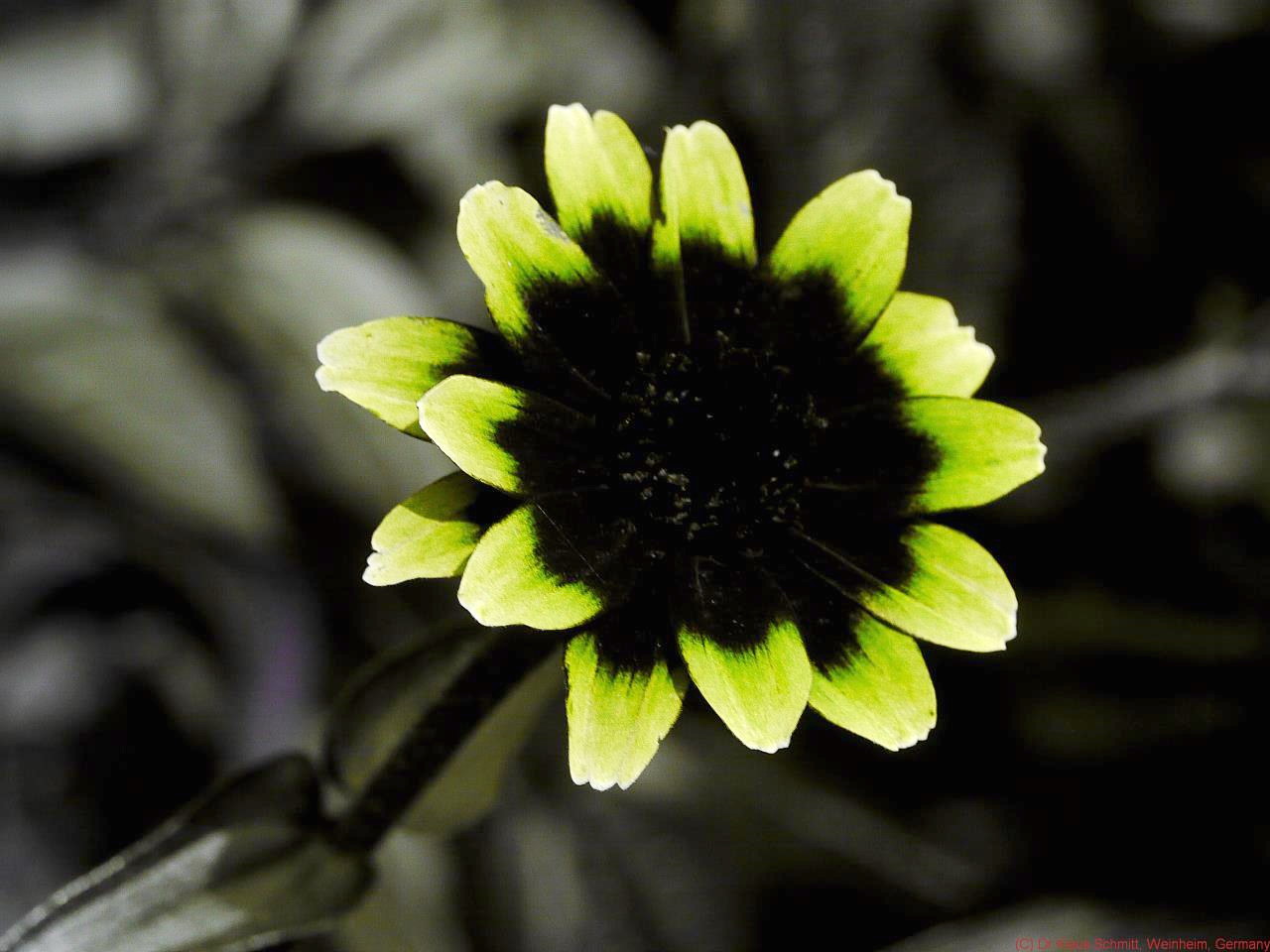
VIS shot for comparison:
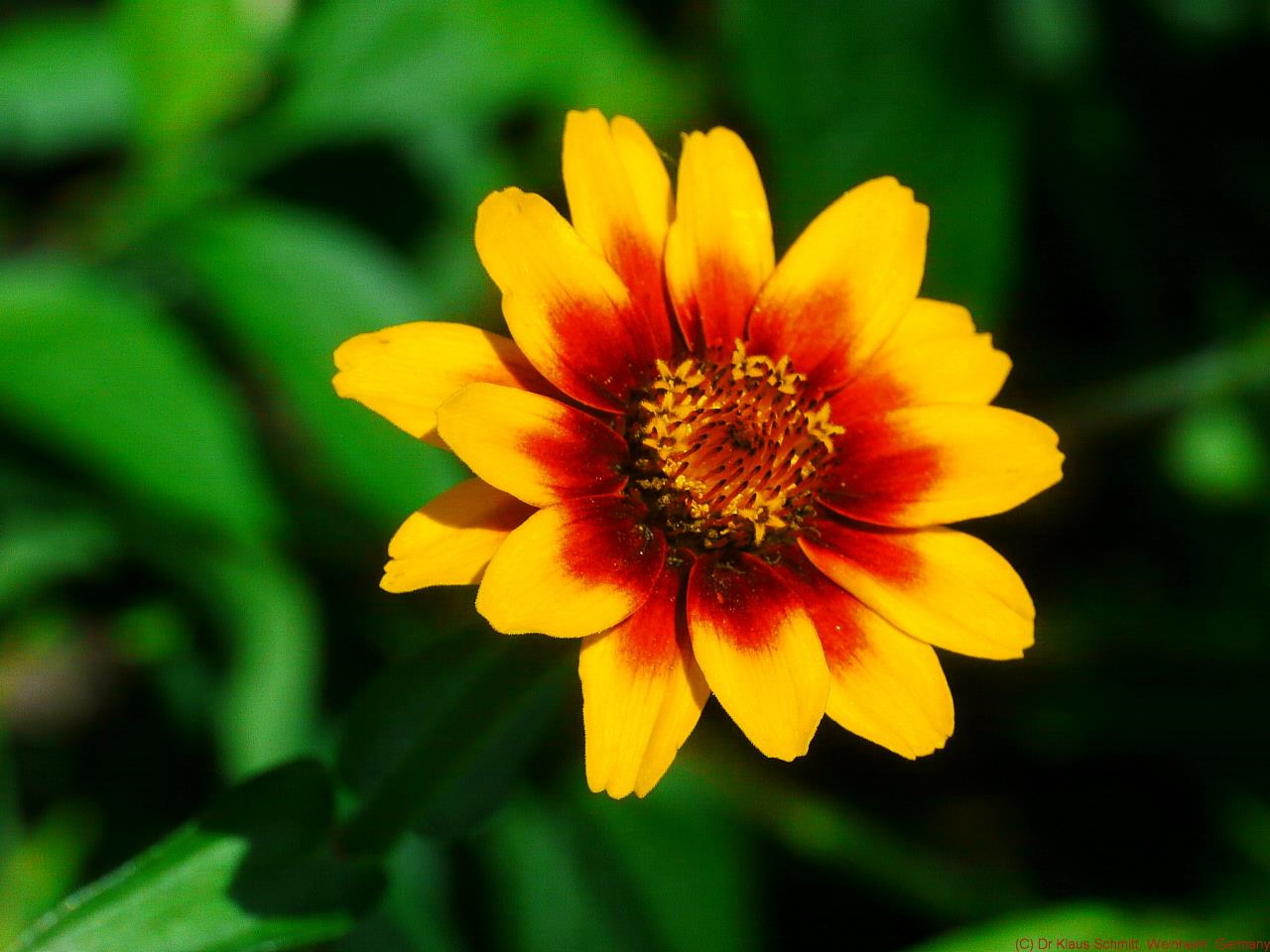
Stay tuned, more will follow on that fascinating subject...
More info on this very interesting field may be found on my site http://www.pbase.com/kds315/uv_photos
[UV, VIS] Zinnia flower competing
I was shooting Zinnias today, when I saw one flowering aside another bright yellow flower. I noticed the Zinnias being frequently visited by bees and bumblebees, whereas the similar looking yellow one had only few guests.
[click on images to see larger ones]
Standardized reflected false UV "colors" according to the previously described "UV color palette" related to wavelength.
The normal and high intensity palette:
Well, the reflected UV image shows clearly how that Zinnia flowers wins the "competition":

Even covered by other plants it makes itself clearly seen (see blurry BG Zinnia). So not really "competition" for that UV-bright Zinnia (340-360nm).
Stay tuned, more will follow on that fascinating subject...
More info on this very interesting field may be found on my site http://www.pbase.com/kds315/uv_photos
[click on images to see larger ones]
Standardized reflected false UV "colors" according to the previously described "UV color palette" related to wavelength.
The normal and high intensity palette:
Well, the reflected UV image shows clearly how that Zinnia flowers wins the "competition":

Even covered by other plants it makes itself clearly seen (see blurry BG Zinnia). So not really "competition" for that UV-bright Zinnia (340-360nm).
Stay tuned, more will follow on that fascinating subject...
More info on this very interesting field may be found on my site http://www.pbase.com/kds315/uv_photos
Thursday, June 30, 2011
[UV] Rudbeckia hirta
Today I found another nice Rudbeckia species (Rudbeckia hirta that is), which sports some interesting UV pattern.
[click on images to see larger ones]
Standardized reflected false UV "colors" according to the previously described "UV color palette" related to wavelength.
The normal intensity palette:
and this is the high intensity palette:
So here now the UV image of that flower:

So from that yellow UV color we may deduct that this flower UV reflection is from around 360nm.
And here the UV image of another flower and two young ones:

which shows quite different UV reflections (360nm region = yellow, but in the 385nm region = violet which the young ones exhibit)
For comparison here the VIS shot:

which shows quite different UV reflections (360nm region = yellow, but in the 385nm
Stay tuned, more will follow on that fascinating subject...
More info on this very interesting field may be found on my site http://www.pbase.com/kds315/uv_photos
[click on images to see larger ones]
Standardized reflected false UV "colors" according to the previously described "UV color palette" related to wavelength.
The normal intensity palette:
and this is the high intensity palette:
So here now the UV image of that flower:
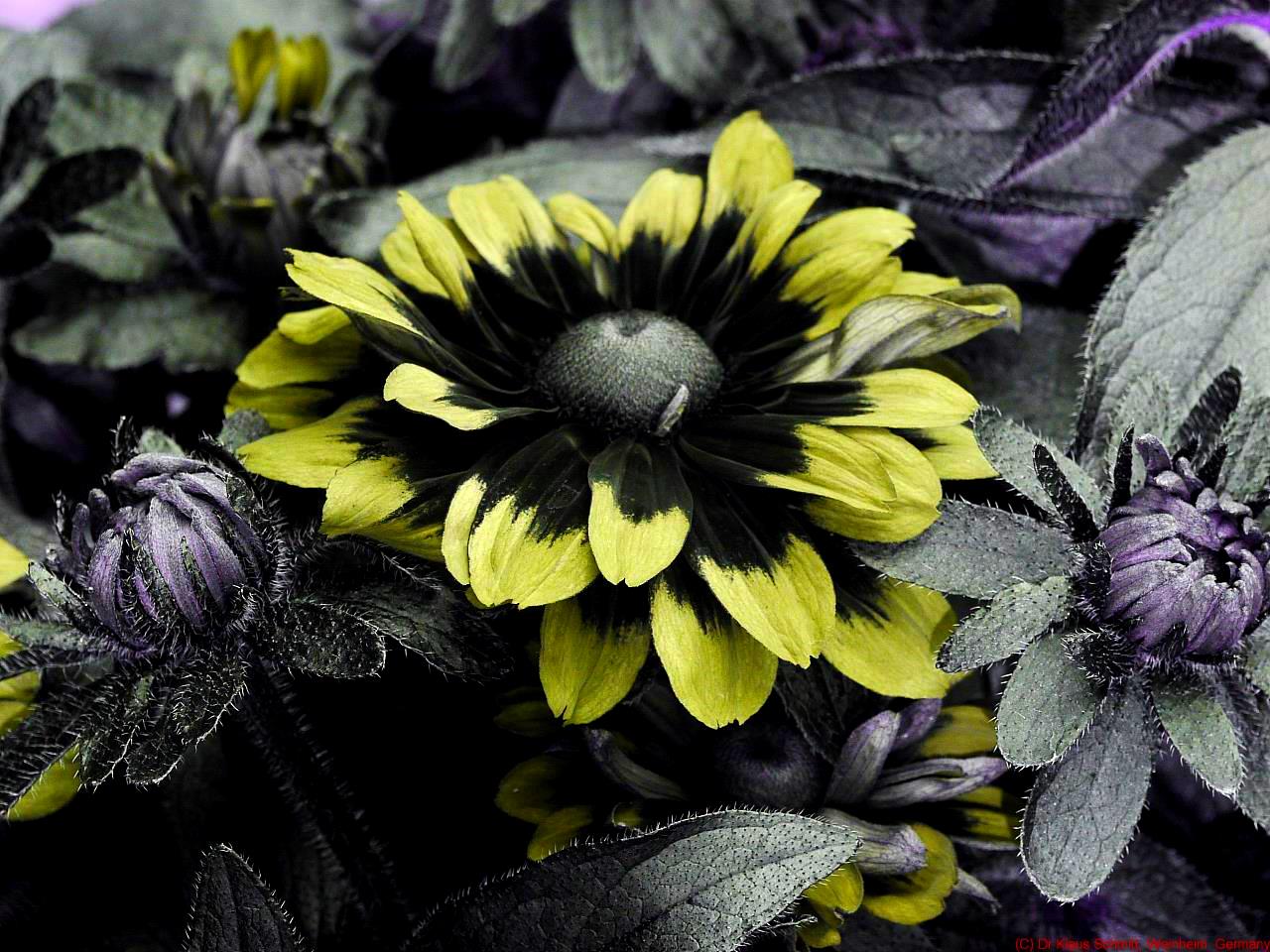
So from that yellow UV color we may deduct that this flower UV reflection is from around 360nm.
And here the UV image of another flower and two young ones:
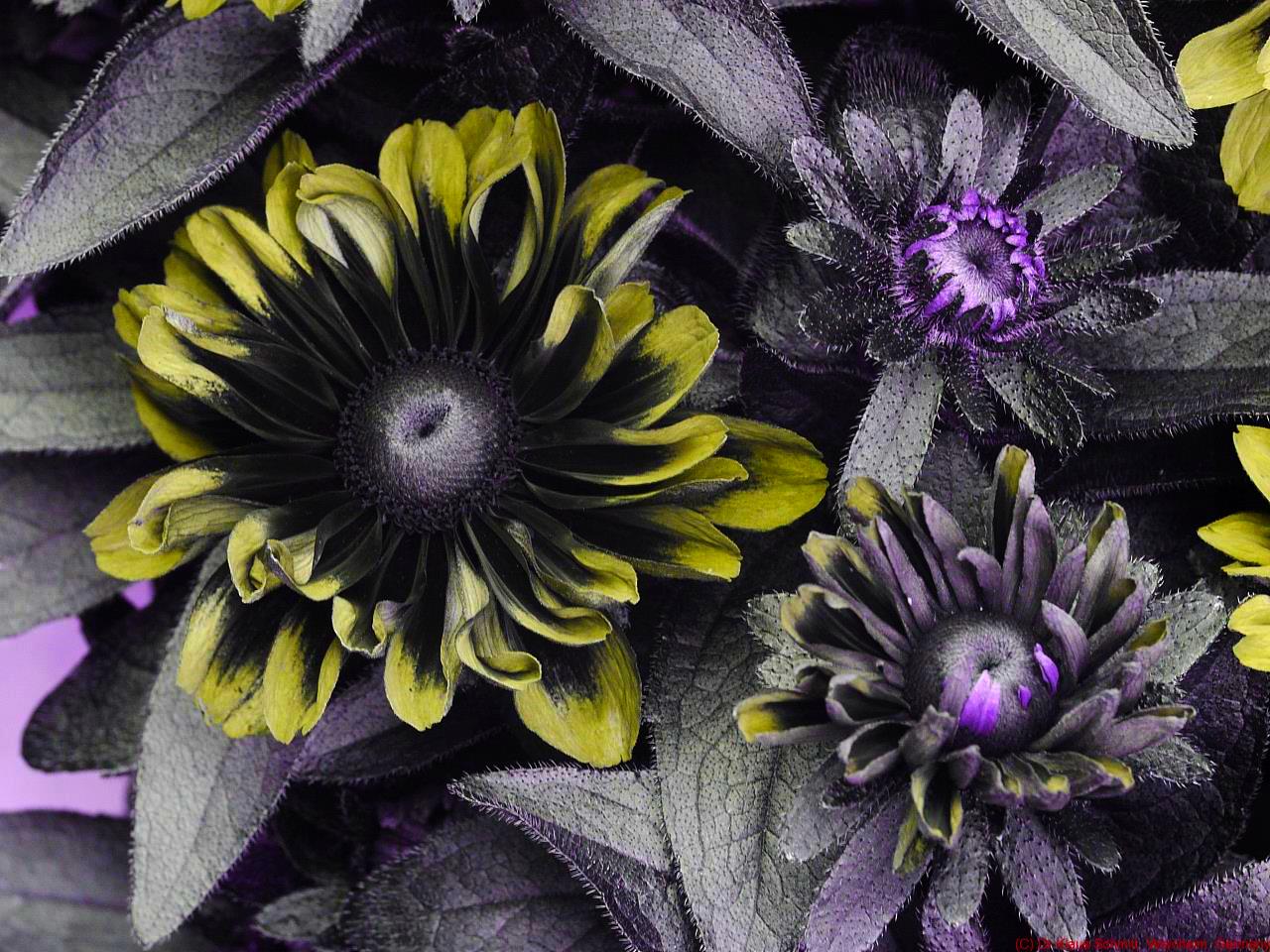
which shows quite different UV reflections (360nm region = yellow, but in the 385nm region = violet which the young ones exhibit)
For comparison here the VIS shot:
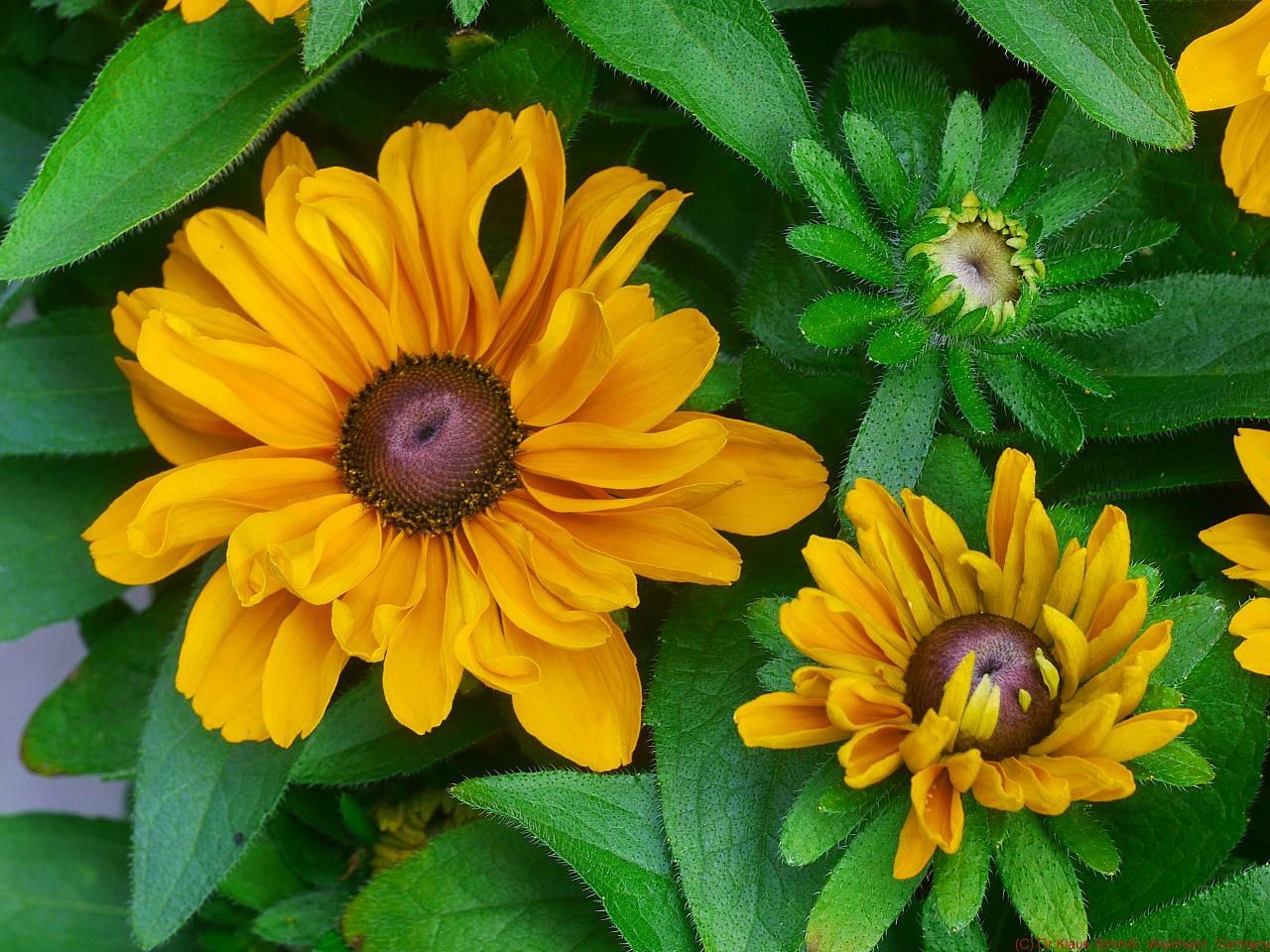
which shows quite different UV reflections (360nm region = yellow, but in the 385nm
Stay tuned, more will follow on that fascinating subject...
More info on this very interesting field may be found on my site http://www.pbase.com/kds315/uv_photos
Saturday, June 25, 2011
[UV] spectrometric vs photographic results using standardized false UV color palette
While I was shooting flowers at Herrmanshof, Weinheim park, I noticed some intense whiteish and some dimmer greenish UV reflectance patters (in my standardized false UV color palette) and I wanted to have some proof, if from the false color UV displayed it could be backward deducted about a specific sub-UV-A waveband reflection using spectrometric measurements .
[click on images to see larger ones]
Standardized reflected false UV "colors" according to the previously described "UV color palette" related to wavelength.
The normal intensity palette:
and this is the high intensity palette:
Well, may I remind, that these false colors do not co-exist at the same time with the same intensity at the same wavelength stimulus (hence cannot be mixed), because of the very different sensor sensitivity to different UV wavelengths.

So from that above re-posted graph, which shows that GH1-UVIR sensor reaction to a monochromatic 5nm bandwith stimulus, for instance a 340nm "UV color" needs 4EV more exposure than one at 395nm and a 300nm needs even 6EV more.
This is why I found it so special to find a green response (340nm) and yellowish response (370nm) in the same image (Zinnias as shown; also the reason why the green is so dim and the whitish yellow so overexposed) as there is 3EV in between - and this is why I doubt to ever find sea-green (around 300nm) in such a photo (6EV difference) that would contain this violet (at 395nm) - except I use a special technique which already forms in my mind...

So if one wanted to simulate how the UV color would look like in a resulting photo, we could use the spectrometer output and would have to multiply it with the Baader-U filter transmittance actually and then look up the exposure values per intensity. Unfortunately the sensor also responds nonlinear over wide exposure ranges (so the above is valid for mid level exposures only), so that yields only a crude approximation. But at least one would get a clue why that petal tip appeared green - yellowish in that image as posted above.
Spectrometric result of such a petal of the following Zinnia variant, tip greenish, rest nearly black (in UV) and yellow tip, orange-red the petal rest in VIS:
 Photographic result: VIS:left, UV:right

 Prediction "UV color": bright whiteish-yellowish tip, dark rest of petal; dark center
Sanvitalia procumbens:
Prediction "UV color": bright whiteish-yellowish tip, dark rest of petal; dark center
Sanvitalia procumbens:
 Prediction "UV color": whiteish-yellowish tip, dark rest of petal; dark center
Photographic result: UV (right part of image is sunlight, left 365nm UV LED; Bidens left, Sanvitalia right):
Prediction "UV color": whiteish-yellowish tip, dark rest of petal; dark center
Photographic result: UV (right part of image is sunlight, left 365nm UV LED; Bidens left, Sanvitalia right):
 Gaillardia aristata:
 Prediction "UV color": bright whiteish-yellowish petal; dark center
Photographic result: VIS / UV (wet, after rain):
Prediction "UV color": bright whiteish-yellowish petal; dark center
Photographic result: VIS / UV (wet, after rain):
 Added today:
Rudbeckia fulgida flower:
Added today:
Rudbeckia fulgida flower:
 Prediction "UV color": yellow tip, dark rest of petal; whiteish-yellowish center reflection
Photographic VIS/UV:
Prediction "UV color": yellow tip, dark rest of petal; whiteish-yellowish center reflection
Photographic VIS/UV:
 So we see, that it holds true so far, that my standardized false UV colors can stand for specific UV-A sub-waveband reflections as shown here on my BLOG.
Stay tuned, more will follow on that fascinating subject...
More info on this very interesting field may be found on my site http://www.pbase.com/kds315/uv_photos
So we see, that it holds true so far, that my standardized false UV colors can stand for specific UV-A sub-waveband reflections as shown here on my BLOG.
Stay tuned, more will follow on that fascinating subject...
More info on this very interesting field may be found on my site http://www.pbase.com/kds315/uv_photos
and this is the high intensity palette:
Well, may I remind, that these false colors do not co-exist at the same time with the same intensity at the same wavelength stimulus (hence cannot be mixed), because of the very different sensor sensitivity to different UV wavelengths.
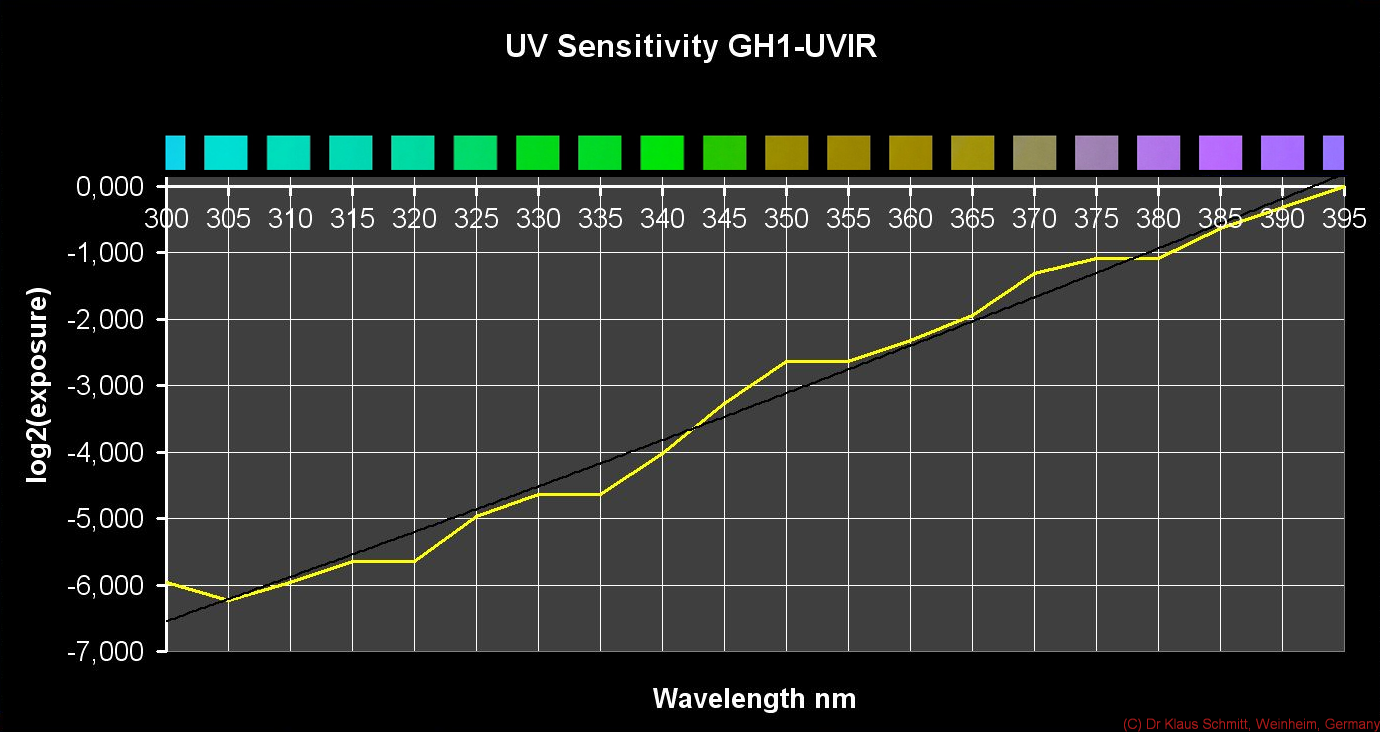
So from that above re-posted graph, which shows that GH1-UVIR sensor reaction to a monochromatic 5nm bandwith stimulus, for instance a 340nm "UV color" needs 4EV more exposure than one at 395nm and a 300nm needs even 6EV more.
This is why I found it so special to find a green response (340nm) and yellowish response (370nm) in the same image (Zinnias as shown; also the reason why the green is so dim and the whitish yellow so overexposed) as there is 3EV in between - and this is why I doubt to ever find sea-green (around 300nm) in such a photo (6EV difference) that would contain this violet (at 395nm) - except I use a special technique which already forms in my mind...

So if one wanted to simulate how the UV color would look like in a resulting photo, we could use the spectrometer output and would have to multiply it with the Baader-U filter transmittance actually and then look up the exposure values per intensity. Unfortunately the sensor also responds nonlinear over wide exposure ranges (so the above is valid for mid level exposures only), so that yields only a crude approximation. But at least one would get a clue why that petal tip appeared green - yellowish in that image as posted above.
Spectrometric result of such a petal of the following Zinnia variant, tip greenish, rest nearly black (in UV) and yellow tip, orange-red the petal rest in VIS:
 Photographic result: VIS:left, UV:right
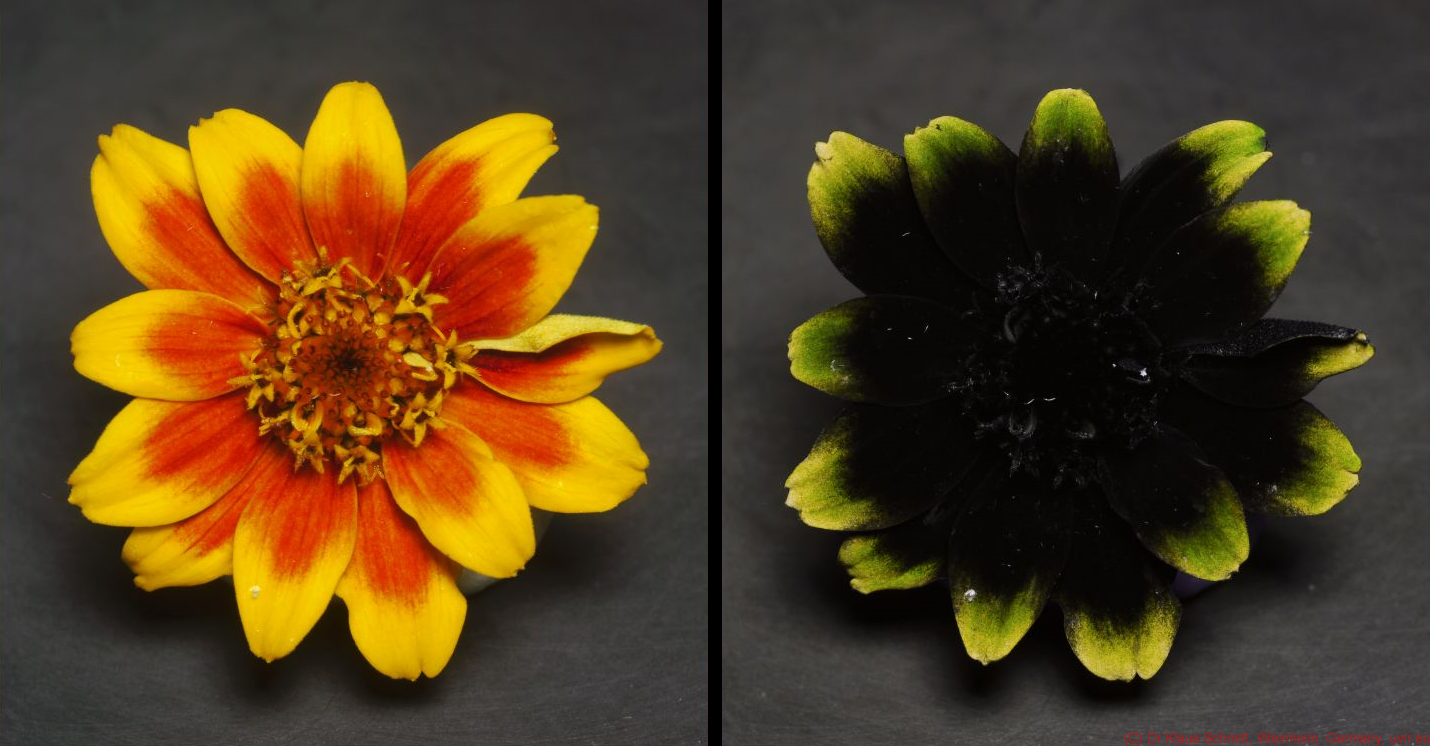
Following examples for comparison,: Bidens ferulifolia, petal tip looks bright yellowish and rest petal quite dark in UV and Sanvitalia procumbens which looks about the same UV color at its petal tip but dimmer and petal rest nearly pitch black in UV (using my standardized false UV color palette). Gaillardia aristata has an underlying UV reflective layer even over the whole tip under a in the visible yellow petal tip and orange-red rest of the tip; the flower center is all UV dark but in the visible orange red outside and greenish in the very center
Spectrometric results
Bidens ferulifolia:
 Prediction "UV color": bright whiteish-yellowish tip, dark rest of petal; dark center
Sanvitalia procumbens:
Prediction "UV color": bright whiteish-yellowish tip, dark rest of petal; dark center
Sanvitalia procumbens:
 Prediction "UV color": whiteish-yellowish tip, dark rest of petal; dark center
Photographic result: UV (right part of image is sunlight, left 365nm UV LED; Bidens left, Sanvitalia right):
Prediction "UV color": whiteish-yellowish tip, dark rest of petal; dark center
Photographic result: UV (right part of image is sunlight, left 365nm UV LED; Bidens left, Sanvitalia right):
 Gaillardia aristata:
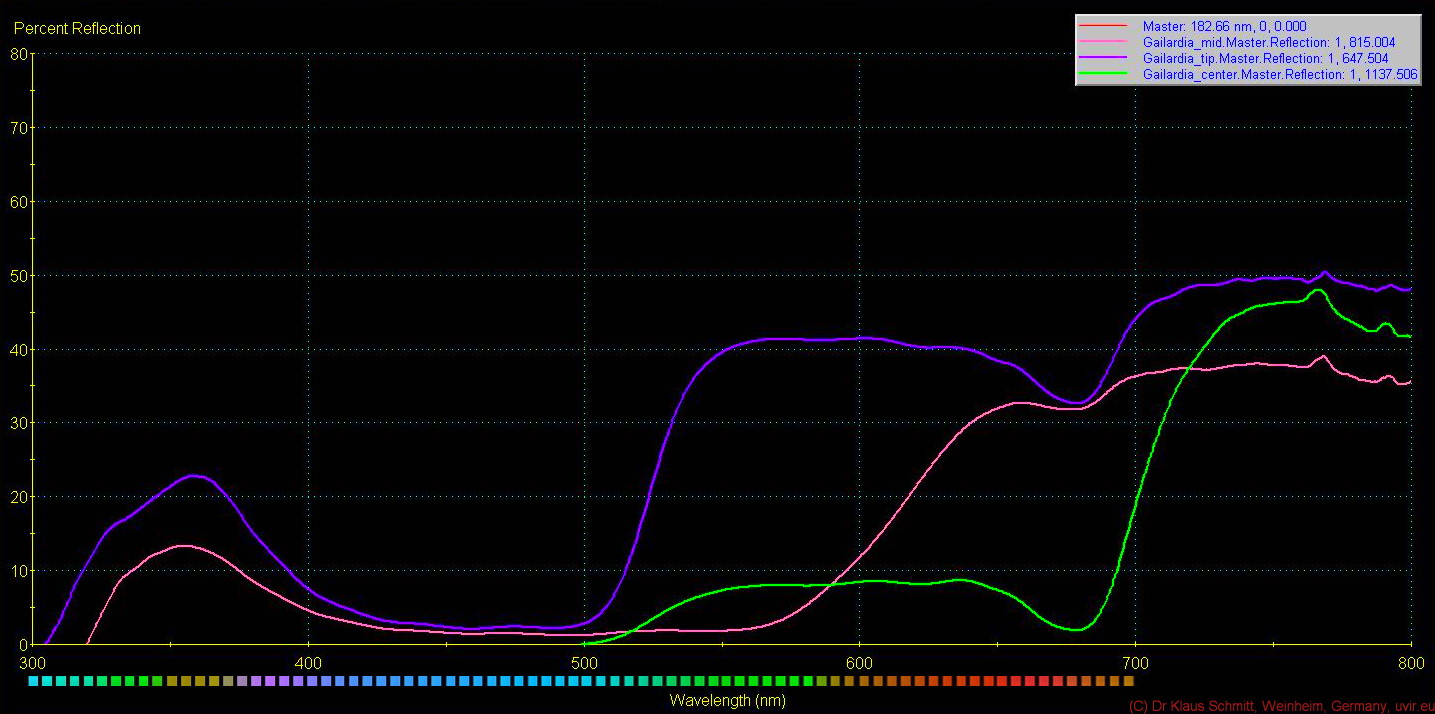 Prediction "UV color": bright whiteish-yellowish petal; dark center
Photographic result: VIS / UV (wet, after rain):
Prediction "UV color": bright whiteish-yellowish petal; dark center
Photographic result: VIS / UV (wet, after rain):
 Added today:
Rudbeckia fulgida flower:
Added today:
Rudbeckia fulgida flower:
 Prediction "UV color": yellow tip, dark rest of petal; whiteish-yellowish center reflection
Photographic VIS/UV:
Prediction "UV color": yellow tip, dark rest of petal; whiteish-yellowish center reflection
Photographic VIS/UV:
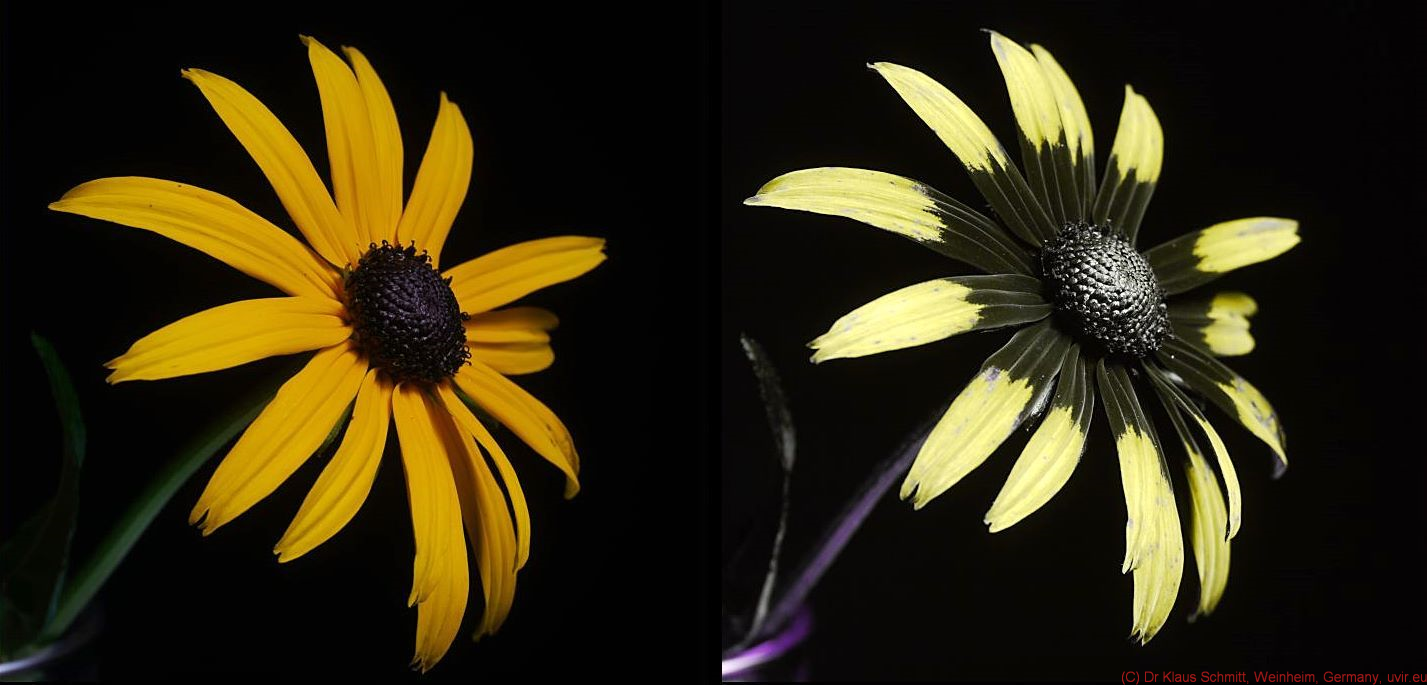 So we see, that it holds true so far, that my standardized false UV colors can stand for specific UV-A sub-waveband reflections as shown here on my BLOG.
Stay tuned, more will follow on that fascinating subject...
More info on this very interesting field may be found on my site http://www.pbase.com/kds315/uv_photos
So we see, that it holds true so far, that my standardized false UV colors can stand for specific UV-A sub-waveband reflections as shown here on my BLOG.
Stay tuned, more will follow on that fascinating subject...
More info on this very interesting field may be found on my site http://www.pbase.com/kds315/uv_photos
Friday, June 24, 2011
Subscribe to:
Posts (Atom)

