Well, in August 2014 a video "How the sun sees you" by Thomas Leveritt went viral on the net, a video about using sun cream for skin cancer protection and raising awareness about the need for skin protection. Leveritt used materials and techniques which were known by UV photographers since many years and my readers here have seen my older videos which employed the very same techniques, however used to make visible what bees, butterflies and other insects see and we cannot - ultraviolet (UV) light. Usually I use a false color palette to make UV visible.
Have a look at the following HD black+white video clip to see that it is indeed doable. I would like to show in part II later that such a video can be made using a suitable camera, lens + filter.
Now the following is the same HD video clip, but this time in false UV colors. They have a meaning, but this might be revealed later on.
I hope you enjoyed this funny little clip today!
Stay tuned, more will follow on that fascinating subject...
More info on this very interesting field may be found on my site http://www.pbase.com/kds315/uv_photos
Tuesday, September 16, 2014
Wednesday, August 13, 2014
150mm Micro reproduction lens for reflected UV photography
Today about a recent find for UV photography, a high resolution (approx. 150-200 lpm) 150mm micro documentation lens, which I have tested positively for UV use. Of course it shows quite some restrictions, but I'm happy about finding such lens in such longer focal length (150mm), which allows for better working distance in some circumstances. All shots were done it studio. Lens for comparision was my CERCO 94mm quartz fluorite lens. Light source was a Xenon flash. All shots were done at about f8.
[click on image to see a larger one]
Test images using Baader-U filter for reflected UV photography and as a target a Rudbeckia fulgida flower. Adjusted for comparison to even out focal length differences. Individual white balance set per image.

[click on image to see a larger one]
Test images using Baader-U filter for reflected UV photography and as a target a Rudbeckia fulgida flower. Adjusted for comparison to even out focal length differences. Individual white balance set per image.
Cerco 94mm (left), Micro Documentation lens (right)
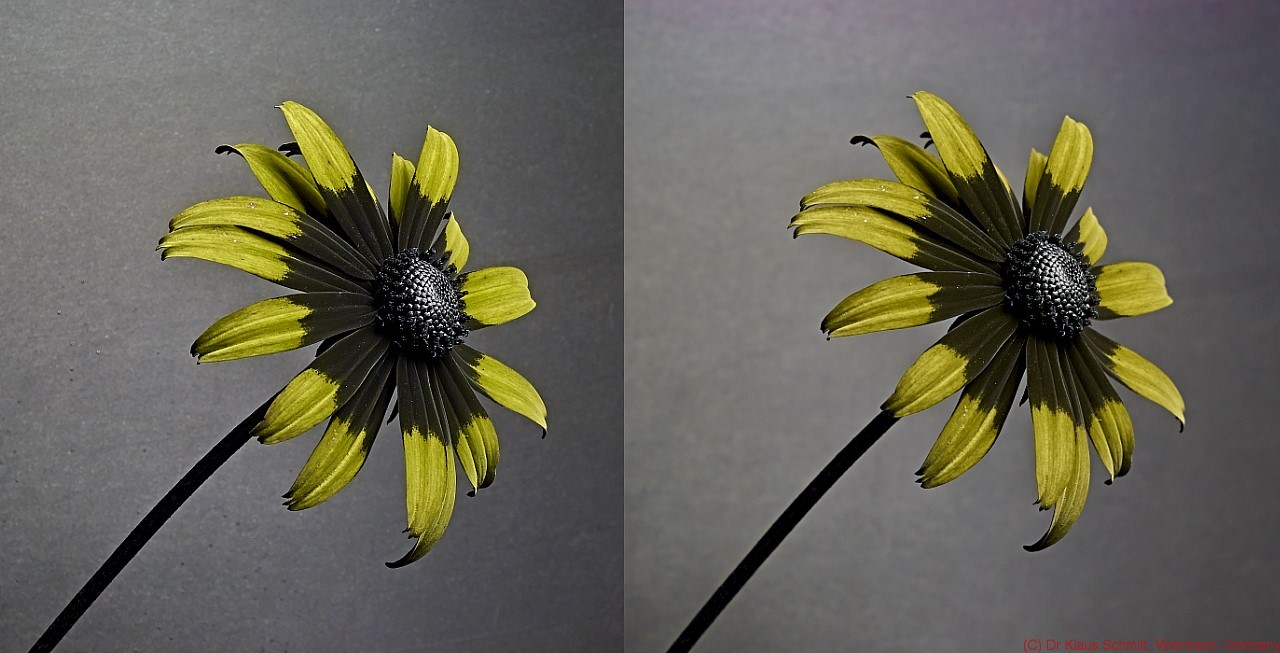
The micro docu lens does quite well and seems to be quite a sharp lens, even when used for UV.
Now about the spectral transmission:

It gets obvious that this micro docu lens only transmits down to about 350nm, but has sufficient transmission around 360nm to make flower UV patterns visible.
So to summarize I would call that a nice find, which adds to the repertoire of suitable UV lenses, especially since it has very high resolution also in UV.
Stay tuned, more will follow on that fascinating subject...
More info on this very interesting field may be found on my site http://www.pbase.com/kds315/uv_photos
Now about the spectral transmission:
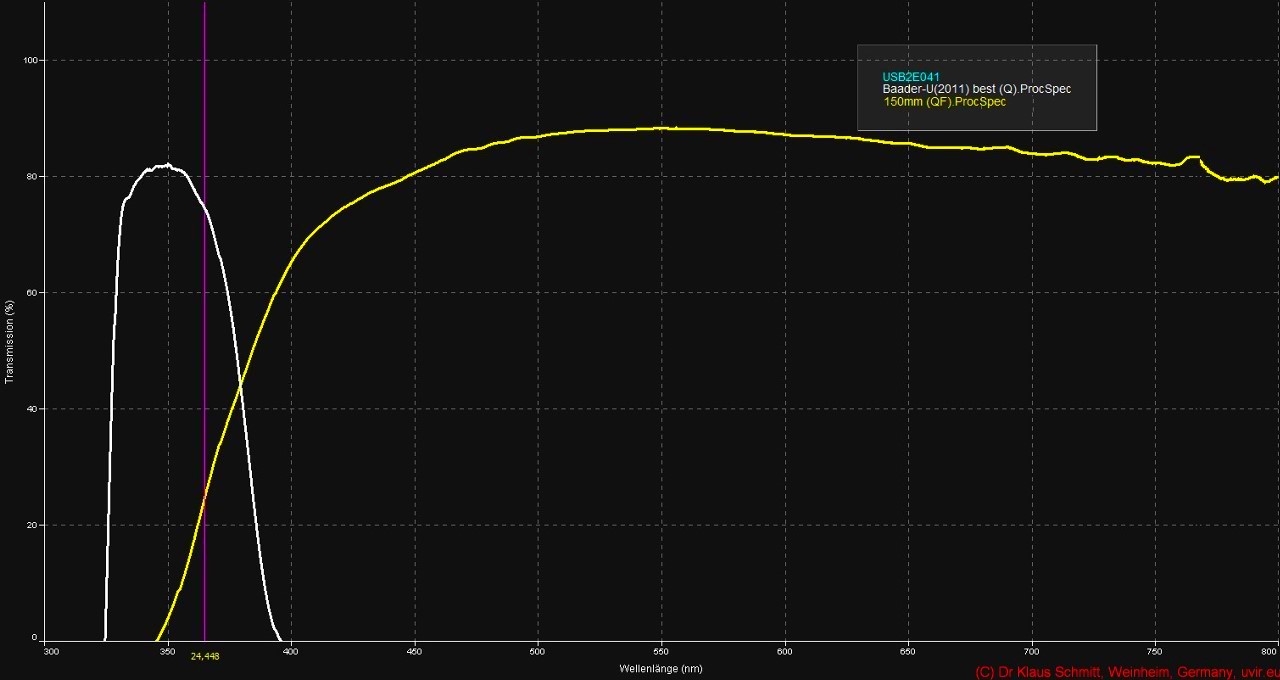
It gets obvious that this micro docu lens only transmits down to about 350nm, but has sufficient transmission around 360nm to make flower UV patterns visible.
So to summarize I would call that a nice find, which adds to the repertoire of suitable UV lenses, especially since it has very high resolution also in UV.
Stay tuned, more will follow on that fascinating subject...
More info on this very interesting field may be found on my site http://www.pbase.com/kds315/uv_photos


Tuesday, August 5, 2014
City of Manchester "Dig the City" focusing on Honey Bee - UV and simulated bee vision photography
The city of Manchester is having their "Dig the City" urban gardening festival again this year 2014 (2-10 August 2014) supported by the National Trust.
The Honey Bee is the sign of the city and it may bee seen all over the city of Manchester. Actually the festival is going on right now as I type this!
This years focus lies on the rapidly decreasing honey bee populations in the UK and worldwide and what each person can do to help. I have contributed some of my work to that, still photography in VIS and UV, as well as in simulated bee vision, which may be seen in use on the following twitter picture which has just been published:

So if you are close, consider a visit, it's quite worth it!
Stay tuned, more will follow on that fascinating subject...
More info on this very interesting field may be found on my site http://www.pbase.com/kds315/uv_photos
This years focus lies on the rapidly decreasing honey bee populations in the UK and worldwide and what each person can do to help. I have contributed some of my work to that, still photography in VIS and UV, as well as in simulated bee vision, which may be seen in use on the following twitter picture which has just been published:
At the Festival Hub @mcrfoe & @NTUrbanGardener are discussing how to encourage a bee friendly environment #beesneeds pic.twitter.com/W6EZbdDJk7
— digthecitymcr (@digthecitymcr) 5. August 2014
That flower shown is Zinnia angustifolia, which I have written about it before HERE.
So if you are close, consider a visit, it's quite worth it!
Stay tuned, more will follow on that fascinating subject...
More info on this very interesting field may be found on my site http://www.pbase.com/kds315/uv_photos
Sunday, August 3, 2014
BBC Hive Alive - series about the life of honey bees including UV photography
BBC2 has receently produced a new two episode series "Hive Alive". This two-part documentary in is presented by Chris Packham and Martha Kearney, assisted by Prof. Adam Hart reveals the mysteries of the honeybee.
As it has already been aired in the UK only, here the link to it on youtube, which starts with the most interesting part here, as it is about the bees ability to see in ultraviolet (UV) light and the UV nectar guides some flowers have developed during evolution.
I have contributed some of my work to that, still photography in VIS and UV, my loyal readers will notice them, as I have shown them before HERE. Prof. Lars Chittka, whom I work with, presents his scientific findings and my works are seen there combined with his and his videos form 28'10" onwards. Here is the link in case the embedded video does not work. Ideally watch it directly there fullscreen, as it is HDTV.
There is a 2nd episode, but it hsn't been uploaded yet.
Stay tuned, more will follow on that fascinating subject...
More info on this very interesting field may be found on my site http://www.pbase.com/kds315/uv_photos
As it has already been aired in the UK only, here the link to it on youtube, which starts with the most interesting part here, as it is about the bees ability to see in ultraviolet (UV) light and the UV nectar guides some flowers have developed during evolution.
I have contributed some of my work to that, still photography in VIS and UV, my loyal readers will notice them, as I have shown them before HERE. Prof. Lars Chittka, whom I work with, presents his scientific findings and my works are seen there combined with his and his videos form 28'10" onwards. Here is the link in case the embedded video does not work. Ideally watch it directly there fullscreen, as it is HDTV.
There is a 2nd episode, but it hsn't been uploaded yet.
Stay tuned, more will follow on that fascinating subject...
More info on this very interesting field may be found on my site http://www.pbase.com/kds315/uv_photos
Tuesday, July 22, 2014
Orange coneflower - Rudbeckia fulgida in reflected deep ultraviolet photography and simulated butterfly and bee vision X
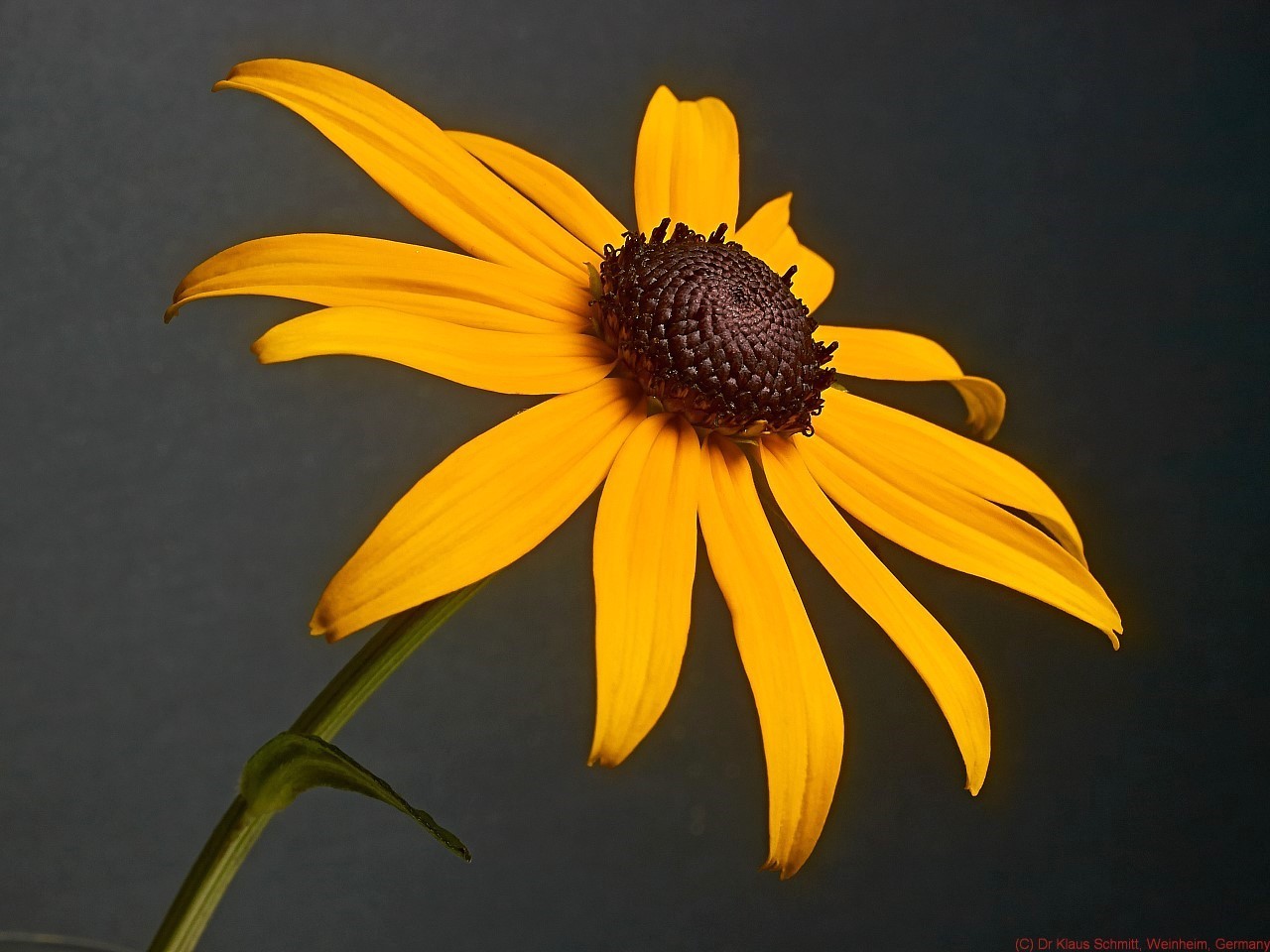
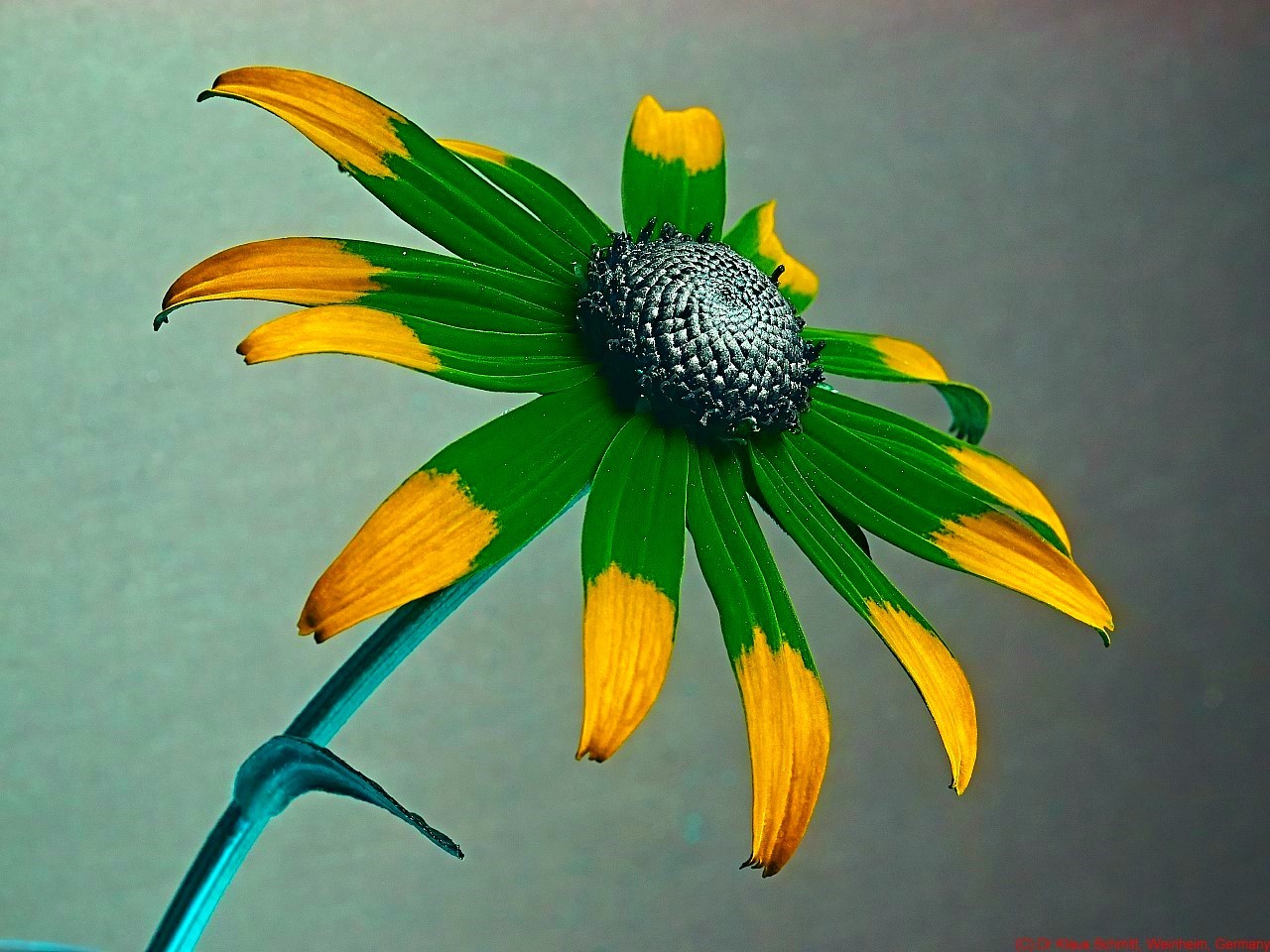
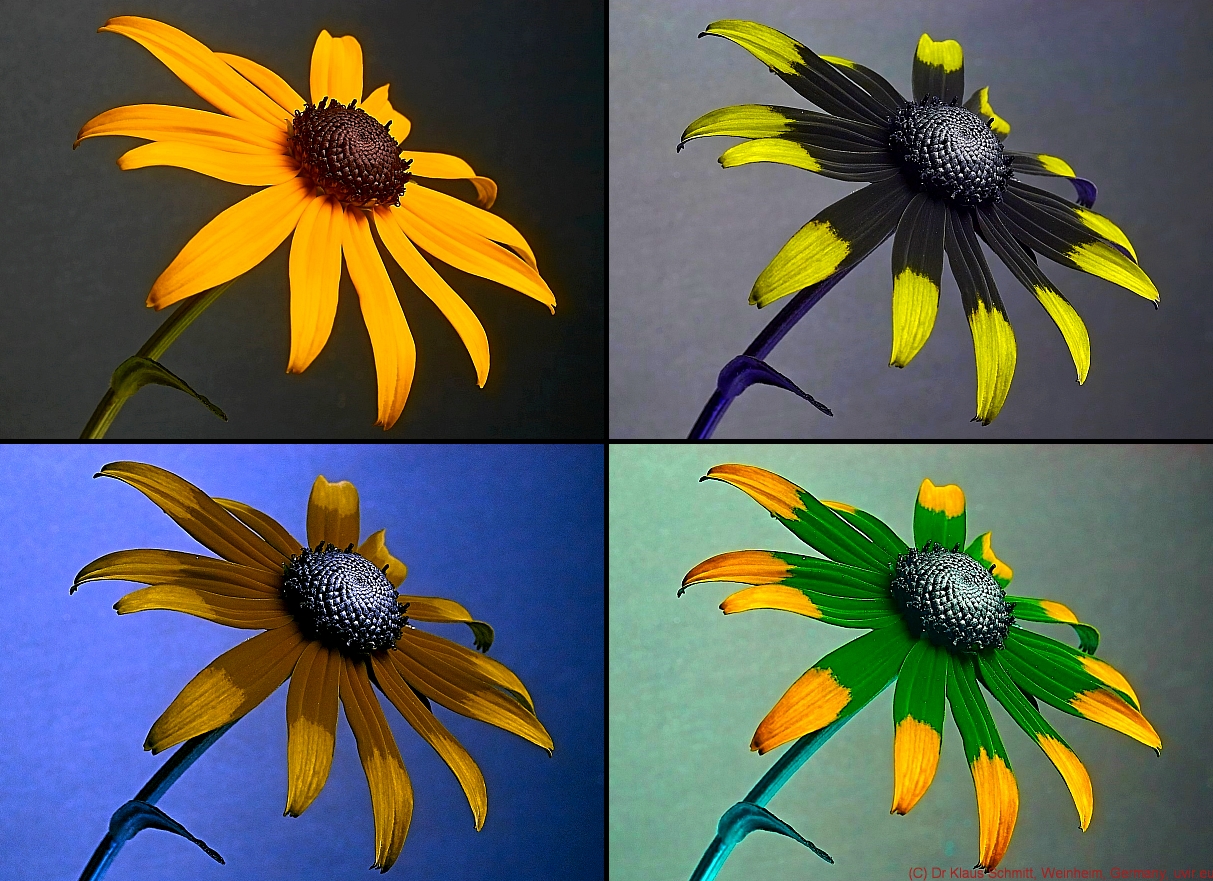
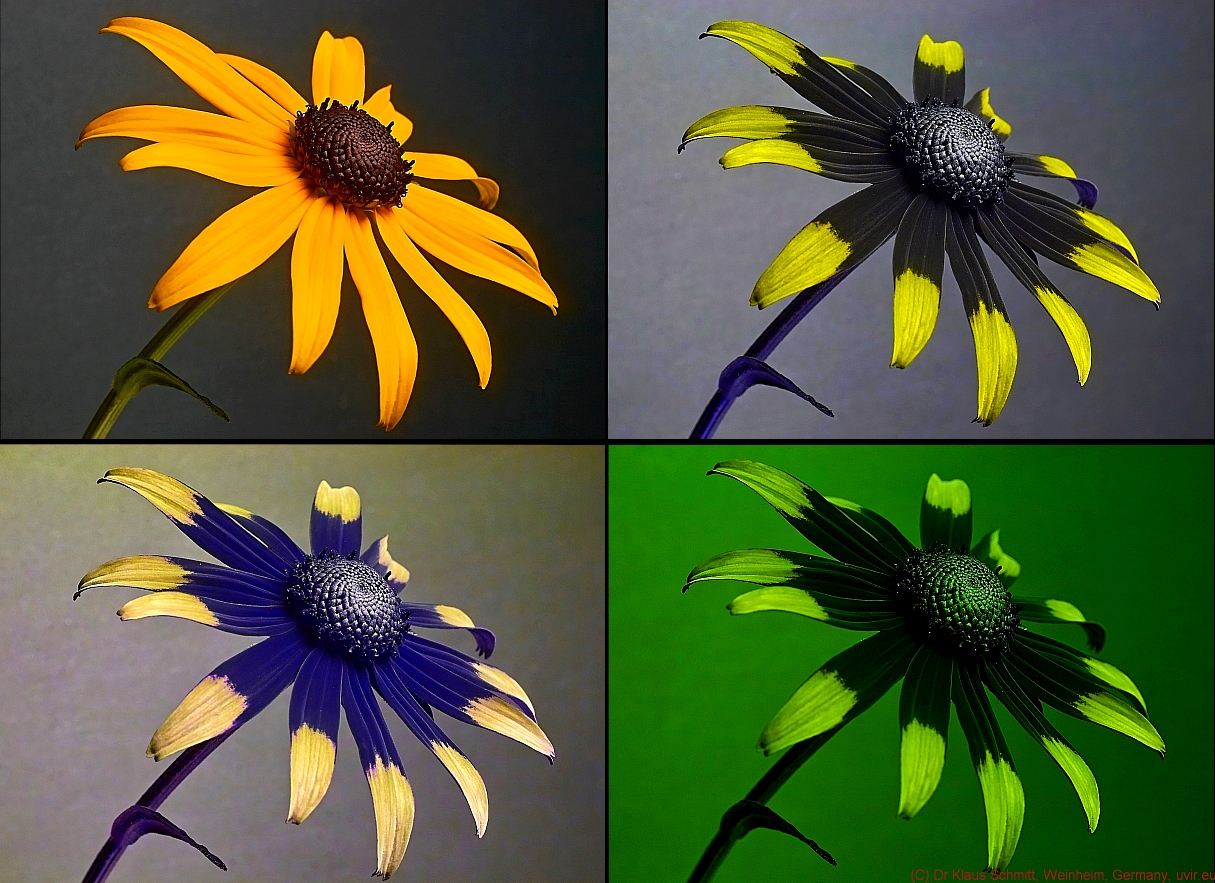
Today lab shots of a decorative summer flower which started to bloom on my balcony, Orange coneflower - Rudbeckia fulgida in reflected ultraviolet photography using my "work horse" UV filter, the Baader-U, Jupiter-U, Saturn-U and Uranus-U deep UV filter, as well as in simulated butterfly and bee vision using my proprietary XBV filters. Lens was my CERCO 94mm quartz flourite lens. Light source was a modified Xenon flash. All shots were done at about f8.
[click on image to see a larger one]
Visible light image

UV image using Baader-U filter (approx. 320-395nm, effective peak approx. 375nm):
UV image using Jupiter-U filter (approx. 280-385nm, effective peak approx. 365nm):

UV image using Saturn-U filter (approx. 300-350nm, effective peak approx. 325nm):

UV image using Uranus-U filter (approx. 270-320nm, effective peak approx. 315nm):

Simulated butterfly vision image using XBV3 filter:
Simulated bee vision image using XBV6 filter:
Quadriptych of the above (with bee/butterfly vision):

Quadriptych of the above (with deep UV):

This attractive flower shows its very prominent UV bullseye pattern, its petals have an UV dark bottom and very UV bright tips (around 365nm), invisible to us humans, and all this gets nicely visible.
Stay tuned, more will follow on that fascinating subject...
[click on image to see a larger one]
Visible light image
UV image using Baader-U filter (approx. 320-395nm, effective peak approx. 375nm):
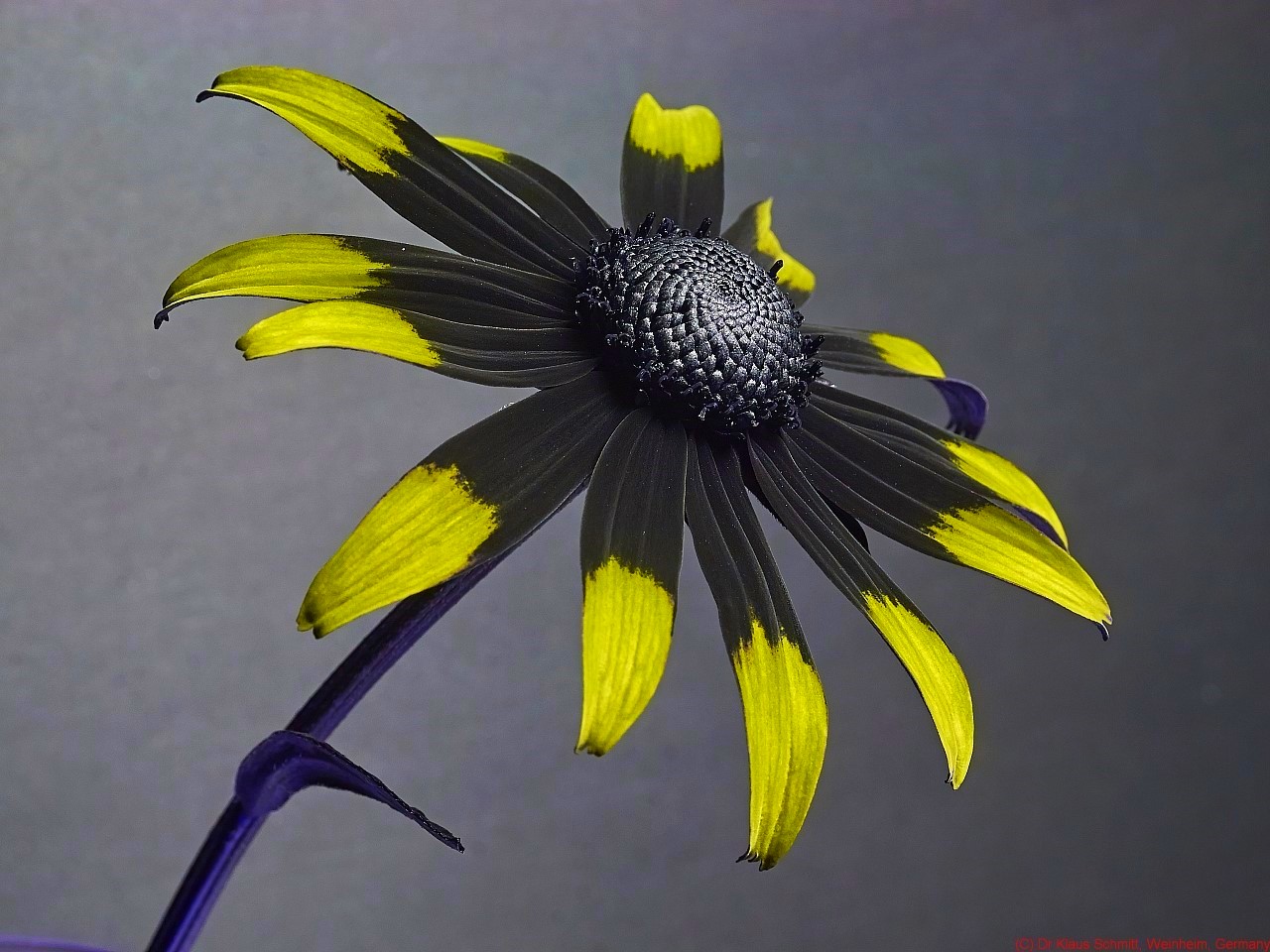
UV image using Jupiter-U filter (approx. 280-385nm, effective peak approx. 365nm):
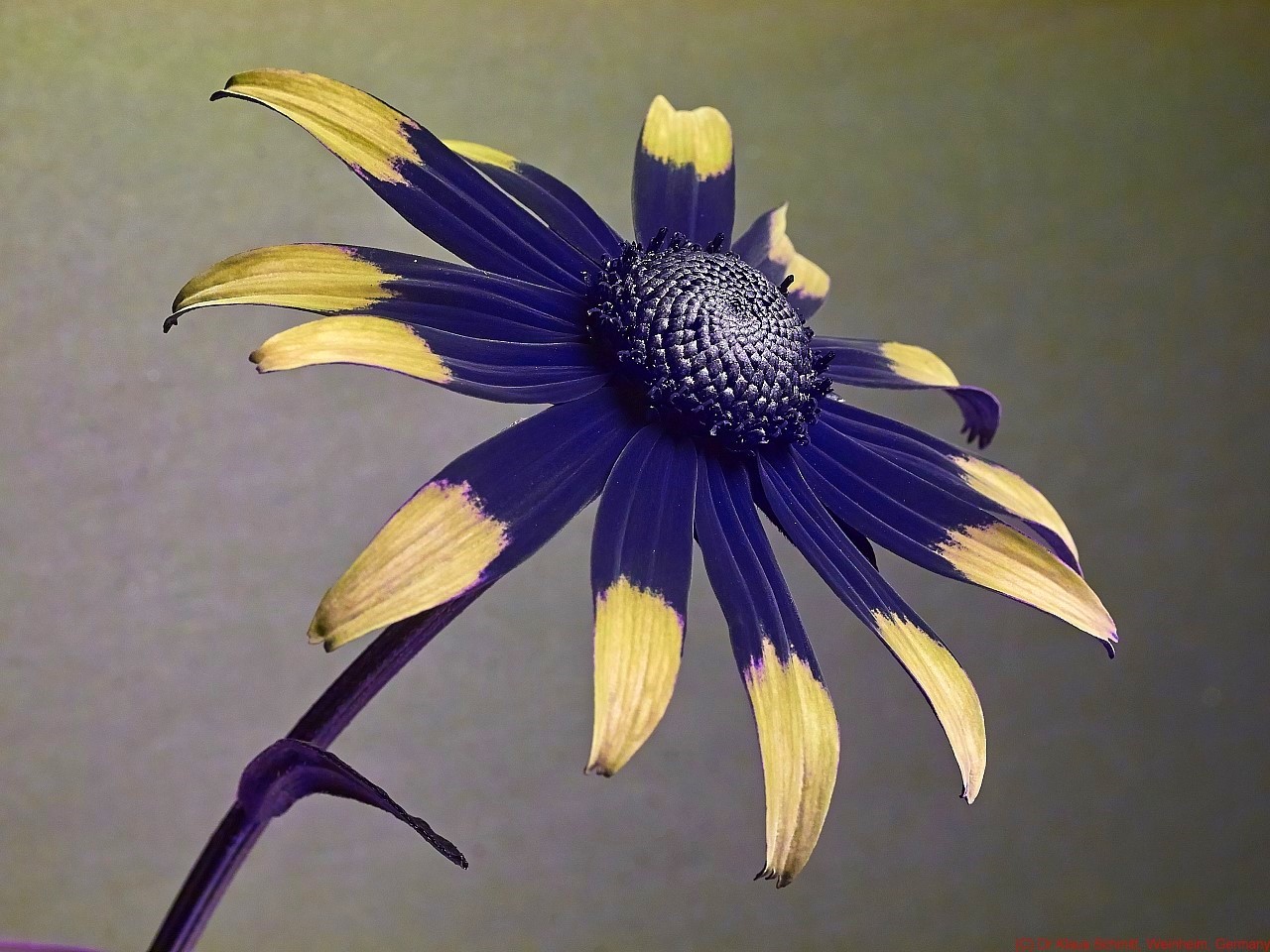
UV image using Saturn-U filter (approx. 300-350nm, effective peak approx. 325nm):
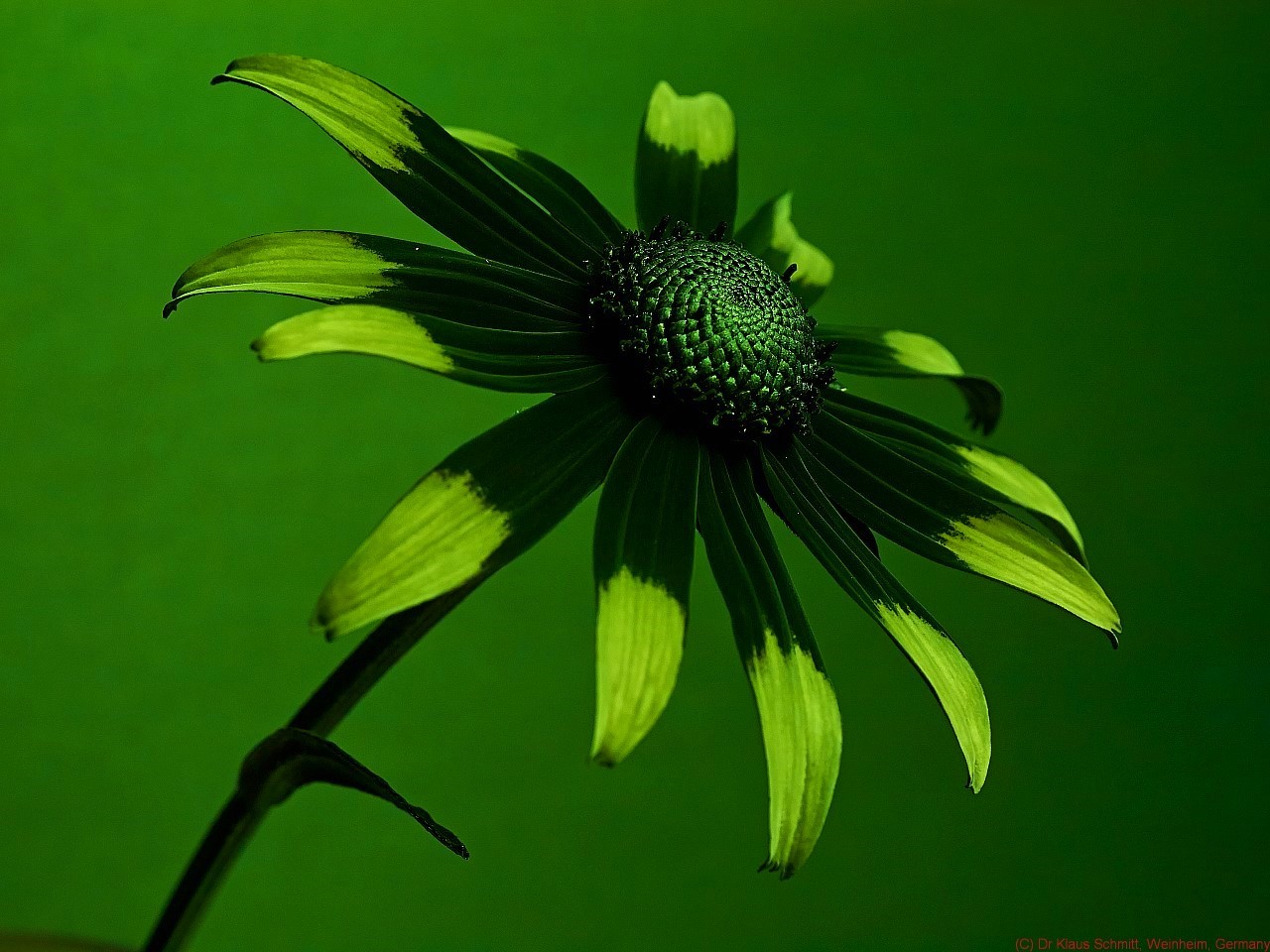
UV image using Uranus-U filter (approx. 270-320nm, effective peak approx. 315nm):
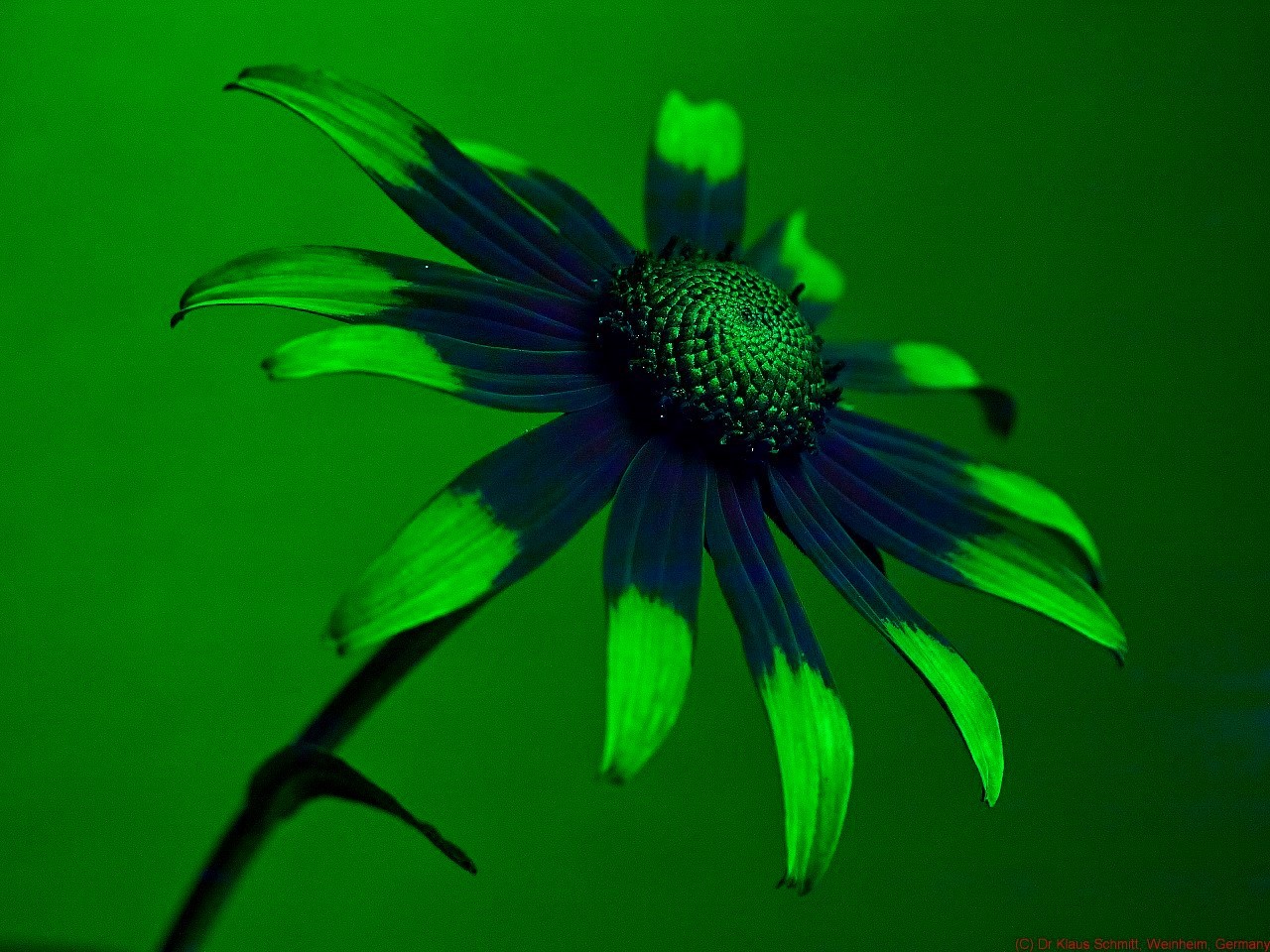
Simulated butterfly vision image using XBV3 filter:
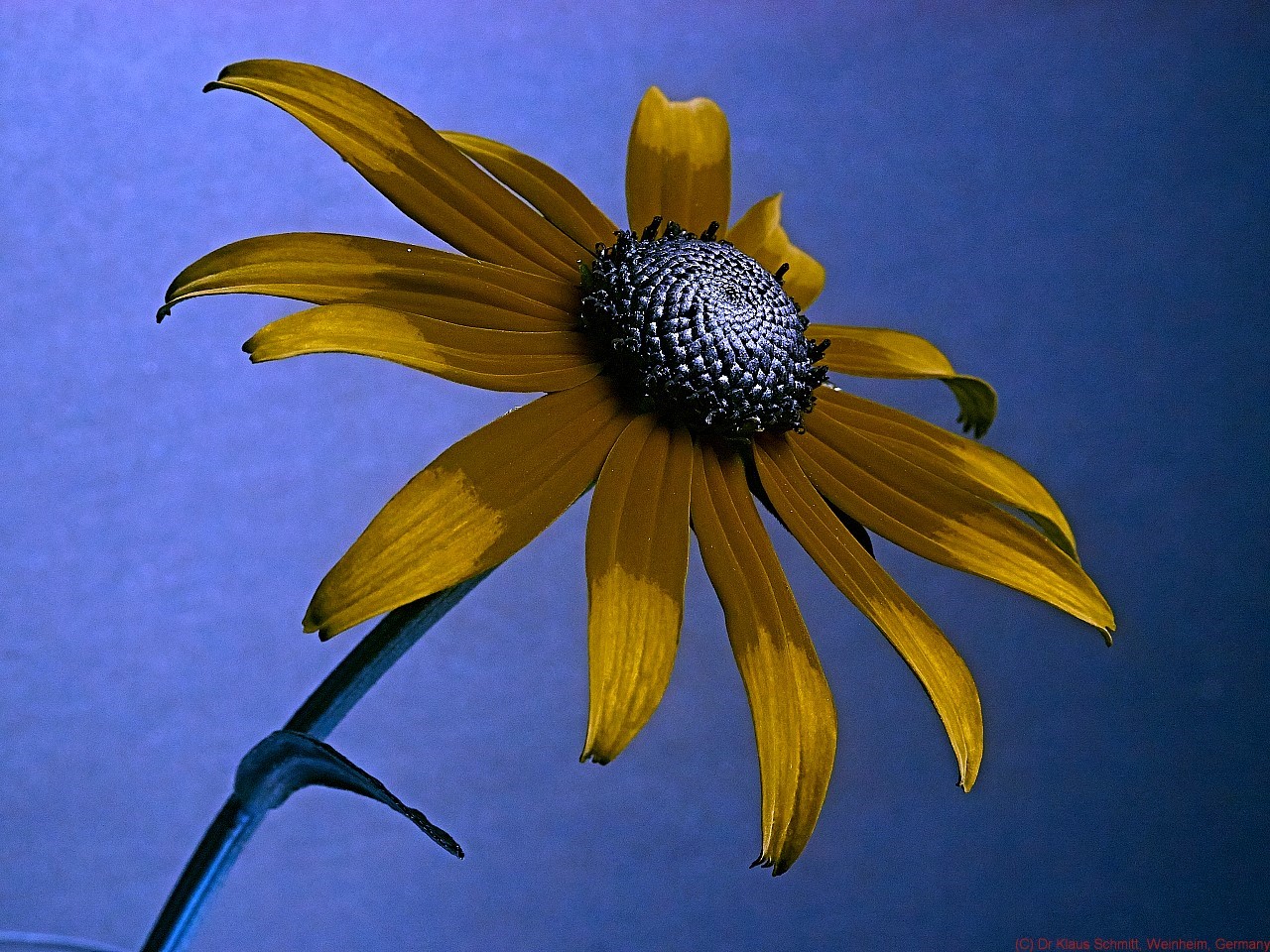
Simulated bee vision image using XBV6 filter:
Quadriptych of the above (with bee/butterfly vision):
Quadriptych of the above (with deep UV):
This attractive flower shows its very prominent UV bullseye pattern, its petals have an UV dark bottom and very UV bright tips (around 365nm), invisible to us humans, and all this gets nicely visible.
Stay tuned, more will follow on that fascinating subject...
Tuesday, July 15, 2014
Flare reduction and sunshade use in reflected UV ultraviolet photography
Today about flare redction when shooting reflected UV and the dedicated UV transmitting filters, like the Baader-U filter, my "work horse", for that. I'm using here my CERCO 94mm quartz fluorite lens, but in principle this method is applicable for any such lens. However, keep in mind, that quartz fluorite lenses for reflected UV are often single or even uncoated or show hotspotting, so it gets even more important to control flare efficiently, resulting in much higher image contrast and sometimes even removal of the hotspot. All images have been done at identical manual exposure settings, which were tested for correct exposure upfront.
Similar methods using such hoods have been used by others, I'm not claiming anything here, this just documents what I have done to further optimize my own setup.
[click on image to see a larger one]
Test images at nearly infinity (left to right) using (optimized for my camera's sensor size, other sensor sizes will require different sizes)
Similar methods using such hoods have been used by others, I'm not claiming anything here, this just documents what I have done to further optimize my own setup.
[click on image to see a larger one]
Test images at nearly infinity (left to right) using (optimized for my camera's sensor size, other sensor sizes will require different sizes)
1) just the UV filter, no sunshade at all
2) a 40mm long sunshade with 50mm free diameter
3) a 50mm long sunshade with 21mm free diameter


The difference gets quite obvious, the longer and narrower the sunshade is, the better flare gets controlled.
Now some closeup shots, using the same method and sequence:


Also here shooting flowers at closeup, it gets pretty obvious, how much flare is present if using no or a simple sunshade, whereas a specilized deep and narrow sunshade results in much improved flare control, hence greatly improved image contrast.
Let me summarize:
Whenever shooting reflected UV (or other multispectral work), make sure to use the deepest and most narrow possible sunshade, that does not vignette, to achieve the best flare control and resulting in best possible image contrast. It is also suitable to control or even remove the effect of hotspots, some of those highly specialized lenses unfortunately show.
I have previously written about filter leakage HERE.
Stay tuned, more will follow on that fascinating subject...
More info on this very interesting field may be found on my site http://www.pbase.com/kds315/uv_photos
Now some closeup shots, using the same method and sequence:


Also here shooting flowers at closeup, it gets pretty obvious, how much flare is present if using no or a simple sunshade, whereas a specilized deep and narrow sunshade results in much improved flare control, hence greatly improved image contrast.
Let me summarize:
Whenever shooting reflected UV (or other multispectral work), make sure to use the deepest and most narrow possible sunshade, that does not vignette, to achieve the best flare control and resulting in best possible image contrast. It is also suitable to control or even remove the effect of hotspots, some of those highly specialized lenses unfortunately show.
I have previously written about filter leakage HERE.
Stay tuned, more will follow on that fascinating subject...
More info on this very interesting field may be found on my site http://www.pbase.com/kds315/uv_photos
Monday, July 7, 2014
Creeping Zinnia - Sanvitalia procumbens in reflected deep ultraviolet photography, simulated bee and butterfly vision III
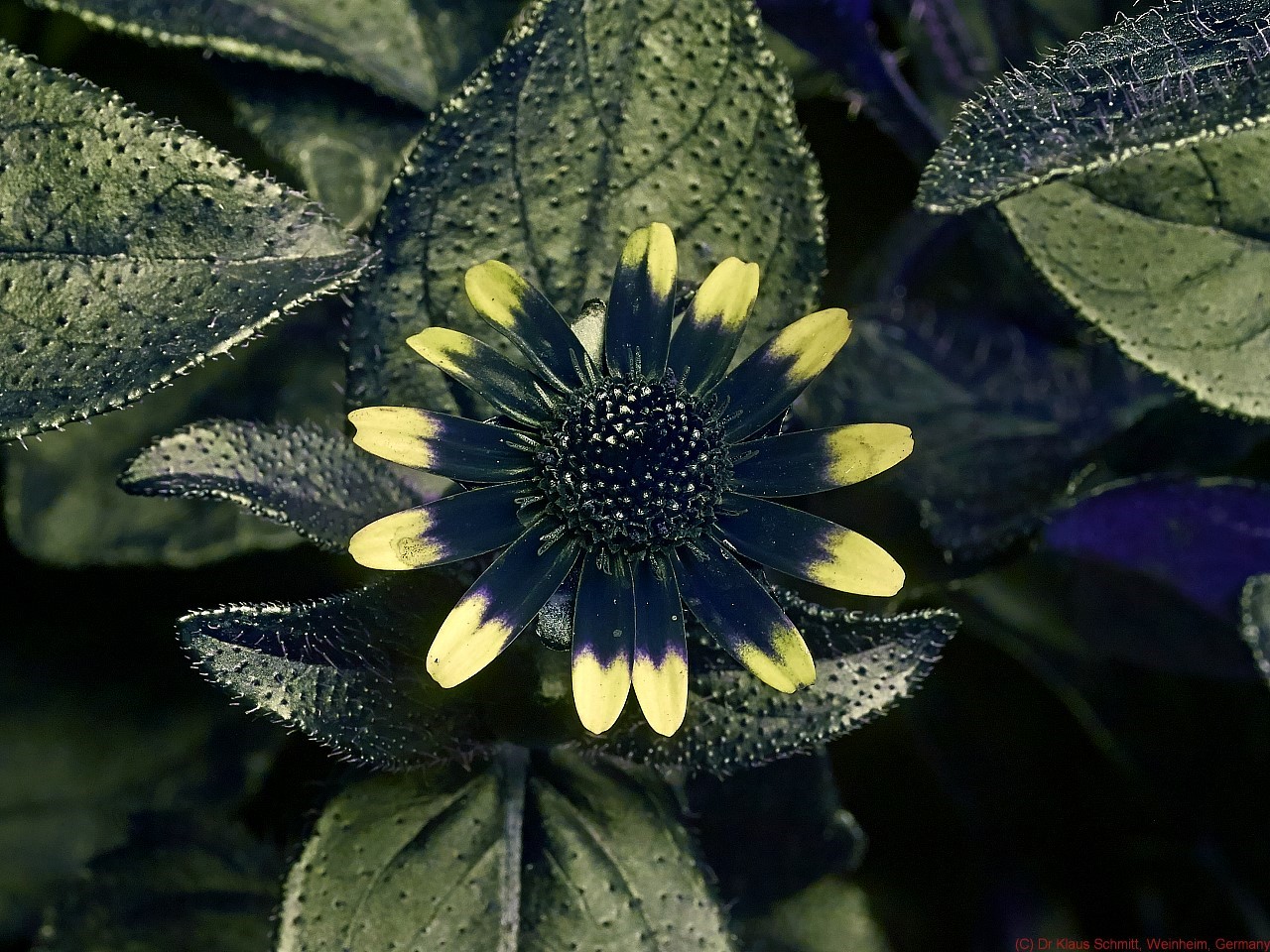
Today shots of a spring flower, developed from RAW files, Creeping Zinnia - Sanvitalia procumbens in reflected ultraviolet photography using my "work horse" UV filter, the Baader-U filter, my Jupiter-U and Saturn-U deeper UV filters, as well as my XBV filters for simulating butterfly and bee vision. Lens was a CERCO 94mm quartz fluorite lens. Light source was a Xenon flash. All shots were done at about f8.
[click on image to see a larger one]
Visible light image:

UV image using Baader-U filter (approx. 320-395nm, effective peak approx. 375nm):

UV image using Jupiter-U filter (approx. 280-385nm, effective peak approx. 365nm):

UV image using Saturn-U filter (approx. 300-350nm, effective peak approx. 325nm):

Simulated butterfly vision (UV - VIS) using XBV3 filter:

Simulated bee vision (UV - VIS) using XBV4 filter:

Simulated bee vision (UV - VIS) using XBV6 filter:

Triptych of the above (with bee/butterfly vision):

Triptych of the above (with deep UV):

Sanvitalia has a strong UV pattern, its petal tips are UV bright around 365nm and its center is quite UV dark, and all this gets nicely visible.
Stay tuned, more will follow on that fascinating subject...
More info on this very interesting field may be found on my site http://www.pbase.com/kds315/uv_photos
[click on image to see a larger one]
Visible light image:

UV image using Baader-U filter (approx. 320-395nm, effective peak approx. 375nm):

UV image using Jupiter-U filter (approx. 280-385nm, effective peak approx. 365nm):
UV image using Saturn-U filter (approx. 300-350nm, effective peak approx. 325nm):

Simulated butterfly vision (UV - VIS) using XBV3 filter:

Simulated bee vision (UV - VIS) using XBV4 filter:

Simulated bee vision (UV - VIS) using XBV6 filter:

Triptych of the above (with bee/butterfly vision):

Triptych of the above (with deep UV):

Sanvitalia has a strong UV pattern, its petal tips are UV bright around 365nm and its center is quite UV dark, and all this gets nicely visible.
Stay tuned, more will follow on that fascinating subject...
More info on this very interesting field may be found on my site http://www.pbase.com/kds315/uv_photos
Subscribe to:
Posts (Atom)

