Monday, March 16, 2009

Normal 135mm lenses for UV?

I invested some time today and measured the spectral transmissions of some 135mm lenses I had around.
[click on graph gives a larger image]


Top to bottom:
1) Pentax Takumar f2.5 135mm, multicoated (white)
2) X135 f2.8 135mm calibrated for UV lens, coated (turquise)
3) Enna f3.5 135mm lens from the 50ies, single coated (violet)
4) modern M42 non-name japanese f2.8 135mm lens, multicoated (orange)
5) Steinheil Quinar f3.8 135mm lens, multicoated (blue)

[please ignore the dips and jitter of the measured curves, that comes from that setup/Deuterium lamp used, this can also bee seen on that red 100% line w/o lens...]
I took the 365nm line as the wavelength to decide about the usebility of such a lens, since it is the center transmission of that famouns 2" Baader U-filter I mostly use for UV photography.  The X135 @365nm reaches 73% UV transmission (and it transmits down to about 320nm which correlates fine with the end of the UV sensitivity of an UV sensitive camera such as the Nikon D790 or D70s), wheras the next best one has only 39% (Quinar). Lens No.1 is a good example of what could be expected from a modern, multicoated lens in terms of UV transmission - not much actually since the multicoating and internal cemented lenses efficiently block UV, thus leaving such a lens quite useless for UV photography as compared to #2!
Please bear in mind that a useful UV transmission is just ONE criteria (but an important one) for successful UV photography. Resolution, sharpness, contrast, stray light and flare control, lack of hotspots etc. and focus shift of course are other important factors to consider.

HERE is a list of all lenses good for UV photography.

Stay tuned, more will follow on that fascinating subject...

More info on this very interesting field may be found on my site http://www.pbase.com/kds315/uv_photos

Is there "life" below 350nm II ?

Here now some infinity tests I made using the same stacked filters to see if there would also be some useful response below 350nm, using sunlight as an UV source. Again both the mod. Nikon D70 (clear quartz glass >270nm) and the Sigma SD-14 without internal filter (which can be clicked out easily without need for a professional service)  were used.

Lens used was a X35 wide angle lens (f=35mm) in both cases (infinity mount conversion done for the Nikon, M42 version with adaptor for the Sigma), shot at ISO200. [In all cases please ignore the vignetting of the corners, this was caused by the experimental filter mount I used, which could be done much better to avoid that effect]

This (blurry) result came out of the Sigma SD-14 after 30 sec exposure and f4 used:

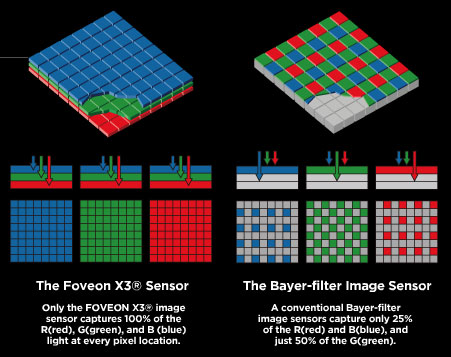
It is pretty obvious that only the blue channel of that stacked FOVEON chip responds to UV radiation (as the theory also says, since that chip does not use any dyes to filter, just the effect that silicon filters out shorter wavelengths the deeper light (UV, VIS, IR radiation) penetrates that silicon chip. (c) photoscala.de

The Nikon D70 result after 30 sec exposure and f8 used showed a much clearer image and two channels being stimulated (blue + red) by that short UV at 330nm peak. Not sure why the results is so much sharper, be it the stepped down to f8 or the infinity converted same lens used. The hue was adjusted so as to match the Sigma result.


That second image shows the result straight out of the Nikon D70 camera:

And NO, this is NOT infrared (IR), just because it is red! I checked with my spectrometer carefully that no IR passes. The color is caused by the fact that at these short UV wavelengths (nearly) only the red channel of that Nikon D70 CCD sensor has some useful UV response (maybe due to visible fluorescence of that red filter dye of the Bayesian filter used when expsosed to UV radiation)

To summarize my findings:

Cameras + exposure used:
1) mod. Nikon D70 (quartz glass filter >270nm) @ ISO200, 30sec, f4
2) Sigma SD-14 w/o int. filter @ISO200, 30sec, f8

It gets pretty obvious, that the mod. Nikon D70 has the much higher UV sensitivity of ca 2EV @330nm. I can only guess that the higher sharpness is due to f8 used and since the UV-infinity converted Noflexar 35mm version was used and not the off the shelf M42 version as for the SD-14. The Nikon image has been adapted to the color of the Sigma, but has pretty much red and a little bit blue channel response. The Sigma only gives some monochromatic blue channel response at much less sensitivity.

So in short the findings:

  • Sigma SD-14 w/o internal filter is about 2 stops less sensitive than a mod. Nikon D70
  • Sigma SD-14 only records UV in the blue channel, also down to about 320-330nm
  • Nikon mod. D70/D70s is about 2 stops more sensitive than a Sigma SD-14
  • Nikon mod. D70/D70s may be used down to ca. 320nm, but with much less sensitivity than 350-400nm
  • The X35 lens may be used succesfully down to 320nm

Some remark here: This has been done since I get many questions about how far a modern DSLR may be able to record UV. Although it has been proven experimentally now that there is some response, in terms of using that 300-350nm band I would consider that as not being much useful since it does not reveal much different information (at least from what I know today). Normal UV photography using the 2" Baader U-filter obviously records mainly in the 350-400nm band due to the steeply decreasing sensitivity of the camera chip with shorter wavelengths and this with 2-4sec exposure time at ISO200-400, f8-f11 for an unmodified Nikon D70/D70s i.e. 8-10 stops below a normal visual light shot (and 1-2 stops faster for UV using a modified D70 with clear quartz glass window) which is in a real outside situation anyway nearly too long. If you have ever tried to shoot a flower with a bee on it in UV, you know what I'm talking about!


Stay tuned, more will follow on that fascinating subject...

More info on this very interesting field may be found on my site http://www.pbase.com/kds315/uv_photos

Monday, March 2, 2009

Multispectral UV+VIS+IR in just one shot?

After some days of mumbling and grumbling and finally designing some special filter, I got that and now had the chance to make some initial tests, to see if the idea works.

Maybe you remember some time ago I published my remapping method to compress two images (UV, VIS) or even three (UV, VIS, IR) into a multispectral one. Quite a cumbersome process esp. making sure that all the images match while screwing in and out filters etc.

The steps looked like this using an off the shelf D70, UV Nikkor 105mm, UVIR cut filter for the VIS shot, Baader U-Filter for the UV shot (these are the old pictures):

[click on image to see a larger version]

Visual (VIS) shot:


UV shot using Baader-U filter:


and finally the composite UV+VIS remapped into one image:


in detail:


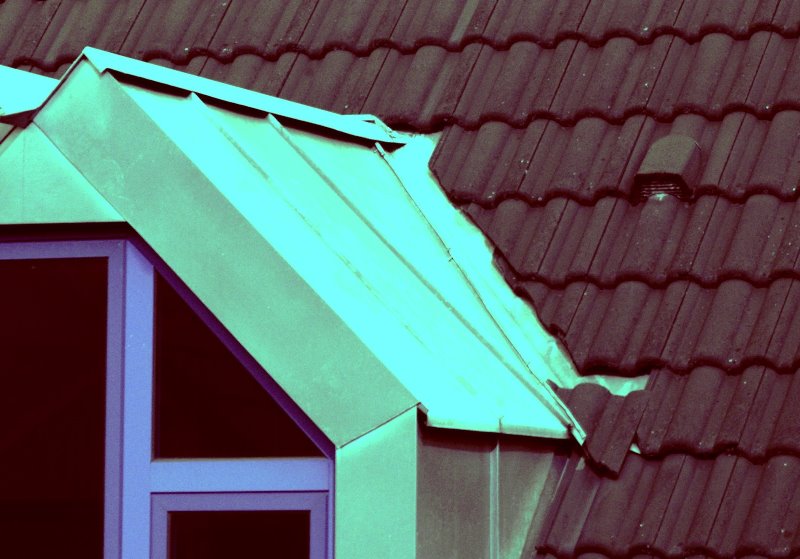
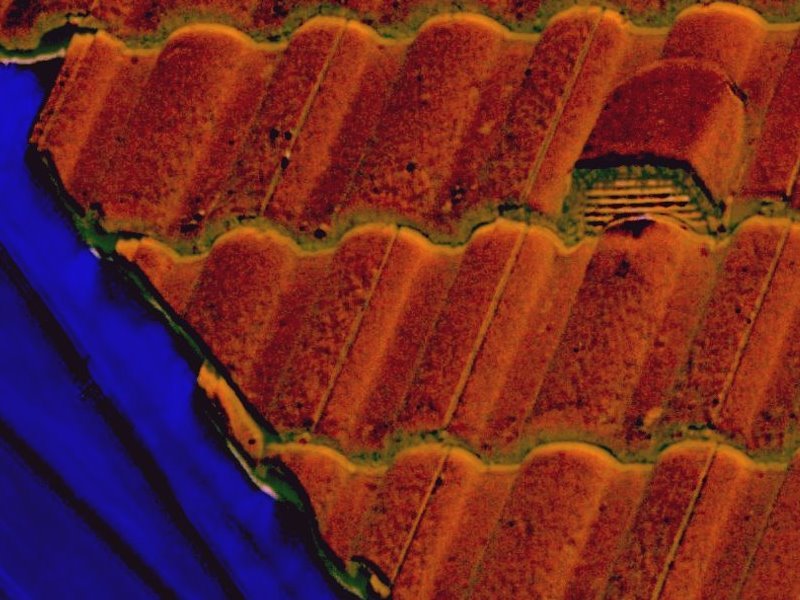
Now the result of the one-shot-process, using a full spectrum mod. D70 (clear quartz glass window >270nm), Nikon UV Nikkor 105mm plus my "secret" XUVIR filter (300-1000nm) to allow UV+VIS+IR in just one shot:


and in detail:


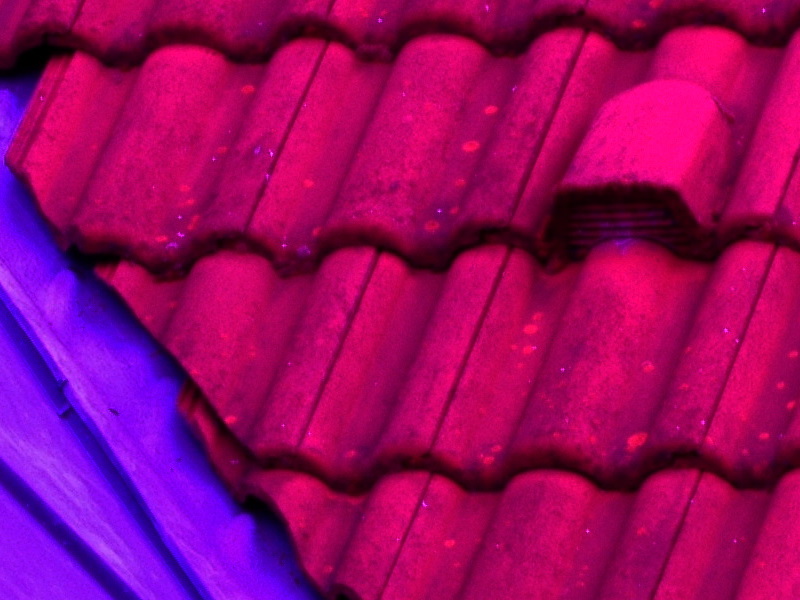
For comparison the identical shot using a special compensating filter, which makes the modified D70 a "normal" one, just VIS (i.e. an external filter which has the same filter characteristics as the removed internal filter had):


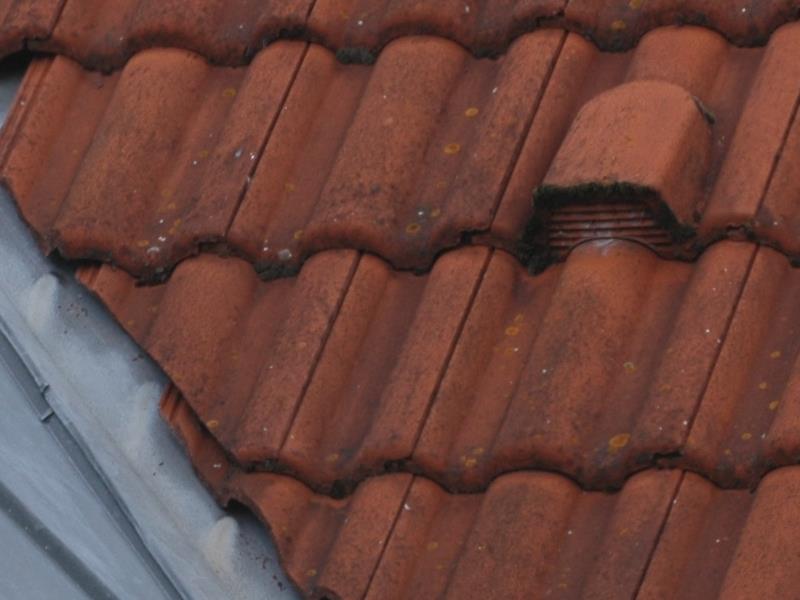
Be careful comparing the images, since the remapped one seems to be much sharper. Due to that embossing effect when overlaying two images it seems to have more structure, but this is not really existing. Another reason for the lack of sharpness is simply the fact that the UV Nikkor is focus corrected for UV+VIS, but not for IR.Important however is the fact, that the tiles reflect IR very strongly, which is clearly shown in red and that the tin roof above that window very strongly reflects UV, which clearly shows as deep blue. 

Another comparison, a street scene, shot some time ago in individual shots and remapped:


and about the same one, now using the new XUVIR filter and just ONE shot:

And both is accomplished now in just one shot, no remapping, no filter fumbling.

If you need such a XUVIR filter, drop me a note, I had made a few more....

[Remark: This technique shown only works well, if the reflection pattern of the subject is quite different in UV and IR, otherwise there won't be a clear separation]


Stay tuned, more will follow on that fascinating subject...

More info on this very interesting field may be found on my site http://www.pbase.com/kds315/uv_photos

Is there "life" below 350nm?

A lot has been discussed a forums dealing with UV photography what the low cut off UV wavelength might be of modern DSLR cameras i.e. how deep into the UV one could reach. A common assumption was around 350nm.

Well for that purpose I found a special steep astronomy filter which transmits only the 300-350nm band. A modified Nikon D70 camera was used, which I had modified using a clear quartz glass filter built in, which itself transmits flat from 270nm onwards. A Nikon UV-Nikkor f4.5 105mm was used as taking lens, since that transmits flat from 200nm onwards.

[click on image to see a larger version]

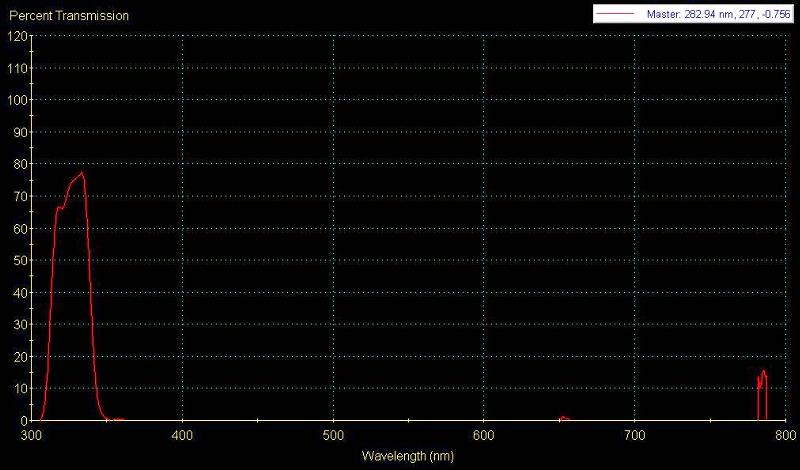
This now is the transmission spectra of that BP350 filter taken using a Ocean Optics USB2000 spectrometer (185-850nm; ignore that ripple on the right, measurement inaccuracy only, caused by the used Deutrium lamp):


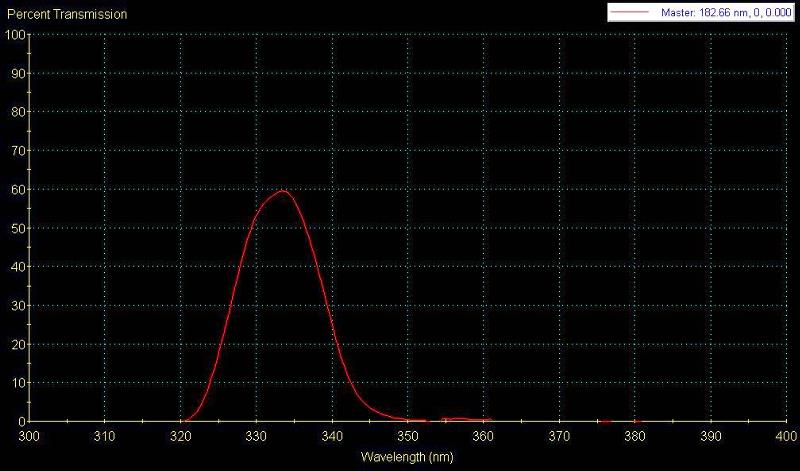
and here in detail the spectra if stacked with a Baader U-filter (310-390nm) to insure NIR >700nm is completely suppressed, since that BP350 filter starts to leak some NIR above 900nm. The resulting transmission peaks at about 333nm and stretches from 320-350nm.


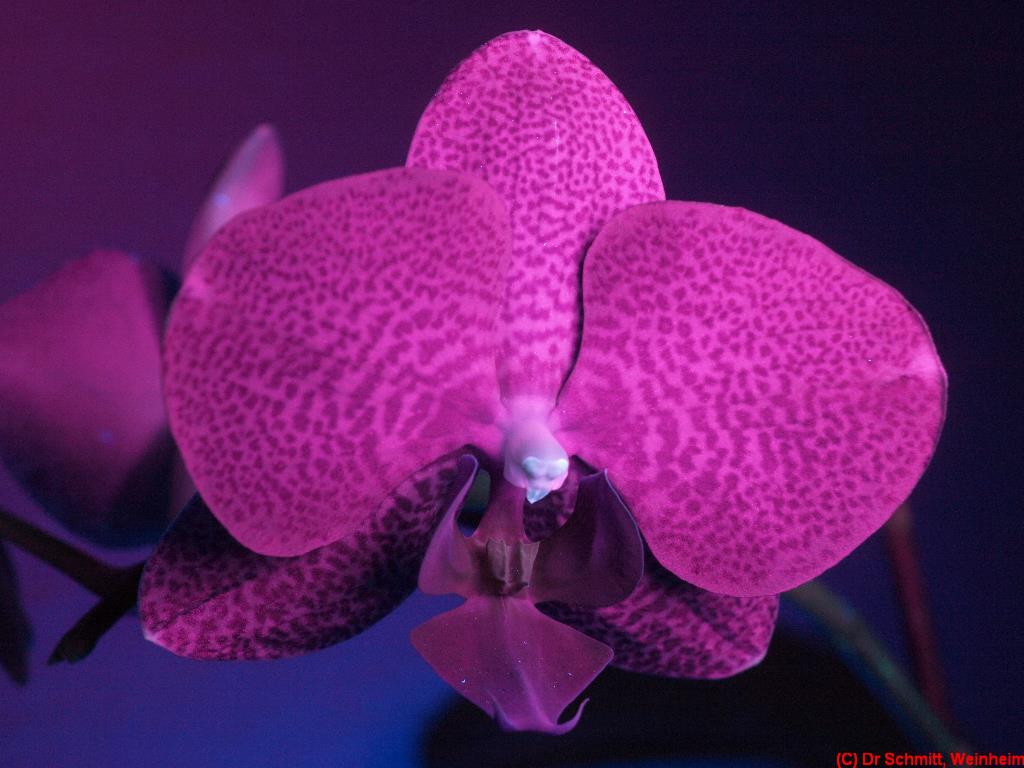
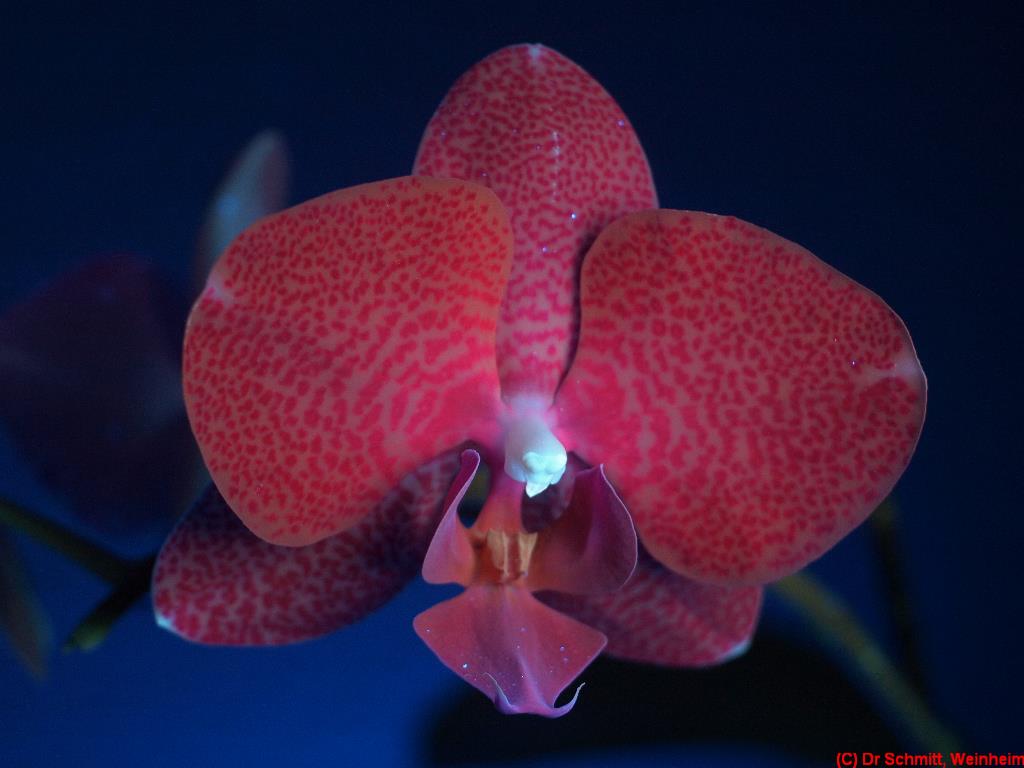
Now to the really interesting part, will the mod. D70 be able to record some useful information below 350nm? The camera was set to ISO1600 and the working aperture was f8. As a UV light source I used one shot of my modified High Power UV flash set at 400Ws, with UV front filter. Image came directly from the camera, only resized, and obviously only the RED channel records some useful information in this waveband.

So yes, there is life below 350nm, actually to about 325...330nm I would say.


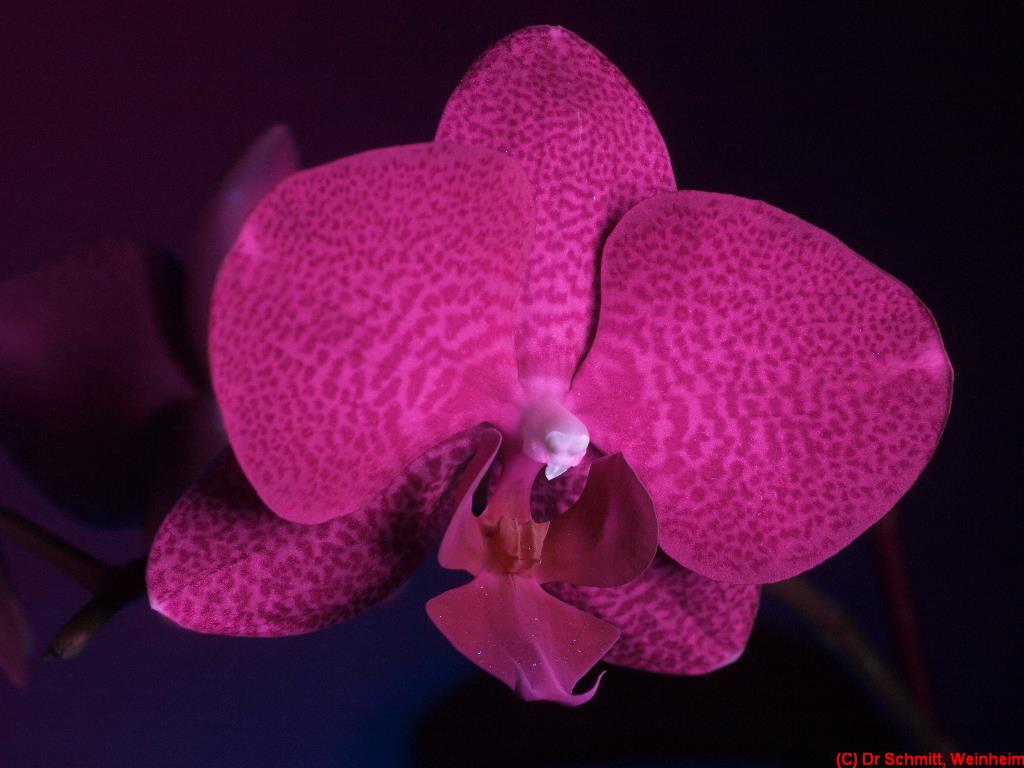
And just for comparison, this is the result if only the Baader U-filter was used at the same f-stop:


It is obvious that using the BP350 and the 320-350nm band causes some 2...3 stops less sensitivity, but shows different detail of that Phalaenopsis Hybride Orchid.

Stay tuned, more will follow on that fascinating subject...

More info on this very interesting field may be found on my site http://www.pbase.com/kds315/uv_photos

Monday, January 26, 2009

Filters for UV induced visible Fluorescence

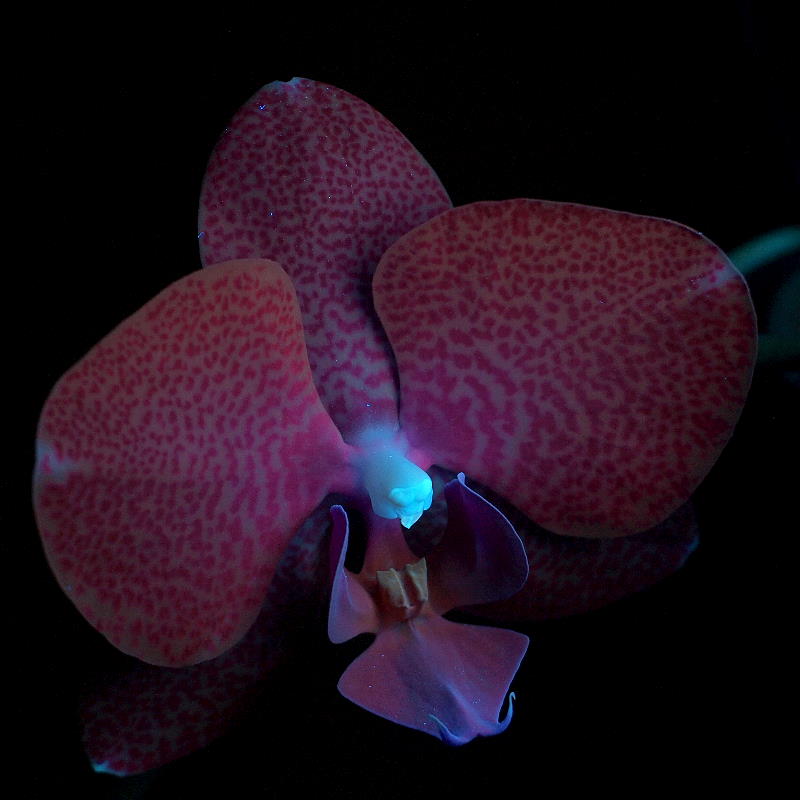
Here now an overview and comparative test of filters for UV induced visible fluorescence, as an outcome of a recent test I made using a Phalaenopsis as a target. I was using for that test my newly developed High Power UV Flash with UV transmitting front filter to stimulate UV induced visible fluorescence.  As optics I used the X35 lens at f8, 1/160 exposure time and the various mentioned filters (but any good lens for visible photography would obviously do).

Just a reminder: The intention was to find a filter, which allows to record visible fluorescence in the 400-650nm range. Deep red or NIR flourescence >650nm is tricky to record, since it coincides with NIR (near infrared) transmitted from the flash, so it would be wiped out in the resulting images (IR leakage). To record that, either a NIR blocking but UV transmissive flash front filter has to be used (a bit tricky, but could be done by sandwiching a BG38 or BG40 filter in front of the UV transmissive flash filter), OR a excinting source like the Nichia 365nm UV LED has to be used, which emits no NIR/IR at all.

[click on image to see a larger version]

1. Schott BG38 filter, transmits UV, but filters out IR - NOT useful


2. Commercial noname IR Cut filter, obviously transmits UV, blocks IR - NOT useful


3. Omega UV cut, IR blocking filter (from 650nm onwards) - too much blue also cut off (missing blue)


4. Baader UV IR Cut filter - nice colors, but transmits to about 700nm, which creates an
issue with most UV transmissive flash filters, since NIR is transmitted (too bright reds)


5. Baader UV IR Cut filter + IR cut filter (from 650nm onwards) - nice and UV flash issue
also nicely covered; but needs two stacked filters


6. Xcut filter, UV + NIR cut, transmits ca 410-650nm - works nicely, the best, all in just one filter


7. Xcut2 filter, UV + NIR cut, transmits ca 400-650nm - works nicely, bit on the cold side with enhanced blue, all in just one filter


8. Tiffen Hotmirror - quite some UV bleed through - NOT useful
[identical to the Canon Hot Mirror Filter btw.]


9. B+W 489 IR blocking filter - quite some UV bleed through - NOT useful
[the B+W 486 digital UV IR cut filter cuts on at 370nm, so it will be about the same, NOT useful result]


10. Noname Hot Mirror Filter - quite some UV bleed through - NOT useful


...and just for the fun of it and for comparison....purely reflected UV...
Baader U-filter ("Venus") 310...390nm


Stay tuned, more will follow on that fascinating subject...

More info on this very interesting field may be found on my site http://www.pbase.com/kds315/uv_photos

Sunday, January 18, 2009

High Power UV Flash for stimulated visible Fluorescence

Here a recent test I made to see if my newly developed High Power UV Flash would be able with just one pop to stimulate UV induced visible fluorescence. I used the X35 lens at f8, 1/160 exposure time and a Xcut blocking filter (prototype) ,which only allows 400-650nm vivible light to pass and thus also controls the risk of IR leakage coming from the flash, since Xenon emits plenty of IR. The flash itself is modified for high UV output and uses a quartz flashtube plus a UV transmissive, visible light blocking filter.

The following pic is (C) Michigan State University and shows clearly the high IR output of a normal Xenon flash (red line). The blue line however shows the effect of a flash circuit modification, allowing more amps per square centimeter to pass through the Xenon plasma, so as to enhance UV output and suppress the usually high IR content.

Here now the shot and the proof that the High Power UV Flash idea works to stimulate visible fluorescence:

[click on image to see a larger version]

And now how fluorescent minerals look like using that flash.

All fluorescent minerals from the famous Franklin Mine/USA:

Stay tuned, more will follow on that fascinating subject... More info on this very interesting field may be found on my site http://www.pbase.com/kds315/uv_photos

Thursday, November 13, 2008

Principle Thoughts about Lenses + Filters for UV

Some priciple thoughts, why normal lenses and filters do not work for reflected ultraviolet (UV) photography.

I get quite a few questions, why a certain camera, lens, filter setup does not or not satisfyingly work for UV photography. I will try and show the effects of that optical system using some transmission graphs I recently made.

So here some results using one my X-lenses (red line) and a very modern, multicoated lens (purple line), a Baader 2" U-filter (dark green line) and a common UV transmissive filter (very light green line) such as a Schott UG-1, Hoya U-340, B+W 403, Kodak Wratten 18A, Nikon FF etc. sometimes also called "Woods Glass".

Let's look at the filters first. The older, common UV filter has a benefit, quite a high peak UV transmission of about 90% - but it also shows IR transmission from about 670nm onwards. In former times of film based cameras, that was no issue, since these film had no IR sensitivity. Today in the times of digital cameras, and especially the modified ones, their IR sensitivity is quite resp. very high. So that leads to quite some contamination of that supposedly UV image due to "IR leakage". One cure would be to add ("stack") another filter in front which passes UV but blocks or reduces IR. Such a filter would be the Schott blue-green BG-38 or BG-40 filter. But that does not completely cure that problem. The german astronomy company Baader developed because of that fact their Baader-U filter (also called "Venus" Filter, since astronomers use it to make details of the surface of planet Venus visible), with perfectly suppressed IR, as the dark green line nicely proves. This fact made it my "filter workhorse" for reflected UV photography, even if the peak transmission is a bit lower at about 80%.

Now about the lenses. Usually a photographic lens should reproduce visible images, which is the wavelength band of about 400-700nm. This is why lens makers apply a special multicoating (aside from achieving higher light transmission), which usually blocks light outside this visible waveband. The purple line of a recent multicoated lens proves, how succesful this is done today. For UV photography, however, the UV-A band (300 - 400nm) is the interesting one. So using a modern lens and that Baader U-filter leads to that mini UV transmission of about 5% only, which usually causes very long exposure times, grainy images and a lot of frustration for some who wanted to step into that field. Here the wrong lens is the reason for that, not the filter!

One solution would be to get one of the highly specialized $$$$ quartz / fluorite lenses I have reported about here, but this is just for a few who can afford that or have access to one of these lenses - surely a pleasure to use. But the ambitioned amateur or researcher on a tight budget needs a solution too.

This was the reason why I started some reasearch to find lenses which would allow similar image quality, but at affordable cost. So my series of X-lenses was born, the most prominent being the X135 (f=135mm), X50 (f=50mm) and X35 (f=35mm), one of them shown as bright red line which shows quite some more and deeper into the UV reaching transmission, one of them to about 310nm.

The system lens + filter using an X-lens now leads to a much higher UV output to the camera chip (assuming a modern digital SLR camera, which also has to have some UV sensitivity, such as a Nikon D70(s), D40 or modified D200) of about 7 times more, a gain of 3 stops or 3EV in photog speak (this is just about 1 stop less than using the UV Nikkor!). This allows much shorter exposure times, better quality in terms of graininess (noise) and UV reproduction, since also a broader UV waveband is covered.

Just a remark, the high UV transmission is a must for a suitable UV lens, but also good sharpness, high contrast, flare resistance, no hot-spots, etc. are requirements such an X-lens has to meet, and I have not jet mentioned an important point - focus shift. This latter point was solved by calibrating such a lens for UV use, to allow for a sharp visible and UV focus.


[click on image let's you see a larger image]


The explanation is not yet complete, two important parts of the system are not covered here in detail, the camera and the light source(s), which should be used for UV photography. I will elaborate on that at a later time here.

Stay tuned, more will follow on that fascinating subject...

More info on this very interesting field may be found on my site http://www.pbase.com/kds315/uv_photos