Thursday, December 17, 2015

Gasometer Oberhausen Museum, Wonders of Nature Exhibit 2016

The project management of Gasometer Oberhausen Museum has asked me to participate with some of my works for their forthcoming 2016 exhibit "Wonders of Nature", which will open up its doors to the public March 11, 2016 and will last till December 30, 2016.

(quote) The forthcoming exhibition at Gasometer Oberhausen celebrates in visually stunning images the life of plants and animals – the highlight will be a 20 metre large terrestrial globe in the gigantic interior (unquote)

(c) Gasometer Oberhausen
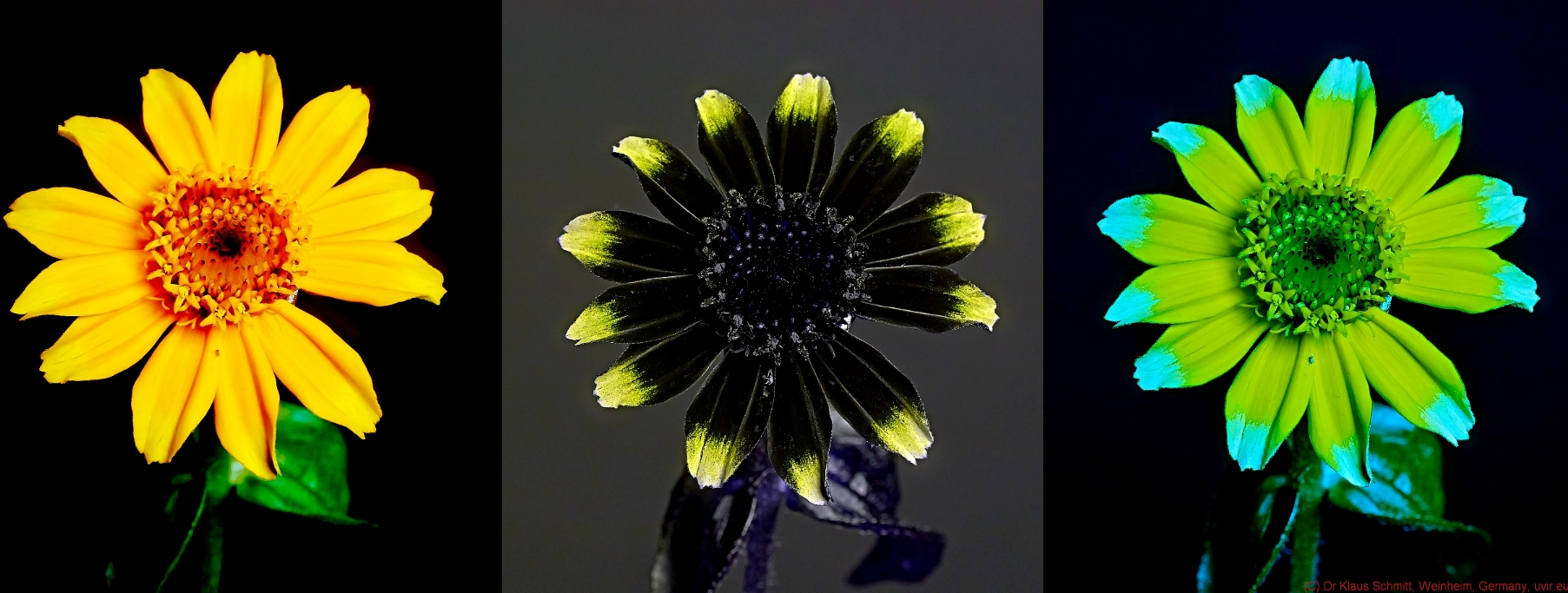
My contribution will be some images of a Zinnia haageana flower in very large prints, on display in their exhibition area below that globe, demonstrating the difference between our human vision and a simulation of that of a honey bee.

Triptych Human Vision, UV, Simulated Bee Vision (left to right):  

I'm certain this exhibit will be visually stunning, as well as highly educative and suited for interested individuals as well as families and schools. Go have a look, it will be well worth it!

I have written about that flower HERE

Stay tuned, more will follow on that fascinating subject...

Friday, November 20, 2015

Orange coneflower - Rudbeckia fulgida in reflected ultraviolet photography, simulated butterfly and bee vision XIII

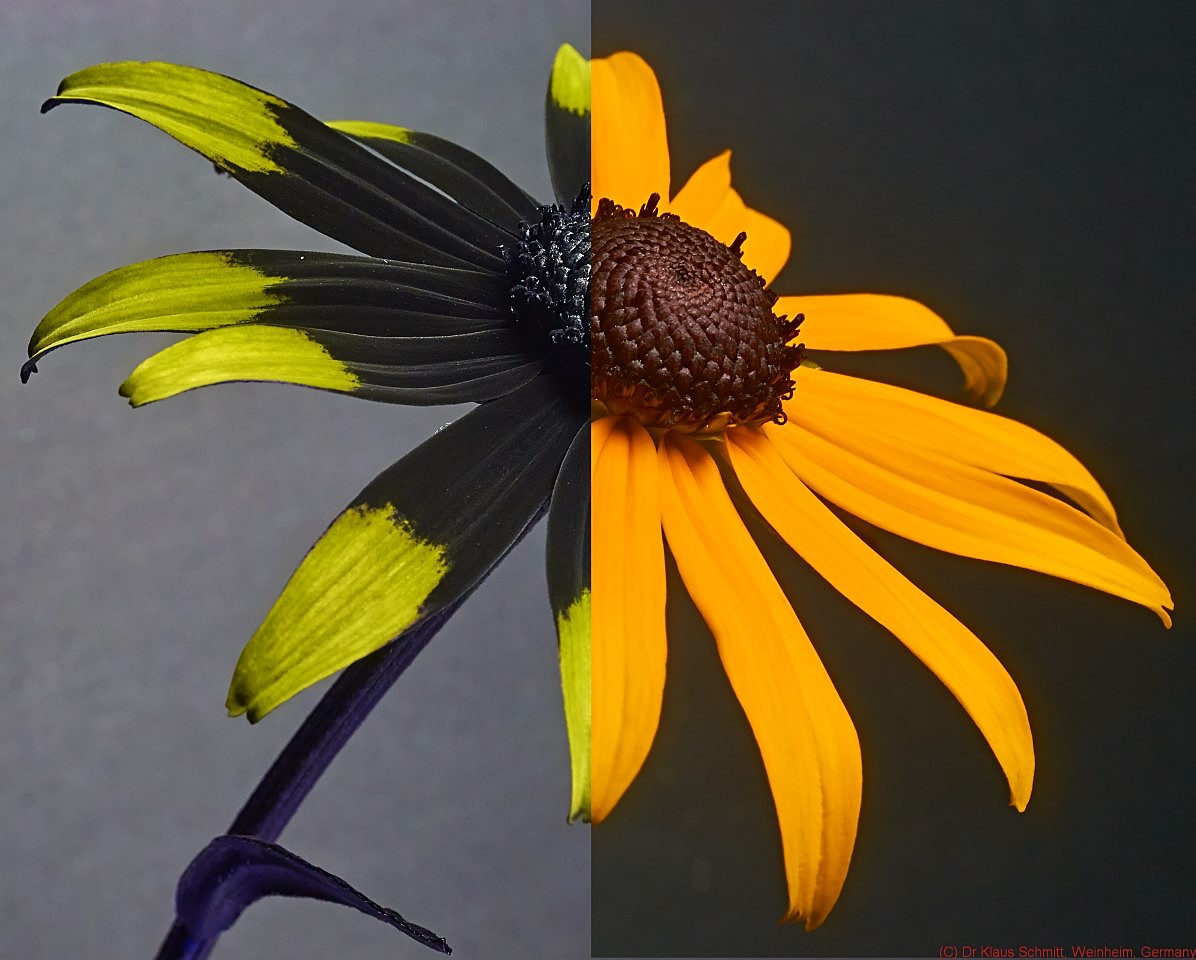
Today about composite shot of a decorative summer flower Orange coneflower - Rudbeckia fulgida in reflected ultraviolet photography using my "work horse" UV filter, the Baader-U filter. Lens was my CERCO 94mm quartz flourite lens. Light source was a modified for high UV output Xenon flash. All shots were done at f8.

[click on image to see a larger one]

Composite image: Human vison (right side), reflected UV (left side):


This attractive flower shows its very prominent UV bullseye pattern, its petals have an UV dark bottom and very UV bright tips (around 365nm), invisible to us humans, but very visible to bees and butterflies, and all this gets nicely visible.

I have previously written about this flower HERE

Stay tuned, more will follow on that fascinating subject...

BBC Four - Colour: The Spectrum of Science

BBC Channel Four has recently produced and aired their three episode series "Colour: The Spectrum of Science ". The last episode "Beyond the Rainbow" has been aired on November 18, 2015 and deals with invisible colors, resp. IR and UV, the latter also about using reflected UV for behavioural reasons (starling) and pollination (bees). I have consulted the production team about the latter and have photographed and shown them the European starlings UV pattern (I wrote about that HERE ).

Diptych (left to right): Human vison, reflected UV (Baader-U filter):


Quote BBC: " Colour: The Spectrum of Science - 3. Beyond the Rainbow
We live in a world ablaze with colour. Rainbows and rainforests, oceans and humanity, earth is the most colourful place we know of. But the colours we see are far more complex and fascinating than they appear. In this series, Dr Helen Czerski uncovers what colour is, how it works, and how it has written the story of our planet.

The colours that we see are only a fraction of what's out there. Beyond the rainbow there are colours invisible to our eyes. In this episode, Dr Helen Czerski tells the story of scientific discovery. To see the universe in a whole new light, Helen takes to the skies in a NASA jumbo jet equipped with a 17-tonne infrared telescope.

We can't see in ultra violet, but many animals can. Helen explores what the world looks like to the birds and the bees. With the discovery of x-rays we could look inside ourselves in ways that previously had only been possible after death. Today those same x-rays allow us to examine life at the atomic level, helping to develop new drugs and better materials. Ultimately, by harnessing all the colours there are, researchers are beginning to image the human body as never before, revealing new ways to treat disease."

Here now is the link to the video on BBC iPlayer

A wonderful production certainly worth watching!


Stay tuned, more will follow on that fascinating subject...
Sunday, October 18, 2015

ZDF TerraX Series "The Magic of Colors" Oct 18 2015 19:30h CET II

The TerraX/ZDF production company had contracted me and my UV cameras to contribute stills and a HD UV video to their series "The Magic of Colors". This episode has been aired on October 18, 2015 at primetime 19:30 hours CET and has shown the iportance of colors in human evolution, but also the importance for flowering plants and bees.

Here now is the video, Flowers + Bees in VIS + UV starts at 15:35
Impressive, as all the TerraX productions are and very worth watching!

I have written about that before HERE

Stay tuned, more will follow on that fascinating subject...

North Carolina Botanical Gardens Bee Exhibit with reflected ultraviolet (UV) photography

The North Carolina Botanical Gardens (University of North Carolina at Chapel Hill) just concluded a four months exhibit about the importance of Bees with some of my works included.


I got informed by the organizing commitee, that it was a great success and well received by its visitors.

Stay tuned, more will follow on that fascinating subject...

Friday, October 2, 2015

ZDF TerraX Series "The Magic of Colors" Oct 18 2015 19:30h CET

TerraX has contracted me to supply them with Vis + UV stills and a reflected UV HD video for their forthcoming two-part series "The Magic of Colors" which will air Oct 18 (part I) and Oct 25 (part II), 2015 19:30 hours CET on TV channel ZDF - my work will be shown in part I on Oct 18.

Quote TerraX: "Whether ocher, red, yellow, green or blue: Behind every color shade are hidden stories and amazing facts. Why do they have such a great importance for us people and why has that always been that way? Only those who could recognize whether a fruit is ripe or toxic, could survive. All colors in nature serve a biological purpose and every living being has specialized his perception towards that. But man alone manufactures colors and gives them symbolic power."

That also applies also to animals and flowers, and evlolution found amazing ways of plant-animal interaction, benefitting them both. However not all animals and insects have the very same color perception we humans have, some of them can see what we cannot see, ultraviolet (UV) light for instance, or the very faint UV induced visible fluorescence some flowers emit to attract night active moths, like this four o'clock flower (Mirabilis jalapa) for instance shown in human vision and fluorescence with its glowing pollen:

Here now some examples what pollinating bees are able to see and what we humans see, Brown Eyed Susan (Rudbeckia fulgida) to start with (1st visible light and 2nd reflected UV)
There will also be a video showing a bee pollinating a Rubbeckia flower in reflected ultraviolet light:  

I'm pretty sure this whole series will be quite exciting to watch as there is so much more in it. Be sure to watch it of you can!

Stay tuned, more will follow on that fascinating subject...
Friday, September 11, 2015

Carl Bosch Museum Heidelberg Special Exhibit Fascination Color with simulated bee and butterfly vision images II

Today about the opening event of the "Fascination Color" exhibit at the Carl Bosch Museum, Heidelberg Germany which will be open from 12. September 2015 - 3. April 2016. Some of my best works will be shown in human vision, in simulated bee and butterfly vision.

Here the introductory text: "How do colors come into existence? What are colors used for? What really is color? These and many other questions are answered by the exhibition and illustrates how broad ranged the subject of colors actually is. With many exciting exhibits, visitors learn that we see colors not only with our eyes and experience how other people and animals see the colorful world. The symbolic and social meanings of colors are explained, as is the extraction and use of historic natural colors, up to modern industrial dyes." [translation by me]


The scientific background of colors are demonstrated with live experiments, how it was found out, color models from history up to now explained, color temperature and the effect of different light sources, as well as natural pigments and dyes from ancient times to todays are being shown.

The last two pictures shows the animated video with my works showing the difference between human, butterfly and bee vision with various flowers with a very prominent UV pattern. Beneath there is an explanation how evolution has started with tetrachromatic vision and how that has developed over millions of years into the various types of vision today.

If you find time to, pay it a visit, it will certainly be worth going with your whole family!
 
The Carl Bosch Museum Heidelberg has been founded and is being actively supported by Gerda Tschira, wife of recently deceased SAP founding member Klaus Tschira . The non-profit Klaus Tschira Foundation promotes the advancement of natural sciences, mathematics, and computer science and strives to raise appreciation for these fields.
 

Stay tuned, more will follow on that fascinating subject...