Wednesday, April 14, 2010

New Book: Bizarre and Incredible World of Plants


There is a new book on the market by W. Stuppy et al. the  "Bizarre and Incredible World of Plants", published by Papadakis Publishing house (also available at amazon ) which also features my work of bees seeing plants in UV very differently than how we do. 

Wolfgang Stuppy is the seed morphologist for the Millennium Seed Bank Project at the Royal Botanic Gardens, Kew and it has been a pleasure and honor to have been asked to be part of his amazing book. His images are so stunning, a great coffee table book just for viewing pleasure, but also for the scientifically interested reader, as it also has plenty of explanatory text in it.

Some detailed images:


all images (c) Papadakis and W. Stuppy.


Stay tuned, more will follow on that fascinating subject...

More info on this very interesting field may be found on my site http://www.pbase.com/kds315/uv_photos

Sunday, April 11, 2010

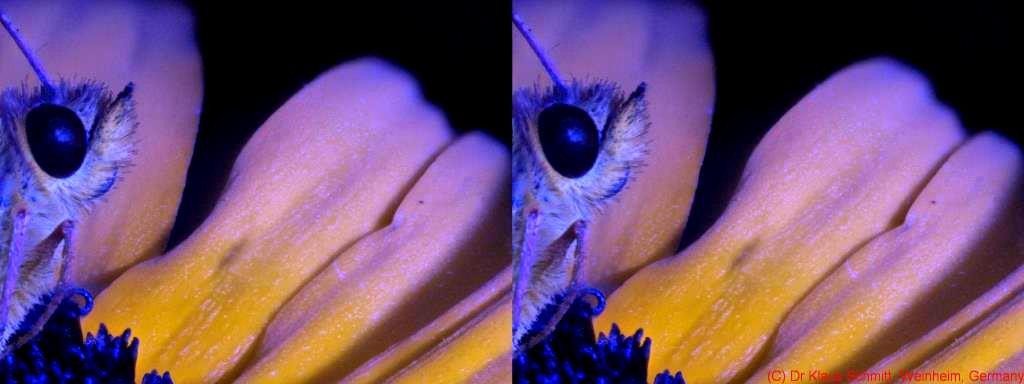
Butterfly on Rudbeckia tetrachromatic - 3D Stereo

Well, I tried something, let me know if that works for you... Butterfly on Rudbeckia flower, simulated tetrachromatic, cross-eyed 3D image.

Tutorial how to see 3D images

[click on image to see larger]


Stay tuned, more will follow on that fascinating subject...

More info on this very interesting field may be found on my site http://www.pbase.com/kds315/uv_photos
[FL] Another Bouquet: Gerber Daisy, Hyacinth, Roses,...

Here a UV induced visible fluorescence shot of another flower bouquet using Nichia 365nm UV LED and a 400-700nm UV/IR Cut filter.

[click on image to see a larger one]


and here for comparison the white light (5600K LED) shot


closer to see more details...


Well and here as another comparison, what happens when a Xenon flash with UV filter is used to stimulate fluorescence.

UV Xenon flash, but that leads to IR + red contamination as may be seen here:


and here now using a BG filter to compensate for that


but in overall comparison, the Nichia UV LED wins hands down IMHO!


Stay tuned, more will follow on that fascinating subject...

More info on this very interesting field may be found on my site http://www.pbase.com/kds315/uv_photos

Sunday, April 4, 2010

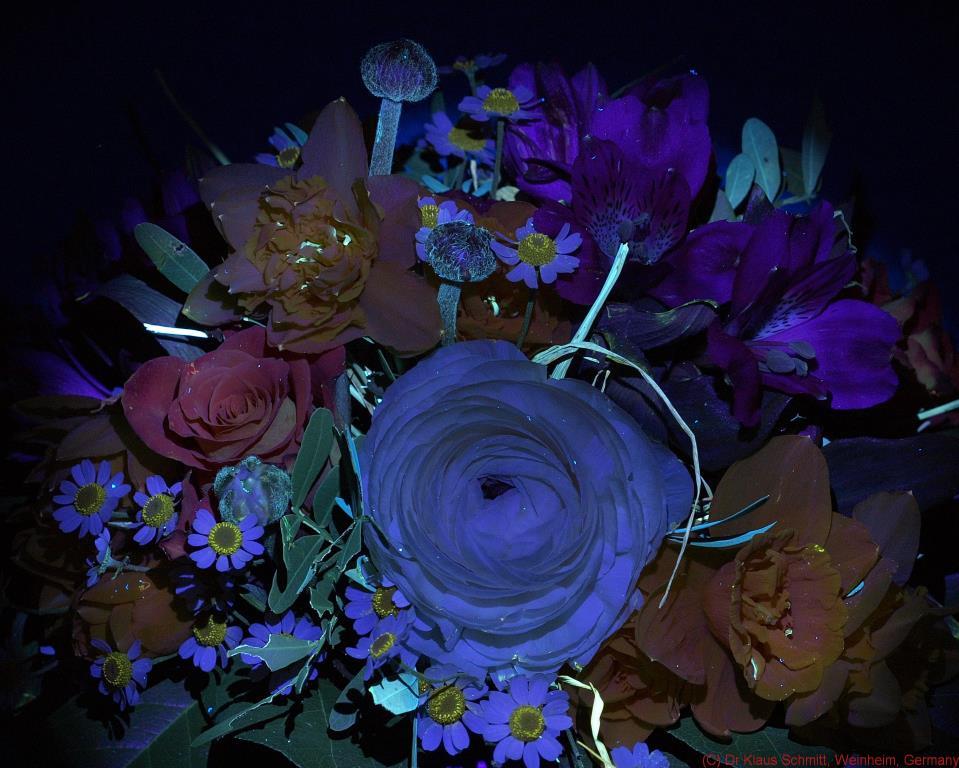
[FL, VIS] Easter Bouquet

Happy Easter everyone (in UV induced visible fluorescence and normal visible light that is)!

[click on image to see a larger one]

Normal visible light image using UV/IR cut filter:


UV induced visible fluorescence (using Nichia 365nm UV LED) and UV/IR cut filter: 


...and a Ranuncula bud in closeup: 


Shot using my UV-Rodagon 60mm and a 400-700nm UV/IR cut filter; UV source was my Nichia 365nm UV LED for the FL shots.


Stay tuned, more will follow on that fascinating subject...

More info on this very interesting field may be found on my site http://www.pbase.com/kds315/uv_photos

Tuesday, March 30, 2010

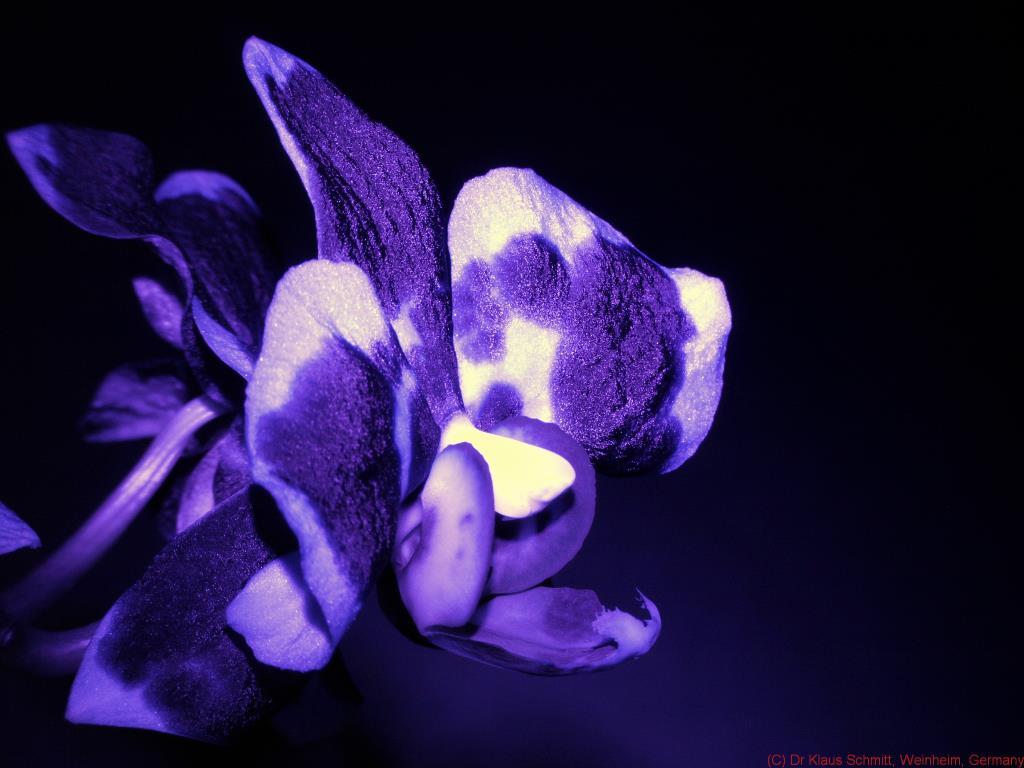
UV reveals Tactile Structures

I find the surface structures amazing, UV shots can reveal...
(both shots from testing a new fast lens designed for UV-A 300-400nm)

[click on image to see a larger one]

Phalaenopsis Orchid UV:


Here a VIS image:


Stay tuned, more will follow on that fascinating subject...

More info on this very interesting field may be found on my site http://www.pbase.com/kds315/uv_photos

Richard Hammond's Invisible Worlds Episode 3 March 30, 9pm GMT on BBC One

BBC London has published more on the forthcoming series "Invisible Worlds".

Episode 3 , the last one, will be "Off the Scale" about things way to huge or way to little for us to see with the unaided eye.

Stay tuned, more will follow on that fascinating subject...

More info on this very interesting field may be found on my site http://www.pbase.com/kds315/uv_photos

[UV, FL] Enhancing the visibility of fossil cephalopods soft tissue structures

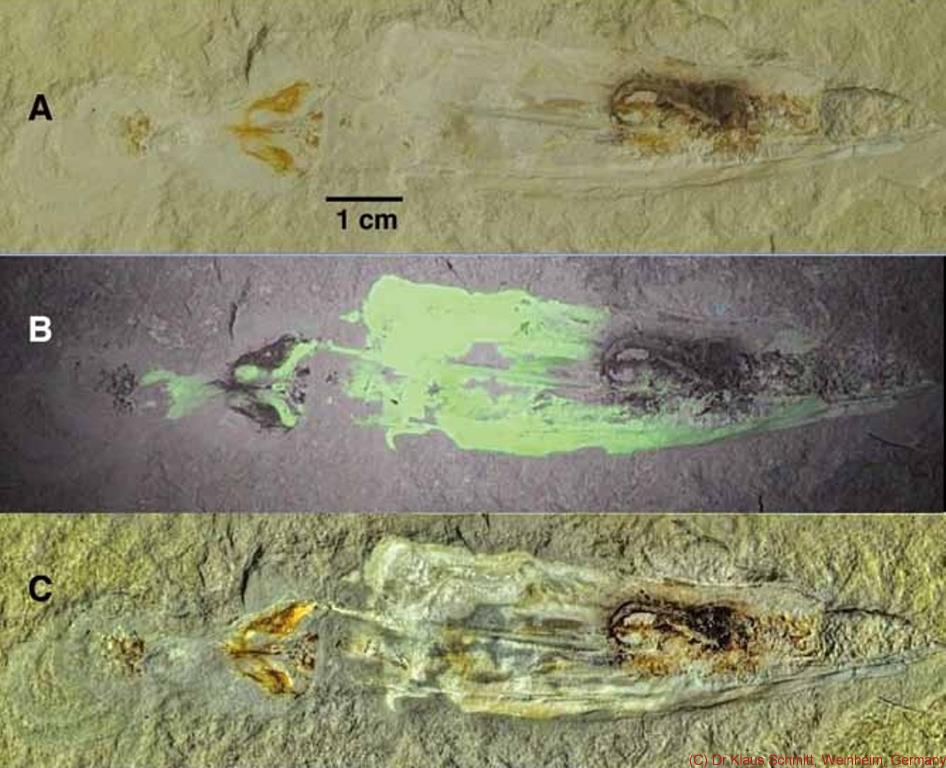
I had the honor to work with Neal Larson (yeah, THAT Neal Larson who discovered SUE, the T-Rex, with his brother Peter) on a paper on fossilized cephalopods found in Hajoula, Lebanon. I used my remapping technology consisting of a visible image (A), a UV stimulated visible fluorescence image (B) to enhance the visibility of preserved soft tissue structures (C) by combining them into one multispectral image.

Should someone be interested in the paper, the full title is:
"A new look at fossil cephalopods", NEAL L. LARSON, ROBERT W. MORTON, PETER L. LARSON AND UWE BERGMANN in
Tanabe, K., Shigeta, Y., Sasaki, T. & Hirano, H. (eds.) 2010. Cephalopods - Present and Past, Tokai University Press, Tokyo, p. 303-314.

Images (c) Neal L Larson and Dr Klaus Schmitt

[click on image to see a larger one]


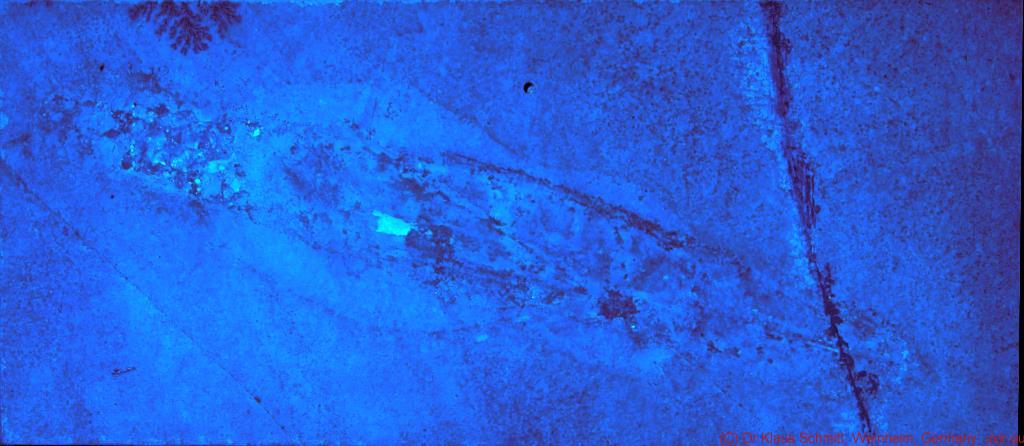
Another example of the same technique, shots I did with a squid fossil I have here from the Upper Cretaceous period, ca 90 million years old.

Visible light image:

UV stimulated visible fluorescence: 

multispectral remapped 


There is a follow up to this one HERE.

Stay tuned, more will follow on that fascinating subject...

More info on this very interesting field may be found on my site http://www.pbase.com/kds315/uv_photos