Wednesday, July 22, 2015

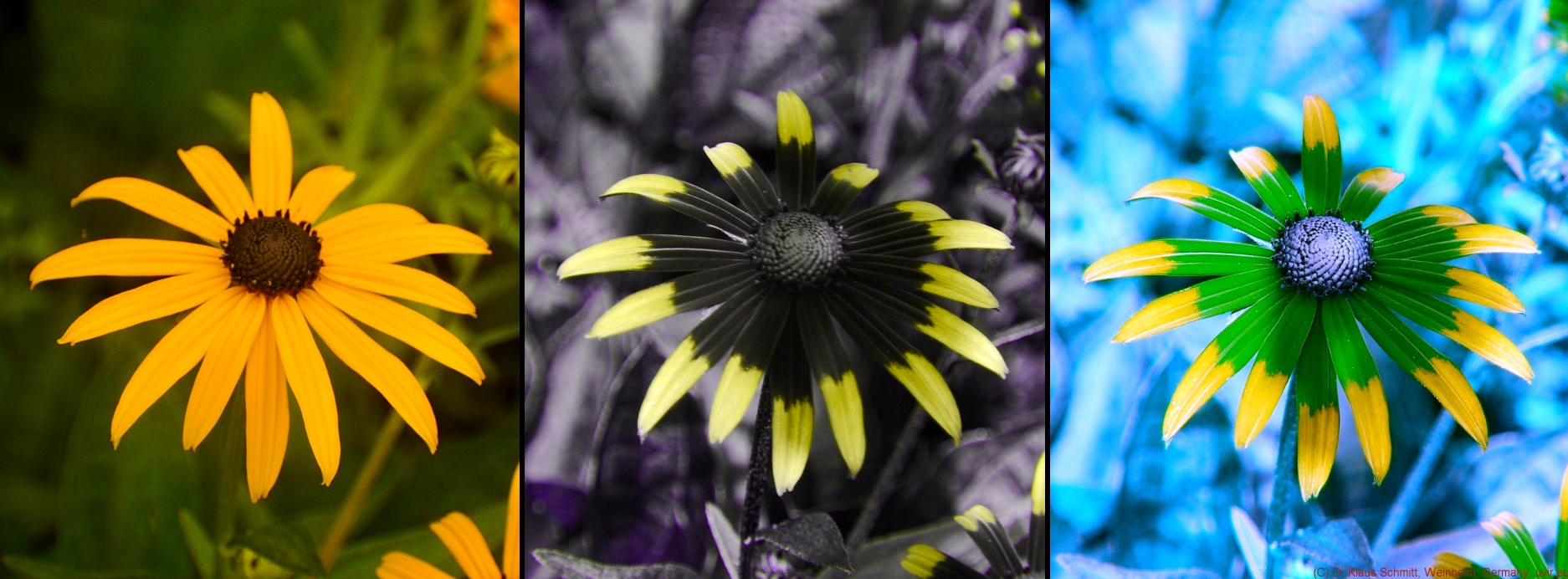
Orange coneflower - Rudbeckia fulgida in reflected ultraviolet photography, simulated butterfly and bee vision XI

Today shots of two species of a decorative summer flower Orange coneflower - Rudbeckia fulgida in reflected ultraviolet photography using my "work horse" UV filter, the Baader-U filter, as well as in simulated butterfly and bee vision using my proprietary XBV filters. Lens was my ZEISS UV-Planar f2/62mm quartz flourite lens. Light source was sunlight. All shots were done at about f5.6.

[click on image to see a larger one]

Triptych (left to right): Human vison, reflected UV, simulated bee vision:


This attractive flower shows its very prominent UV bullseye pattern, its petals have an UV dark bottom and very UV bright tips (around 365nm), invisible to us humans, and all this gets nicely visible.

I have previously written about this flower HERE

Stay tuned, more will follow on that fascinating subject...

Day Lilly - Hemerocallis lilioasphodelus in reflected ultraviolet photography and simulated bee vision III

Today shots of an attractive summer flower, a creamy yellow Day Lilly - Hemerocallis lilioasphodelus in reflected ultraviolet photography using my "work horse" UV filter, the Baader-U filter as well as in simulated bee vision using my proprietary XBV filter. Lens was my ZEISS UV-Planr f2/62mm quartz flourite lens. Light source was sunlight. All shots were done at about f5.6.

[click on image to see a larger one]

Triptych (left to right): Human vison, reflected UV, simulated bee vision:


Most Hemerocallis have a very prominent "dark throat" UV pattern, and that gets nicely visible here, also in simulated bee vision.

I have previously written about that flower HERE
 
Stay tuned, more will follow on that fascinating subject...

More info on this very interesting field may be found on my site http://www.pbase.com/kds315/uv_photos

Mexican Zinnia - Zinnia haagenea in reflected ultraviolet photography XXIX

Today more shots of very decorative summer flowers, Mexican Zinnia - Zinnia haagenea in reflected ultraviolet photography using my "work horse" UV filter, the Baader-U filter. Lens was my ZEISS UV-Planar f2/62mm quartz flourite lens. Light source was sunlight. All shots were done at about f5.6.

[click on image to see a larger one]

Triptych (left to right): Human vision, reflected UV, simulated bee vision:
 

Mexican Zinnia flowers have very specific UV patterns. Their petals are very UV dark in the middle and bottom, their petal tips, however, are very UV bright (around 360nm outer tip, 350nm middle tip, 345nm border to dark), reaching deeper into UV as any other flower I know of, and all this gets nicely visible.

I have previously written about those Zinnias HERE

Stay tuned, more will follow on that fascinating subject...

Mexican Zinnia - Zinnia haagenea in reflected ultraviolet photography XXVIII

Today shots of very decorative summer flowers, Mexican Zinnia - Zinnia haageana in reflected ultraviolet photography using my "work horse" UV filter, the Baader-U filter. Lens was my ZEISS UV-Planar f2/62mm quartz flourite lens. Light source was sunlight. All shots were done at about f5.6.

[click on image to see a larger one]

Triptych (left to right): Human vision, reflected UV, simulated bee vision:
 

Mexican Zinnia flowers have very specific UV patterns. Their petals are very UV dark in the middle and bottom, their petal tips, however, are very UV bright (around 360nm outer tip, 350nm middle tip, 345nm border to dark), reaching deeper into UV as any other flower I know of, and all this gets nicely visible.

I have previously written about those Zinnias HERE

Stay tuned, more will follow on that fascinating subject...

Monday, July 13, 2015

XVUV - A Variable UV Transmission filter for reflected ultraviolet (UV) photography

Today about something rather unique, a variable UV transmission filter (XVUV) for reflected UV photography. Well, actually one with an adjustable / variable transmission shoulder which may be steplessly adjusted by some 20nm. I tested it for the first time now using the Baader-U UV pass filter for comparison, a UV-Nikkor 105mm quartz flourite lens and my UV sensitive camera. Light was sunlight on a bright sunny day.

[click on image to see a larger one]

Ultraviolet (UV) image using Baader-U left) and shortest possible setting of the XVUV variable filter (right) - architecture:


Ultraviolet (UV) images using XVUV variable filter at different settings with shifting peak transmisison towards the right (different whitebalance as above) - architecture:


Relative transmission spectra of the XVUV variable filter at different settings, illustrating its ability to prefer shorter UV wavelengths:


This filter now allows to steplessly shift the peak transmission from about 360nm down to some 340nm, albeit with some loss of peak transmission.

I will report more about that XVUV variable UV transmission filter here later, as more testing, calibration and optimization needs to be done.

Stay tuned, more will follow on that fascinating subject...

More info on this very interesting field may be found on my site http://www.pbase.com/kds315/uv_photos

XNUV2 - a much faster filter for reflected ultraviolet (UV) photography

Today about another, faster filter for reflected UV photography, as there still seems to be some demand for handheld UV shooting or shooting at higher speeds for instance for video work. This here is the XNUV2, that I finally tested for the first time now using the Baader-U UV pass filter for comparison, a UV-Nikkor 105mm quartz flourite lens and my UV sensitive camera. Light was late evening light on a rather dull day.

[click on image to see a larger one]

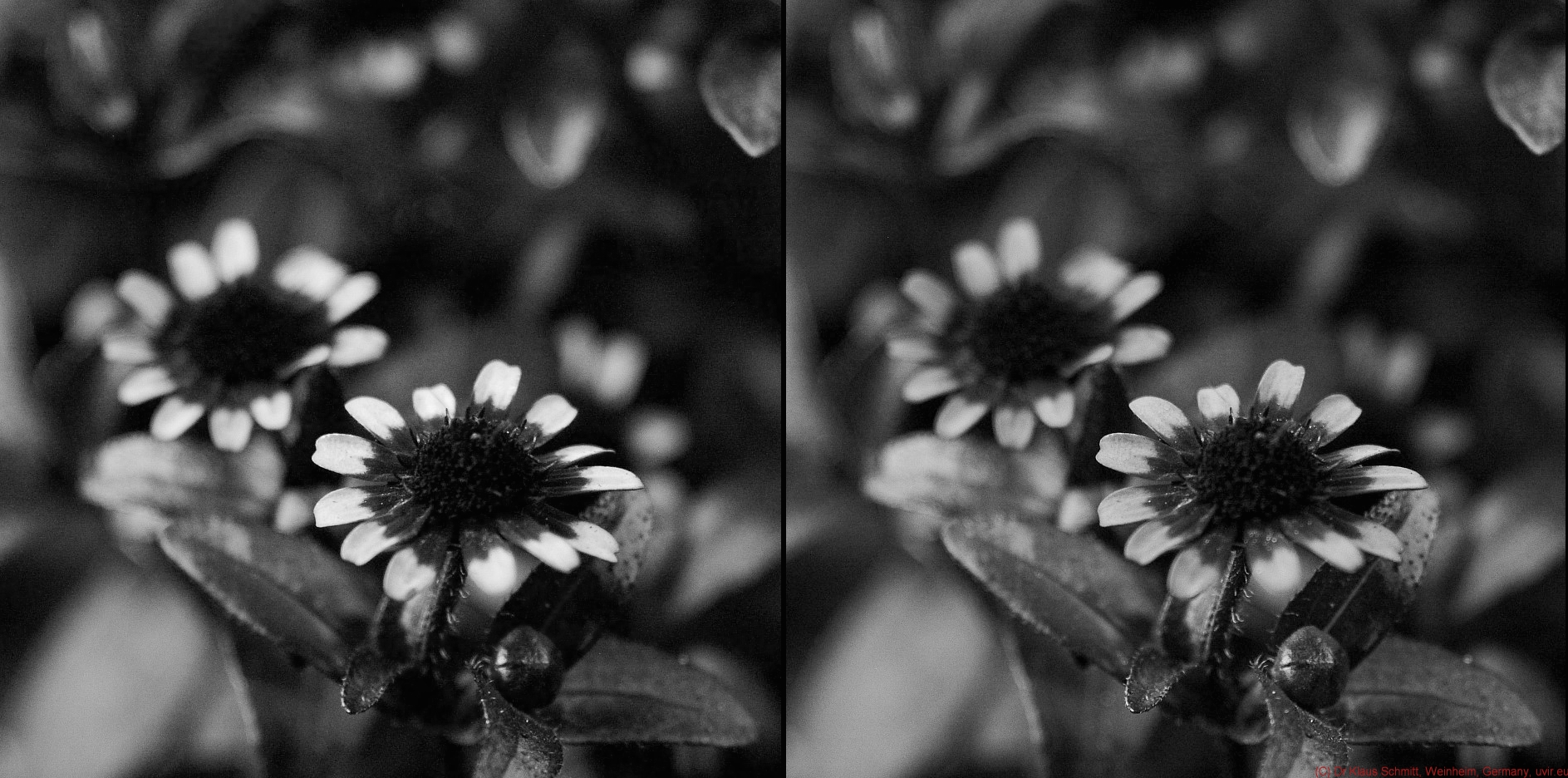
Ultraviolet (UV) image using Baader-U left) and XNUV2 filter (right) - flower :

bw image shows that the UV content is basically identical:


Ultraviolet (UV) image using Baader-U left) and XNUV filter (right) - architecture:


What is important to notice is, that also the XNUV2 is also able to precisely reproduce this distinct flower UV pattern, as well as it shows good sharpness, as compared to the Baader-U filter. And most importantly it is 2.3 stops faster than using the Baader-U filter, which is quite an impressive result as it will make it much easier for video work.

I will report more about that filter here later, as more testing needs to be done.

I have written before about a faster XNUV filter HERE

Stay tuned, more will follow on that fascinating subject...

More info on this very interesting field may be found on my site http://www.pbase.com/kds315/uv_photos

Wednesday, July 8, 2015

Nikon UV-Nikkor f4.5 105mm vs CERCO f4.3 94mm

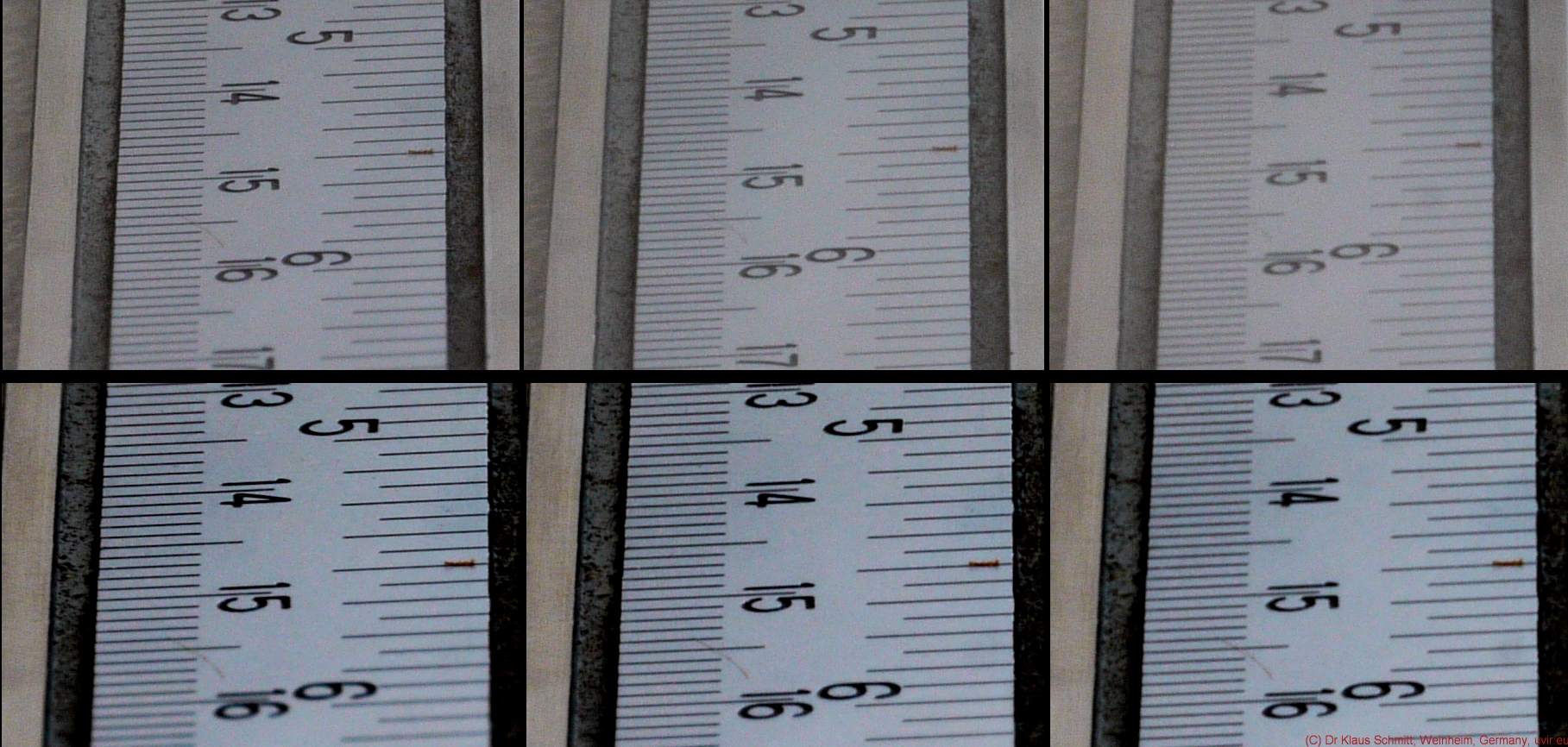
As I was testing a Nikon UV-Nikkor f4.5 105mm, I thought it would be interesting to compare it to my CERCO f4.3 94mm workhorse lens, especially about possible chromatic aberration, sharpness and contrast. Target was a metallic precision ruler, light was sunlight. Only visible light photograhy was done here.

[click on image to see a larger one]

CERCO top, Nikon bottom. Increasing f-stop setting towards the right, starting fully open leftmost.


Both lenses do not show CA. But interesting to note, how much higher the contrast of the UV Nikkor is. The CERCO shows futher decreasing contrast when stopping down (to the right) although flare control was used by using a deep hood against stray light. Both lenses are very sharp, but overall the Nikkor seems to be the clear winner here and it also covers FF sensors, which the CERCO does not do. Both are excellent lenses in terms of sharpness, but contrast and flare always need special attention, especially when using the CERCO multispectral lens.

I have compared quartz fluorite lenses in terms of their transmissions HERE

Stay tuned, more will follow on that fascinating subject...

More info on this very interesting field may be found on my site http://www.pbase.com/kds315/uv_photos