Showing posts sorted by relevance for query hirta. Sort by date Show all posts

Sunday, July 31, 2016

How to stand out in the crowd - Gazania rigens shows its ecologic advantage vs Rudbeckia fulgida and Rudbeckia hirta using intense UV reflection III

Today about how even some UV reflecting flowers (Gazania rigens) have achieved a competitive edge over other UV reflecting flowers (Rudbeckia fulgida and R. hirta) by making use of a specific very intense UV reflection around 370nm. This will be shown in human vision, in reflected ultraviolet photography and also in simulated bee vision. I was using my "work horse" UV filter, the Baader-U filter for reflected UV, my XBV filter for simulated bee vision aside from a visible light shot. Lens was my UV-Nikkor 105mm quartz flourite lens. Light source was a modified Xenon flash. All shots were done at f11. [These shots were done with a new camera system and are available on request in very high resolution (40 and 60 Mp)].

[click on image to see a larger one]

Rudbeckia fulgida + R. hirta vs white Gazania rigens, visible image:  

Rudbeckia fulgida + R. hirta vs white Gazania rigens, reflected UV image:  

Rudbeckia fulgida + R. hirta vs white Gazania rigens, simulated bee vision image:  
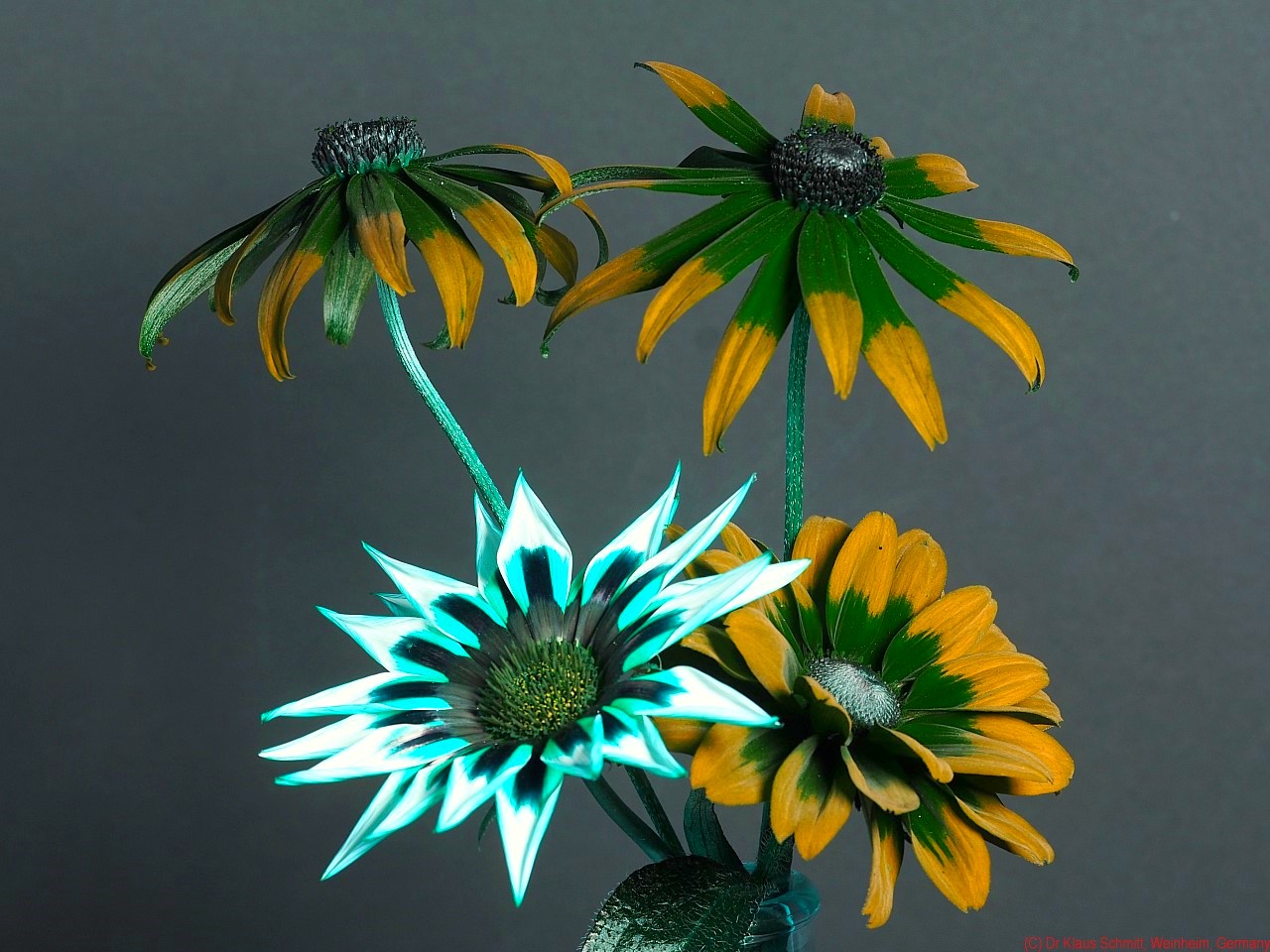
In visible light, all these flowers are rather bright yellow / orange (Rudbeckia) and white (Gazania) to our human eye. But the white Gazania rigens against the Rudbeckia fulgida and R. hirta flowers shows an even more prominent and bright bullseye pattern in reflected UV (only visible to bees and butterflies), as its petals are very, very UV bright (around 370nm) and its center is very UV dark, compared to the other UV reflecting flowers, which makes them clearly even more visible in UV, hence creating an impressive competitive edge in terms of chances for getting pollinated even against those other flowers with UV bullseye pattern - and all this gets nicely visible, also in simulated bee vision.

I have written HERE about it before.

Stay tuned, more will follow on that fascinating subject...

Friday, July 15, 2016

How to stand out in the crowd - R. Hirta shows its ecologic advantage using intense UV reflection

Today a little different topic: I would like to show, how a flower (R. hirta) achives a competitive edge over other flowers (Monardia, Echinacea) by making use of a specific intense UV reflection around 365nm, matched to the insect eyes sensitivity. This will be shown using a flower originating from the USA Prairie, a Black-eyed Susan - Rudbeckia hirta and it will be done in reflected ultraviolet photography using my "work horse" UV filter, the Baader-U filter aside from a visible light shot. Lens was my UV-Nikkor 105mm quartz flourite lens. Light source was sunlight. All shots were done at f8.

[click on image to see a larger one]

Visible light image (400-750nm):  

Reflected UV image using Baader-U filter (320-395nm):  

Diptych of visible image (left) and reflected UV image (right):  

In visible light, all flowers are rather bright to our human eye. But this R. hirta flower in UV (only visible to bees and butterflies) shows a very prominent and bright bullseye pattern, as its petals are very UV bright (around 365nm) and its center is very UV dark, compared to the rather dull UV reflecting Monardia and Echinacea flowers (around 380nm only), hence creating an impressive competitive edge in terms of chances for getting pollinated - and all this gets nicely visible.

Stay tuned, more will follow on that fascinating subject...

Thursday, June 20, 2019

Rudbeckia hirta - Human vs simulated animal vision: butterfly, bee, dog, horse, bat

Today comparison shots of a Rudbeckia hirta flower Black Eyed Susan - Rudbeckia hirta using visible, reflected ultraviolet photography to create simulated animal vision images. All shots were done at f8 in reflected ultraviolet photography using my "work horse" UV filter, the Baader-U filter, as well as my XBV filters for simulated animal vision. Lens was a UV-Nikkor 105mm quartz fluorite lens. Light source was a modified Xenon flash.

[click on image to see a larger one]

Human vision:
 

Simulated butterfly vision:
 

Simulated bee vision:
 

Simulated dog vision:
 

Simulated horse vision:
 

Simulated bat vision:
 

Hexaptych of the above:


  1. Humans have trichromatic vision, they see Blue, Green, Red
  2. Butterflies see UV, Blue, Green, Red, they are Tetrachromats
  3. Bees see UV, Blue, Green, they are Trichomats
  4. Dogs are Dichromats, see Blue and Yellow, but also some UV
  5. Horses are Dichromats, they see Blue and Yellow, but no UV
  6. Bats do not see color, but some are sensitive to UV also
The idea behind these mappings is, to demonstrate the different forms of vision, including the ability to see UV and with this ability, to see patterns which only appear in ultraviolet light (UV) but invisible to us humans.

I chose Rudbeckia, as it has a strong UV pattern, its petal tips are UV bright around 365nm, buts its center is quite UV dark, so this gets quite nicely visible, hence why I used this flower here.
 
Stay tuned, more will follow on that fascinating subject...

More info on this very interesting field may be found on my site http://www.pbase.com/kds315/uv_photos

Saturday, July 9, 2011

[UV] UV color of a flower leaf

Today about why leaves do have some false UV color when shooting reflected UV. So a quick reflectrometric experiment sheds some light into that, here using a Rudbeckia hirta and a Rudbeckia fulgida leaf and comparing them with reflected UV shots.

[click on images to see larger ones]

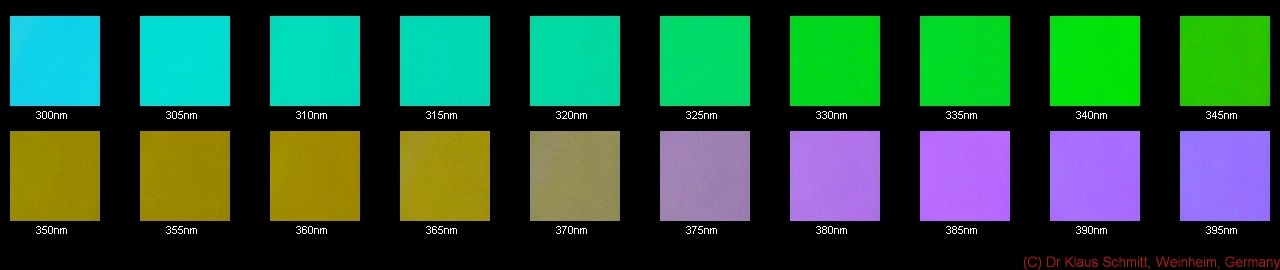
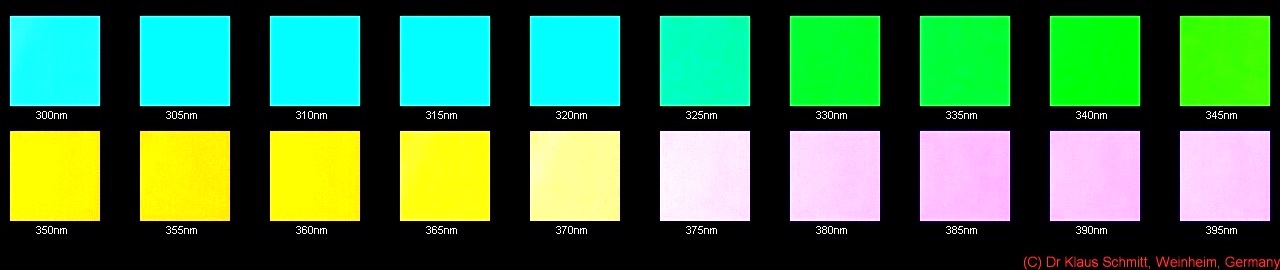
Standardized reflected false UV "colors" according to the previously described "UV color palette" related to wavelength.

Standardized false UV color normal and high intensity palette:


The R. hirta leaf on the left shows some greenish/grayish reflection with some violet on it depending on angle. The spectrometeric result reveals, that indeed the highest UV reflection is in the violet sub UVA range, wheras there is also some in the yellowish/brownish sub UVA range, but only a little reflection in the greenish sub band.


The R. fulgida leaf on the right shows some greenish/yellowish reflection and not much angle dependency. The spectrometeric result reveals, that it has quite an even UV reflection, which reaches quite deep into the UVA range to about 310nm and has proportionally a higher green / yellow content than R. hirta.


Stay tuned, more will follow on that fascinating subject...

More info on this very interesting field may be found on my site http://www.pbase.com/kds315/uv_photos

Saturday, September 1, 2012

Rudbeckia hirta: human vision vs simulated bee vison; reflected UV ultraviolet photography V

Well today I modified my high power flash for even more UV output. So a few test shots using as target a R. hirta as I have shown before in its multispectral representation. I took some shots in normal human vision VIS, in UV using the Baader-U, my all proprietary filters Jupiter-U and Saturn-U (300-350nm) filter, as well as in simulated bee and butterfly vision using my XBV2, XBV3 and XBV6 filter respectively.

[click on image to see a larger one]

Visual shot - human vision: Simulated butterfly vision using XBV3 filter: Simulated butterfly vision using XBV2 filter: Simulated bee vision using XBV6 filter: UV using Baader-U filter: UV using Jupiter-U filter: UV using Saturn-U (300-350nm) filter: IR (basically) as it was shot using only a ND filter: About all Rudbeckias and also this R. hirta have a very prominent, otherwise invisible "bullseye pattern" which gets nicely visible in UV (around 360nm) and bee vision (BV). Since leafs (petals were leafs one) reflect from 700-750nm onwards, that pattern is also invisible in IR.

Stay tuned, more will follow on that fascinating subject...

More info on this very interesting field may be found on my site http://www.pbase.com/kds315/uv_photos

Wednesday, April 23, 2025

Texas State Park Authorities showing Rudbeckia hirta UV patterns at Lake Sommerville Park

Today about my works being used with my permission by the Texas State Park Authorities. Their idea is to show visitors how differently bees and butterflies see the world, including their ability to see reflected ultraviolet (UV) light in one of their state parks, the Lake Sommerville Park.

They chose to use an attractive yellow flower, a Rudbeckia hirta, which were shot by me in reflected ultraviolet photography, simulated bee and butterfly vision. All shots were done at f8 in reflected ultraviolet photography using my "work horse" UV filter, the Baader-U filter, as well as my XBV filters for simulated bee and butterfly vision. Lens was a UV-Nikkor 105mm quartz fluorite lens. Light source was a modified Xenon studio flash, modified for high UV output.

[click on image to see a larger one]

Human vision:
 

Reflected UV:
 

Simulated butterfly vision:
 

Simulated bee vision:
 

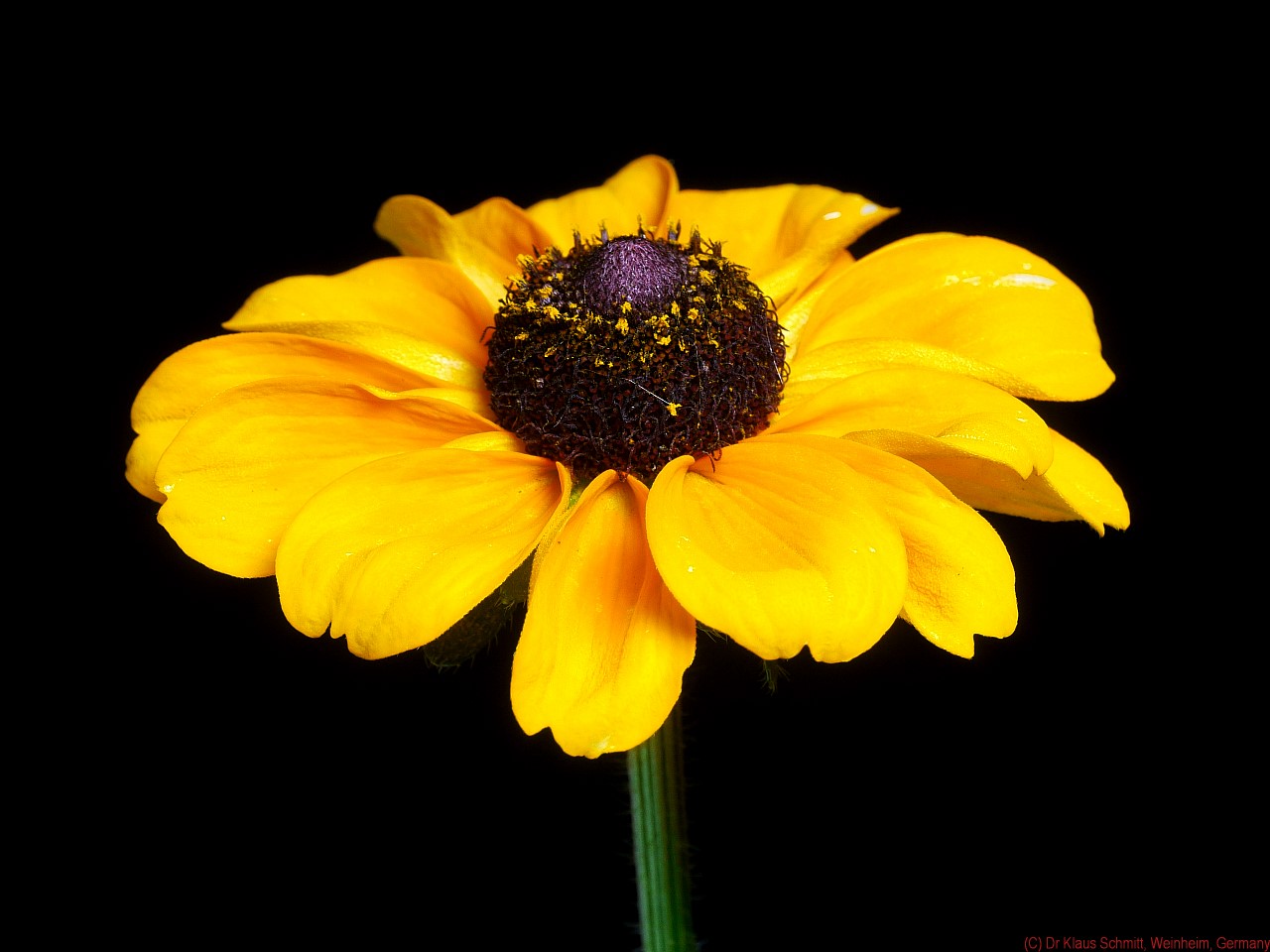
Quadriptych of human vision, UV, simulated bee and butterfly vision (left to right, top to bottom):
 

Rudbeckia hirta's outer petals strongly reflect UV around 365nm, whereas its center parts are quite darker, reflecting around 365nm, hence forming UV nectar guides for UV seeing insects. This is all invisible to us humans, but clearly visible to bees and butterflies, and all this will be nicely visible to the visitors at Lake Sommerville State Park, TX USA.

I have written more about this flower HERE.

Stay tuned, more will follow on that fascinating subject...
More info on this very interesting field may be found on my site http://www.pbase.com/kds315/uv_photos 

Stay tuned, more will follow on that fascinating subject...

Saturday, December 21, 2024

Nature in Brilliant Colour exhibit at the Royal Ontario Museum in Toronto, Canada showing butterfly vision

I have been asked by the Royal Ontario Museum (ROM), Queens Park, Toronto Canada for permission to exhibit a series of images to simulate the vision of butterflies at their forthcoming exhibit "Nature in Brilliant Colour " which is a travelling exhibit originally developed by the Field Museum Chicago. The exhibition will run from 14 December 2024 to 17 August 2025.

For that exhibit I chose images of a Rudbeckia hirta flower Black Eyed Susan - Rudbeckia hirta which I had shot using visible and reflected ultraviolet photography. All shots were then done at f8 in reflected ultraviolet photography using my "work horse" UV filter, the Baader-U filter, as well as my XBV filters for simulated animal vision. Lens was a UV-Nikkor 105mm quartz fluorite lens. Light source was a modified Xenon flash.

[click on image to see a larger one]

Human vision:
 

Simulated butterfly vision:
 

I chose Rudbeckia hirta, as it has a strong UV pattern, its petal tips are UV bright around 365nm, but its center is quite UV dark, so this gets quite nicely visible, hence why I used this flower here to simulate butterfly vision.

 
Stay tuned, more will follow on that fascinating subject...

More info on this very interesting field may be found on my site http://www.pbase.com/kds315/uv_photos

Saturday, August 22, 2026

Black-eyed Susan - Rudbeckia hirta in 3D reflected ultraviolet photography and simulated bee and butterfly vision XX

Today more shots of that beautiful flower, originating from the USA Prairie, here today again that commercially sold hybrid of a Black-eyed Susan - Rudbeckia hirta (possibly R. hirta x R. fulgida) in 3D STEREO (crosseye) in reflected ultraviolet photography using different filters aside from the Baader-U filter, but different ones today for simulated bee and butterfly vision but also part of my XBV filter set. All shots were done at f8-f11 on my balcony. Lens was a UV transmitting 35mm wide angle lens with an older Zeiss Jena Macro beamsplitter. Light source was direct sunlight. 

 
[click on image to see a larger one]

Human vision:
 

Reflected ultraviolet (UV - false color):
 

Simulated butterfly vision:
 

Simulated bee vision:
 

This flower shows a very prominent UV bullseye pattern, as its petal tips are very UV bright (around 365nm) and its center is very UV dark, and all this gets nicely visible, also in simulated bee and butterfly vision in 3D STEREO.

I have previously written about that flower HERE  


Stay tuned, more will follow on that fascinating subject...

More info on this very interesting field may be found on my site http://www.pbase.com/kds315/uv_photos

Thursday, July 23, 2026

Black-eyed Susan - Rudbeckia hirta in reflected ultraviolet photography and simulated bee and butterfly vision XIX

Today more shots of that beautiful flower, originating from the USA Prairie, here today again that commercially sold hybrid of a Black-eyed Susan - Rudbeckia hirta (possibly R. hirta x R. fulgida) in reflected ultraviolet photography using different filters aside from the Baader-U filter, but different ones today for simulated bee and butterfly vision but also part of my XBV filter set. All shots were done at f8-f11 on my balcony. Lens was a UV-Nikkor 105mm quartz fluorite lens. Light source was direct sunlight. 

PS: These other filters (filter stacks actually) I used have partially corroded over time, so I had to polish them using finest Cerium-Oxide powder. I made some slurry with that using filtered water, then polished the filter glasses with that using a very soft cloth and small circular movements, then rinsed them clean and dried them. So these images hopefully prove that this was successfully done....I think so.

[click on image to see a larger one]

Human vision:
 

Reflected ultraviolet (UV - false color):
 

Simulated butterfly vision:
 

Simulated bee vision:
 

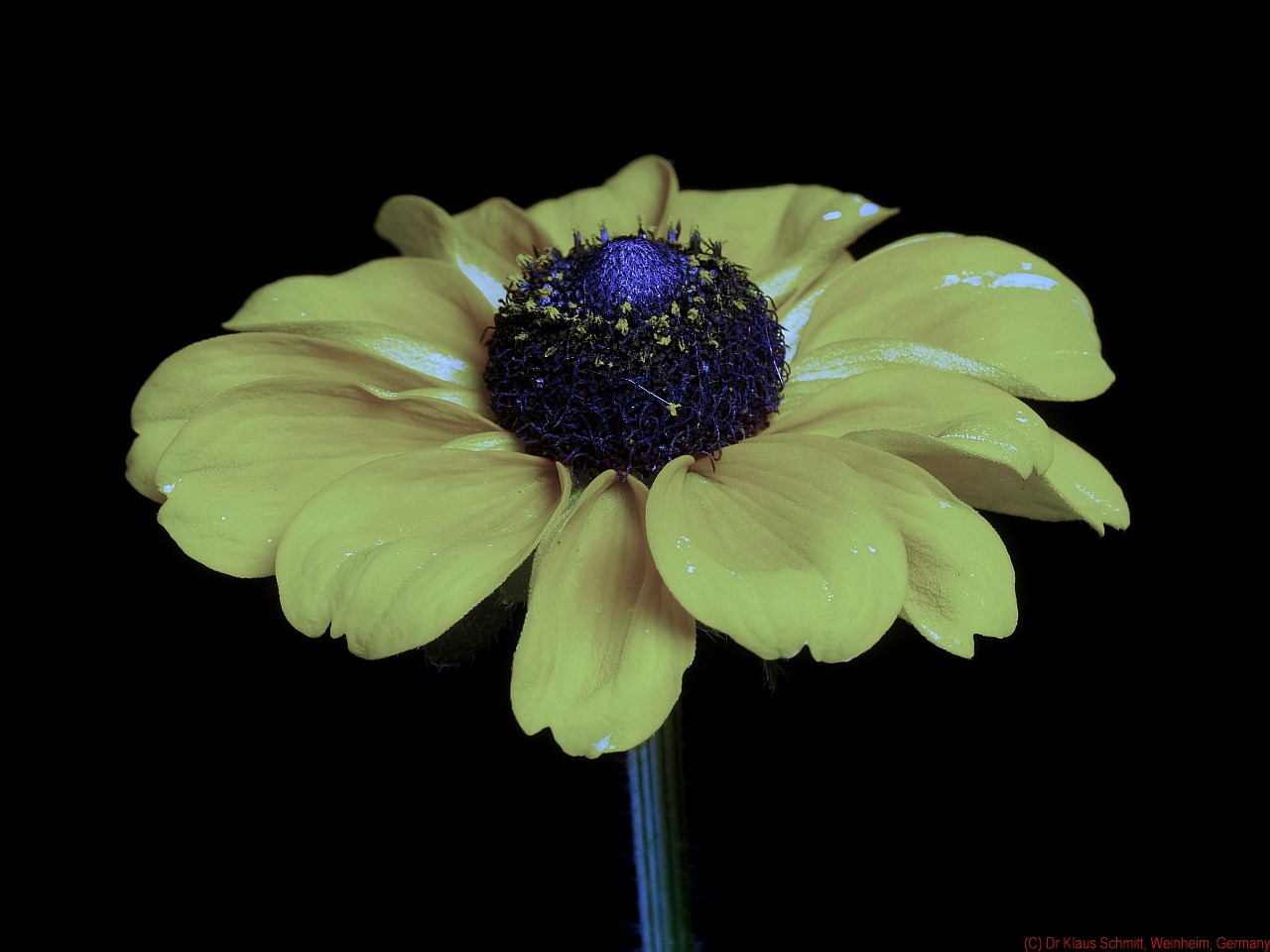
Quadriptych of human vision, ultraviolet, simulated bee and butterfly vision (left to right, top to bottom):
 

This flower shows a very prominent UV bullseye pattern, as its petal tips are very UV bright (around 365nm) and its center is very UV dark, and all this gets nicely visible, also in simulated bee and butterfly vision.

I have previously written about that flower HERE  


Stay tuned, more will follow on that fascinating subject...
More info on this very interesting field may be found on my site http://www.pbase.com/kds315/uv_photos

Monday, July 13, 2026

Black-eyed Susan - Rudbeckia hirta in reflected ultraviolet photography and simulated bee and butterfly vision XVIII

Today shots of a beautiful flower, originating from the USA Prairie, here today a commercially sold hybrid of a Black-eyed Susan - Rudbeckia hirta (possibly R. hirta x R. fulgida) in reflected ultraviolet photography using my "work horse" UV filter, the Baader-U filter, as well as in simulated bee and butterfly vision using my XBV filters. All shots were done at f8-f11 on my balcony in shade. Lens was a UV-Nikkor 105mm quartz fluorite lens. Light source was available light.

[click on image to see a larger one]

Human vision:
 

Reflected ultraviolet (UV):
 

Simulated butterfly vision:
 

Simulated bee vision:
 

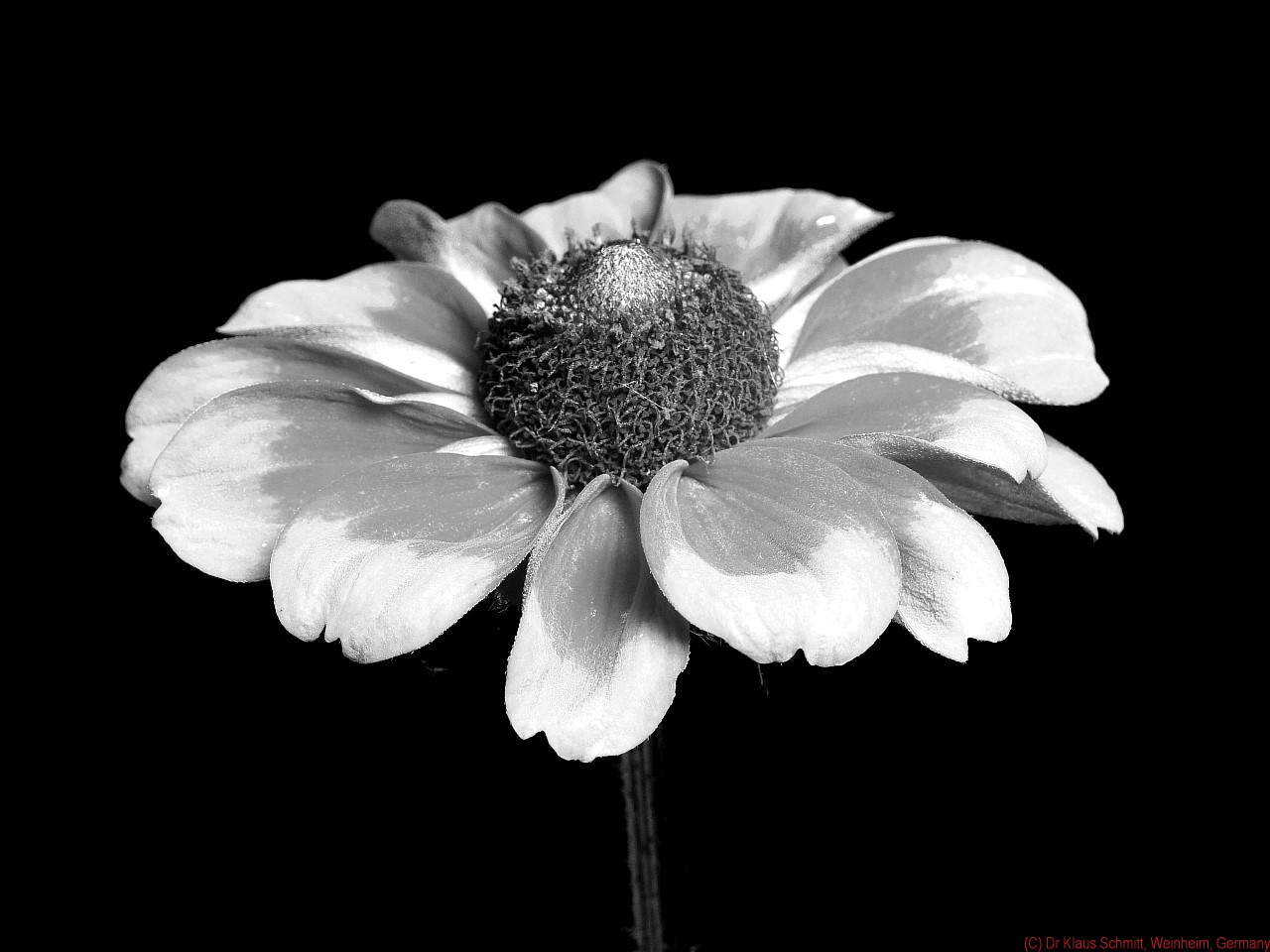
Quadriptych of human vision, ultraviolet, simulated butterfly and bee vision (left to right, top to bottom):
 

This flower shows a very prominent UV bullseye pattern, as its petal tips are very UV bright (around 365nm) and its center is very UV dark, and all this gets nicely visible, also in simulated bee and butterfly vision.

I have previously written about that flower HERE  
Stay tuned, more will follow on that fascinating subject...
More info on this very interesting field may be found on my site http://www.pbase.com/kds315/uv_photos

Friday, October 11, 2024

Rudbeckia hirta - Human vs simulated animal vision II: butterfly, bee, dog, horse, bat

I was asked by a member working for their program Jeux Photoniques at the Université Laval in Québec, Canada for a series of images to simulate the vision of different animals. I used images of a Rudbeckia hirta flower Black Eyed Susan - Rudbeckia hirta which I had shot using visible and reflected ultraviolet photography. All shots were then done at f8 in reflected ultraviolet photography using my "work horse" UV filter, the Baader-U filter, as well as my XBV filters for simulated animal vision. Lens was a UV-Nikkor 105mm quartz fluorite lens. Light source was a modified Xenon flash.

[click on image to see a larger one]

Human vision:
 

Simulated butterfly vision:
 

Simulated bee vision:
 

Simulated dog vision:
 

Simulated horse vision:
 

Simulated bat vision:
 

Hexaptych of the above:
 

The idea behind these mappings is, to demonstrate the different forms of vision, including the ability to see UV and with this ability, to see patterns which only appear in ultraviolet light (UV) but invisible to us humans.

 I chose Rudbeckia hirts, as it has a strong UV pattern, its petal tips are UV bright around 365nm, but its center is quite UV dark, so this gets quite nicely visible, hence why I used this flower here to simuate the following visions:

  1. Humans have trichromatic vision, they see Blue, Green, Red
  2. Butterflies see UV, Blue, Green, Red, they are Tetrachromats
  3. Bees see UV, Blue, Green, they are Trichomats
  4. Dogs are Dichromats, see Blue and Yellow, but also some UV
  5. Horses are Dichromats, they see Blue and Yellow, but no UV
  6. Bats do not see color, but some are sensitive to UV also

 
Stay tuned, more will follow on that fascinating subject...

More info on this very interesting field may be found on my site http://www.pbase.com/kds315/uv_photos